The beginnings of a planetary nebula
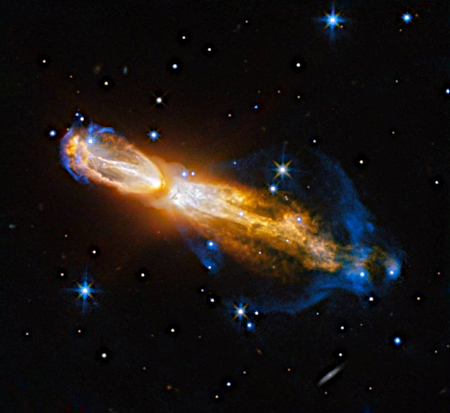
Click for original image.
Cool image time! The picture to the right, reduced and sharpened to post here, was taken by the Hubble Space Telescope back in 2017 but released this week by NASA’s PR department. It shows what astronomers have nicknamed the Calabash Nebula. From the Wikipedia page:
The Calabash Nebula, also known as the Rotten Egg Nebula or by its technical name OH 231.84 +4.22, is a protoplanetary nebula (PPN) 1.4 light years (13 Pm) long and located some 5,000 light years (47 Em) from Earth in the constellation Puppis. The name “Calabash Nebula” was first proposed in 1989 in an early paper on its expected nebular dynamics, based on the nebula’s appearance.[5] The Calabash is almost certainly a member of the open cluster Messier 46, as it has the same distance, radial velocity, and proper motion.[6] The central star is QX Puppis, a binary composed of a very cool Mira variable and an A-type main-sequence star.
The star in the center is an ancient red giant that is in the initial stages of dying. As it does so it periodically erupts, sending out jets of material from its poles. The result is this elongated shape. According to the release, “the gas shown in yellow is moving close to a million kilometers an hour.”
Over the next few thousand years these eruptions will shape the planetary nebula. Since the central star is actually a binary, those two stars will likely act like the blades in a mixer, adding more interesting forms to the material as it is shot out to form this nebula.

On Christmas Eve 1968 three Americans became the first humans to visit another world. What they did to celebrate was unexpected and profound, and will be remembered throughout all human history. Genesis: the Story of Apollo 8, Robert Zimmerman's classic history of humanity's first journey to another world, tells that story, and it is now available as both an ebook and an audiobook, both with a foreword by Valerie Anders and a new introduction by Robert Zimmerman.
The print edition can be purchased at Amazon or from any other book seller. If you want an autographed copy the price is $60 for the hardback and $45 for the paperback, plus $8 shipping for each. Go here for purchasing details. The ebook is available everywhere for $5.99 (before discount) at amazon, or direct from my ebook publisher, ebookit. If you buy it from ebookit you don't support the big tech companies and the author gets a bigger cut much sooner.
The audiobook is also available at all these vendors, and is also free with a 30-day trial membership to Audible.
"Not simply about one mission, [Genesis] is also the history of America's quest for the moon... Zimmerman has done a masterful job of tying disparate events together into a solid account of one of America's greatest human triumphs."--San Antonio Express-News
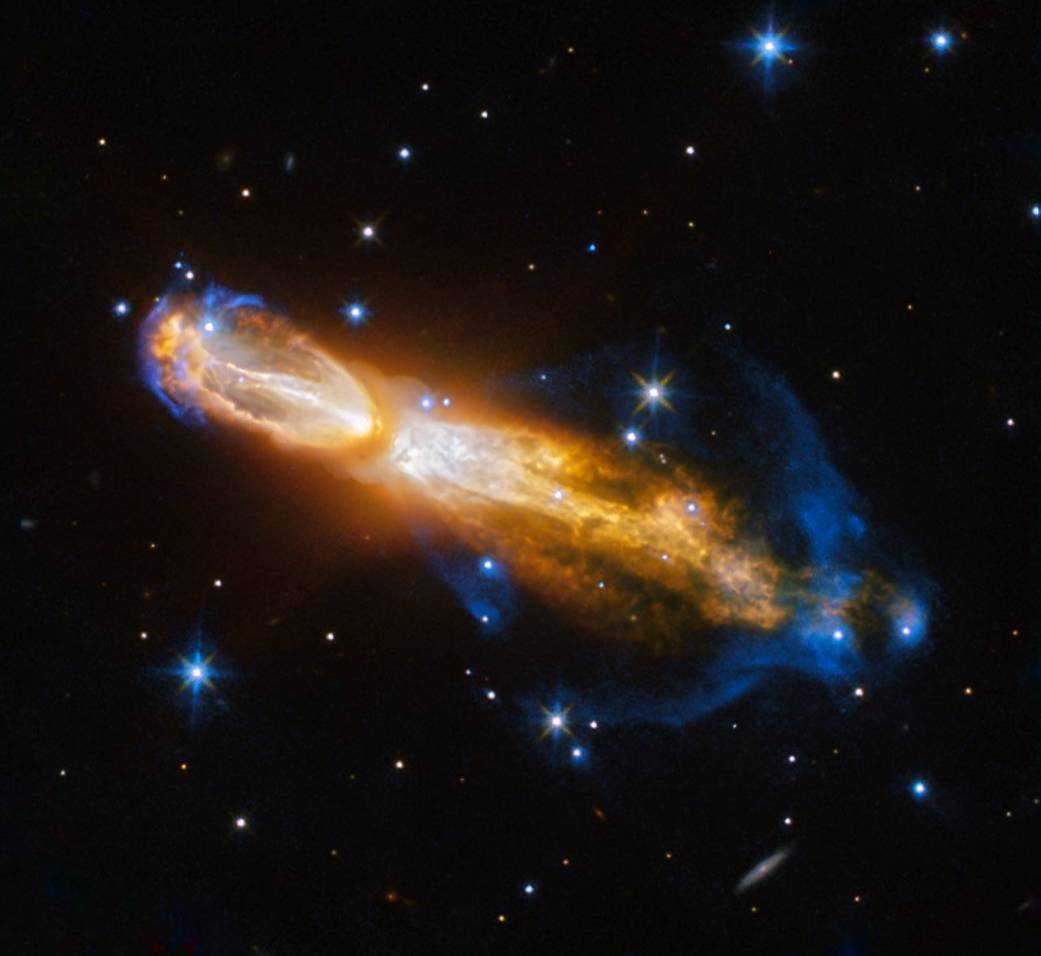
Click for original image.
Cool image time! The picture to the right, reduced and sharpened to post here, was taken by the Hubble Space Telescope back in 2017 but released this week by NASA’s PR department. It shows what astronomers have nicknamed the Calabash Nebula. From the Wikipedia page:
The Calabash Nebula, also known as the Rotten Egg Nebula or by its technical name OH 231.84 +4.22, is a protoplanetary nebula (PPN) 1.4 light years (13 Pm) long and located some 5,000 light years (47 Em) from Earth in the constellation Puppis. The name “Calabash Nebula” was first proposed in 1989 in an early paper on its expected nebular dynamics, based on the nebula’s appearance.[5] The Calabash is almost certainly a member of the open cluster Messier 46, as it has the same distance, radial velocity, and proper motion.[6] The central star is QX Puppis, a binary composed of a very cool Mira variable and an A-type main-sequence star.
The star in the center is an ancient red giant that is in the initial stages of dying. As it does so it periodically erupts, sending out jets of material from its poles. The result is this elongated shape. According to the release, “the gas shown in yellow is moving close to a million kilometers an hour.”
Over the next few thousand years these eruptions will shape the planetary nebula. Since the central star is actually a binary, those two stars will likely act like the blades in a mixer, adding more interesting forms to the material as it is shot out to form this nebula.
On Christmas Eve 1968 three Americans became the first humans to visit another world. What they did to celebrate was unexpected and profound, and will be remembered throughout all human history. Genesis: the Story of Apollo 8, Robert Zimmerman's classic history of humanity's first journey to another world, tells that story, and it is now available as both an ebook and an audiobook, both with a foreword by Valerie Anders and a new introduction by Robert Zimmerman.
The print edition can be purchased at Amazon or from any other book seller. If you want an autographed copy the price is $60 for the hardback and $45 for the paperback, plus $8 shipping for each. Go here for purchasing details. The ebook is available everywhere for $5.99 (before discount) at amazon, or direct from my ebook publisher, ebookit. If you buy it from ebookit you don't support the big tech companies and the author gets a bigger cut much sooner.
The audiobook is also available at all these vendors, and is also free with a 30-day trial membership to Audible.
"Not simply about one mission, [Genesis] is also the history of America's quest for the moon... Zimmerman has done a masterful job of tying disparate events together into a solid account of one of America's greatest human triumphs."--San Antonio Express-News
It’s quite beautiful!
<0C on the Cool Image scale.