
The first launch by South Korean rocket startup Innospace fails shortly after liftoff
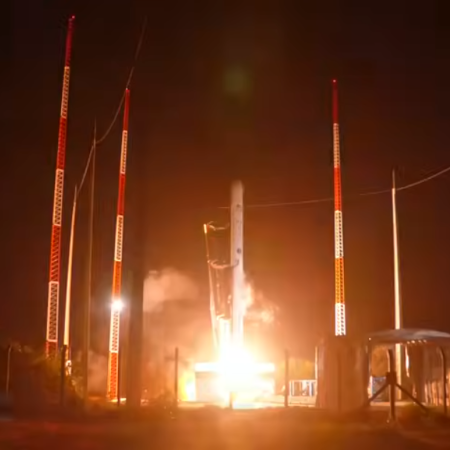
Though details are not yet available, the first launch by South Korean rocket startup Innospace of its Hanbit-Nano rocket failed less than 2 minutes after liftoff from Brazil’s long unused Alcantera spaceport. The failure occurred sometime after the rocket passed through max-q, the moment when the aerodynamic pressure of the atmosphere and the speed of the rocket stresses the rocket the most.
The live stream provided no details, other than to say “we experienced an anomaly during the flight.” No other details have yet been released.
The image to the right is a screen capture of the rocket lifting off the pad, less than a few seconds after T-0. Though the rocket appeared to move upward in a smooth controlled flight, soon thereafter it became impossible to see anything but the bright engine flame at its base. Either the flames were so bright it overexposed the live stream, or the fire was spreading beyond the nozzles. At the moment however we know nothing about what happened.

On Christmas Eve 1968 three Americans became the first humans to visit another world. What they did to celebrate was unexpected and profound, and will be remembered throughout all human history. Genesis: the Story of Apollo 8, Robert Zimmerman's classic history of humanity's first journey to another world, tells that story, and it is now available as both an ebook and an audiobook, both with a foreword by Valerie Anders and a new introduction by Robert Zimmerman.
The print edition can be purchased at Amazon or from any other book seller. If you want an autographed copy the price is $60 for the hardback and $45 for the paperback, plus $8 shipping for each. Go here for purchasing details. The ebook is available everywhere for $5.99 (before discount) at amazon, or direct from my ebook publisher, ebookit. If you buy it from ebookit you don't support the big tech companies and the author gets a bigger cut much sooner.
The audiobook is also available at all these vendors, and is also free with a 30-day trial membership to Audible.
"Not simply about one mission, [Genesis] is also the history of America's quest for the moon... Zimmerman has done a masterful job of tying disparate events together into a solid account of one of America's greatest human triumphs."--San Antonio Express-News
Though details are not yet available, the first launch by South Korean rocket startup Innospace of its Hanbit-Nano rocket failed less than 2 minutes after liftoff from Brazil’s long unused Alcantera spaceport. The failure occurred sometime after the rocket passed through max-q, the moment when the aerodynamic pressure of the atmosphere and the speed of the rocket stresses the rocket the most.
The live stream provided no details, other than to say “we experienced an anomaly during the flight.” No other details have yet been released.
The image to the right is a screen capture of the rocket lifting off the pad, less than a few seconds after T-0. Though the rocket appeared to move upward in a smooth controlled flight, soon thereafter it became impossible to see anything but the bright engine flame at its base. Either the flames were so bright it overexposed the live stream, or the fire was spreading beyond the nozzles. At the moment however we know nothing about what happened.
On Christmas Eve 1968 three Americans became the first humans to visit another world. What they did to celebrate was unexpected and profound, and will be remembered throughout all human history. Genesis: the Story of Apollo 8, Robert Zimmerman's classic history of humanity's first journey to another world, tells that story, and it is now available as both an ebook and an audiobook, both with a foreword by Valerie Anders and a new introduction by Robert Zimmerman.
The print edition can be purchased at Amazon or from any other book seller. If you want an autographed copy the price is $60 for the hardback and $45 for the paperback, plus $8 shipping for each. Go here for purchasing details. The ebook is available everywhere for $5.99 (before discount) at amazon, or direct from my ebook publisher, ebookit. If you buy it from ebookit you don't support the big tech companies and the author gets a bigger cut much sooner.
The audiobook is also available at all these vendors, and is also free with a 30-day trial membership to Audible.
"Not simply about one mission, [Genesis] is also the history of America's quest for the moon... Zimmerman has done a masterful job of tying disparate events together into a solid account of one of America's greatest human triumphs."--San Antonio Express-News
Getting to orbit on a first-ever launch isn’t the usual result. That said, HANBIT-Nano outperformed both its hybrid-engined Australian cousin, Gilmour Space’s Eris, and the liquid-propellant Spectrum of Germany’s Isar Aerospace, neither of which got anywhere near Max-Q on their maiden outings. Good show, Innospace. Comb the telemetry, find and fix the cause and try again. You can be making a second effort in the coming year while a lot of others are just making their first.
How the Germans are falling behind in engineering is just sad. They were world beaters.
Japan also had brilliance, but it is a scandal how they let China run up the score on them.
You only win if you are hungry–driven–and a little mad.
It was a good first attempt. I’m hoping they work out the issues as Quub are scheduled to fly on their second launch although we might push that out a bit. They are a great team and they will figure it out. The pad is intact and the next rocket is almost set to go. Get through the analysis, fix it, and get back to flying.
Rookie question… But does max q occur at the speed of sound ( at whatever altitude that occurs) ? It seems to me that would be logical.
I guess I could ask AI but I trust the BTB faithful more!
Lee S: I am no engineer, and others here can chime in with better knowledge. My understanding is that Max q occurs at that sweet spot during launch when the speed of the rocket and the thickness of the atmosphere create the most stress.
At lower altitudes, the atmosphere is thicker but the speed is less. At higher altitudes the speed is higher but the atmosphere is now thinner.
Imagine two curves on a graph, one going up and one going down. When they cross you’ve hit Max q.
I don’t think this moment is specifically tied to reaching the speed of sound, but on this I could be wrong.
Rockets have kind of a pop up trajectory where they don’t have to spend any more time in atmosphere than they have to.
Winged fuel-rich, air-breathing designs think to save weight by trying to harvest oxygen from the searing murk outside that comes from lingering in the atmosphere for a longer stretch…but hot oxygen attacks everything.
Adding pistons gave diminishing returns too–another reason for jets. Now those are looked askew for space.
Lee S,
Our host explained Max Q pretty well. There is no invariant relationship between going supersonic and reaching Max Q other than the former occurring before the latter. How much Max Q occurs after reaching supersonic speed varies depending upon the acceleration curve of the ascent. Falcon 9 Starlink missions, for example, go supersonic at or just before the one minute into flight mark, with Max Q occurring five to ten seconds later. New Glenn, which has quite a leisurely ascent profile in boost phase, reaches supersonic speed about 75 – 80 seconds after launch with Max Q following about 15 seconds later. Rockets that accelerate quickly off the pad – solid-fueled rockets tend to do this – go supersonic and hit Max Q the quickest because they reach these critical points lower in the atmosphere.
Robert’a two-lines-crossing analogy is descriptive. Max Q occurs at the point when the air density/pressure (they are related, but temperature variations modify the relationship) drops off faster than the upward acceleration of the rocket. It is largely coincidence that this happens around the speed of sound.
At the speed of sound, the rocket is going around 1,100 feet per second, mostly upward, and the air density is dropping off around 5% over the course of the next second (for an upward traveling rocket). A second later, the rocket, at 1G acceleration after burning off some propellant, is going around 1,130 feet per second, around 3% faster.
The difference is that the rocket is not going straight up, so the rocket didn’t really rise 1,100 feet and the air didn’t really drop off that 5% that I had assumed, but hopefully that example helps to clarify the phenomenon.
By the way, the stress on the first stage is (related to) the force from the dynamic pressure on the nosecone (fairings) added to the force of accelerating the fully-tanked upper stage(s), so reducing the thrust on the main engines can reduce the stress on the first stage by reducing the acceleration of the heavy upper stage.
At this point I want to say that it ain’t rocket science, but it actually is.
The shorter footage.
https://m.youtube.com/watch?v=rxe36G1Icx0
The pulsing did not look healthy
Elon shared explosion footage more often than not