The first orbiting private space telescope releases “first light” image
Click for original image.
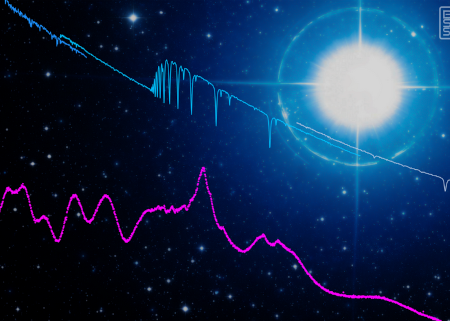
The first orbiting private space telescope, owned by Blue Skies Space and dubbed Mauve, has successfully taken its first image and data, a 5 second long exposure of a single star.
That image is to the right, with the spectroscopic data shown by the magenta line. The Hubble Space Telescope’s spectroscopic data is shown in blue and while for comparison.
As part of early commissioning, Mauve was pointed at its first calibration target, eta Ursae Majoris (eta UMa), a bright star in the constellation Ursa Major, approximately 104 light-years from Earth, for a 5-second observation. Eta UMa is a hot, blue-white star, much hotter than our Sun. Eta UMa shines brightly in ultraviolet light, making it an ideal calibration target for a UV observatory like Mauve.
The telescope has a 5-inch mirror, so its resolution is far lower than Hubble’s 94-inch mirror, but because it is above the atmosphere its view is far better than larger ground-based telescopes. Mauve is intended as a three-year-long demonstration project, during which it will study flares from nearby stars that are thought to have exoplanets, as well as binary star systems and variable stars. It is also making this data available to scientists, for a subscription fee. It already has almost a dozen universities signed up.
Blue Skies hopes Mauve’s success will help it raise the capital to build Twinkle, a space telescope with an 18-inch primary mirror. If that succeeds, the company plans to scale up to even bigger orbiting telescopes.
This private sector astronomy model is how the U.S. did things routinely prior to World War II. Then, for many reasons, the government took over for the next three-quarters of a century. It now appears the pendulum is shifting back to the private sector.

On Christmas Eve 1968 three Americans became the first humans to visit another world. What they did to celebrate was unexpected and profound, and will be remembered throughout all human history. Genesis: the Story of Apollo 8, Robert Zimmerman's classic history of humanity's first journey to another world, tells that story, and it is now available as both an ebook and an audiobook, both with a foreword by Valerie Anders and a new introduction by Robert Zimmerman.
The print edition can be purchased at Amazon or from any other book seller. If you want an autographed copy the price is $60 for the hardback and $45 for the paperback, plus $8 shipping for each. Go here for purchasing details. The ebook is available everywhere for $5.99 (before discount) at amazon, or direct from my ebook publisher, ebookit. If you buy it from ebookit you don't support the big tech companies and the author gets a bigger cut much sooner.
The audiobook is also available at all these vendors, and is also free with a 30-day trial membership to Audible.
"Not simply about one mission, [Genesis] is also the history of America's quest for the moon... Zimmerman has done a masterful job of tying disparate events together into a solid account of one of America's greatest human triumphs."--San Antonio Express-News
Click for original image.
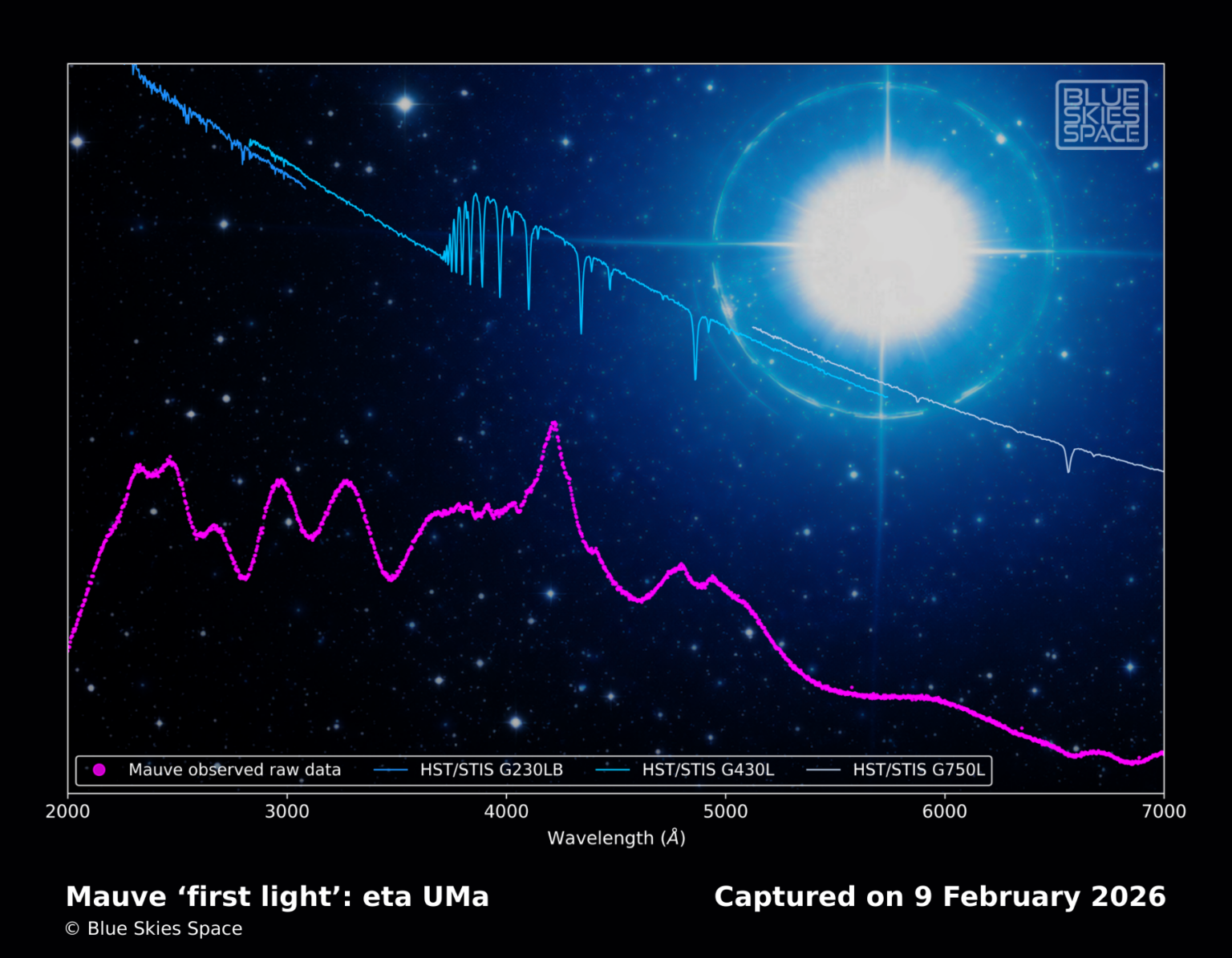
The first orbiting private space telescope, owned by Blue Skies Space and dubbed Mauve, has successfully taken its first image and data, a 5 second long exposure of a single star.
That image is to the right, with the spectroscopic data shown by the magenta line. The Hubble Space Telescope’s spectroscopic data is shown in blue and while for comparison.
As part of early commissioning, Mauve was pointed at its first calibration target, eta Ursae Majoris (eta UMa), a bright star in the constellation Ursa Major, approximately 104 light-years from Earth, for a 5-second observation. Eta UMa is a hot, blue-white star, much hotter than our Sun. Eta UMa shines brightly in ultraviolet light, making it an ideal calibration target for a UV observatory like Mauve.
The telescope has a 5-inch mirror, so its resolution is far lower than Hubble’s 94-inch mirror, but because it is above the atmosphere its view is far better than larger ground-based telescopes. Mauve is intended as a three-year-long demonstration project, during which it will study flares from nearby stars that are thought to have exoplanets, as well as binary star systems and variable stars. It is also making this data available to scientists, for a subscription fee. It already has almost a dozen universities signed up.
Blue Skies hopes Mauve’s success will help it raise the capital to build Twinkle, a space telescope with an 18-inch primary mirror. If that succeeds, the company plans to scale up to even bigger orbiting telescopes.
This private sector astronomy model is how the U.S. did things routinely prior to World War II. Then, for many reasons, the government took over for the next three-quarters of a century. It now appears the pendulum is shifting back to the private sector.
On Christmas Eve 1968 three Americans became the first humans to visit another world. What they did to celebrate was unexpected and profound, and will be remembered throughout all human history. Genesis: the Story of Apollo 8, Robert Zimmerman's classic history of humanity's first journey to another world, tells that story, and it is now available as both an ebook and an audiobook, both with a foreword by Valerie Anders and a new introduction by Robert Zimmerman.
The print edition can be purchased at Amazon or from any other book seller. If you want an autographed copy the price is $60 for the hardback and $45 for the paperback, plus $8 shipping for each. Go here for purchasing details. The ebook is available everywhere for $5.99 (before discount) at amazon, or direct from my ebook publisher, ebookit. If you buy it from ebookit you don't support the big tech companies and the author gets a bigger cut much sooner.
The audiobook is also available at all these vendors, and is also free with a 30-day trial membership to Audible.
"Not simply about one mission, [Genesis] is also the history of America's quest for the moon... Zimmerman has done a masterful job of tying disparate events together into a solid account of one of America's greatest human triumphs."--San Antonio Express-News
A telescope looking at stars from LEO has a good chance over time of discovering the orbits of black stealth satellites over time by recording occlusion events. Same thing for large earth based systems. So eventually there is military man in the middle requirements on the raw data.
Impressive that they already have a dozen universities signed up at 5-inches.