
The smooth and extremely calm methane lakes of Titan
Click for full image.
Using archival radar data obtained by the Saturn orbiter Cassini from one of its many fly-bys of the moon Titan, scientists now believe that most of the high northern latitude lakes on Titan are mostly made of pure methane, not ethane, and that their surface is remarkably calm and smooth. From the abstract:
During its 119th flyby of the moon, the Cassini spacecraft conducted a bistatic radar experiment observing a group of seven lakes in Titan’s Northern Lake District located between (72°N, 143°W) and (77°N, 131°W). The orbiter transmitted a continuous-wave signal at a wavelength of 3.56 cm (X-band) toward Titan’s surface, targeting the moving specular reflection point between the spacecraft and Earth. As the antenna footprint intercepted the liquid surfaces of the lakes, distinct specular reflections were detected on Earth by the 70-m antenna at NASA’s Canberra Deep Space Network complex. Analysis of these reflections shows that all seven lakes exhibit similar dielectric properties—linked to their composition—and surface roughness, suggesting they are methane-dominated and may have a few millimeters of surface roughness. [emphasis mine]
The highlighted phrase underscores what previous data had shown, that the methane lakes of Titan are remarkably calm, almost to the point of absurdity.
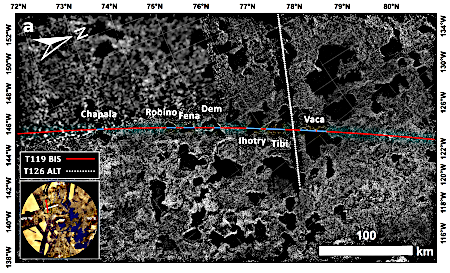
The image to the right, figure 1 of the paper, shows the track of this radar observation. Based on this data as well as data obtained during a later fly-by of another nearby lake, the scientists posit that all the lakes in this region are likely similar, mostly filled with methane having a surface with barely no ripples at all.
This information is crucial for the planned Dragonfly mission, that will fly over and onto Titan’s methane lakes, though not in the high latitudes but in its equatorial regions. Knowing the conditions as best as possible will increase the odds that this very risky mission will succeed.

On Christmas Eve 1968 three Americans became the first humans to visit another world. What they did to celebrate was unexpected and profound, and will be remembered throughout all human history. Genesis: the Story of Apollo 8, Robert Zimmerman's classic history of humanity's first journey to another world, tells that story, and it is now available as both an ebook and an audiobook, both with a foreword by Valerie Anders and a new introduction by Robert Zimmerman.
The print edition can be purchased at Amazon or from any other book seller. If you want an autographed copy the price is $60 for the hardback and $45 for the paperback, plus $8 shipping for each. Go here for purchasing details. The ebook is available everywhere for $5.99 (before discount) at amazon, or direct from my ebook publisher, ebookit. If you buy it from ebookit you don't support the big tech companies and the author gets a bigger cut much sooner.
The audiobook is also available at all these vendors, and is also free with a 30-day trial membership to Audible.
"Not simply about one mission, [Genesis] is also the history of America's quest for the moon... Zimmerman has done a masterful job of tying disparate events together into a solid account of one of America's greatest human triumphs."--San Antonio Express-News

Click for full image.
Using archival radar data obtained by the Saturn orbiter Cassini from one of its many fly-bys of the moon Titan, scientists now believe that most of the high northern latitude lakes on Titan are mostly made of pure methane, not ethane, and that their surface is remarkably calm and smooth. From the abstract:
During its 119th flyby of the moon, the Cassini spacecraft conducted a bistatic radar experiment observing a group of seven lakes in Titan’s Northern Lake District located between (72°N, 143°W) and (77°N, 131°W). The orbiter transmitted a continuous-wave signal at a wavelength of 3.56 cm (X-band) toward Titan’s surface, targeting the moving specular reflection point between the spacecraft and Earth. As the antenna footprint intercepted the liquid surfaces of the lakes, distinct specular reflections were detected on Earth by the 70-m antenna at NASA’s Canberra Deep Space Network complex. Analysis of these reflections shows that all seven lakes exhibit similar dielectric properties—linked to their composition—and surface roughness, suggesting they are methane-dominated and may have a few millimeters of surface roughness. [emphasis mine]
The highlighted phrase underscores what previous data had shown, that the methane lakes of Titan are remarkably calm, almost to the point of absurdity.
The image to the right, figure 1 of the paper, shows the track of this radar observation. Based on this data as well as data obtained during a later fly-by of another nearby lake, the scientists posit that all the lakes in this region are likely similar, mostly filled with methane having a surface with barely no ripples at all.
This information is crucial for the planned Dragonfly mission, that will fly over and onto Titan’s methane lakes, though not in the high latitudes but in its equatorial regions. Knowing the conditions as best as possible will increase the odds that this very risky mission will succeed.
On Christmas Eve 1968 three Americans became the first humans to visit another world. What they did to celebrate was unexpected and profound, and will be remembered throughout all human history. Genesis: the Story of Apollo 8, Robert Zimmerman's classic history of humanity's first journey to another world, tells that story, and it is now available as both an ebook and an audiobook, both with a foreword by Valerie Anders and a new introduction by Robert Zimmerman.
The print edition can be purchased at Amazon or from any other book seller. If you want an autographed copy the price is $60 for the hardback and $45 for the paperback, plus $8 shipping for each. Go here for purchasing details. The ebook is available everywhere for $5.99 (before discount) at amazon, or direct from my ebook publisher, ebookit. If you buy it from ebookit you don't support the big tech companies and the author gets a bigger cut much sooner.
The audiobook is also available at all these vendors, and is also free with a 30-day trial membership to Audible.
"Not simply about one mission, [Genesis] is also the history of America's quest for the moon... Zimmerman has done a masterful job of tying disparate events together into a solid account of one of America's greatest human triumphs."--San Antonio Express-News
This is THE site crying out the loudest for human landings. Hydrocarbon seas for fuels and plastics to hold said fuels.
The guy in THE GRADUATE was right.
The Chevron world.
If Musk would just forgo Mars.
Just to tick the Greens off, I want cities on Titan named after oil men….the Red Adair Hellfighters, etc.
Bob wrote: “the high northern latitude lakes on Titan are mostly made of pure methane, not ethane,”
Lakes of methane. Where did this methane come from? I remember that when some hear that methane has been found they jump to “life” being found. We know this is a gross assumption.
But where did all this methane come from?
If one looks at methane production on the earth all the sources say the vast majority are some sort of biological process(decay, digestion or ancient biomass) and a small amount of abiogenic generation. One source said cattle produce 500 liters of methane per day. I assume if they get blocked they explode. I guess it’s good they mostly belch it.
But in space all that methane is all from some sort of chemical reaction at ultra low temperatures with dust as a catalyst. “The atoms slowly “crawl” around on the surface of the dust grain, eventually meet and make bonds. ”
(this particular phrase seems to appear in many of the explanations of space produced methane. )
There also seems to be reactions that require water and rock, or something called “serpentinization, involving water, carbon dioxide, and olivine (common on Mars)”. Apparently none of this occurs on or in the earth.
My wonder here is not to say methane on Titan is from prior “life”
nor to say that all methane on earth is abiotic
But it seems odd that lakes of methane exist on Titan (yes very alien and cold) and methane is detected on most(all?) planets but that the vast majority of methane on earth has to come from some sort of present or past life process…. seems odd.
Chris: You are asking a very fundamental question about the formation of our solar system that scientists periodically ask but never really address because they simply don’t know enough to give a good answer.
The problem isn’t just Titan. Almost every single object in the solar system, be it planet, moon, asteroid, appears almost always to be radically unique. We have some that are similar (such as Bennu and Ryugu), but most of the time each object is very different than its neighbors. For example, based on New Horizons observations, Pluto and Charon are very different from each other, even though they are a binary planet system.
The same can be said for the moon’s of Jupiter and Saturn. Titan for example is nothing like the other moons of Saturn. And consider also how radically different Venus, the Earth, and Mars are.
Yet all these objects formed from the same primeval solar accretion disk. Somehow that process caused this wild differentiation, in a manner we do not yet understand.
I wouldn’t call this odd. I would call it the number one mystery for planetary theorists in their effort now trying to figure out how our solar system formed.
Sounds like this would be terrific news for the Titan Mare Explorer or the Titan Submarine, if they ever get funded in any form.
Assuming that there are winds on Titan, such a smooth lake surface suggests a very high viscosity. Higher than pure liquid methane? Could there be polymerization going on at the lake surface?
maybe that’s why they sent 3I/Atlas to investigate :)
Chris,
Excluding coal seams – in which actual fossils are found with some frequency – there are good reasons to suppose that all other so-called “fossil fuels” such as oil and gas are the products of abiogenesis deep in the Earth’s mantle. There does not seem to be a reasonable biogenesis theory that explains shale oil and gas, for example. You might want to look at the writings on this subject by the late Dr. Thomas Gold.
I hope he is right.
I once saw a map of assets in the Gulf of Mexico…it looked more worked over than I thought
Titan’s hydrocarbons
https://www.esa.int/Science_Exploration/Space_Science/Cassini-Huygens/Titan_s_surface_organics_surpass_oil_reserves_on_Earth
Dick Eagleson
Dr Thomas gold – very interesting stuff – Thank you
There’s a running gun battle among the oilies over the origin of petroleum and natural gas. The old theory (guess) was formation was similar to that of coal, based on processing of organic matter afterwards. The newer theory is that it is primordial, delivered along with all the rock, water and gas when the solar system formed. Real answer is probably a mix of the two.
Lots of hydrocarbons in the outer solar system. The orange tholins on the Kuiper Belt Objects, the Pluto system and even comets are reworked methane and nitrogen compounds (UV action reworks them).
The real oddity is that in Alien, the Nostromo was ferrying oil back from wherever they got it from before being flagged to go on their snipe hunt. And we are now considering off planet hydrocarbons in our own solar system. To the best of my knowledge, at the time, nobody was talking about that. The author just made it up. Serendipity? The Simulation? Or run of the mill weirdness? Tough to ignore weirdness. Cheers –
Extraterrestrial hydrocarbons will eventually be exploited by humans for most of the same uses as terrestrial hydrocarbons excepting mainly the burning of same for electricity generation, residential heating, industrial process heat and transport. Those are all very significant use cases on Earth, so extraterrestrial civilization will not need nearly as much hydrocarbon raw material per capita for its upkeep and expansion, but it will need some. There will be an extensive extraterrestrial petrochemical industry. It is just not going to feature herbicide and pesticide manufacture, but polymer synthesis will be central.
Methane from cows is largely a myth… Take it from an old farmer who milked cows morning and evening.
All biomass rots from anaerobic bacteria and turns into Methane, hydrogen sulfide, alcohol and other gases. Food the cow eats does not remain inside of the cow long enough to produce Methane! Grass and hay does not have much sugar so the cows must eat more volume and constantly process it through. (The exception is added grain which is loaded with carbohydrates to make the cows fat, just as it does to humans, but it still passes through them so quickly that pigs will eat the cows poop because of undigested kernels)
The only way a cow can belch methane, is if it has been dead for a while.
Cows eat, then re-chew their cud into a froth with their mouth open which means they’re swallowing a considerable amount of air. this air comes out when they’re throwing up more food to ruminate and then sent into a different stomach.
The bottom line, the cows poop will be gathered as fertilizer into a pile where it becomes hot from anaerobic bacteria breaking it down. The smell from the methane being created is from that pile, not the cows.
If the cows did not exist, all of the grass they did not eat would rot on the ground and become Methane anyway… Just as all the biomass in every forest does.
Tree leaves increase the CO2 content of the air every fall from rotting leaves turning into Methane which quickly converts in to CO2 and water vapor. (The carbon dioxide cycle of life)
Despite anaerobic bacteria making methane for billions of years, there’s almost 0 methane in our atmosphere. Oxygen oxidizes it nearly as fast as it’s being created. 1.8 ppm is extremely close to zero… Or the equivalent of $1.80 to a millionaire.
X class flares from the sun is constantly hitting us with methane and ammonia and other gases. (billions of tons of material burning as northern lights in our atmosphere, enough to rise the sea levels 5 to 8 inches per century)
It is theorized that enough solar material is cast in to space to make the equivalent of another earth every 11 million years. (accumulation) that this material is vacuumed up by planets and moons should not surprise anyone.
Solar Wind Irradiation of Methane and Methane–Water Ices: A Molecular Dynamics Approach
https://pmc.ncbi.nlm.nih.gov/articles/PMC11664651/
Diesel fuel gels in cold temperatures, We would mix kerosene (Number one diesel) to prevent this in Alaska. It would not surprise me if Titans Methane is gelled or even frozen.
One of my professors in college was a chemist, along with developing ammonium nitrate explosives and the first solid fuel rockets, he explained that the “fossils” in fossil fuel is lime stone… Not dinosaurs… or ancient forest / peat covered over from a large meteor impact. (coal)
If you heat lime stone you make cement, and if you use heat, water, and pressure… You make oil.
The results of colliding with a Mars sized object (our moon, which is missing 2 miles of the surface facing the earth) is the formation of the continents on top of the earth’s ancient CO2 atmosphere (the bones of ancient life). Continental drift passing over 2000 feet deep of lime stone creates oil and methane and dozens of other chemical compounds we utilize from pumping it from the ground. As long as there is continental drift, there will be oil and volcanoes. 1/10 of the surface of the planet is CO2 rock lime stone. Carbon capture that!!!