The space station race: Startup Max Space to establish factory at Kennedy in Florida
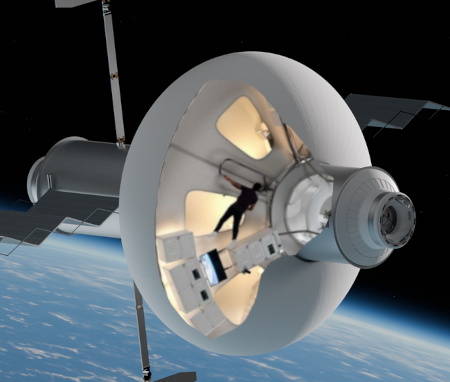
Max Space’s proposed Thunderbird station, with cut-out showing
interior and person for scale. Click for original images.
The space station startup Max Space has apparently decided to establish its manufacturing facility at the Kennedy Space Center in Florida, and expects to hire its first 30 to 50 employees there this year.
Currently working with Space Florida, Max Space is moving toward setting up operation in Exploration Park on Space Commerce Way, and has already begun hiring. While the company already has a address in Exploration Park, they are seeking to set up in an existing 20,000 to 30,000 square-foot manufacturing facility. This is where the large space habitat modules will be manufactured.
While Space Florida confirmed Max Space’s intentions to move into the area, no further details were provided. Max Space said they expect to bring 30 to 50 new hires onboard within the first half of 2026.
The company had previously positioned itself as the builder of modules that any one of the four other commercial private space stations could buy and add to their stations. It now appears it has decided to enter the competition as its own station, proposing Thunderbird as its bid. It is gearing up to fly a smaller demonstration mission in ’27 to prove its inflatable design that is based on the same technology used by the modules built by the now-defunct company Bigelow.
With this in mind, I have now added Max Space to my rankings of the commercial stations under construction, and have placed it ahead of Blue Origin’s Orbital Reef station, based on my impression of where both projects presently stand. Essentially, they are tied for last place, but I put Max Space ahead because it seems to have positive momentum, while the partnership of Blue Origin and Sierra Space appears to be faltering.
- Haven-1, being built by Vast, with no NASA funds. The company is moving fast, with Haven-1 to launch in 2026 for a three-year period during which it will be occupied by four 2-week-long manned missions. The company is already testing an unmanned small demo module in orbit. By flying actual hardware and manned missions it hopes this will put it in the lead to win NASA’s phase 2 contract to build its much larger multi-module Haven-2 station. It has also made preliminary deals with Colombia, Uzbekistan, Japan, and the Maldives possible astronaut flights to Haven-1.
- Axiom, being built by Axiom, has launched four tourist flights to ISS, with the fourth carrying government passengers from India, Hungary, and Poland. The rumors of cash flow issues seem to have been alleviated with an infusion of $100 million from Hungary’s telecommunications company 4iG. The development of its first two modules has also been proceeding more or less as planned, with the first’s hull completed and presently undergoing testing. It has also signed Redwire to build that module’s solar panels.
- Starlab, being built by a consortium led by Voyager Space, Airbus, and Northrop Grumman, with extensive partnership agreements with the European Space Agency and others. Though no construction has yet begun on its NASA-approved design, it has raised $383 million in a public stock offering in addition to the $217.5 million provided by NASA. It has also begun signing up a number of companies to build the station’s hardware.
- Thunderbird, proposed by the startup Max Space. It is building a smaller demo test station to launch in ’27 on a Falcon 9 rocket, and has begun work on its manufacturing facility at Kennedy in Florida. Its management includes one former NASA astronaut and one former member of the Bigelow space station team that built the first private orbiting inflatable modules, Genesis-1, Genesis-2, and BEAM (still operating on ISS).
- Orbital Reef, being built by a consortium led by Blue Origin and Sierra Space. This station looks increasingly dead in the water. Blue Origin has built almost nothing, as seems normal for this company. And while Sierra Space has successfully tested its inflatable modules, including a full scale version, its reputation is soured by its failure in getting its Dream Chaser cargo mini-shuttle launched.

On Christmas Eve 1968 three Americans became the first humans to visit another world. What they did to celebrate was unexpected and profound, and will be remembered throughout all human history. Genesis: the Story of Apollo 8, Robert Zimmerman's classic history of humanity's first journey to another world, tells that story, and it is now available as both an ebook and an audiobook, both with a foreword by Valerie Anders and a new introduction by Robert Zimmerman.
The print edition can be purchased at Amazon or from any other book seller. If you want an autographed copy the price is $60 for the hardback and $45 for the paperback, plus $8 shipping for each. Go here for purchasing details. The ebook is available everywhere for $5.99 (before discount) at amazon, or direct from my ebook publisher, ebookit. If you buy it from ebookit you don't support the big tech companies and the author gets a bigger cut much sooner.
The audiobook is also available at all these vendors, and is also free with a 30-day trial membership to Audible.
"Not simply about one mission, [Genesis] is also the history of America's quest for the moon... Zimmerman has done a masterful job of tying disparate events together into a solid account of one of America's greatest human triumphs."--San Antonio Express-News
Max Space’s proposed Thunderbird station, with cut-out showing
interior and person for scale. Click for original images.
The space station startup Max Space has apparently decided to establish its manufacturing facility at the Kennedy Space Center in Florida, and expects to hire its first 30 to 50 employees there this year.
Currently working with Space Florida, Max Space is moving toward setting up operation in Exploration Park on Space Commerce Way, and has already begun hiring. While the company already has a address in Exploration Park, they are seeking to set up in an existing 20,000 to 30,000 square-foot manufacturing facility. This is where the large space habitat modules will be manufactured.
While Space Florida confirmed Max Space’s intentions to move into the area, no further details were provided. Max Space said they expect to bring 30 to 50 new hires onboard within the first half of 2026.
The company had previously positioned itself as the builder of modules that any one of the four other commercial private space stations could buy and add to their stations. It now appears it has decided to enter the competition as its own station, proposing Thunderbird as its bid. It is gearing up to fly a smaller demonstration mission in ’27 to prove its inflatable design that is based on the same technology used by the modules built by the now-defunct company Bigelow.
With this in mind, I have now added Max Space to my rankings of the commercial stations under construction, and have placed it ahead of Blue Origin’s Orbital Reef station, based on my impression of where both projects presently stand. Essentially, they are tied for last place, but I put Max Space ahead because it seems to have positive momentum, while the partnership of Blue Origin and Sierra Space appears to be faltering.
- Haven-1, being built by Vast, with no NASA funds. The company is moving fast, with Haven-1 to launch in 2026 for a three-year period during which it will be occupied by four 2-week-long manned missions. The company is already testing an unmanned small demo module in orbit. By flying actual hardware and manned missions it hopes this will put it in the lead to win NASA’s phase 2 contract to build its much larger multi-module Haven-2 station. It has also made preliminary deals with Colombia, Uzbekistan, Japan, and the Maldives possible astronaut flights to Haven-1.
- Axiom, being built by Axiom, has launched four tourist flights to ISS, with the fourth carrying government passengers from India, Hungary, and Poland. The rumors of cash flow issues seem to have been alleviated with an infusion of $100 million from Hungary’s telecommunications company 4iG. The development of its first two modules has also been proceeding more or less as planned, with the first’s hull completed and presently undergoing testing. It has also signed Redwire to build that module’s solar panels.
- Starlab, being built by a consortium led by Voyager Space, Airbus, and Northrop Grumman, with extensive partnership agreements with the European Space Agency and others. Though no construction has yet begun on its NASA-approved design, it has raised $383 million in a public stock offering in addition to the $217.5 million provided by NASA. It has also begun signing up a number of companies to build the station’s hardware.
- Thunderbird, proposed by the startup Max Space. It is building a smaller demo test station to launch in ’27 on a Falcon 9 rocket, and has begun work on its manufacturing facility at Kennedy in Florida. Its management includes one former NASA astronaut and one former member of the Bigelow space station team that built the first private orbiting inflatable modules, Genesis-1, Genesis-2, and BEAM (still operating on ISS).
- Orbital Reef, being built by a consortium led by Blue Origin and Sierra Space. This station looks increasingly dead in the water. Blue Origin has built almost nothing, as seems normal for this company. And while Sierra Space has successfully tested its inflatable modules, including a full scale version, its reputation is soured by its failure in getting its Dream Chaser cargo mini-shuttle launched.
On Christmas Eve 1968 three Americans became the first humans to visit another world. What they did to celebrate was unexpected and profound, and will be remembered throughout all human history. Genesis: the Story of Apollo 8, Robert Zimmerman's classic history of humanity's first journey to another world, tells that story, and it is now available as both an ebook and an audiobook, both with a foreword by Valerie Anders and a new introduction by Robert Zimmerman.
The print edition can be purchased at Amazon or from any other book seller. If you want an autographed copy the price is $60 for the hardback and $45 for the paperback, plus $8 shipping for each. Go here for purchasing details. The ebook is available everywhere for $5.99 (before discount) at amazon, or direct from my ebook publisher, ebookit. If you buy it from ebookit you don't support the big tech companies and the author gets a bigger cut much sooner.
The audiobook is also available at all these vendors, and is also free with a 30-day trial membership to Audible.
"Not simply about one mission, [Genesis] is also the history of America's quest for the moon... Zimmerman has done a masterful job of tying disparate events together into a solid account of one of America's greatest human triumphs."--San Antonio Express-News
I think you meant the headline to read “space station” rather than “station station.” That aside, this seems, as usual, a very fair and reasonable evaluation and ranking.
Dick Eagleson: Oy. Thanks. Now fixed.
I look at these space station concepts, and I always thing…why?
Starship would make a perfectly acceptable space station. With a small mod kit and a few minor design changes….link 2-3 together, and that’s it.
Geoman asked “Why?” He also suggested Starship as a space station.
1. SpaceX has shown no interest in turning Starship into an orbiting station. It might in the future, but that is not its strategy. It is instead focused on building a reusable quick reflight transportation system, which it is already selling to these stations.
2. There is actually a great deal of potential profit for these stations, in manufacturing and research. Pharmaceuticals alone could pay for everything. The orbital data centers is a new “thing” that might pay off, but it is certainly driving investment to these stations right now.
3. NASA wants a station to replace ISS. Europe wants a station to replace ISS. Japan wants a station to replace ISS. A lot of third world nations want a station to fly their astronauts to on the cheap. There is money to be made serving the needs of nations.
Bottom line: It appears there is enough demand to have caused five different projects to get started.
Remember G. Harry Stine? Remember how people were, let’s say, skeptical of his claims for the benefits of space industry? I was influenced by his work in that regard, and always a bit embarrassed to say so. Not anymore, baby.
Interesting that they are locating at the Cape – evidently there is still some advantage to being there. I wonder if we will ever get to the time where the Cape holds no special advantage and is no longer a central focus… to the same degree that there isn’t ONE central focus airport in the US?
I suppose Boca Chica is the first step in ending that trend.
Saville: my guess is when all launch vehicles are fully reusable, and reliability has improved as a result. It’s convenient to avoid cross-country shipping if you don’t have to do it.
Robert Zimmerman,
I agree that use of Starships as space stations or elements of same is not a particularly efficient use of the vehicle from an economic standpoint. That will likely keep SpaceX out of the direct-construction-and-operation-of-space-stations business unless a really large rotating resort station shows potentially attractive economics. Even then, SpaceX wouldn’t build such a thing using Starships as modules.
But I am dubious that the recent enthusiasm for AI-oriented data centers in space will have much influence on the business cases for the various post-ISS space station projects. To make sense – for everyone but SpaceX, anyway – such centers need to be large. LEO is not going to be a good place to put really large things that can’t be quickly maneuvered owing to the sizable populations, both trackable and non-trackable, of space debris objects. SpaceX has the unique option of building a distributed AI data center in space via piggyback payloads on Starlink birds. But even SpaceX sees this as merely a way to get started quickly. Longer-term, the plan is now to industrialize the Moon and build such centers in lunar orbits using materials yeeted up from the lunar surface.
This is one of the relatively rare ways in which the Bezos-ian vision of moving heavy industry off of Earth can actually work. AI data centers certainly qualify as heavy industry given their voracious energy demands. And they can return “product” to Earth via radio waves. The insoluble problem – absent a crypto-physics breakthrough that makes anti-grav technology possible – with moving most forms of heavy industry off-Earth is that the products of heavy industry are, well, heavy. That makes getting them from space back to Earth’s surface the key problem. The masses involved are simply unmanageable absent cheap anti-grav tech.
Heavy industry doesn’t have to go off-planet; China is handling that. There are any number of industries that don’t depend on mass to produce profit. And, think of the children (jobs). We are, though, within a generation or so of not having to lift *everything* out of a steep well. One may also consider the political implications of throwing industrial-mass product down that same well. Just a liiittle bit of an ‘error’. . .