Three launches and one scrub overnight
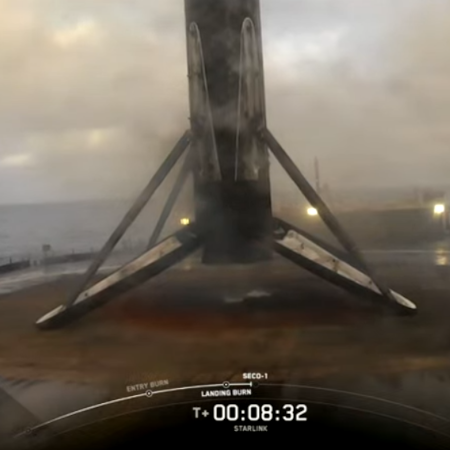
Falcon 9 1st stage after landing for 30th time
In the past twelve hours there was one launch abort at T-0 and three successful launches.
First, Japan’s space agency JAXA attempted to launch a GPS-type satellite using its H3 rocket, built by Mitsubishi. The countdown reached T-0 but then nothing happened. The launch was then scrubbed because of an issue in the ground systems. No new date was announced.
Next, Arianespace, the commercial division of the European Space Agency (ESA), launched two European Union GPS-type satellites, Galileos 33 and 34, its Ariane-6 rocket lifting off from French Guiana.
This was Arianespace’s seventh launch in 2025, the most it has achieved since 2021, though still about 20-30% lower than the numbers it generally managed in the 2010s.
Finally, SpaceX followed with two launches on opposite coasts. First, its Falcon 9 rocket launched 29 Starlink satellites from the Kennedy Space Center in Florida, the first stage completing its sixth flight by landing on a drone ship in the Atlantic.
Shortly thereafter the company launched another 27 Starlink satellites, its Falcon 9 rocket lifting off from Vandenberg Space Force Base in California. The first stage (B1063) completed its 30th flight, landing on a drone ship in the Pacific. This stage is now the third Falcon 9 booster to reach 30 reuses:
39 Discovery space shuttle
33 Atlantis space shuttle
32 Falcon 9 booster B1067
30 Falcon 9 booster B1071
30 Falcon 9 booster B1063
28 Falcon 9 booster B1069
28 Columbia space shuttle
The leaders in the 2025 launch race:
168 SpaceX (a new record)
84 China
16 Rocket Lab
15 Russia
SpaceX now leads the rest of the world in successful launches, 168 to 139. The South Korean rocket startup Innospace had hoped to do its its first orbital launch of its HANBIT-Nano rocket from Brazil today, but that launch has now been delayed to December 19, 2025. Rocket Lab however has a launch scheduled for the evening.

On Christmas Eve 1968 three Americans became the first humans to visit another world. What they did to celebrate was unexpected and profound, and will be remembered throughout all human history. Genesis: the Story of Apollo 8, Robert Zimmerman's classic history of humanity's first journey to another world, tells that story, and it is now available as both an ebook and an audiobook, both with a foreword by Valerie Anders and a new introduction by Robert Zimmerman.
The print edition can be purchased at Amazon or from any other book seller. If you want an autographed copy the price is $60 for the hardback and $45 for the paperback, plus $8 shipping for each. Go here for purchasing details. The ebook is available everywhere for $5.99 (before discount) at amazon, or direct from my ebook publisher, ebookit. If you buy it from ebookit you don't support the big tech companies and the author gets a bigger cut much sooner.
The audiobook is also available at all these vendors, and is also free with a 30-day trial membership to Audible.
"Not simply about one mission, [Genesis] is also the history of America's quest for the moon... Zimmerman has done a masterful job of tying disparate events together into a solid account of one of America's greatest human triumphs."--San Antonio Express-News
Falcon 9 1st stage after landing for 30th time
In the past twelve hours there was one launch abort at T-0 and three successful launches.
First, Japan’s space agency JAXA attempted to launch a GPS-type satellite using its H3 rocket, built by Mitsubishi. The countdown reached T-0 but then nothing happened. The launch was then scrubbed because of an issue in the ground systems. No new date was announced.
Next, Arianespace, the commercial division of the European Space Agency (ESA), launched two European Union GPS-type satellites, Galileos 33 and 34, its Ariane-6 rocket lifting off from French Guiana.
This was Arianespace’s seventh launch in 2025, the most it has achieved since 2021, though still about 20-30% lower than the numbers it generally managed in the 2010s.
Finally, SpaceX followed with two launches on opposite coasts. First, its Falcon 9 rocket launched 29 Starlink satellites from the Kennedy Space Center in Florida, the first stage completing its sixth flight by landing on a drone ship in the Atlantic.
Shortly thereafter the company launched another 27 Starlink satellites, its Falcon 9 rocket lifting off from Vandenberg Space Force Base in California. The first stage (B1063) completed its 30th flight, landing on a drone ship in the Pacific. This stage is now the third Falcon 9 booster to reach 30 reuses:
39 Discovery space shuttle
33 Atlantis space shuttle
32 Falcon 9 booster B1067
30 Falcon 9 booster B1071
30 Falcon 9 booster B1063
28 Falcon 9 booster B1069
28 Columbia space shuttle
The leaders in the 2025 launch race:
168 SpaceX (a new record)
84 China
16 Rocket Lab
15 Russia
SpaceX now leads the rest of the world in successful launches, 168 to 139. The South Korean rocket startup Innospace had hoped to do its its first orbital launch of its HANBIT-Nano rocket from Brazil today, but that launch has now been delayed to December 19, 2025. Rocket Lab however has a launch scheduled for the evening.
On Christmas Eve 1968 three Americans became the first humans to visit another world. What they did to celebrate was unexpected and profound, and will be remembered throughout all human history. Genesis: the Story of Apollo 8, Robert Zimmerman's classic history of humanity's first journey to another world, tells that story, and it is now available as both an ebook and an audiobook, both with a foreword by Valerie Anders and a new introduction by Robert Zimmerman.
The print edition can be purchased at Amazon or from any other book seller. If you want an autographed copy the price is $60 for the hardback and $45 for the paperback, plus $8 shipping for each. Go here for purchasing details. The ebook is available everywhere for $5.99 (before discount) at amazon, or direct from my ebook publisher, ebookit. If you buy it from ebookit you don't support the big tech companies and the author gets a bigger cut much sooner.
The audiobook is also available at all these vendors, and is also free with a 30-day trial membership to Audible.
"Not simply about one mission, [Genesis] is also the history of America's quest for the moon... Zimmerman has done a masterful job of tying disparate events together into a solid account of one of America's greatest human triumphs."--San Antonio Express-News
I’m old enough to remember, vaguely, the rockets that were blowing up on the pad BEFORE the Mercury 7 astronauts climbed on board. Some say those astronauts were crazy, others say brave. Probably a little of both.
That photo of the Falcon 9 on the drone reminds me of the first SpaceX drone landing attempts. There was the video for the world to see. No hiding, no obfuscation. Sometimes, the rocket would put two landing legs on the drone surface, and tip over into the ocean. I now enjoy watching the drone landings because very often it lands in the middle of the middle of the target.
All of this makes me want to re-read more Robert Heinlein.
Ronaldus Magnus,
I remember those late-’50s-early-’60s rocket blowups too. The frequency and lack of drama of SpaceX Falcon 9 launches and 1st-stage landings warms the cockles of this aging Boomer’s heart.
And re-reading more Heinlein is always in order.
I re-read or re-listen (book on tape) to “The Moon is a Harsh Mistress” on a regular basis.
I have a few other faves from Heinlein. When I was younger, Starship Troopers was on a mandatory reading list.
I quite enjoyed it.
Some of his stuff is a stretch, and I cannot take it.
Clarke and Asimov are good too. I just started a re-read of Foundation.
But when I drive somewhere I have audio version of some of Harlan Ellison’s stuff.
What a character.
I actually bounce between books. My brain can rarely focus long enough on one thing.
I will read 2 or 3 books simultaneously, while listening to another, or to podcasts, in the car, or while exercising (walking or treadmill).
Perhaps, Mr Z, we need an occasional book or reading thread. An open book review or other broad bibliophilic babbling.
sippin_bourbon: I don’t know if you have noticed, but I have been doing a book review or book inspired column one a week for the past month (though I haven’t done one this week quite yet). Discussing books is the point of those posts.
I have caught them.
But they are not quite open threads on books, and if we have not had an opportunity to read the book as well, it makes it difficult for us to provide input, feedback, or other educated commentary.
I try to respect the overall topic that has been posted, and try to stay in the confines of the discussion as it tacks about.
Heinlein’s rockets got around easier than Falcon…the latter hoverslams down all but empty.
For the Moon lithobraking with a sled design might save a bit on fuel.
sippin_bourbon,
Heinlein was a true pioneer who ranged widely. There are probably more people who love one of his books and hate another than is the case for any other sci-fi writer of his generation or, almost certainly, any generation. Harlan Ellison was one of the greats and liked to style himself the bad boy of sci-fi, but Heinlein was the real deal.
Another great old-timer you might want to look into – if you haven’t already long-since – is Poul Anderson, though his later stuff got pretty dark.
Jeff Wright,
For a hard sci-fi writer, Heinlein never went into much detail about spaceship powerplants. Most of his rockets were nuclear-powered with water as the reaction mass and those that weren’t ran on the V-2 diet of alcohol and LOX. An example of the latter was the long-lost Astarte, a ship sent on the first expedition to Venus but which vanished without trace a century before being found again by the protagonists of Heinlein’s Space Cadet.
Probably based on his naval engineering background, Heinlein’s big rockets – interplanetary liners – had engine rooms with crews just like the big Cunards and White Stars or the capital ships of his day. That was a key element of the story of “Noisy” Rhysling, “The Blind Singer of the Spaceways” from The Green Hills of Earth.
In The Puppet Masters, the mind-controlling parasites pretty obviously arrive in ships having reactionless drives of some sort, but no details are vouchsafed.
All of Heinlein’s rockets are also SSTAs – Single-Stage to Anywhere. No staged rockets that I ever recall in any of his yarns.
I’ve always found use of the term “hoverslam” to describe the Falcon 9 1st-stage landing technique rather ironic as there is neither any hovering nor any slamming involved. But, that terminology is now so well-established that changing it to something more accurately descriptive is probably a hopeless cause at this point.
“Far Beyond the Stars” (Marc Scott Zicree)
Deep Space 9 [se6 ep14]
https://youtu.be/q0zQ7efX8Rk
4:57
Ronaldus Magnus observed: “. I now enjoy watching the drone landings because very often it lands in the middle of the middle of the target.”
The ten-ring. While I very much appreciate, and have witnessed a fair amount of, the road here, I more look forward to a real interplanetary economy before personal end-of-life.
Oh, we could talk all day and get good and drunk discussing the sci-fi influencers. My first exposure to Ellison was “The Glass Teat” around the time my voice broke.
“City on the Edge of Forever”
“I Have No Mouth, And I Must Scream”
Contributed writing and story direction to ‘Babylon 5’
I’d say that’s ‘real deal’.
Blair Ivey,
Ellison was certainly a “real deal” as a consequential figure in sci-fi from the 1950s on. And while he was a bad boy of the field, he was just not the bad boy of the field.