
Uzbekistan signs deal to possibly fly astronauts on Vast’s Haven-1 space station
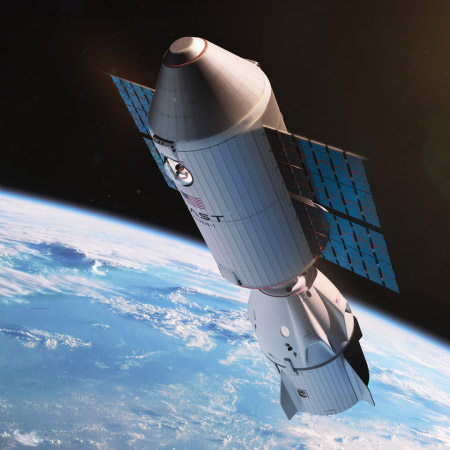
Haven-1 with docked Dragon capsule
According to a press release earlier this week from the Uzbekistan government, it has signed an agreement with the American space station startup Vast to possibly fly its astronauts on Vast’s Haven-1 space station, scheduled for launch early next year for a three year mission that will include four two-week manned occupancies.
The parties discussed prospects for long-term cooperation with Vast, including participation in joint scientific research, personnel exchange programs, and the involvement of Uzbek specialists in upcoming missions following the successful launch of the Haven-1 orbital station.
Discussions also covered the potential involvement of Uzbek scientists and engineers in research on artificial gravity, life support systems, and orbital architecture within the framework of the Haven-2 project, the proposed successor to the International Space Station.
Neither Vast nor Uzbekistan apparently made any firm commitments to fly astronauts to Haven-1, but the agreement clearly laid the groundwork for doing so, if not on Haven-1 then on Vast’s follow-up much larger station, Haven-2. At the moment Vast has not yet announced any of passengers or crew for the four Haven-1 manned missions, so there clearly is room for an astronaut from Uzbekistan, assuming it is able and willing to pay the freight.
Hat tip to BtB’s stringer Jay.

On Christmas Eve 1968 three Americans became the first humans to visit another world. What they did to celebrate was unexpected and profound, and will be remembered throughout all human history. Genesis: the Story of Apollo 8, Robert Zimmerman's classic history of humanity's first journey to another world, tells that story, and it is now available as both an ebook and an audiobook, both with a foreword by Valerie Anders and a new introduction by Robert Zimmerman.
The print edition can be purchased at Amazon or from any other book seller. If you want an autographed copy the price is $60 for the hardback and $45 for the paperback, plus $8 shipping for each. Go here for purchasing details. The ebook is available everywhere for $5.99 (before discount) at amazon, or direct from my ebook publisher, ebookit. If you buy it from ebookit you don't support the big tech companies and the author gets a bigger cut much sooner.
The audiobook is also available at all these vendors, and is also free with a 30-day trial membership to Audible.
"Not simply about one mission, [Genesis] is also the history of America's quest for the moon... Zimmerman has done a masterful job of tying disparate events together into a solid account of one of America's greatest human triumphs."--San Antonio Express-News
Haven-1 with docked Dragon capsule
According to a press release earlier this week from the Uzbekistan government, it has signed an agreement with the American space station startup Vast to possibly fly its astronauts on Vast’s Haven-1 space station, scheduled for launch early next year for a three year mission that will include four two-week manned occupancies.
The parties discussed prospects for long-term cooperation with Vast, including participation in joint scientific research, personnel exchange programs, and the involvement of Uzbek specialists in upcoming missions following the successful launch of the Haven-1 orbital station.
Discussions also covered the potential involvement of Uzbek scientists and engineers in research on artificial gravity, life support systems, and orbital architecture within the framework of the Haven-2 project, the proposed successor to the International Space Station.
Neither Vast nor Uzbekistan apparently made any firm commitments to fly astronauts to Haven-1, but the agreement clearly laid the groundwork for doing so, if not on Haven-1 then on Vast’s follow-up much larger station, Haven-2. At the moment Vast has not yet announced any of passengers or crew for the four Haven-1 manned missions, so there clearly is room for an astronaut from Uzbekistan, assuming it is able and willing to pay the freight.
Hat tip to BtB’s stringer Jay.
On Christmas Eve 1968 three Americans became the first humans to visit another world. What they did to celebrate was unexpected and profound, and will be remembered throughout all human history. Genesis: the Story of Apollo 8, Robert Zimmerman's classic history of humanity's first journey to another world, tells that story, and it is now available as both an ebook and an audiobook, both with a foreword by Valerie Anders and a new introduction by Robert Zimmerman.
The print edition can be purchased at Amazon or from any other book seller. If you want an autographed copy the price is $60 for the hardback and $45 for the paperback, plus $8 shipping for each. Go here for purchasing details. The ebook is available everywhere for $5.99 (before discount) at amazon, or direct from my ebook publisher, ebookit. If you buy it from ebookit you don't support the big tech companies and the author gets a bigger cut much sooner.
The audiobook is also available at all these vendors, and is also free with a 30-day trial membership to Audible.
"Not simply about one mission, [Genesis] is also the history of America's quest for the moon... Zimmerman has done a masterful job of tying disparate events together into a solid account of one of America's greatest human triumphs."--San Antonio Express-News
This seems to underline what Max Haot was saying in his interview last week with Space News: sovereign clients are likely the biggest customer base that’s evident for commercial space missions *right now*. The “hopeful future market” is a different sort of mix: space manufacturing, media missions, sponsorships, making drugs that cannot be made on Earth, etc. But since the latter will take awhile to form, Vast has to maximize their possibility of appealing to both markets. Getting Uzbekistan to send up a mission on Haven 1 is how they get today’s market. It’s how they make Haven 1 a profitable venture.
Haot, by the way, makes favorable references to Trump and America First, emphasizing that Vast is highly vertically integrated, building its station modules entirely in the United States. Smart political player!
I like everything I’m seeing from Vast. I think they’re the smartest players in the commercial space station fish pond.
https://www.youtube.com/watch?v=kJjy9Jfsm1E
Richard M,
Can’t argue with any of that. One index of Vast’s perspicacity is in having a lot of SpaceX veterans in its ranks. Vertical integration is the default at SpaceX and is one of the things that has allowed that enterprise to move as quickly as it has. Vast will be getting hardware into space far faster than, say, Axiom, which has relied on outside contractors for most of its hardware – particularly large structural elements.
Hi Dick,
Axiom is really just a wholly owned spinoff of the Space Operations Mission Directorate, and it’s run every bit as bureaucratically and expensively as that implies. Axiom contracted out its module fabrication to Thales-Alenia because that’s what the SOMD did with the latter stages of the ISS. Their brains would have fried at the idea that they find a way to built it themselves, stateside.
As Haot affirms in this interview, doing it this way was, as you rightly say, the only reason Vast was able to move so fast, and so cheaply, with Haven-1. This is what happens when you recruit your management from SpaceX rather than the SOMD.
Axiom is in a weird place now. They built their entire business model on acting like SOMD, feathering all of SOMD’s usual beds, and hiring all the right NASA and NASA contractor alums. Politically, that worked for them when it came time to get an inside track on NASA commercial space station funding; getting ISS comercial mission slots; and that unique role of building off the ISS. Unfortunately, that was also an financially unsustainable model even then. And now the politics seem to have changed, since the new decree from Duffy pretty plainly favors the Vast approach. So what was a great strength for Axiom has now turned into a vulnerability.
I still think that Axiom will get something into orbit; they’re too close to the finish line. But I have my doubts now that they will do anything sustainable with it. I think Vast has a much better chance of being around in 2035 than Axiom does.
Richard M: I agree with you as to Axiom. I am very close (but not quite there) in moving Starlab ahead of Axiom in my station rankings. It all depends on Starship, since Starlab depends on it for launch. If Starship proceeds as SpaceX hopes, then it will pass Axiom.
Richard M & Robert Zimmerman,
Can’t argue with any of your subsequent comments either. Vast has definitely wangled itself the first-mover advantage. Axiom now looks as though it will be lucky to have even a single module on-orbit by the time Haven-1 has aged out and the first Haven-2 modules are coming up to LEO. I suspect Vast will have the initial version of Haven-2 entirely up before Axiom can finish up its own station – if it ever does. By the time the notional Axiom station could be complete, Vast may well have launched the planned large hub module for the remodeled cruciform version of Haven-2.
If Axiom goes toes up before completing its station, one wonders who might buy their assets. Vast seems an unlikely acquirer as Axiom has little or nothing Vast might want – EVA suits possibly excepted. But, even there, I suspect SpaceX will have an offering by that time that is both cheaper and better.
”I am very close (but not quite there) in moving Starlab ahead of Axiom in my station rankings…”
Oh good heavens, no. Starlab isn’t even in the same ballpark as Axiom. Four years after contract award, they just had their **P**DR. That’s something that would normally take maybe four months to get to. It signifies that they are 10-20% of the way through development. They have to get through CDR (about 80-90% of the way through development) before they can even start parts fab in earnest.
By contrast Axiom had **C**DR years ago, is mostly done with structural assembly of their first two operational modules, and is about to begin systems installation. They have also completed four private astronaut missions (PAMs) which had real customer astronauts conducting real science on a real space station using real scientific equipment. Neither Starlab nor Vast has done that.
It should be noted that Vast’s Haven-1 space station is just a minimal proof-of-concept station that will conduct no real science. It won’t even have a full life support system, instead relying on Crew Dragon for essential parts of life support. As such, Haven-1 is about on-par with the PAMs that Axiom has already completed.
So Axiom is well in the lead, Vast is on the field of play, and Starlab just got on the bus to the stadium. As for Blue Origin? As far as I can tell, they’re still eating breakfast.
mkent: Your points about Axiom are quite valid, and are why I have not changed my rankings. I want to see Starlab cut some metal. Its recent contracts suggest it is about to do so, but until that happens, it is mere hand-waving.
What I like about Starlab are two things: 1) It has established a lot of partnerships in Europe that will likely produce a solid reliable profit stream. 2) Its station design, one very large module launched on Starship, has the potential of simplicity and low cost.
But, all that means nothing if they don’t make it happen.
And as for Blue Origin’s Orbital Reef, as I say in my rankings, it appears to be dead in the water.