
Weird mottled terrain in the dry tropics of Mars
Click for full image.
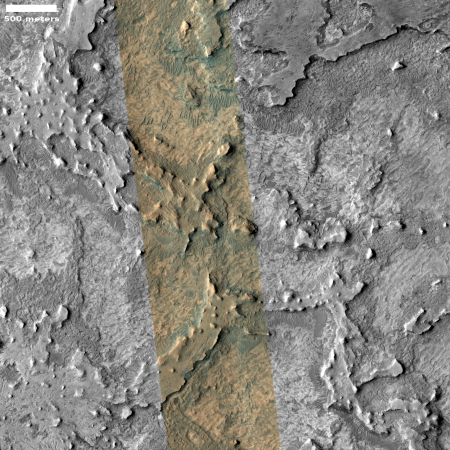
Cool image time! The picture to the right, cropped, reduced, and enhanced to post here, was taken on October 28, 2025 by the high resolution camera on Mars Reconnaissance Orbiter (MRO). Labeled by the science team as “mottled ridged terrain,” it shows a relatively flat area of scattered broken-up flat-topped ridges and knobs, following no clear pattern of formation.
In trying to research this, I could only find one paper [pdf] discussing this kind of mottled ridges that did a survey of similar features across a large region to the northwest. That paper could not determine what caused such features, but came up with hypothesis. From the abstract:
While it is not possible to determine the precise formation mechanism of these polygonal ridge networks from our new data, their formation can be assessed in terms of three possibly separate processes: (1) polygonal fracture formation, (2) fracture filling and (3) exhumation. We find that polygonal
fracture formation by impact cratering and/or desiccation of sedimentary host deposits is consistent with our results and previous spectral studies. Once the polygonal fractures have formed, fracture filling by clastic dikes and/or mineral precipitation from aqueous circulation is most consistent with our results. Exhumation, probably by aeolian processes that eroded much of these ancient Noachian terrains where the ridges are present caused the filled fractures to lie in relief as ridges today.
To put this in plain terms, the initial polygon-patterned cracks were formed by either an impact or the drying out of the surface (similar to the cracks seen on dried mud here on Earth). Both could have contributed. Then material welled up from below, either lava or mud, that hardened to fill the cracks. Later erosion by wind stripped away the surface, leaving behind these broken ridges.
As always, the location adds some very interesting context.
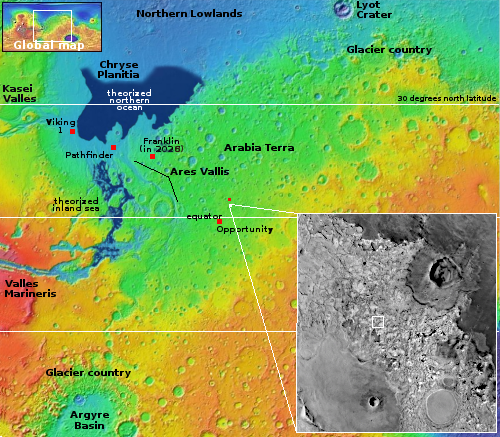
The white dot on the overview map to the right marks the location, about 300 miles northeast from the region where the rover Opportunity roamed. This is also the same region I highlighted two weeks ago in two different cool images, “Cracks on Mars” and “What might be the weirdest crater on Mars”, the location of both indicated by the red dot about 65 miles to the north.
It is clear this is a region with a lot of very weird geology. I for example chose today’s picture before I knew it was in this same area. Clearly the features here are worth looking at.
In the inset the rectangle marks the area covered by the picture above. This mottled ridge terrain however extends far beyond, and is indicated in the inset by the lighter material that covers the inset’s central regions. Overall its appears to cover a region about 75 to 150 miles across.
Note the two larger craters to the northeast and southeast. The northern crater appears to be an impact that cut into this ridged terrain, producing a splash apron as it did so. The southern “crater” however appears to not be an impact but a raised caldera that at one point filled with lava and then hardened, producing that flat smooth circle.
All guesses on my part. This region is strange, however, considering how I keep finding strange things there to post.

On Christmas Eve 1968 three Americans became the first humans to visit another world. What they did to celebrate was unexpected and profound, and will be remembered throughout all human history. Genesis: the Story of Apollo 8, Robert Zimmerman's classic history of humanity's first journey to another world, tells that story, and it is now available as both an ebook and an audiobook, both with a foreword by Valerie Anders and a new introduction by Robert Zimmerman.
The print edition can be purchased at Amazon or from any other book seller. If you want an autographed copy the price is $60 for the hardback and $45 for the paperback, plus $8 shipping for each. Go here for purchasing details. The ebook is available everywhere for $5.99 (before discount) at amazon, or direct from my ebook publisher, ebookit. If you buy it from ebookit you don't support the big tech companies and the author gets a bigger cut much sooner.
The audiobook is also available at all these vendors, and is also free with a 30-day trial membership to Audible.
"Not simply about one mission, [Genesis] is also the history of America's quest for the moon... Zimmerman has done a masterful job of tying disparate events together into a solid account of one of America's greatest human triumphs."--San Antonio Express-News
Click for full image.
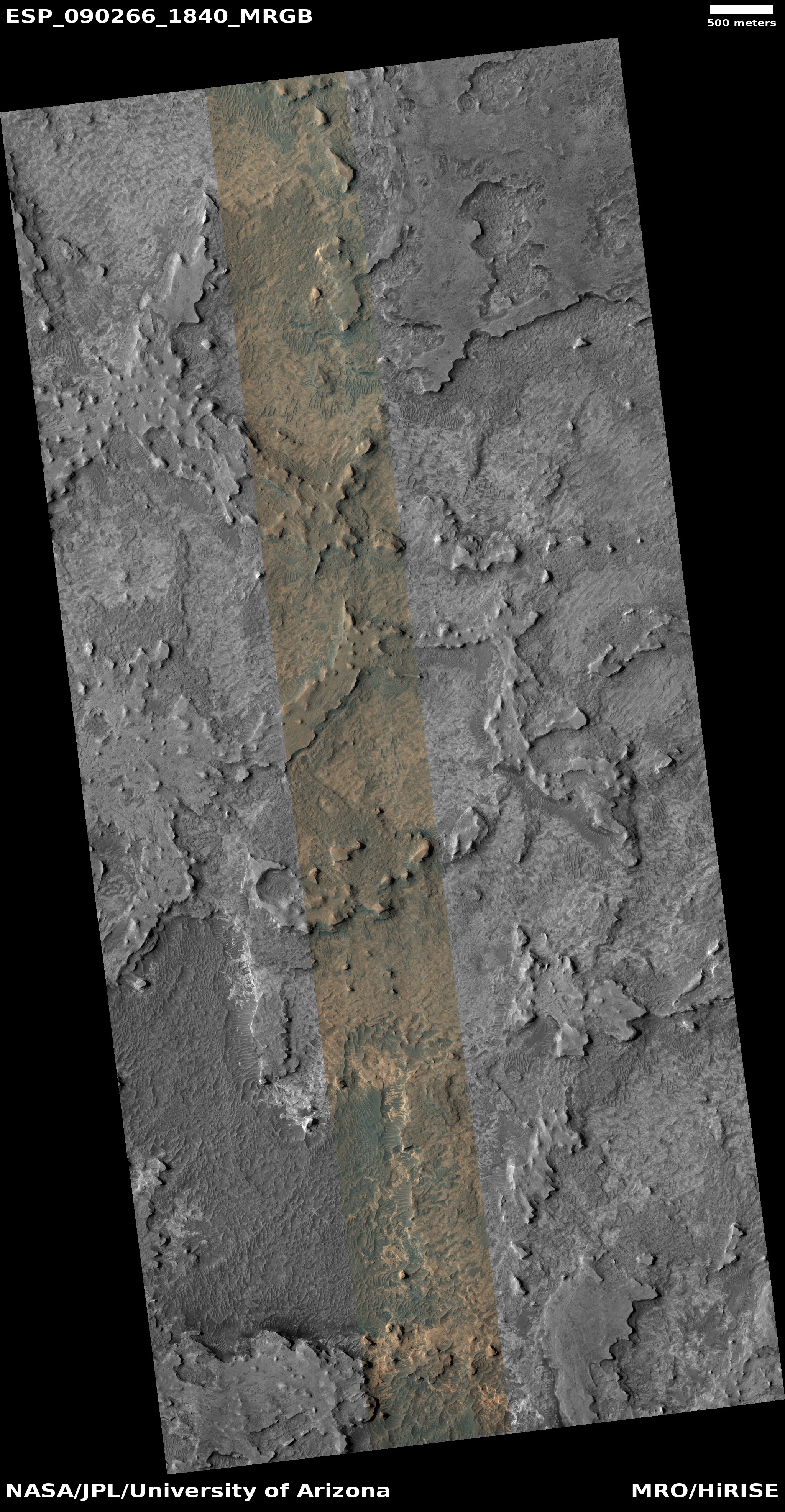
Cool image time! The picture to the right, cropped, reduced, and enhanced to post here, was taken on October 28, 2025 by the high resolution camera on Mars Reconnaissance Orbiter (MRO). Labeled by the science team as “mottled ridged terrain,” it shows a relatively flat area of scattered broken-up flat-topped ridges and knobs, following no clear pattern of formation.
In trying to research this, I could only find one paper [pdf] discussing this kind of mottled ridges that did a survey of similar features across a large region to the northwest. That paper could not determine what caused such features, but came up with hypothesis. From the abstract:
While it is not possible to determine the precise formation mechanism of these polygonal ridge networks from our new data, their formation can be assessed in terms of three possibly separate processes: (1) polygonal fracture formation, (2) fracture filling and (3) exhumation. We find that polygonal
fracture formation by impact cratering and/or desiccation of sedimentary host deposits is consistent with our results and previous spectral studies. Once the polygonal fractures have formed, fracture filling by clastic dikes and/or mineral precipitation from aqueous circulation is most consistent with our results. Exhumation, probably by aeolian processes that eroded much of these ancient Noachian terrains where the ridges are present caused the filled fractures to lie in relief as ridges today.
To put this in plain terms, the initial polygon-patterned cracks were formed by either an impact or the drying out of the surface (similar to the cracks seen on dried mud here on Earth). Both could have contributed. Then material welled up from below, either lava or mud, that hardened to fill the cracks. Later erosion by wind stripped away the surface, leaving behind these broken ridges.
As always, the location adds some very interesting context.
The white dot on the overview map to the right marks the location, about 300 miles northeast from the region where the rover Opportunity roamed. This is also the same region I highlighted two weeks ago in two different cool images, “Cracks on Mars” and “What might be the weirdest crater on Mars”, the location of both indicated by the red dot about 65 miles to the north.
It is clear this is a region with a lot of very weird geology. I for example chose today’s picture before I knew it was in this same area. Clearly the features here are worth looking at.
In the inset the rectangle marks the area covered by the picture above. This mottled ridge terrain however extends far beyond, and is indicated in the inset by the lighter material that covers the inset’s central regions. Overall its appears to cover a region about 75 to 150 miles across.
Note the two larger craters to the northeast and southeast. The northern crater appears to be an impact that cut into this ridged terrain, producing a splash apron as it did so. The southern “crater” however appears to not be an impact but a raised caldera that at one point filled with lava and then hardened, producing that flat smooth circle.
All guesses on my part. This region is strange, however, considering how I keep finding strange things there to post.
On Christmas Eve 1968 three Americans became the first humans to visit another world. What they did to celebrate was unexpected and profound, and will be remembered throughout all human history. Genesis: the Story of Apollo 8, Robert Zimmerman's classic history of humanity's first journey to another world, tells that story, and it is now available as both an ebook and an audiobook, both with a foreword by Valerie Anders and a new introduction by Robert Zimmerman.
The print edition can be purchased at Amazon or from any other book seller. If you want an autographed copy the price is $60 for the hardback and $45 for the paperback, plus $8 shipping for each. Go here for purchasing details. The ebook is available everywhere for $5.99 (before discount) at amazon, or direct from my ebook publisher, ebookit. If you buy it from ebookit you don't support the big tech companies and the author gets a bigger cut much sooner.
The audiobook is also available at all these vendors, and is also free with a 30-day trial membership to Audible.
"Not simply about one mission, [Genesis] is also the history of America's quest for the moon... Zimmerman has done a masterful job of tying disparate events together into a solid account of one of America's greatest human triumphs."--San Antonio Express-News