
Post-Artemis-1 report: heat shield ablated more than expected; power system issued unexpected commands; damage to launchpad

In a March 7, 2023 briefing, NASA officials provided an overall report of what happened during the first SLS launch, noting that there were some minor engineering issues but none that appeared to them significant.

The biggest issue of note was the Orion heat shield.

Howard Hu, Orion program manager at NASA, said that material on the heat shield had ablated differently than what engineers expected from ground tests and computer models. โ€œWe had more liberation of the charred material during reentry than we had expected,โ€ he said. Engineers are just beginning detailed analysis of the heat shield to determine why it behaved differently than expected.

The amount ablated was well within safety margins, but engineers still do not understand why the material behaved differently than expected.

Engineers are also trying to understand why the power system of the Orion service module issued unplanned commands, several times opening what officials called a “latching current limiter.” This action caused no problems to the capsule’s operations, but it is concerning it occurred.

The launch also did more damage to the mobile launcher tower than expected.

According to NASA officials, none of these issues will delay the planned November 2024 launch date for the Artemis-2 mission, the first intended to carry humans.
0 comments

Update on the ten cubesats launched by SLS

Link here.

At this moment six of the ten cubesats either accomplished their mission successfully or are still operating, while four cubesats failed entirely.

Of those still working, two will go into lunar orbit and try to find evidence of both hydrogen and ice on the Moon. A third is testing “solid iodine” thrusters, while a fourth will observe how yeast samples react to a long exposure in deep space. A fifth cubesat is a joint NASA-JAXA mission, and is testing how to fly a smallsat in the low gravity of a Lagrangian point.

Finally, an Italian cubesat was used to successfully take images of the Moon and Orion, and has completed its mission.

1 comment

Orion successfully splashes down in the Pacific

NASA’s Orion capsule today successfully returned from a three week trip around the Moon, splashing down in the Pacific where it was successfully recovered.

The next Artemis flight will be a manned one, using SLS and Orion to fly around the Moon. It will also be the first time Orion will use its full environmental system, with humans on board. Though presently scheduled for May 2024, it is almost certainly not going to fly before 2025.

The actual Artemis manned lunar landing will follow, no sooner than two years after that. As presently designed, that mission requires the establishment of the Lunar Gateway station — astronauts can be transferred from Orion to Starship and back again, and that station is likely not going to be ready in this time frame.

As I said yesterday, I predict the two already purchased private Starship missions around the Moon, paid for by Yusaku Maezawa and Jared Isaacman, will happen first. Both will certainly beat NASA’s planned landing on the Moon. I also expect both to beat that Orion manned fly-around in ’24-’25. And each will cost pennies compared to the entire SLS/Orion program, while actually making a profit that will be used to further development and more manned private flights.

2 comments

Orion completes burn to send spacecraft back to Earth

NASA’s Orion capsule yesterday successfully fired its engines as it zipped past the Moon to send it on a trajectory back to Earth, with splashdown in the Pacific off the coast of California scheduled for December 11, 2022.

Not all was hunky-dory, however. Prior to the burn a power unit shut down unexpectedly.

A power unit on board the Orion spacecraft turned off four devices “responsible for downstream power” that connect to the Artemis 1 vehicle’s propulsion and heating subsystems, NASA officials wrote in a statement. But mission personnel swiftly put a fix in place and the mission is carrying on, the statement emphasized. “Teams confirmed the system was healthy and successfully repowered the downstream components,” agency officials wrote in the statement, released late on Sunday. “There was no interruption of power to any critical systems, and there were no adverse effects to Orion’s navigation or communication.”

Engineers think the shut down was related to a test performed in connection with an earlier incident.

Regardless, all now appears well for that December 11nd splashdown.

2 comments

Orion fires engine, leaves lunar orbit

After firing its engines yesterday, NASA’s Orion spacecraft has left lunar orbit and begun a long looping route that will zip past the Moon and then head back to Earth.

The burn changed Orionโ€™s velocity by about 454 feet per second and was performed using the Orion main engine on the European Service Module. The engine is an orbital maneuvering system engine modified for use on Orion and built by Aerojet Rocketdyne. The engine has the ability to provide 6,000 pounds of thrust. The proven engine flying on Artemis I flew on 19 space shuttle flights, beginning with STS-41G in October 1984 and ending with STS-112 in October 2002.

The burn is one of two maneuvers required ahead of Orionโ€™s splashdown in the Pacific Ocean on Dec. 11. The second will occur on Monday, Dec. 5, when the spacecraft will fly 79.2 miles above the lunar surface and perform the return powered flyby burn, which will commit Orion on its course toward Earth.

The spacecraft will splashdown on December 11, 2022, if all goes right.

3 comments

Orion enters retrograde lunar orbit

Engineers today successfully completed an engine burn that put Orion into the retrograde lunar orbit in which it will remain for the next week.

Due to the distance of the orbit, it will take Orion nearly a week to complete half an orbit around the Moon, where it will exit the orbit for the return journey home. About four days later, the spacecraft will harness the Moonโ€™s gravitational force once again, combined with a precisely timed lunar flyby burn to slingshot Orion onto its return course to Earth ahead of splashdown in the Pacific Ocean on Sunday, Dec. 11.

As of now all systems seem to be working as intended.

15 comments

Controllers lose contact with Orion for almost an hour

NASA engineers unexpectedly lost all contact with Orion for 47 minutes just after midnight last night.

NASAโ€™s Mission Control Center at the agencyโ€™s Johnson Space Center in Houston unexpectedly lost data to and from the spacecraft at 12:09 a.m. CST for 47 minutes while reconfiguring the communication link between Orion and Deep Space Network overnight. The reconfiguration has been conducted successfully several times in the last few days, and the team is investigating the cause of the loss of signal. The team resolved the issue with a reconfiguration on the ground side.

At present the loss of signal caused no issues with the spacecraft. However, its cause has not yet been pinpointed.

2 comments

Six of the ten cubesats launched toward the Moon by SLS still working

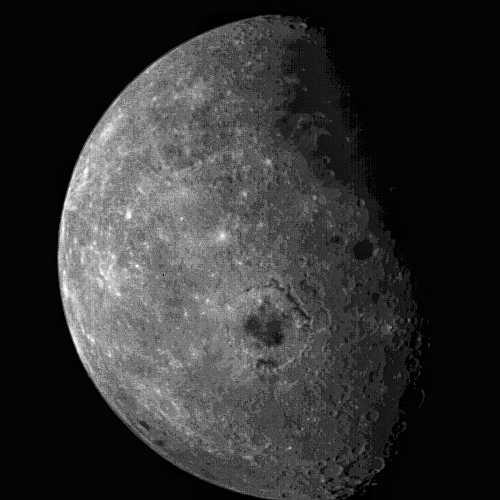
The Moon as seen by ArgoMoon
Click for full image.

Of the ten cubesats launched toward the Moon by SLS last week, six are still working while four have problems that are likely killing their missions.

The photo to the right, cropped, reduced, and sharpened to post here, was taken by ArgoMoon, an Italian cubesat that is working perfectly. The large impact basin visible is Orientale Basin, located just on the edge of the visible face of the Moon but partly hidden on the far side.

A summary of the status of all ten can be found here. Of the other five still functioning properly, all have been able to maintain proper communications.

Possibly the biggest disappointment however is the failure of Japan’s Omotenashi lander, which was going to attempt a lunar soft landing. Shortly after launch it began tumbling, and engineers were never able to regain full control or communications. The landing attempt has now been abandoned.

Side note: Orion itself also captured some images as it zipped past the Moon yesterday, but they do not appear as high quality as ArgoMoon’s pictures.

0 comments

Ten cubesats released by SLS on way to Moon; one has problems

Shortly after SLS’s upper stage completed its engine burn to send Orion to the Moon, it separated and then successfully released ten cubesats on their own deep space missions.

These CubeSats will fly to various destinations including the Moon, asteroids, and interplanetary space. They will study various facets of the Moon and interplanetary travel, ranging from navigation techniques to radiation and biology. One of them is even planned to conduct a soft landing on the lunar surface.

Because of SLS’s numerous delays, there was a chance that many of these cubesats would lose the charges on their batteries and not function after launch. According to the article at the link, communications with six of these cubesats has been established.

The last cubesat above, from Japan and dubbed Omotenashi, was designed as a demonstration test. According to Japan’s space agency, JAXA, however, communications with the spacecraft are “unstable.”

Japan’s space agency said Thursday it has been unable to establish stable communication with the country’s mini moon lander launched on a U.S. rocket the previous day along with a mini satellite. The Japan Aerospace Exploration Agency said it is now trying to control the position of the Omotenashi lander, adding its system of automatically turning to the Sun to gain solar power appears to be not functioning.

Before launch JAXA had rated the mission’s chances of success at 60%, but that mostly referred to the lunar landing. Though intended as a demo mission, it will be unfortunate if it fails for these reasons this early in the mission.

0 comments

NASA’s SLS rocket successfully launches Orion toward the Moon

After almost eighteen years of development and almost sixty billion dollars, NASA tonight finally completed the first unmanned test launch of its Space Launch System (SLS) rocket, lifting off at 1:41 am (Eastern).

The two solid rocket boosters functioned as planned, separating from the core stage with no problem. Then core stage and its four former shuttle engines completed its burn, putting the capsule and its upper stage into Earth orbit, and then separated cleanly. At about 30 minutes after launch the service module’s solar arrays completed their deployment. At 53 minutes after launch a 30 second burn circularized the orbit in preparation for the trans-lunar-injection (TLI) burn that will send Orion to the Moon. TLI occurred about 90 minutes after launch, after a period of check-out in orbit.

Orion will spend 26 days in space, about a week of which will be in a wide lunar orbit, testing its systems. If all goes right it will splashdown on around December 11th.

As this was the first U.S. government launch in more than a decade, since 2011 when the space shuttle was retired, the leader board for the 2022 launch race remains unchanged:

The leaders in the 2022 launch race:

52 SpaceX
51 China
19 Russia
9 Rocket Lab
8 ULA

The U.S. now leads China 76 to 51 in the national rankings, and trails the rest of the world combined 79 to 76.

20 comments

Watching the first SLS launch tonight

At this moment, with weather 90% favorable and the countdown underway, the first launch of NASA’s SLS rocket appears go for a 1:04 AM (Eastern) launch tonight.

You can watch the live stream on NASA TV here, which will begin at 3:30 pm today and mostly be NASA propaganda intermixed with descriptions of the rocket, its payloads, its full mission, and updates on the launch countdown.

NASA’s live stream is now embedded below, beginning at 10:30 PM (Eastern) when actual coverage of the final countdown begins. I would still suggest that you wait until at least 12:30 AM (Eastern) before watching, as those first two hours will still be filled with a lot of NASA propaganda blather.
» Read more

13 comments

NASA managers okay SLS launch attempt November 16th

NASA managers have given the go-ahead to the scheduled launch of the agency’s SLS rocket for 1:04 am (Eastern) on November 16, 2022, despite the existence of some detached caulking that Hurricane Nicole had pulled free.

Engineers examined detailed analysis of caulk on a seam between an ogive on Orionโ€™s launch abort system and the crew module adapter and potential risks if it were to detach during launch. The mission management team determined there is a low likelihood that if additional material tears off it would pose a critical risk to the flight.

Technicians also completed replacing a component of an electrical connector on the hydrogen tail service mast umbilical. While swapping the component did not fully fix the issue, engineers have redundant sources of information supplied through the connector.

The launch window is two hours long. As this is a night launch, it will be quite spectacular, no matter what happens. I will embed the live stream tomorrow in the early evening, for those who wish to watch NASA’s multi-hour propaganda stream. My suggestion would be to find a better use of your time until around 12:50 am (Eastern). Then would be a good time to tune in.

3 comments

SLS launch early on November 16th remains uncertain

Despite repeated assurances that the November 16, 2022 1:04 am (Eastern) launch of NASA’s SLS rocket remains on target, managers have also noted that damage to a small piece of caulking at the base of the shroud protecting the Orion capsule remains an issue that could cause a scrub.

But high winds from Nicole caused a thin strip of caulk-like material known as RTV to delaminate and pull away from the base of the Orion crew capsule’s protective nose cone at the top of the rocket. The material is used to fill in a slight indentation where the fairing attaches to the capsule, minimizing aerodynamic heating during ascent. The fairing fits over the Orion capsule and is jettisoned once the rocket is out of the dense lower atmosphere. “It was an area that was about 10 feet in length (on the) windward side where the storm blew through,” said mission manager Mike Sarafin. “It is a very, very thin layer of RTV, it’s about .2 inches or less … in thickness.”

Engineers do not have access for repairs at the pad and must develop “flight rationale,” that is, a justification for flying despite the delaminated RTV, in order to proceed with the launch. Managers want to make sure any additional material that pulls away in flight will not impact and damage downstream components.

In plain language, NASA managers would either have to issue a waiver that says this small piece of caulking poses no risk, or scrub and roll the rocket back to the assembly building to fix it. The second option would delay the launch another month, at a minimum.

A waiver however would continue NASA’s pattern with the shuttle (and continuing with SLS) to dismiss potential engineering problems simply to avoid schedule delays. With the shuttle, this pattern twice caused the loss of a shuttle and crew. With SLS, NASA has already waived by more than a year its rules concerning the stacked life of the rocket’s solid-fueled boosters. Agency managers have also waived the full test requirements from the dress rehearsal countdown, so that this test did not test everything it should.

It is expected that NASA managers will announce the waiver today on this problem. Whether it matters when the rocket goes through maximum dynamic pressure shortly after lift-off will likely determine the future of SLS.

6 comments

SLS rides out hurricane; engineers now assessing damage

NASA’s SLS rocket has apparently successfully survived on the launchpad the hurricane-force winds from Nicole, though engineers will need to inspect the rocket to see if there is any less obvious damage that might delay the now scheduled November 16th launch.

With blastoff on a long-delayed maiden flight on tap next week, sensors at pad 39B recorded gusts as high as 100 mph atop a 467-foot-tall lightning tower near the rocket. But winds at the 60-foot-level, which are part of the booster’s structural certification, peaked at 82 mph, just below the 85 mph limit.

The observed winds were “within the rocket’s capability,” said Jim Free, manager of exploration systems at NASA headquarters. “We anticipate clearing the vehicle for those conditions shortly.”

“Our team is conducting initial visual check outs of the rocket, spacecraft and ground system equipment with the cameras at the launch pad,” he tweeted. “Camera inspections show very minor damage such as loose caulk and tears in weather coverings. The team will conduct additional on-site walk down inspections of the vehicle soon.”

If no issues are found, the countdown will begin on November 14th.

8 comments

SLS launch delayed until November 16

In order to give them time to make sure all is right after the coming tropical storm, NASA managers have decided to delay the first test flight of SLS two days until November 16.

A launch during a two-hour window that opens at 1:04 a.m. EST on Nov. 16 would result in a splashdown on Friday, Dec. 11. If needed, NASA has a back-up launch opportunity on Saturday, Nov. 19, and will coordinate with the U.S. Space Force for additional launch opportunities.

At the moment they have decided to keep the rocket on the launchpad, as they expect it will be able to withstand the predicted storm. If the predictions change however they still have the option to roll it back into the assembly building.

0 comments

Hurricane threatens SLS on launchpad

A storm, now rated subtropical, that is expected to cross the east coast of Florida on November 10th with the possibility that it could strengthen into a hurricane now threatens NASA’s SLS rocket that is on its Florida launchpad preparing for its first test flight on November 14, 2022.

A map of the storm’s presently predicted track can be seen here.

NASAโ€™s Kennedy Space Center in Florida is currently in a HURCON (Hurricane Condition) IV status, which includes implementing checklists and preparations for the storm as the agency continues to prioritize its employees in the Kennedy area. Based on current forecast data, managers have determined the Space Launch System rocket and Orion will remain at Launch Pad 39B. Teams at Kennedy will continue to monitor the weather, make sure all personnel are safe, and will evaluate the status of the Monday, Nov. 14, launch attempt for the Artemis I mission as we proceed and receive updated predictions about the weather.

Depending on the storm’s track in the next 24 hours, as well as its strength, NASA managers have the option of returning the rocket to the assembly building to protect it. If they do so, however, it is certain the November 14th launch date will be scrubbed. As they have a window of a number of additional dates [pdf] through November 27th, I suspect they will then aim for one of those dates.

2 comments

NASA sets November 14th as next SLS launch date

NASA today announced that it will make its next attempt to launch its SLS rocket just past midnight on November 14, 2022.

NASA is targeting the next launch attempt of the Artemis I mission for Monday, Nov. 14 with liftoff of the Space Launch System (SLS) rocket carrying the Orion spacecraft planned during a 69-minute launch window that opens at 12:07 a.m. EST. Artemis I is an uncrewed flight test to launch SLS and send Orion around the Moon and back to Earth to thoroughly test its system before flights with astronauts.

This is the second launch opportunity in the November launch window, as shown in this graph [pdf]. It will result in a 26-day mission for the Orion capsule to and from lunar orbit, returning on December 9th.

2 comments

NASA now aiming for SLS launch in November

In finding that Hurricane Ian caused little damage at its vehicle assembly building at Kennedy, NASA managers have decided to target the the November 12 to 27 launch window for the first launch of its SLS rocket.

According to this graph [pdf], November 27th is the only date that will provide NASA with the longest mission for Orion (38 to 42 days). Furthermore, the mission precludes launches on November 13, 20-21, and 26.

Expect them to aim for November 12th, even though that will result in an Orion mission only 26 to 28 days long.

10 comments

NASA managers decide finally to roll SLS back to assembly building

NASA managers this morning finally gave up on launching their SLS rocket in an early October launch window and scheduled rolling back the rocket to the assembly building tonight.

NASA will roll the Artemis I Space Launch System rocket and Orion spacecraft back to the Vehicle Assembly Building on Monday, Sept. 26. First motion is targeted for 11 p.m. EDT.

Managers met Monday morning and made the decision based on the latest weather predictions associated with Hurricane Ian, after additional data gathered overnight did not show improving expected conditions for the Kennedy Space Center area. The decision allows time for employees to address the needs of their families and protect the integrated rocket and spacecraft system. The time of first motion also is based on the best predicted conditions for rollback to meet weather criteria for the move.

Based on this graph [pdf] provided by NASA earlier this year, the next launch window is from October 17 to October 31, followed by another from November 12 to November 27. It is unclear whether they can meet that first window, even if all engineers do is check and recharge the flight termination system batteries.

The question of the rocket’s two solid-fueled boosters however looms. Both are now one year past NASA’s use-by date, and it appears somewhat unknown what the risks are using them. Replacing them however will entail a significant delay, from three to six months.

As I said this weekend, NASA managers face no good choice, because of the impractical and inefficient design of this rocket.

4 comments

NASA managers might forego SLS rollback and aim for Oct 2nd launch

Based on the present hurricane track, NASA managers are considering the possibility of leaving SLS on the launchpad so that they can go for a launch on October 2, 2022.

NASA managers will meet this evening to evaluate whether to roll back or remain at the launch pad to preserve an opportunity for a launch attempt on Oct. 2. The exact time of a potential rollback will depend on future weather predictions throughout the day and could occur Monday or very early Tuesday morning.

If they stay on the launchpad, it means the flight termination system is questionable at launch. If the rocket goes out of control during its first test launch — a not-unreasonable possibility for a new rocket — there is a chance the range officer will not be able to destroy it.

If they roll back to the assembly building, it means the rocket’s two solid strap-on boosters will either have to be replaced, delaying the launch months more, or the rocket will launch with two boosters that are questionable.

Every choice they face is a bad one, simply because this rocket is really not well designed for practical use.

8 comments
1 2