The wind speeds on seven exoplanets also suggest presence of magnetic fields

Astronomers using two different ground-based telescopes were able to measure the wind speeds on seven different gas giant exoplanets, and found the speeds also suggested the presence of planetary magnetic fields, the first time such magnetic fields have been deduced on an exoplanet.

In the study, the researchers investigated the wind speeds on seven exoplanets orbiting different stars. These are gas giants similar to Jupiter, which are very close to their star. Elspeth Lee explains: “The rotation of the planets was synchronized with their orbits by the tidal forces of the parent star. Just as we only ever see one side of the moon, these planets always have one side facing the star. Thus, a glowing hot day side and a permanently dark night side have formed on the planets. The extreme temperature differences in turn lead to the generation of extremely strong winds.”

…The research team was able to show that wind speeds of around 7,200 km/h to over 25,000 km/h prevail on the exoplanets. For comparison: the fastest winds measured on Jupiter reach speeds of around 1,500 km/h.

The data showed that the hotter the planet, the slower the wind, the opposite of what was expected. The scientists believe that each planet’s magnetic field is acting to brake the winds, with the hotter planets likely having more powerful fields.

1 comment

Webb detects methane being released by interstellar comet 3I/Atlas

Comet 3I/Atlas's methane as seen by Webb
Comet 3I/Atlas’s methane as seen by Webb.
Click for full image.

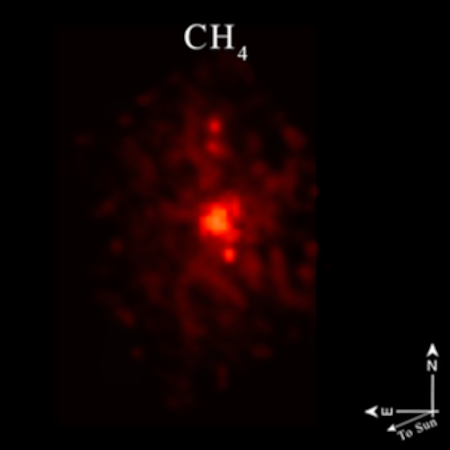
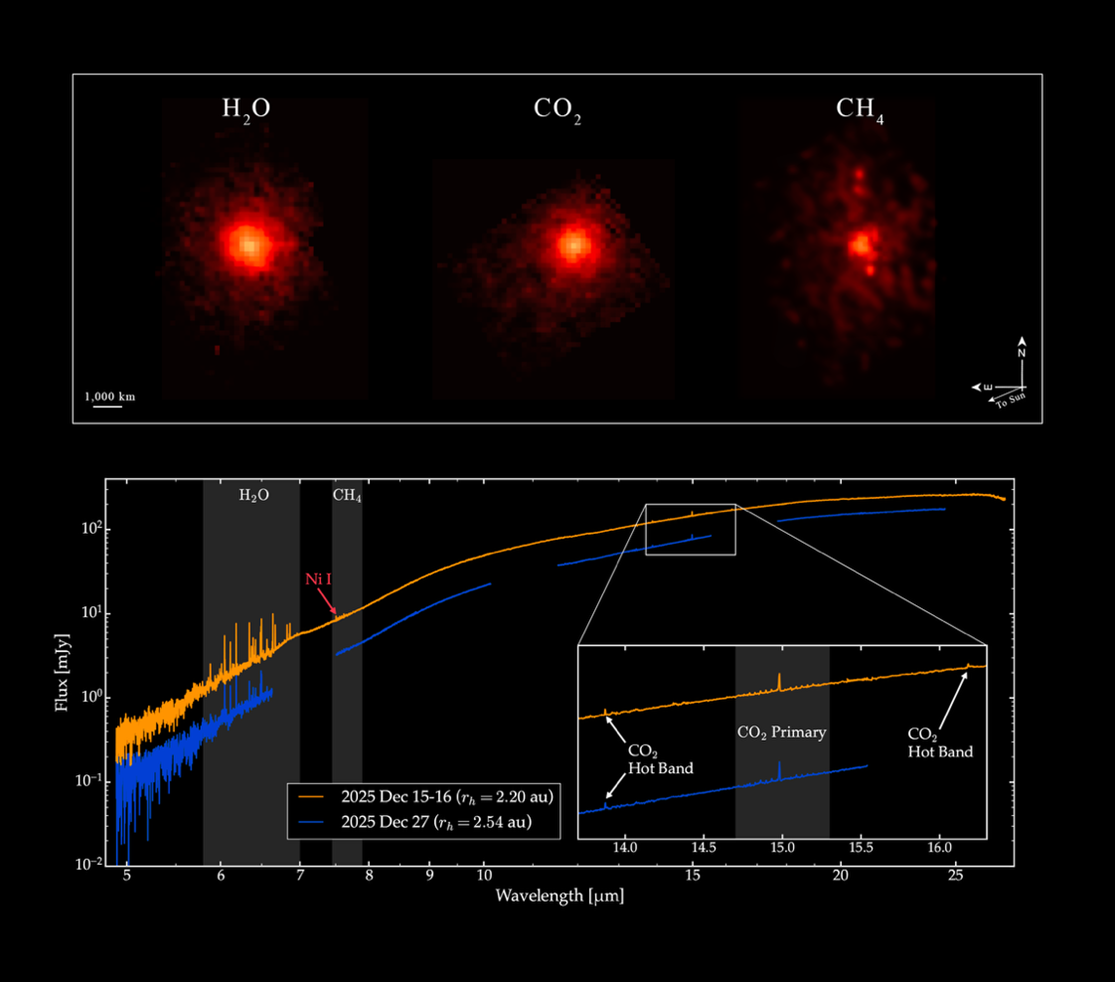
Using the Webb Space Telescope, astronomers have now detected methane in the cloud of material released by the interstellar comet 3I/Atlas as it zipped past the Sun last fall.

The observations were taken using Webb’s MIRI (Mid-Infrared Instrument) on two separate dates as the comet traveled back out of our solar system after whipping around the Sun (post-perihelion). The first observation occurred Dec. 15 to 16, when the comet was about 205 million miles from the Sun. This was followed by a second observation Dec. 27, when the comet was about 236 million miles from the Sun.

For the first time on an interstellar visitor, Webb directly detected methane gas. Methane is highly volatile, meaning it sublimates from solid ice into a gas very easily. Its delayed appearance in comet 3I/ATLAS suggests it was buried below the comet’s top surface layer and protected from sublimation until heat from the comet’s close pass to the Sun reached deeper parts of the icy subsurface. The amount of methane relative to water found is surprisingly high, with few similar analogs in our own solar system.

Webb’s observations also confirmed that comet 3I/ATLAS remains unusually rich in carbon dioxide, releasing far more carbon dioxide relative to water when compared to typical solar system comets.

You can read their peer-reviewed paper here [pdf]. This new data confirms that Comet 3I/Atlas is not from our solar system, as its make-up is sufficiently different from solar system comets to show this. It also gives us a hint as to the solar system it came from. At the same time, the comet’s behavior is remarkably similar to solar system comets, suggesting our solar system evolved much like others.

0 comments

An active galaxy peered at by Webb in the infrared

M77 as seen by Webb
Click for original image.

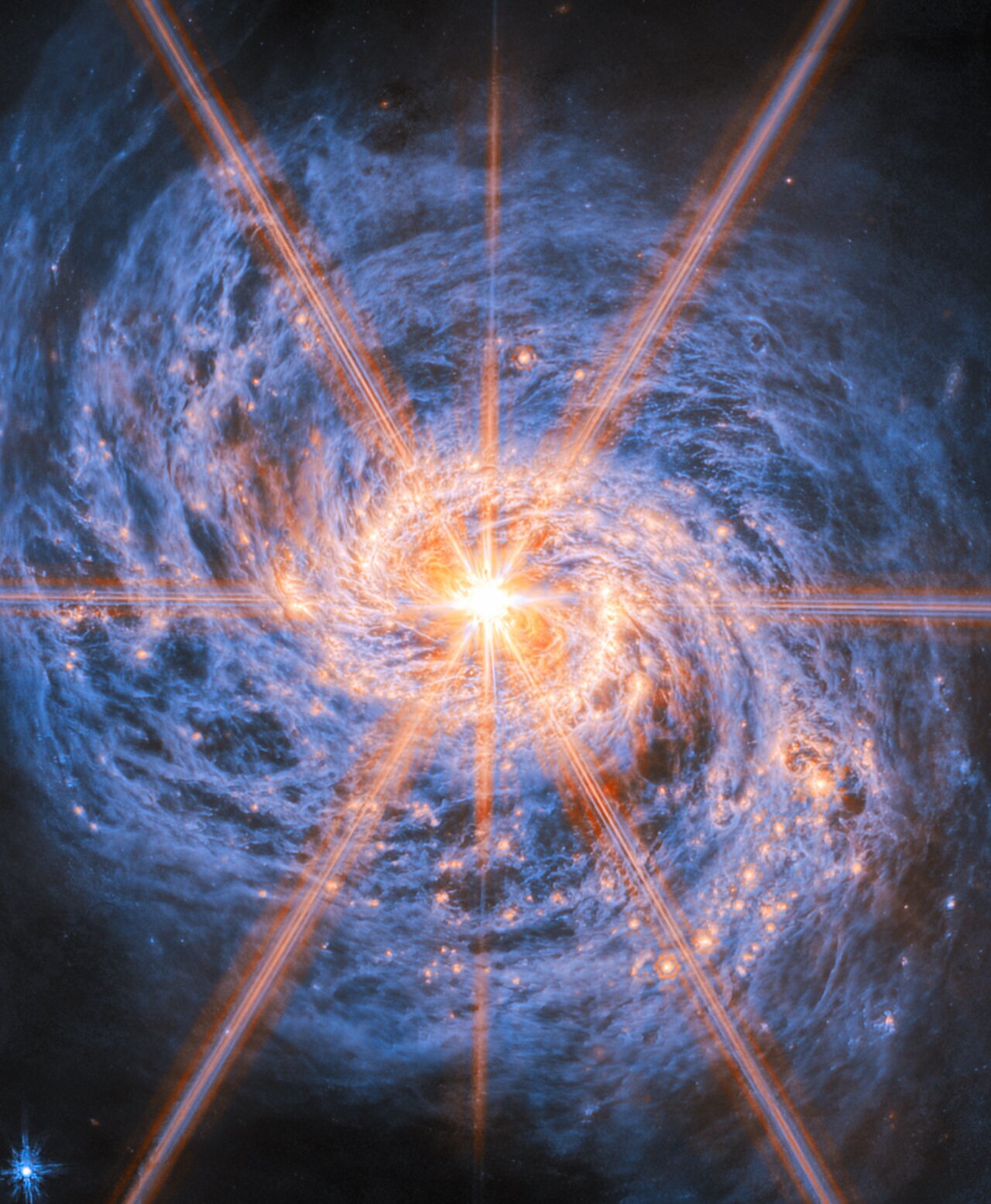
Cool image time! The false-color infrared image to the right, cropped and reduced to post here, was taken by the Webb Space Telescope as part of a research of “massive, nearby, star-forming galaxies.” It shows Messier 77 (M77), a barred spiral galaxy located 45 million light-years away.

What makes the image cool are the eight diffraction spikes, which are an artifact of Webb and its camera.

Called diffraction spikes, they are created because the intense light from the unresolved AGN is bent (“diffracted”) very slightly at the edges of Webb’s hexagonal mirror panels and around one of the struts that hold up its secondary mirror. This distinctive six-plus-two-pointed pattern is the same for any image taken by Webb. For diffraction spikes to appear, the light source has to be very bright and very concentrated, so they’re most often seen on stars. But in some galaxies, as here, the nucleus is bright and compact enough to make diffraction spikes appear as well.

In the case of M77, the nucleus is especially bright.

At the heart of M77 is a compact region filled with hot gas that handily outshines the rest of the galaxy put together, even overcoming the light-gathering capacity of Webb’s cameras. This is an active galactic nucleus (AGN), and it’s powered by M77’s central supermassive black hole, which is eight million times as massive as our Sun. Gas in the galaxy’s central regions is pulled by the strong gravity into a tight and rapid orbit around the black hole, where it crashes together and heats up, releasing tremendous amounts of radiation.

The result is this very cool image that also highlights a great deal about galaxies and their evolution.

3 comments

Using Webb astronomers think they have detected daily weather changes on exoplanet

The data confirming explanet's existence from 2014 paper
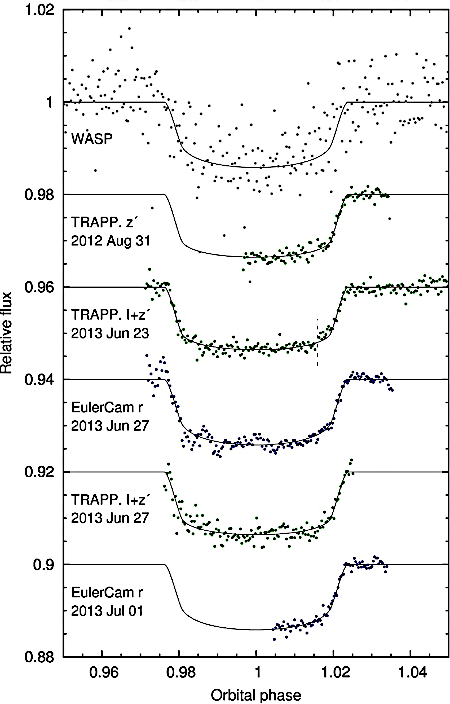
Figure 1 from the 2014 paper confirming exoplanet’s existence.

Using the Webb Space Telescope’s infrared spectroscopic data astronomers believe they have detected the daily weather changes on exoplanet WASP-94A b, a hot gas giant about half the mass of Jupiter that orbits its star every four days.

Observations revealed that mornings and evenings on WASP-94A b have extremely different weather patterns: Mornings are riddled with clouds made of magnesium silicate, a common mineral found in rocks, while the evening has clear skies.

The star itself is about 700 light years away, and is known to have two exoplanets circling it.

The scientists proposed two explanations for their data. Either strong winds are clearing the air in the evening, or the clouds are the equivalent of morning fog on Earth that naturally dissipates as the day brightens.

Note that there is great uncertainty with these results, as we are only getting a very limited view from 700 light years away. In a sense, our knowledge of these exoplanets is comparable to what we knew of our own solar system’s planets prior to the space age. Once we got our first close looks at the planets almost everything we thought we knew beforehand turned out to be either wrong or misguided, due to the limited nature of the data.

1 comment

An amoeba in space more than a light year in size

An amoeba in space more than a light year in size
Click for original image.

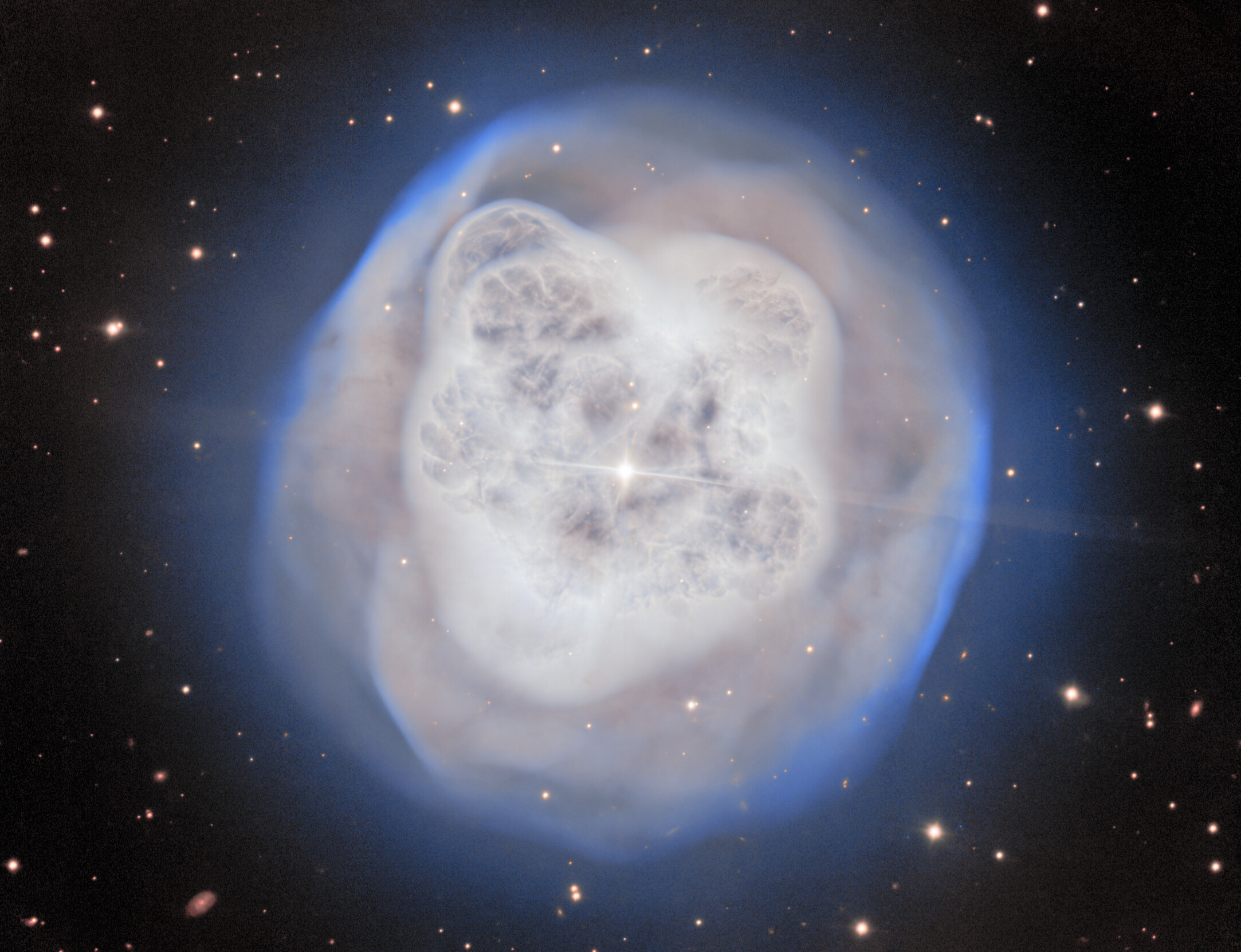
Time for another cool image. The picture to the right, cropped and reduced to post here, was released today by the science team of the 8.1 meter Gemini North telescope on Mauna Kea in Hawaii. It provides a close-up view of the central blob that forms NGC 1514, a planetary nebula located about 1,500 light years away and nicknamed the Crystal Ball Nebula by Gemini’s PR team.

They might think it resembles a crystal ball, but to my eye this is an amoeba undulating in weightlessness.

Planetary nebulae form when a low- or intermediate-mass star ejects its outer layers near the end of its life, forming a somewhat spherical cloud of gas. They typically have smoother, spherical shapes, making the Crystal Ball Nebula unique for its bumpy shells of gas. As the central star casts away this gas, its inner core is exposed. Radiation from the core energizes the gas, giving it a scorching temperature and chromatic glow. The Crystal Ball Nebula, for example, has an estimated temperature of 15,000 K.

…While it may appear in this image as if there is a single shining light source at the heart of the Crystal Ball Nebula, as Herschel saw, it actually contains two stars. These two stars orbit each other with a period of around nine years — the longest known for any binary pair within a planetary nebula. Scientists believe that one of these stars, which was once several times more massive than our Sun, released its outer layers while in the throes of death. As the progenitor star and its binary companion orbit each other, they mold the expanding shell of gas with their strong, asymmetrical winds, forming the lumpy layers we see today.

The analogy I like to use for this process is that of a blender. The two stars act like the blender’s blades, mixing the outflowing gas from the stars into these spectacular shapes.

The Webb Space Telescope took its own infrared image of this nebula, and showed that its is surrounded by two larger rings of material, also expanding outward.

1 comment

Psyche approaches Mars

Mars as seen by Psyche
Click for original image.

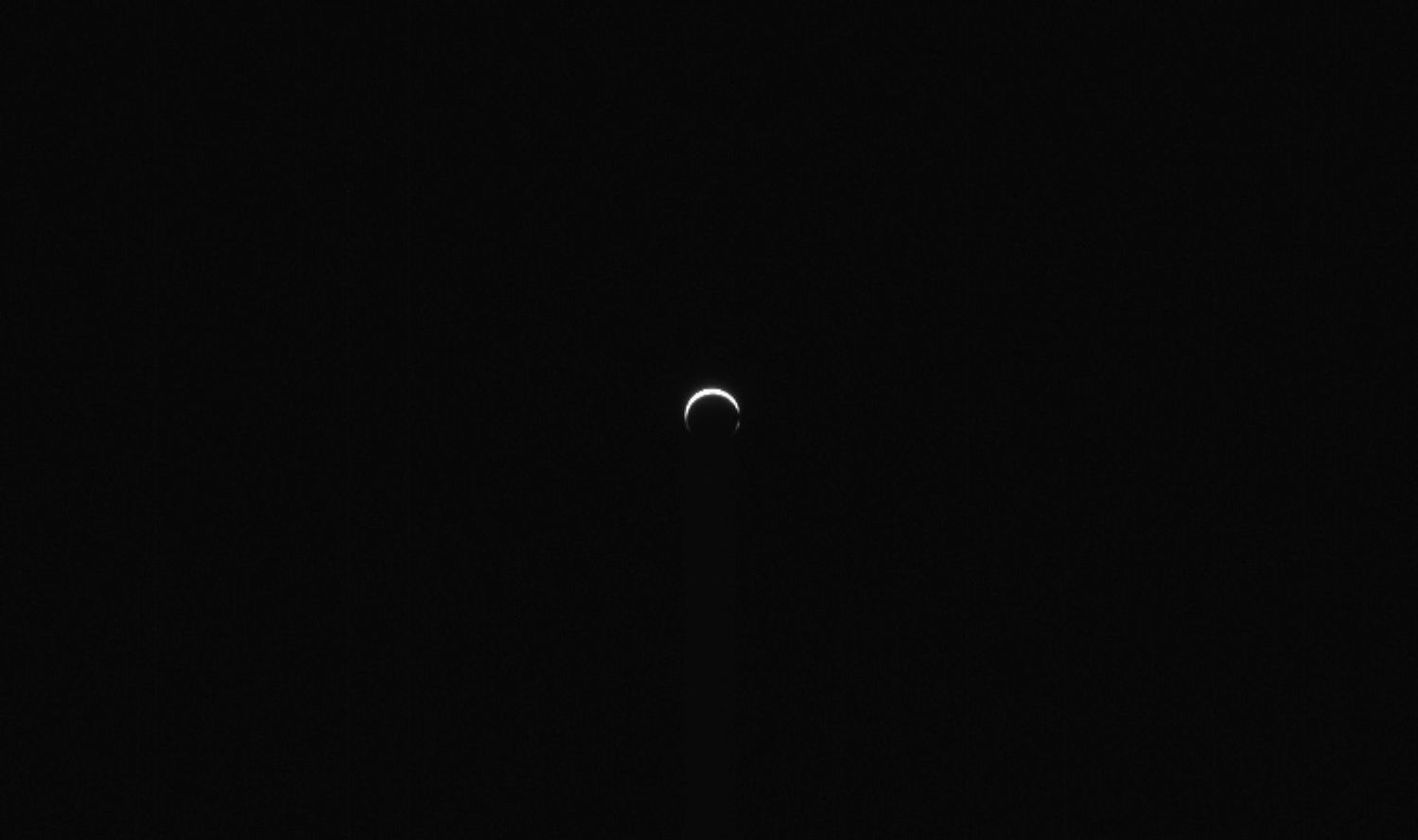
The asteroid probe Psyche is now approaching Mars for a May 15, 2026 fly-by that will slingshot it out to the metal asteroid Psyche in 2029.

The image to the right, cropped and expanded to post here, was taken on May 3, 2026 when the spacecraft was still about three million miles away.

The observation was acquired by the multispectral imager instrument’s panchromatic or broadband filter, with an exposure time of just 2 milliseconds. Even with this very short exposure time, the crescent is extremely bright and parts of the image are oversaturated. The light seen here is sunlight reflected off the surface of Mars and also scattered by dust particles in its atmosphere. Because the quantity of dust in the atmosphere can vary rapidly over time, the anticipated brightness of the crescent was hard to predict before this early image was acquired.

The dustiness of Mars leads to sunlight being scattered by its atmosphere, making the crescent appear to extend farther around the planet than if it had no atmosphere (as with our Moon).Of note, on the right side of the extended crescent, there appears to be a gap, which coincides with the planet’s icy north polar cap. The cap is currently in winter and mission specialists hypothesize that seasonal clouds and hazes may be forming in that region, possibly blocking the atmospheric dust’s ability to scatter sunlight like it does elsewhere around the planet.

Though the spacecraft had had a thruster issue last year, all seems well at this time.

10 comments

Katalyst completes final ground testing of its Swift rescue spacecraft

Katalyst's proposed Swift rescue mission
Katalyst’s proposed Swift rescue mission.
Click for original image.

The orbital servicing startup Katalyst has now successfully completed the final ground testing of its Swift rescue spacecraft, dubbed LINK, that it hopes will be able to catch the Gehrels-Swift Telescope and raise its orbit, thus saving the telescope.

During vibration testing at NASA Goddard, engineers mimicked the shaking the spacecraft will experience during its launch from a Northrop Grumman Pegasus rocket. In the footsteps of Swift itself and NASA’s upcoming Nancy Grace Roman Space Telescope, the Katalyst team also used NASA Goddard’s Space Environment Simulator for thermal vacuum testing.

Once the air was pumped out of this 27-foot-wide chamber, LINK experienced space-like hot and cold temperature extremes. The team also practiced firing the satellite’s three xenon-powered ion thrusters and deployed one of the arms.

After some more testing in Arizona, the spacecraft will be integrated in June onto Northrop Grumman’s Pegasus rocket — the last one in its inventory — and launched later that month.

Katalyst has never done this before. It was preparing LINK as a demo mission when NASA requested bids for saving Swift. It proposed reconfiguring LINK for that purpose, and won the contract in September 2025, only eight months ago.

If this mission succeeds it will be a big feather in Katalyst’s cap.

9 comments

New data says interstellar Comet 3I/Atlas IS different from comets in our solar system

Using spectroscopic data from the ALMA telescope in Chile, astronomers have determined that interstellar comet 3I/Atlas is enriched in deuterium (sometimes called “heavy water”), with quantities as much as 30 times that found in ordinary solar system comets and 40 times that found in Earth’s oceans.

You can read the peer-reviewed paper here. From its abstract:

3I/ATLAS shows a deuterium enrichment exceeding Earth’s ocean value by more than a factor of about 40 and typical Solar System cometary values by more than a factor of about 30. The elevated deuterium enrichment points to water that formed under colder, less irradiated conditions and from less thermally processed material, consistent with an origin in a planetary system that formed under different physical and chemical conditions than our own.

In other words, the conditions in which Comet 3I/Atlas’ solar system formed were very different from those when our own solar system formed.

This conclusion is wonderful, but it raises more questions than it answers. Since we do not know how old the comet is, nor do we really know where it came from, there is little else we can glean from this result, other than it proves the conditions when solar systems form can vary widely.

7 comments

Hubble looks at the Trifid Nebula again

Trifid Nebula as seen by Hubble
Click for original image.

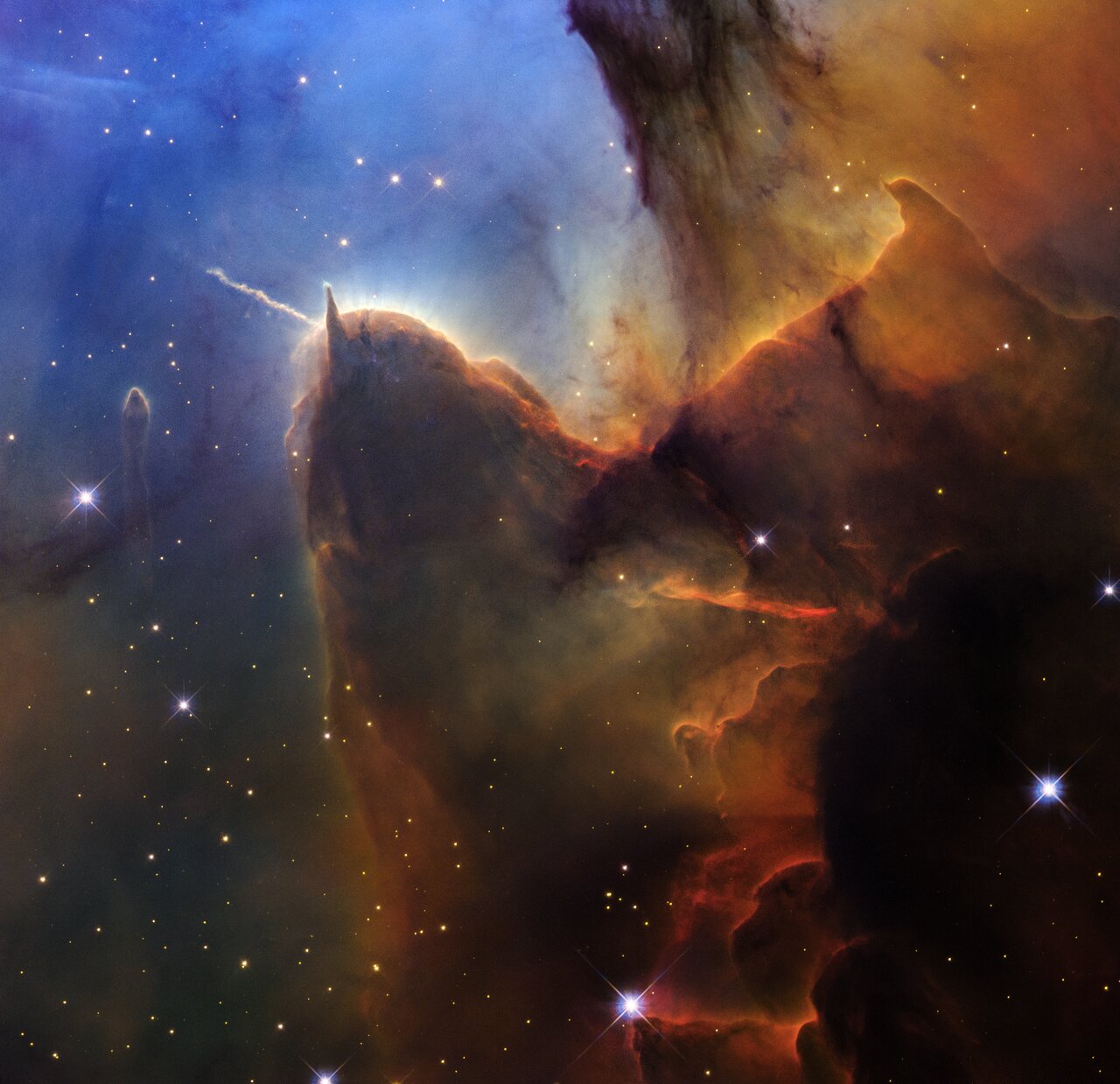
Cool image time! The picture to the right, cropped to post here, was taken by the Hubble Space Telescope and released today. It shows a small section of the Trifid Nebula, located about 5,000 light years away.

This location has been imaged numerous times in the past by Hubble. The area shown illustrates some fundamental aspects of stellar and nebula formation. The dark area in the lower right is a thick dust cloud. Several energetic O and B supermassive stars are out of view at the top. The radiation from these stars (indicated by the blue), is hitting that dust cloud and literally destroying it. It appears that the foreground “horn” exists because a larger object is blocking the radiation, allowing dust to survive in the background.

I have no explanation for the background “horn”.

This new image was taken in parallel with an image of the entire Trifid Nebula, taken by the new Rubin Telescope in Chile. Though Rubin cannot see with the same resolution as Hubble, its image is quite worthwhile viewing.

0 comments

Final ground testing begins of Katalyst’s Swift rescue spacecraft

Katalyst's proposed Swift rescue mission
Katalyst’s proposed Swift rescue mission.
Click for original image.

Only seven months after NASA awarded the satellite repair startup Katalyst the contract to save the Gehrels-Swift space telescope, the company has delivered the completed LINK spacecraft to the Goddard Space Flight Center in Maryland for final ground testing.

Katalyst will move forward with LINK’s vibration and thermal tests using NASA Goddard’s in-house facilities in the coming weeks before installation into Northrop Grumman’s Pegasus rocket at the agency’s Wallops Flight Facility in Virginia.

Gehrels-Swift has been one of NASA’s most productive space telescopes. Unfortunately its orbit is decaying and if nothing is done to raise that orbit it will burn up in the atmosphere in 2029 or so. To extend this timeline engineers have stopped almost all science work in February.

Katalyst hopes to launch LINK as soon as later this year. It was able to get it built so quickly because it was already under construction as the company’s first demo of its repair technology. When NASA put out a bid for boosting Swift, the company shifted gears and reconfigured LINK for this mission.

If successfully, the achievement will be a major coup for this startup.

1 comment

DESI telescope completes its nominal mission, mapping more than 47 million galaxies

DESI map
Click for original image.

The Dark Energy Spectroscopic Instrument (DESI) on the Mayall 4-meter telescope at Kitt Peak in Arizona, in Arizona has now completed its initial five-year nominal mission, mapping more than 47 million galaxies to produce a rough 3D map of the universe.

By comparing how galaxies clustered in the past with their distribution today, researchers can trace dark energy’s influence over 11 billion years of cosmic history. Surprising results using DESI’s first three years of data hinted that dark energy, once thought to be a “cosmological constant,” might be evolving over time. With the full set of five years of data, researchers will have significantly more information to test whether that hint disappears or grows. If confirmed, it would mark a major shift in how we think about our Universe and its potential fate, which hinges on the balance between matter and dark energy.

The image to the right shows the map, with the blank areas to the left and right regions blocked by the Milky Way.

DESI will continue mapping for at least another three years, refining its data. I suspect when scientists begin analyzing this information they will find there are more than one way to interpret it.

1 comment

The new Rubin telescope discovers over 11,000 new asteroids in first observations

Rubin's first asteroid discoveries
Click for full animation.

The new Rubin Observatory, a ground-based telescope in Chile, has discovered over 11,000 new asteroids in its first preliminary observations, with most in the main asteroid belt but a large number in the Kuiper Belt beyond Neptune and 33 previously unknown near-Earth asteroids.

The graphic to the right, annotated by me to post here, shows all of Rubin’s asteroid detections in light blue.

The submission to MPC [Minor Planet Center] comprises approximately one million observations, taken over the span of a month and a half, of over 11,000 new asteroids and more than 80,000 already known asteroids, including some that had previously been observed but were later “lost” because their orbits were too uncertain to predict their future locations. You can interact with all of Rubin’s asteroid discoveries in the Rubin Orbitviewer, which uses real data to provide an intuitive way to explore the structure of our cosmic backyard in three dimensions and in real time. Also, visit the Rubin Asteroid Discoveries Dashboard to learn about the new objects Rubin has uncovered.

…Among the newly identified objects are 33 previously unknown near-Earth objects (NEOs), which are small asteroids and comets whose closest approach to the Sun is less than 1.3 times the distance between Earth and the Sun. None of the newly discovered NEOs pose a threat to Earth, and the largest is about 500 meters wide.

Astronomers predict that Rubin will eventually find 90,000 new near-Earth objects, with some expected to pose a risk of hitting the Earth. It does this by repeatedly surveying the southern sky with its large mirror, then identifying new objects with its sophisticated software.

2 comments
1 2 3 188