The war-mongers are always those in power

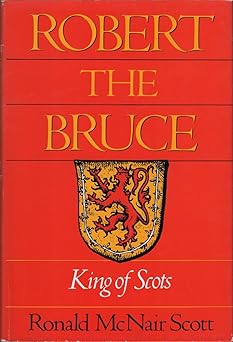
Robert the Bruce: King of Scots

After Diane and I recently watched Mel Gibson’s movie Braveheart I was intrigued to find out the real history behind William Wallace and the war between Scotland and England in the 1200-1300s. Fortunately, I stumbled upon Ronald McNair Scott’s excellent 1982 history, Robert the Bruce, King of Scots.

Not surprisingly, I learned that William Wallace played a relatively minor role in the effort of the Scots to break free from English rule than implied by the movie. The movie was reasonably accurate overall, but the real leader of that long battle was Robert the Bruce, who was descended from previous rulers and fought a long guerilla war against multiple English kings over more than three decades to establish his nation’s independence and his right to rule as king.

That fight began after the death of Scotland’s previous king, Alexander III in 1286. Alexander had for years maintained a peaceful alliance with England, as two separate nations. The problem was that when he died, his heir was still a child. His regents signed a deal with the English king, Edward I, allowing them to rule an independent Scotland as allies with England, but Edward soon realized the power vacuum in Scotland provided him an opportunity. He repudiated the treaty and began a long violent effort to conquer these northern provinces.

The result was thirty years of endless war, ravaging the countryside both in Scotland and northern England. Eventually Robert the Bruce won, getting England to acknowledge the independence of Scotland. Thus Bruce in many ways is seen as Scotland’s own version of George Washington.

What struck me as I read this book however was the plunder and devastation this long war visited upon the ordinary people in both England and Scotland. Edward would invade Scotland, wrecking havoc on local villages and castles. Bruce would respond with repeated raids into northern England, where he would destroy villages and farms, leaving the surviving inhabitants to starve.

And what was the war about?
» Read more

Buffalo Bill: The greatest true boy adventure story that’s never been told

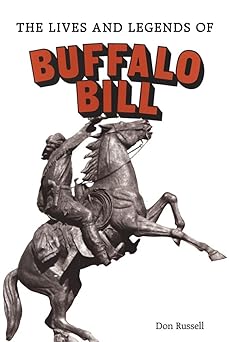
The Lives and Legends of Buffalo Bill

In American popular culture, Buffalo Bill is an icon whose history we all think we know, a western showman who in the latter decades of the 19th century traveled the world with his Wild West show, enchanting heads of states as well as ordinary people with the romantic fantasy of the American west, made up of wagon trains, gunfighters, Indian attacks, and last-minute cavalry rescues.

His name inspired the name of a professional football team. His Wild West show inspired at least one musical and numerous Hollywood movies and television shows.

Yet do we really know who the man was?

I discovered recently that we do not. Our culture knows nothing about the man, whose real name was William Cody. Worse, its cartoon vision of him denigrates his unique American nature. He was not only the greatest scout the U.S. Army ever saw, his knowledge of American Indian made it possible for him to not only help make peace with those Indians who wanted it, it also helped the U.S. put down those Indians willing only to wage terrorist war. And when he shifted into the entertainment world, his show provided employment for both his many cowboy friends as well as for many of those same Indians, both friends and former enemies.

And most astonishing of all, I discovered that Buffalo Bill’s childhood was one of the most amazing boy adventure tales, far more exciting than any kid’s movie made in the last hundred years. That Hollywood has never made a movie of his youth now baffles me. It is the stuff that Hollywood craves, but more significantly, it appears it actually happened!

I discovered these facts in reading Don Russell’s wonderful biography of Bill Cody, The Lives and Legends of Buffalo Bill, published by the University of Oklahoma in 1979. Russell’s focus was to dig into the original source material in order to separate the fact from the fiction, since much of Cody’s life had been exaggerated by himself and others during his showman days, and then overblown and warped by Hollywood’s later interpretations.

In this Russell succeeds brilliantly. He describes what we know in vivid language, but also outlines what we don’t know or can’t trust about each story. In the end he describes a unique man with unique talents who always tried to do the right thing, even in difficult circumstances. In every sense Cody’s life was the epitome of an American western pioneer cowboy, pushing the unknown with courage and pluck.

But to me the most amazing part of Russell’s biography was its first few chapters, when Russell describes Cody’s childhood. The boy’s father, Isaac Cody, was a pioneer in his own right, taking his family farther and farther west until they ended up in Kansas and involved in the violent politics there preceding the Civil War. When Isaac died in 1857, he left behind a widow and three young children, who then had to find a way to survive in that difficult pioneer world.

And so, at the age of eleven Billy Cody went out to find work. And the work the boy found was truly astonishing, when compared to what we expect from kids his age today.
» Read more

Who was Cornelius Vanderbilt?

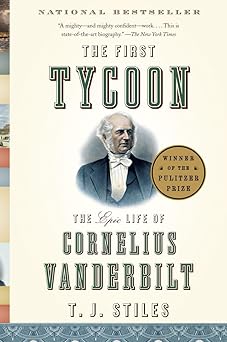
The First Tycoon

I ask the question in my headline because I am quite sure it is a question most Americans can no longer answer, with any firm knowledge. I myself didn’t know who Vanderbilt really was until I read a wonderful biography of him, The First Tycoon: The epic life of Cornelius Vanderbilt by T.J. Stiles, about two months ago.

Beforehand, all I really knew about Vanderbilt was that he had been a big deal somehow in the 1800s, and as a result there was a statue of him on the south side of Grand Central Station in New York, visible only by drivers going past on the overpass that circles the station.

What I learned from Stiles book however was astonishing. Not only did Vanderbilt build Grand Central Station, it was part of a transportation empire he created that by the end of his life covered most of the eastern United States. For Americans in the 1800s, if you needed to get from one place to another, you almost certainly rode on a Vanderbilt steamship or railroad.

Even more interesting to me however were the remarkable similarities in style, approach, and success between the Cornelius Vanderbilt of the 1800s and the Elon Musk of the 2000s. Both focused on taking new technology and making it profitable. Both built their empires on transportation.

And most of all, both focused on the product they were building to make money, not on speculating its value to make a quick buck.
» Read more

Another enthusiastic review of Conscious Choice

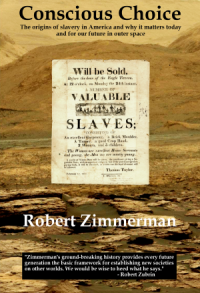
Cover of Conscious Choice

A new review of my latest book, Conscious Choice: The origins of slavery in America and why it matters today and for our future in outer space, has just been published by American Thinker. I especially like this quote:

What makes Conscious Choice interesting is that it’s not just another social history of what happened, and who did what to whom in a horrible time of man’s inhumanity to man. It’s an effort to draw concrete knowledge from the past, for application to solving predictable problems in the not-too-distant, not altogether impossible future.

Conscious Choice reads easily, flows smoothly, is linguistically elegant, covers an extremely important topic, and asks important questions. Conscious Choice is also well referenced, with two appendices of additional data and sourcing information for the deepest dive. Conscious Choice is well worth reading simply to revel in the technical merits, which are far too rare these days. It would also pair well with a rereading of Robert A. Heinlein’s classic The Moon is a Harsh Mistress, possibly while listening to Jason Aldean’s “Rich Men North of Richmond,” and sipping a few pints of good New England beer.

As is to be expected, I don’t entirely agree with the reviewer’s interpretation of my book, but such disagreements are to be expected (and celebrated), as they enhance our knowledge. Moreover, in this case the disagreement is very minor, and provides me another piece of evidence that I was successful in conveying in a readable fashion the conclusions I drew from history.

As always, if my readers are interested in buying the book, it is available in hardback, paperback, and ebook editions. You can get it at all major book outlets, such as Amazon and Barnes & Noble, as well directly from my publisher, ebookit. You can also get an autographed hardback or paperback by buying it directly from me. Just email me at [my last name] at nasw dot org.