
Titan’s tallest mountains
After more than a hundred flybys by Cassini of Titan scientists think they have located most of Titan’s mountains, including what they think will be its highest peak.
After more than a hundred flybys by Cassini of Titan scientists think they have located most of Titan’s mountains, including what they think will be its highest peak.
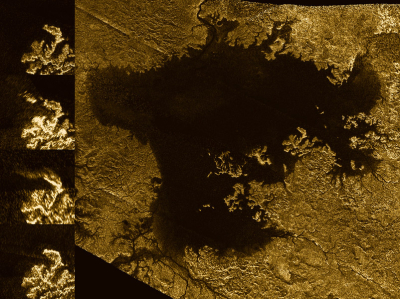
Cool image time! Using radar images taken during the past decade by Cassini scientists have discovered changes taking place along the shorelines of Titan’s hydrocarbon seas.
Analysis by Cassini scientists indicates that the bright features, informally known as the “magic island,” are a phenomenon that changes over time. They conclude that the brightening is due to either waves, solids at or beneath the surface or bubbles, with waves thought to be the most likely explanation. They think tides, sea level and seafloor changes are unlikely to be responsible for the brightening.
The images in the column at left show the same region of Ligeia Mare as seen by Cassini’s radar during flybys in (from top to bottom) 2007, 2013, 2014 and 2015.
These shoreline changes are not the only ones spotted by Cassini. However, because these are radar images, not visual, there are many uncertainties about what causes the changes, which is why they list several possibilities. For example, with radar, a simple roughness on the surface (such as waves) could cause a brightening.
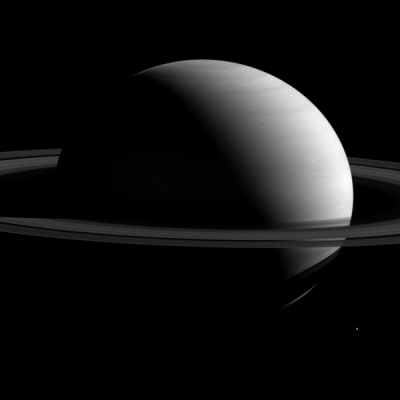
Cool image time! Be sure to click on this link to see the full resolution Cassini version of the image on the right. Its resolution is 10 miles per pixel, and even so the giant planet cannot be fit in the frame.
One moon, Tethys, is visible, though to make it so required its brightness to be increased by 2. Also, if you look close at the bands at the north pole you can see their strange still-not-understood pentagon shape.
The Cassini science team have released the first images from Cassini’s last fly-by of Saturn’s moon Enceladus.
More images are still being downloaded.
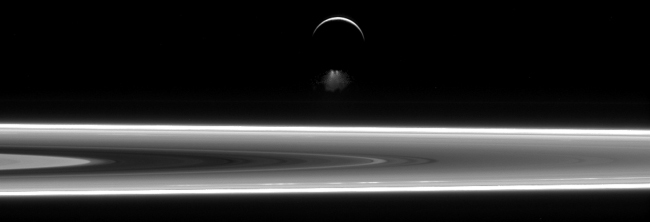
Cool image time! The image above, taken in June by Cassini, shows the night side of Saturn’s moon Enceladus, framed by Saturn’s rings, and faintly showing the jets of water coming from its south pole. To show it here I have cropped it and reduced it somewhat, as well as brightened the jets to make them more visible.
The release notes how the image compares the frozen water of Saturn’s rings and the liquid activity of Enceladus’s jets. I note how the image is simply beautiful. Be sure to click on the link to see the full resolution image.
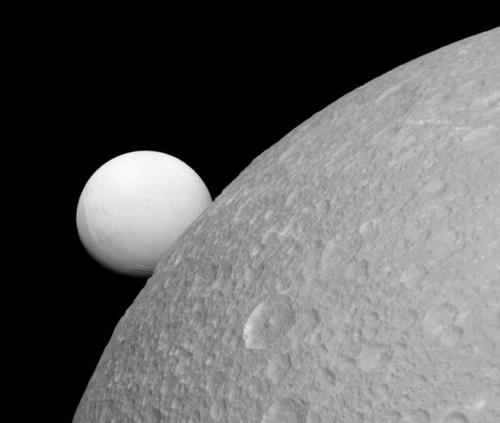
Cool image time! The image on the right was taken by Cassini in September 2015, and shows two Saturn moons, bright Enceladus partly blocked by darker and nearer Dione.
Although Dione (near) and Enceladus (far) are composed of nearly the same materials, Enceladus has a considerably higher reflectivity than Dione. As a result, it appears brighter against the dark night sky.
The surface of Enceladus (313 miles or 504 kilometers across) endures a constant rain of ice grains from its south polar jets. As a result, its surface is more like fresh, bright, snow than Dione’s (698 miles or 1123 kilometers across) older, weathered surface. As clean, fresh surfaces are left exposed in space, they slowly gather dust and radiation damage and darken in a process known as “space weathering.”
The image doesn’t contain any earth-shattering discoveries. It is simply beautiful. And in these dark times, seeing beauty is sometimes the most important thing one can do.
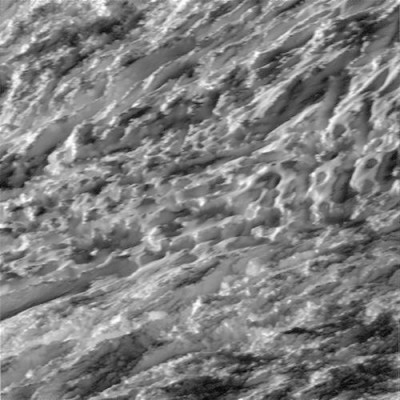
Cool image time! The image on the right is the first processed close-up image released from Cassini’s fly-by of Saturn’s moon Enceladus on Wednesday. The resolution is about 50 feet per pixel, taken from about 77 miles away. This surface, in the general area where Enceladus vents lie, reminds me of a thick field of snow that has begun to melt away.
Since the fly-by got within 30 miles, even higher resolution images should follow.
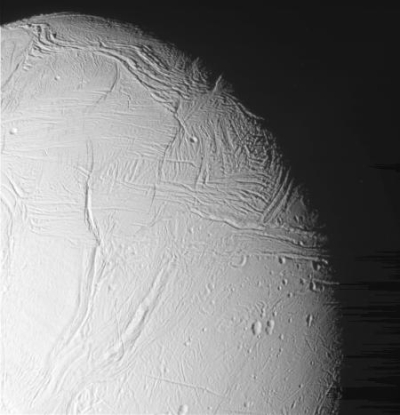
Cool image time! The first images from Cassini’s close flyby of Saturn’s moon Enceladus on Wednesday have started to arrive.
None have yet been processed, though the press release above provided a distant view of the moon’s plumes as the spacecraft approached. The image on the right, showing the moon itself, is one of the flyby I pulled off from the raw image website. Expect some interesting views to appear there throughout the day, with a more detailed press release tomorrow.
With images expected in the next day or two, scientists have confirmed that Cassini survived without damage its close flyby through Enceladus’s plumes on Wednesday.
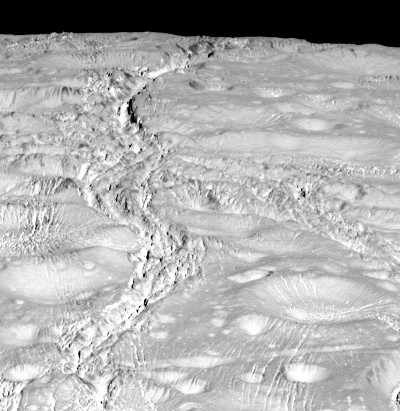
The Cassini science team has released the first image from Wednesday’s flyby of the Saturn moon Enceladus.
Scientists expected the north polar region of Enceladus to be heavily cratered, based on low-resolution images from the Voyager mission, but the new high-resolution Cassini images show a landscape of stark contrasts. “The northern regions are crisscrossed by a spidery network of gossamer-thin cracks that slice through the craters,” said Paul Helfenstein, a member of the Cassini imaging team at Cornell University, Ithaca, New York. “These thin cracks are ubiquitous on Enceladus, and now we see that they extend across the northern terrains as well.”
To see more you can browse the raw images here.
The next flyby later this month will be especially interesting as they will dip to within 30 miles of the surface.
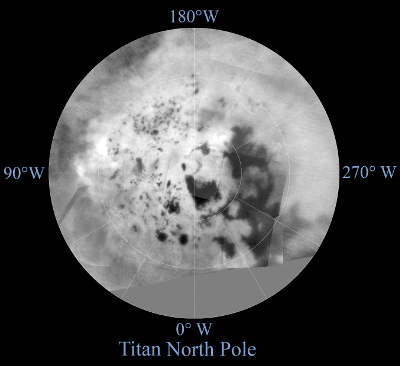
The Cassini science team has released new maps of Titan, including new maps of both poles, assembled from images taken during the 100 flybys that the spacecraft has made of the moon since it arrived in orbit around Saturn.
The scale is rough, just less than a mile at best, and there is no topographic information because the thick atmosphere allows for no strong sunlight or shadows. The images show differences in surface brightness, which does tell us where Titan’s dark methane lakes are.
This is likely the best we will get of Titan for decades, until another spacecraft is sent there.
As Cassini approaches the end of its decade-long mission at Saturn it will begin its last series of flybys of the moon Enceladus starting October 14.
Images will arrive a day or two afterward. The last two flybys will take place in late October and then in December, with the second October flyby getting closest, only 30 miles from the surface.
Beginning next year they will shift the spacecraft’s orbit so that it can get a better look at Saturn’s poles during its last two years. In that orbit flybys of the moons cannot be done.
Using data from seven years of flybys by Cassini of Enceladus scientists now think they have confirmed the existence of a global ocean of liquid water beneath the moon’s icy crust.
Cassini scientists analyzed more than seven years’ worth of images of Enceladus taken by the spacecraft, which has been orbiting Saturn since mid-2004. They carefully mapped the positions of features on Enceladus — mostly craters — across hundreds of images, in order to measure changes in the moon’s rotation with extreme precision. As a result, they found Enceladus has a tiny, but measurable wobble as it orbits Saturn. Because the icy moon is not perfectly spherical — and because it goes slightly faster and slower during different portions of its orbit around Saturn — the giant planet subtly rocks Enceladus back and forth as it rotates.
The team plugged their measurement of the wobble, called a libration, into different models for how Enceladus might be arranged on the inside, including ones in which the moon was frozen from surface to core. “If the surface and core were rigidly connected, the core would provide so much dead weight the wobble would be far smaller than we observe it to be,” said Matthew Tiscareno, a Cassini participating scientist at the SETI Institute, Mountain View, California, and a co-author of the paper. “This proves that there must be a global layer of liquid separating the surface from the core,” he said.
Previous data had suggested a lens-shaped ocean under the south pole. This new data suggests the ocean in global.
As always, the possibility of liquid water suggests the possibility of life. None has been found, but with water and energy it is certainly possible.
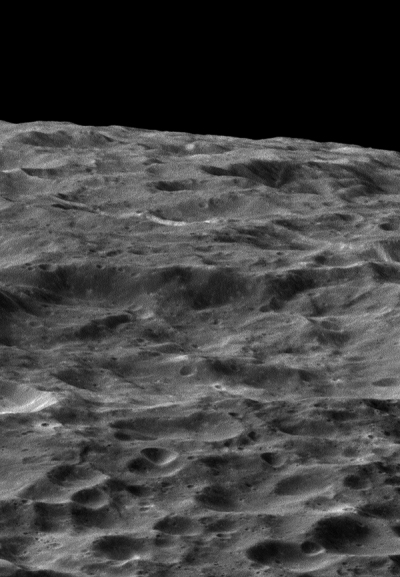
Cool image time! NASA has released images from Cassini’s Monday close fly-by of Saturn’s moon Dionne.
The press release itself did not include any of the close-ups for some reasons. You have to dig for them at the site. Go here, here, here, and here to see a few of more interesting, the first of which is a global view taken just before the fly-by. The second is the highest resolution image, with a resolution 10 feet per pixel. The third shows the nighttime surface lit entirely by reflected light from Saturn. The fourth, shown on the right, was taken from an altitude of 470 miles with a resolution of 150 feet to the pixel. It shows the moon’s rolling, pock-marked, and cratered surface, to the horizon.
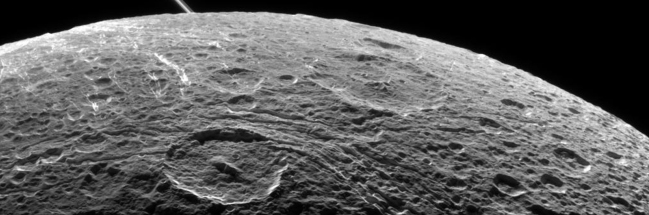
On Monday August 17 Cassini will make its last close fly-by of Saturn’s moon Dionne, dipping to within 295 miles of the surface.
During the flyby, Cassini’s cameras and spectrometers will get a high-resolution peek at Dione’s north pole at a resolution of only a few feet (or meters). In addition, Cassini’s Composite Infrared Spectrometer instrument will map areas on the icy moon that have unusual thermal anomalies — those regions are especially good at trapping heat. Meanwhile, the mission’s Cosmic Dust Analyzer continues its search for dust particles emitted from Dione.
The image of Dionne above is from a June 16, 2015 fly-by, The diagonal line at the top is Saturn’s rings.
After more than a decade, Cassini’s mission is in its final stages. When completed, we will have no way for decades to get close-up images of this gas giant, its spectacular rings, or its many very different moons.
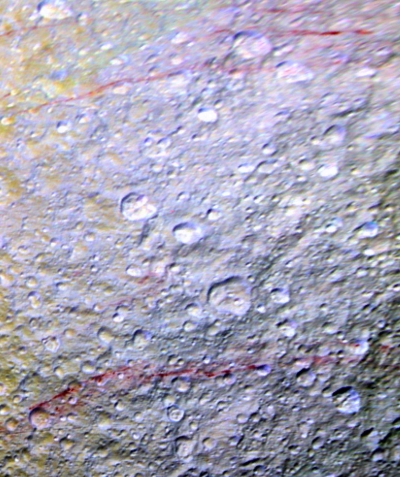
Baffling image time! Images taken in April 2015 by Cassini of the Saturn moon Tethys have produced the best images yet of the puzzling red arcs on the moon’s surface, first identified in 2004.
The origin of the features and their reddish color is a mystery to Cassini scientists. Possibilities being studied include ideas that the reddish material is exposed ice with chemical impurities, or the result of outgassing from inside Tethys. They could also be associated with features like fractures that are below the resolution of the available images.
Except for a few small craters on Saturn’s moon Dione, reddish-tinted features are rare on other moons of Saturn. Many reddish features do occur, however, on the geologically young surface of Jupiter’s moon Europa. “The red arcs must be geologically young because they cut across older features like impact craters, but we don’t know their age in years.” said Paul Helfenstein, a Cassini imaging scientist at Cornell University, Ithaca, New York, who helped plan the observations. “If the stain is only a thin, colored veneer on the icy soil, exposure to the space environment at Tethys’ surface might erase them on relatively short time scales.”
I could also file this under “the uncertainty of science”, as the scientists at this point haven’t the slightest idea what created these arcs.
Using Cassini scientists have detected tiny grains of rock orbiting Saturn that they think were formed on the floor of the interior ocean of Enceladus and then spewed out its vents into space.
They believe that these silicon-rich grains originate on the seafloor of Enceladus, where hydrothermal processes are at work. On the seafloor, hot water at a temperature of at least 90 degrees Celsius dissolves minerals from the moon’s rocky interior. The origin of this energy is not well understood, but likely includes a combination of tidal heating as Enceladus orbits Saturn, radioactive decay in the core and chemical reactions.
As the hot water travels upward, it comes into contact with cooler water, causing the minerals to condense out and form nano-grains of ‘silica’ floating in the water. To avoid growing too large, these silica grains must spend a few months to several years at most rising from the seafloor to the surface of the ocean, before being incorporated into larger ice grains in the vents that connect the ocean to the surface of Enceladus. After being ejected into space via the moon’s geysers, the ice grains erode, liberating the tiny rocky inclusions subsequently detected by Cassini.
Additional data suggest that the interior of Enceladus is very porous, which means that interior ocean might not be one large bubble but a complex liquid-filled cave.
Thar’s black gold up thar! Data from Cassini has confirmed the presence of ocean waves on Titan’s seas, while also providing suggesting that they are made mostly of liquid methane, not ethane as had been predicted.
The maximum depth of Kraken Mare appears to be 160 meters, and Ligeia Mare could be as much as 200 meters deep, reported Marco Mastrogiuseppe of Sapienza University of Rome. The fact that the radar signals could bounce off the sea bottom suggests that the seas were more transparent than expected and thus must contain mostly methane, not ethane. Hayes says his best estimate is about 90% methane. Essam Marouf, a planetary scientist at San José State University in California, reported on the first results from a separate radar experiment that sent radar reflections to Earth instead of back to the spacecraft. Those tests provide independent evidence that the seas are dominated by methane, Marouf says, and it implies that the lakes are kept filled by precipitating methane.
As the article also notes, this methane is “55 times Earth’s oil reserves.”
Using images collected after ten years in orbit around Saturn, Cassini scientists have released global color maps of six of Saturn’s icy moons, Mimas, Enceladus, Tethys, Dione, Rhea and Iapetus.
These enhanced colour views have yielded several important discoveries about the icy moons. The most obvious are differences in colour and brightness between the two hemispheres of Tethys, Dione and Rhea. The dark reddish colours on the moons’ trailing hemispheres are due to alteration by charged particles and radiation in Saturn’s magnetosphere. The blander leading hemispheres, the sides that always face forward as the moons orbit Saturn, are all coated with icy dust from Saturn’s E-ring, formed from tiny particles erupting from the south pole of Enceladus.
Cassini has captured a wonderful image of Titan’s polar lakes glinting from sunlight.