Predicting dust storms in the Starship candidate landing zone on Mars
Click for original figure.
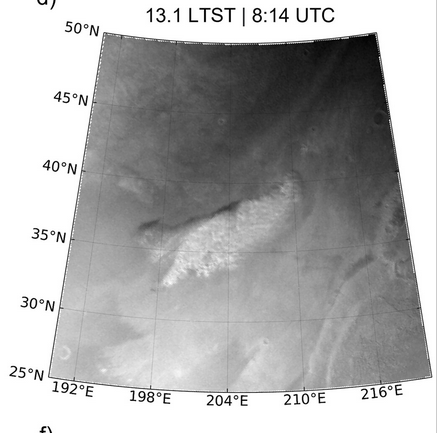
Scientists using the UAE’s Al-Amal Mars orbiter were able to track two near-identical dust storms that occurred in the northern lowland plains of Mars and near the candidate landing zone for SpaceX’s Starship spacecraft.
The image to the right comes from figure 2 of the paper, and was taken by Al-Amal approximately 25,000 miles above the red planet’s surface. By comparing the growth and evolution of both storms, the scientists now think they have a method for predicting when such storms occur in this region. From their abstract:
Our observational case study constrains scenarios presented by Ogohara (2025). We show the first scenario, summarized in Section 5 of Ogohara (2025), [explains] dust storms 1 and 2. This scenario is as follows. Dust storms form in the later morning hours through combined effects of the warm sector of a low-pressure system and daytime phenomena. The low-pressure system is associated with wavenumber 3 baroclinic waves.
There is no doubt that dust storms 1 and 2 start to form and develop in the late morning hours, in or near the warm sector of a low-pressure system. Also, combined effects of this low-pressure system and daytime convection are possible. This is supported by evidence for daytime convection, such as the dust devil number in MY 28 and planetary boundary layer height estimates from the Mars Climate Database.
In other words, future SpaceX colonists should be prepared for late morning dust storms when a low-pressure system moves in.

Click for original figure.
Scientists using the UAE’s Al-Amal Mars orbiter were able to track two near-identical dust storms that occurred in the northern lowland plains of Mars and near the candidate landing zone for SpaceX’s Starship spacecraft.
The image to the right comes from figure 2 of the paper, and was taken by Al-Amal approximately 25,000 miles above the red planet’s surface. By comparing the growth and evolution of both storms, the scientists now think they have a method for predicting when such storms occur in this region. From their abstract:
Our observational case study constrains scenarios presented by Ogohara (2025). We show the first scenario, summarized in Section 5 of Ogohara (2025), [explains] dust storms 1 and 2. This scenario is as follows. Dust storms form in the later morning hours through combined effects of the warm sector of a low-pressure system and daytime phenomena. The low-pressure system is associated with wavenumber 3 baroclinic waves.
There is no doubt that dust storms 1 and 2 start to form and develop in the late morning hours, in or near the warm sector of a low-pressure system. Also, combined effects of this low-pressure system and daytime convection are possible. This is supported by evidence for daytime convection, such as the dust devil number in MY 28 and planetary boundary layer height estimates from the Mars Climate Database.
In other words, future SpaceX colonists should be prepared for late morning dust storms when a low-pressure system moves in.