Firefly buys the AI navigation technology used on its Blue Ghost lunar landing

Blue Ghost's shadow on the Moon, with the Earth in the background
Blue Ghost’s shadow on the Moon, with the Earth in the background,
after its 2025 touchdown.

Firefly has now acquired Space-ng, the company that makes the AI navigation technology and software that Firefly used on its successful Blue Ghost lunar landing in 2025.

Space-ng’s vision navigation software was utilized during Firefly’s historic Blue Ghost Mission 1 to determine position and attitude, detect hazardous lunar terrain, and autonomously redirect Blue Ghost in real-time, enabling a safe, precise touchdown within the Moon’s Mare Crisium.

…In addition to vision navigation software, Space-ng brings high-resolution spacecraft cameras and AI compute hardware to enable advanced space domain awareness, onboard optical navigation, rendezvous and proximity operations, and docking without requiring GPS or GNSS. Firefly plans to integrate Space-ng’s technologies across its fleet of lunar landers and orbital vehicles to support its growing mission manifest, including three additional lunar missions under NASA’s Commercial Lunar Payload Services initiative, another lunar mission supporting NASA MoonFall, and a space domain awareness mission for the Defense Innovation Unit.

Of all the recent attempts by commercial companies to land on the Moon, Firefly is the only one to have a complete success. While Space-ng’s technology worked perfectly to guide Blue Ghost to a safe touch down, the guidance technology used by Intuitive Machines (twice), Ispace (twice), Beresheet, and the first Vikram lander for India all failed close to landing. No wonder Firefly decided to buy it.
1 comment

Firefly announces new stock sale aimed at raising more than a half billion in new funds

The publicly traded rocket/lunar lander company Firefly yesterday announced a new public offering of stock, totalling more than 12 million shares, with the goal of raising more than a half billion for “general corporate purposes.”

Firefly Aerospace (Nasdaq: FLY), a market leading space and defense technology company, today announced the pricing of its public offering of 4,000,000 shares of its common stock and 8,000,000 shares of common stock by certain selling stockholders (the “Offering”) at a public offering price of $48.00 per share. In addition, the selling stockholders have granted the underwriters a 30-day option to purchase up to an additional 1,800,000 shares of common stock at the public offering price, less underwriting discounts and commissions. The Offering is expected to close on June 1, 2026, subject to customary closing conditions.

Firefly intends to use the net proceeds from the Offering for general corporate purposes, including to support growth of core business and recently awarded programs and initiatives. Firefly will not receive any of the proceeds from the sale of shares by the selling stockholders.

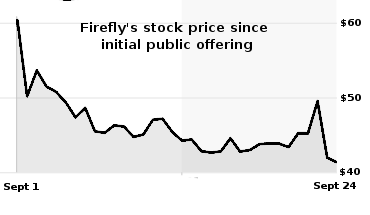
Firefly's stock history
Click for source.

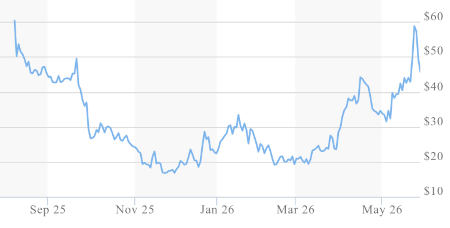
Simple math says this offering hopes to raise $576 million dollars, assuming the $48 per share price holds.

The graph to the right shows the full price history of Firefly’s stock since the initial public offering in 2025. After an initial high around $60, the stock sagged to around $20, and only has recovered back into the $40 to $50 range in the past few months. It appears therefore that the company has well timed this new offering.

2 comments

Lockheed Martin joins partnership to build off-shore launch platform

Artist's rendering of Seagate platform
Artist’s rendering of Seagate platform. Click for original.

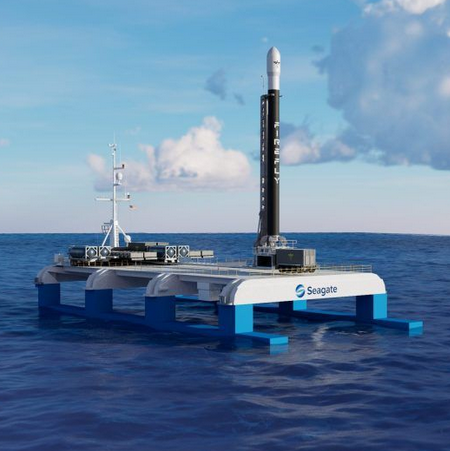
According to a post yesterday by Johnathon Caldwell, a vice president and general manager at Lockheed Martin, the company will be joining the partnership of Seagate and Firefly to build an off-shore launch platform from which Firefly hopes to launch its Alpha rocket.

The three companies will work together on mission‑application concepts and flight‑demonstration projects that leverage Seagate’s Gateway offshore launch platform. This sea‑based launch facility, combined with Firefly’s responsive Alpha launch vehicle, will provide rapid, flexible access to space from diverse locations, an essential capability for tactical payloads and national‑security missions.

Seagate only went public with this project in late March. Firefly signed on in April. Now Lockheed Martin has joined. It appears the concept has great potential for it to attract so much interest so quickly. Nor should this be surprising. The Chinese have been very successful in the past two years with its own sea platform, and the concept was proven years ago with Sea Launch.

Though Firefly presently launches Alpha from Vandenberg, the company also has deals with Sweden’s Esrange spaceport and a lease for a pad at Cape Canaveral. It has also been studying launching from a proposed commercial spaceport in northern Japan. This partnership with Seagate might allow it to abandon all these land-based sites, or supplement them.

Lockheed Martin in the past has invested heavily in new rocket companies, including Rocket Lab, ABL, Orbex, and X-Bow. Of these, only Rocket Lab has succeeded. With this deal Lockheed is looking for another option for getting its commercial and military payloads into orbit, with a much greater launch flexibility.

0 comments

Firefly’s delays launch of its Eclipse rocket to 2027

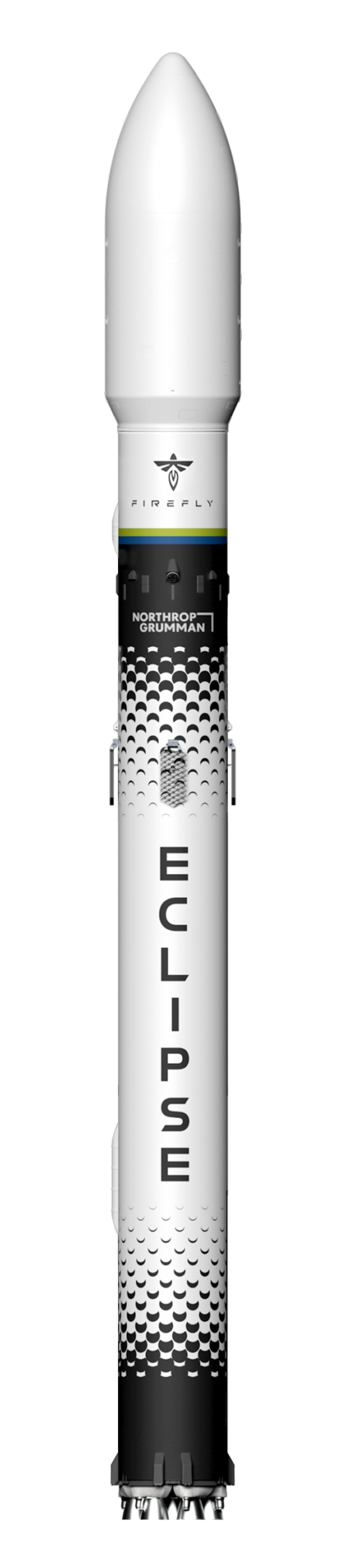
Eclipse as of April 2026
Click for original image.

It appears that Firefly has delayed the first launch of its new more powerful Eclipse rocket — being built in partnership with Northrop Grumman — to 2027.

The company made no specific announcement, but in a tweet today touting the rocket’s “fresh look”, with no details, the company linked to its Eclipse webpage (in the first link above) that describes the rocket in detail. In the last paragraph adds that the first launch is now scheduled for “no earlier than 2027”, a delay from the 2026 launch date both companies were originally targeting.

This guarantees that SpaceX’s Falcon 9 is going to get more launch contracts taking Northrop Grumman’s Cygnus capsule to ISS.

Firefly says Eclipse is being built for re-usability, but the graphics of the rocket, as shown above, are puzzling in that they show grid fins but no landing legs.

7 comments

Firefly signs deal with modular sea launch startup Seagate

The startup Seagate, which is building a modular sea launch platform for any rocket company, has now signed a partnership deal with the rocket company Firefly to jointly develop that sea platform.

Seagate Space Corporation announced today a Memorandum of Understanding (MOU) with Firefly Aerospace to collaborate on the development of an offshore launch platform that enables a sea-based launch capability for Firefly’s Alpha rocket. This collaboration marks a significant milestone in expanding responsive, resilient launch solutions for the rapidly growing space economy.

Under the MOU, Seagate Space is working closely with Firefly to mature the design of an integrated offshore launch system capable of supporting the unique requirements of liquid-fueled orbital rockets. Central to this development is the integration of Seagate Space’s Gateway Series, the industry’s first purpose-built offshore spaceport designed specifically for launch operations.

Firefly presently has one operational launchpad, at Vandenberg, though it has a deal to launch its Alpha rocket from Sweden’s Esrange spaceport as well as a lease for a pad at Cape Canaveral. It has also been studying launching from a proposed commercial spaceport in northern Japan. Apparently, the company wants more spaceport options, and a sea platform gives it the most flexibility.

4 comments

Sweden’s Esrange spaceport signs launch deal with Swedish military

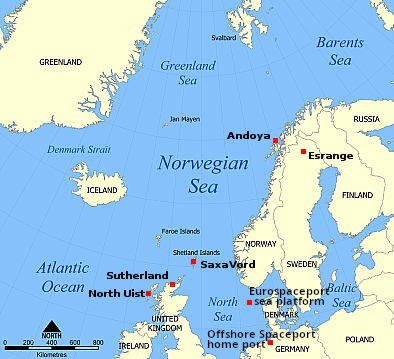
Proposed or active spaceports in North Europe

Sweden’s Esrange spaceport, used for decades for suborbital test launches but now trying to become an orbital spaceport, this past week signed a launch agreement worth about $22 million with Sweden’s military.

The contract covers systems and infrastructure that ensure protection, availability, and execution of satellite launches for the Swedish Armed Forces, as well as for partners and allies. The capability is scheduled to be operational by 2028.

…The initiative is part of a government decision from 2023 to allocate approximately [$100 million] to the Swedish Armed Forces through 2032 to develop Sweden’s space capabilities. The decision includes, among other things, improved space situational awareness, expansion of infrastructure at Esrange in cooperation with SSC Space, and the ability for the Swedish Armed Forces to carry out multiple satellite launches.

It seems unlikely Sweden’s military will be able to produce its own rockets for this amount of money. More likely they will buy the services from others. The American rocket company Firefly in 2024 signed a deal to launch its Alpha rocket from Esrange, but it appears there might be regulatory issues blocking any launches, some of which might stem from opposition by Norway. Esrange has an interior location, so any orbital launch has to fly over territory belonging to other countries. It appears Sweden is having problems getting permission to do so.

My guess is that this deal is mostly aimed at keeping Esrange open. Or to put it more bluntly, use the earnings of Swedish taxpayers to support a government-controlled spaceport with little financial promise.

1 comment

Firefly launches its Alpha rocket, almost a year after previous launch failure

Firefly today successfully launched its Alpha rocket, almost a year after a launch failure in April 2025.

This launch, from Firefly’s launchpad at Vandenberg Space Force Base in California, was the last for this version of Alpha, and was designed as a test flight, both to check out the fixes to correct last year’s failure as well as to prove out some of the technology that will be used on the upgraded Alpha to be used on all future flights.

The 2026 launch race:

30 SpaceX
8 China
3 Rocket Lab
2 Russia
1 ULA
1 Europe (Arianespace)
1 Firefly

SpaceX continues to lead the entire world combined in total launches — as it did in both ’24 and ’25 — and is doing almost twice as many launches as everyone else.

3 comments

SpaceX completes its second Starlink launch today; Firefly scrubs launch

SpaceX successfully placed another 29 Starlink satellites in orbit this evening during its second launch today, its Falcon 9 rocket lifting off from Cape Canaveral Space Force Station in Florida.

The first stage completed its 26th launch, landing on a drone ship in the Atlantic.

Firefly meanwhile scrubbed its launch of its Alpha rocket due to high winds. No new launch date as yet been scheduled. This would be Firefly’s first launch since it had a launch failure in April 2025, followed by a static fire test explosion in September 2025. According to the company, this Alpha launch will be the last of this version before it begins flying an upgraded rocket.

The 2026 launch race:

27 SpaceX
8 China
2 Rocket Lab
2 Russia
1 ULA
1 Europe (Arianespace)

As it did in both ’24 and ’25, SpaceX in ’26 so far has more launches than the entire rest of the world combined.

0 comments

Firefly to provide the launch rocket for Kratos’ hypersonic test vehicles

The rocket/lunar lander startup Firefly yesterday announced that it has signed a partnership deal with the hypersonic test startup Kratos.

In August Kratos partnered with the Australian company Hypersonix to build 20 scramjet test vehicles for the Pentagon for hypersonic test flights. Firefly with this new deal will provide the launch vehicle for getting those scramjets into the air at the speeds required. In fact, it appears Firefly is now going to do with its Alpha rocket the same thing that Rocket Lab did with its Electron rocket, revising it for suborbital testing.

Rocket Lab has already completed six successful HASTE launches. It will be interesting how quickly Firefly can get Alpha reconfigured and launched in this manner. Some of that schedule will also hinge on Kratos’ ability to provide the scramjets. The press release makes no mention of schedule.

Firefly’s action here continues the recent shift by many American space startups from rocketry and space exploration to defense work that is only tangentially related to space. It appears they are all diversifying to grab the expected rich contracts the Pentagon is expected to hand out to develop Trump’s proposed Golden Dome defense system. It also appears that many are diversifying because they have doubts the civilian space industry can sustain them, by itself.

1 comment

Firefly identifies cause of first stage explosion during static fire test in September

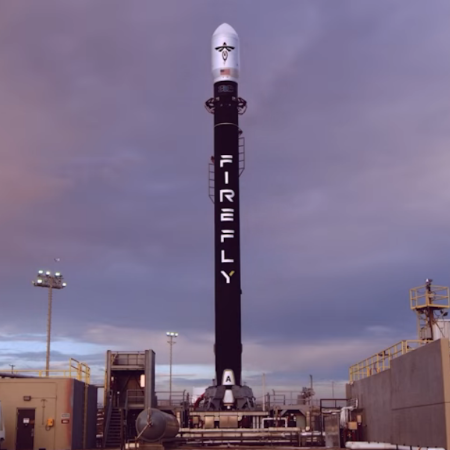
Alpha on the launchpad
The Alpha first stage, prior to September explosion

Firefly yesterday announced it has completed its investigation into the explosion during a static fire test in September that destroyed the first stage of the Alpha rocket during final preparations prior to launch.

Following a thorough review of the Alpha Flight 7 first stage ground test on September 29, Firefly identified a process error during stage one integration that resulted in a minute hydrocarbon contamination, which then led to a combustion event in one of the engines during the ground test. The test stand structure remained intact and no other facilities were impacted.

…Firefly immediately took action and implemented corrective actions, which included increasing inspection requirements for the fluid systems, optimizing the first stage sensors, and incorporating additional automated aborts. Firefly also implemented key process improvements following a daylong quality stand down where the production, integration, and test teams conducted exercises to review and optimize existing procedures. As part of Firefly’s effort to improve reliability and quality, the team will continue to hold regular exercises for sustained process enhancements.

The company also said the problem was not a design issue with the rocket.

It appears from the company’s press release that the contamination occurred because of a work force quality control issue, that required a major daylong review by all their employees to make sure their operations in building the stage would be more rigorous going forward.

The plan now is to pull another first stage from the company’s production line and stack that with the original upper stage. The target date for launch is late this year or early next year, “depending on range availability.”

Firefly had hoped to do five launches in 2025. At this moment it has only attempted one, in April, which failed. That investigation took until mid-September to complete. The next launch attempt was then delayed by the first stage explosion.

I imagine the company very much wants to get at least one launch off this year. I also imagine it is aggressively reviewing its rocket work force due to these issues.

1 comment

Firefly Aerospace buys defense contractor SciTec

Firefly Aerospace yesterday announced that it is buying the defense contractor SciTec for $300 million in cash plus $555 million in Firefly shares.

The shares go to SciTec’s owners at an agreed-to value of $50 per share, essentially making those individuals part owners of Firefly.

The acquisition will advance Firefly’s comprehensive space services by adding mission-proven defense software analytics, remote sensing, and multi-phenomenology data expertise. SciTec’s core capabilities – which include missile warning, tracking and defense, intelligence, surveillance and reconnaissance, space domain awareness, and autonomous command and control – will supplement Firefly’s launch, lunar, and in-space services. SciTec further adds ground and onboard data processing as well as AI-enabled systems designed for low latency operations to support advanced threat tracking and response across multiple domains.

In other words, this acquisition is aimed at improving Firefly’s ability to win defense contracts, thus diversifying its business beyond outer space. This suggests its managers believe there isn’t enough business in outer space to put the company in the black. It needs defense contracts, and adding SciTech increases the odds it will win those contracts.

The stock price in this sale, $50, I think tells us something of the motives of SciTec’s owners. At present Firefly’s stock is selling at about $30 on Wall Street, and the price has not changed much today after this announcement. It appears the stock obtained by SciTec’s owners is thus not as valuable as listed in the intended sale price. This in turn suggests that those owners also needed this deal to diversify the company, and were willing to take a loss in the value of their stock to get it.

Then again, my understanding of how Wall Street and stocks function is limited, and my analysis on this point could be completely wrong.

5 comments

Firefly loses first stage for next launch when it explodes during static fire test

During a static fire engine test yesterday in preparation for launch, the rocket startup Firefly lost the first stage when an explosion occurred at what appeared to be the base of the rocket. From the company’s update:

During testing at Firefly’s facility in Briggs, Texas, the first stage of Firefly’s Alpha Flight 7 rocket experienced an event that resulted in a loss of the stage. Proper safety protocols were followed, and all personnel are safe. The company is assessing the impact to its stage test stand, and no other facilities were impacted.

Video of the explosion can be seen here.

This incident will obviously delay the next launch, which had only just been scheduled following the completion of the company’s investigation into its launch failure in April. This explosion also suggests there remain serious issues with the Alpha rocket, which has only had two full successes in six launch attempts.

At the same time, with the successful soft landing of its Blue Ghost lander on the Moon earlier this year, Firefly has demonstrated its engineering can be sound and robust. It just appears that a lot more work needs to be done to get Alpha into shape.

4 comments

Firefly’s stock sags due to poor revenue numbers in 1st quarter report

Firefly's stock price since IPO

Apparently Wall Street has lost faith in the rocket startup Firefly since that company went public last month. The stock zoomed initially, but has now sagged due to a poor 1st quarter report that showed revenues far below expectations.

The stock’s initial price had been predicted to range from $35 to $39, but quickly rose to $70.

Since then the price has steadily dropped, so that today it sits about about $41.

The news reports seem to think this indicates bad things for the company. I see this as simply a long term correction from the initial over-enthusiasm by buyers. The company had first offered a stock price close to this number. The price is now exactly where Firefly predicted.

If I was interested in buying stock, this might actually be a good time to buy. As a rocket startup, Firefly appears quite solid, being the only startup to successfully soft land on the Moon. Its Alpha rocket has also been cleared for further launches, and though it has had a mixed launch record, with several launches failing due to upper stage issues, it has likely solved these problems.

3 comments

The causes behind the launch failure of Firefly’s Alpha rocket in April

In late August the FAA and Firefly completed the investigation into the launch failure of Firefly’s Alpha rocket in April, clearing the way for the company to resume launches.

At the time however this approval was reported here merely as a quick link on X. The company however also published its conclusions at that time which explained the cause of the failure. For completeness I post that now, describing what happened just after the first stage separated from the second stage.

Alpha’s first stage then experienced a rupture milliseconds after stage separation. The pressure wave hit Alpha’s second stage, leading to the loss of the engine’s nozzle extension and substantially reducing stage two thrust. The second stage was able to recover attitude control and continued to ascend to an altitude of 320 km until running out of propellant. The vehicle was three seconds short of achieving orbital velocity and five seconds short of the target payload deployment orbit.

The ground-based video, onboard telemetry, post-flight empirical testing and Computational Fluid Dynamics analysis corroborated excessive heat from Plume Induced Flow Separation as the most probable root cause of the mishap. Alpha Flight 6 flew a higher angle of attack than prior missions. Plume-induced flow separation intensified heat on the leeward side reducing structural margins, causing the booster to rupture from stage separation induced loads.

Fortunately, the corrective actions are straight forward: increase thermal protection system thickness on Stage 1 and reduce angle of attack during key phases of the flight. Corrective actions have already been implemented.

The company expects to resume flights in the very near future, probably before the end of 2025.

0 comments

Firefly studying feasibility of launching from northern Japanese spaceport

Japan's spaceports
Japan’s spaceports indicated by red dots.

Firefly and the commercial Japanese Hokkaido spaceport in the north of Japan have begun a feasibility study for launching Firefly’s Alpha rocket there.

Establishing an memorandum of understanding with the Hokkaido Spaceport means that the two entities can flesh out a more concrete launch complex design and figure out all of the logistics to bring Alpha launch capabilities to Japan.

In the past Hokkaido has been the location for a number of suborbital launches, but no orbital launches as yet. For example, the Japanese startup Interstellar used this site for its suborbital test flights in 2018, and hopes to use it for future orbital flights.

Firefly meanwhile has launched its Alpha rocket multiple times from Vandenberg in California. The company is also building a launchpad at Wallops Island in Virginia, and has signed a deal with the Esrange spaceport in Sweden. The Swedish launch site however is questionable because any orbital launch from there would have to cross over land of other countries, and so far it appears permission for such a thing has not been arranged. Firefly might therefore be looking at Hookaiddo for precisely this reason.

0 comments

Firefly’s stock value far exceeds the predicted price

When Firefly announced it was going public at the end of July, it predicted the stock price would range from $35 to $39, with the initial public offering raising about $600 million in capital for the company. Less than a week later it revised these predictions upward to $45 and about $700 million.

When trading opened yesterday, these numbers were still too low, with the stock immediately trading at $70 per share> and raising almost $900 million.

The space and defense technology company reached a peak valuation of more than $9.84 billion during intraday trading, after its shares began trading at $70 — up more than 55% from the initial public offering price of $45. The stock climbed as high as $73.80 during the session before closing at $60.35.

Firefly sold more than 19 million shares in the offering, raising at least $868 million. By the end of trading Thursday, total volume had approached 30 million shares.

This confidence and enthusiasm by Wall Street reflects Firefly’s success this year in becoming the first private company to land an unmanned spacecraft softly on the Moon. It also suggests the market expects the company’s orbital tug and rockets to succeed. Though its Alpha rocket has had a mixed record of success, its new larger Eclipse rocket is being built in partnership with Northrop Grumman, which has invested $50 million into its development.

0 comments

Firefly wins new NASA lunar lander contract, worth $176.7 million

NASA announced yesterday that it has awarded Firefly a $176.7 million contract to use the company’s Blue Ghost lunar lander to deliver two rovers and three other science instruments to the Moon’s south pole region.

Under the new CLPS task order, Firefly is tasked with delivering end-to-end payload services to the lunar surface, with a period of performance from Tuesday to March 29, 2030. The company’s lunar lander is targeted to land at the Moon’s South Pole region in 2029.

This is Firefly’s fifth task order award and fourth lunar mission through CLPS. Firefly’s first delivery successfully landed on the Moon’s near side in March 2025 with 10 NASA payloads. The company’s second mission, targeting a launch in 2026, includes a lunar orbit drop-off of a satellite combined with a delivery to the lunar surface on the far side. Firefly’s third lunar mission will target landing in the Gruithuisen Domes on the near side of the Moon in 2028, delivering six experiments to study that enigmatic lunar volcanic terrain.

One of the rovers is being built in partnership with Canada.

2 comments

Firefly hopes to raise more than $600 million in initial stock offering

The rocket startup and lunar lander company Firefly yesterday posted details about its initial public stock offering, designed to hopefully raise more than $600 million.

Firefly Aerospace, a market leading space and defense technology company, today announced that it has launched the roadshow for its proposed initial public offering of 16,200,000 shares of its common stock. In addition, Firefly intends to grant the underwriters a 30-day option to purchase an additional 2,430,000 shares of its common stock at the initial public offering price, less underwriting discounts and commissions. The initial public offering price is expected to be between $35.00 and $39.00 per share.

The company stated it would use the money “to repay outstanding borrowings under its credit agreement, pay any accrued and unpaid dividends on certain series of its preferred stock, and for general corporate purposes.”

The company has not yet announced the date when this stock offering will become available for purchase.

1 comment

Northrop Grumman invests $50 million in Firefly and new rocket

Northrop Grumman and the rocket startup Firefly announced yesterday that the former has invested $50 million in the latter in order to develop a fully new rocket, dubbed Eclipse, with capabilities allowing it to compete with SpaceX for customers.

“Firefly is incredibly grateful for Northrop Grumman’s investment that further solidifies our first-of-its-kind partnership to build the first stage of Antares 330 and jointly develop Eclipse,” said Jason Kim, CEO of Firefly Aerospace. “…With a 16 metric ton to orbit capability, Eclipse is a sweet spot for programs like NSSL Lane 1 and a natural fit to launch proliferated constellations in LEO, MEO, GEO, and TLI.”

Built upon Northrop Grumman’s Antares and Firefly’s Alpha rocket, Eclipse offers a significant leap in power, performance, production cadence, and payload capacity. The launch vehicle retains the flight-proven avionics from the Antares program with additional upgrades, including a larger 5.4 meter payload fairing. Eclipse also utilizes the same first stage Firefly is developing for Antares 330 and retains scaled-up versions of Alpha’s propulsion systems and carbon composite structures, allowing the team to rapidly build and test Eclipse with significant production efficiencies and economies of scale.

The companies say that because of its reliance on already proven launch rockets, they hope Eclipse’s first launch will take place in 2026 from Wallops Island.

As I noted yesterday, the demand for launch services — especially for heavier payloads — presently exceeds the supply, as already established rocket companies ULA and Blue Origin have so far failed to deliver as promised. Rocket Lab is developing its medium-lift Neutron expressly to grab this market. It now appears Northrop Grumman wants a share as well, and is partnering with Firefly to get it.

If all goes as planned this partnership will soon have two rockets to offer customers, the Antares 330 and Eclipse.

2 comments

Firefly launch fails

In its first launch attempt in 2025, Firefly’s Alpha rocket had a problem shortly after the first stage separated from the upper stage and the upper stage’s engines began firing. The upper stage began swivel somewhat though it appeared to stablize after a few seconds.

Subsequent reports confirmed that the stage failed to reach orbit.

The launch of the FLTA0006 mission appeared to go as planned until stage separation about 2 minutes and 35 seconds after liftoff. A cloud suddenly formed between the two stages, and video showed what appeared to be debris falling away as the upper stage continued its ascent.

A camera on the upper stage also showed debris falling away from it seconds after separation. The nozzle for the single Lightning engine in the upper stage appeared to be seriously damaged, if not missing entirely.

In a statement four and a half hours after launch, Firefly confirmed that the upper stage and its payload failed to reach orbit because of the stage separation issue. “The rocket then experienced a mishap between stage separation and second stage ignition that led to the loss of the Lightning engine nozzle extension, substantially reducing the engine’s thrust,” the company stated.

Alpha has now launched a total of six times, but only two of those launches were completely successful. Two of the other launches got their payloads into orbit, but not at the proper positions. In all the failures but one, the problems were with the upper stage. Today’s failure is another example of this.

7 comments
1 2 3 6