Scientists: Europa’s theorized plumes of water vapor might simply be statistical noise

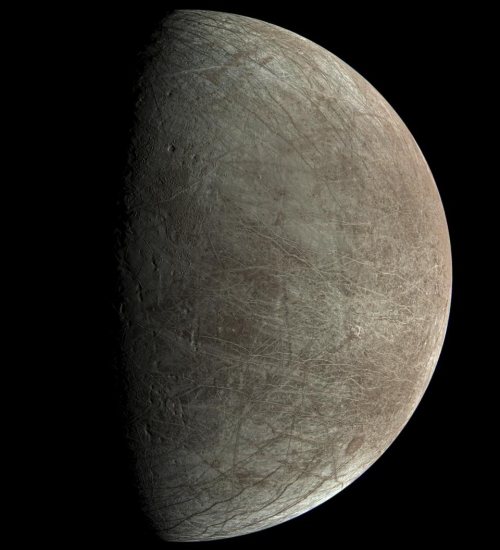
Europa in true color
Europa in true color, taken by Juno September 2022.
Click for full image.

The uncertainty of science: Based on a re-analysis of data from the Hubble Space Telescope, scientists now say that the plumes of water vapor that Hubble had supposedly detected erupting from the surface of the Jupiter moon Europa might not exist, and could instead simply be statistical noise in the data.

The new paper looks at the last 14 years of data from the Hubble Space Telescope’s Space Telescope Imaging Spectrograph (HST/STIS) focused on Europa’s Lyman-alpha emissions. Lyman-alpha is a specific wavelength of ultraviolet light emitted and scattered by hydrogen atoms. From 2012-2014, the team was pushing the limits of the Hubble telescope’s capabilities.

“One of the difficulties in interpreting the data back then was determining where to place Europa within its context,” Retherford said. “The way Hubble works left some uncertainty in terms of placement relative to the center of the image. If Europa’s placement was off even just by a pixel or two, it could affect how the data gets interpreted.”

As a result, what they thought could be evidence of a water vapor plume could also just be statistical noise. “Our reanalysis took our original 99.9% confidence in the plumes’ existence and reduced it to less than 90% confidence,” said Dr. Lorenz Roth (KTH Royal Institute of Technology, Sweden), the paper’s lead author. “That’s simply not enough evidence to support the certainty of claims we made at the time.”

The plumes might still exist, but the data used here is simply more uncertain that previously thought. It is hoped that when Europa Clipper and Juice both enter Jupiter orbit in a few years they will be able to settle this issue more definitively.

3 comments

Hubble looks at the Trifid Nebula again

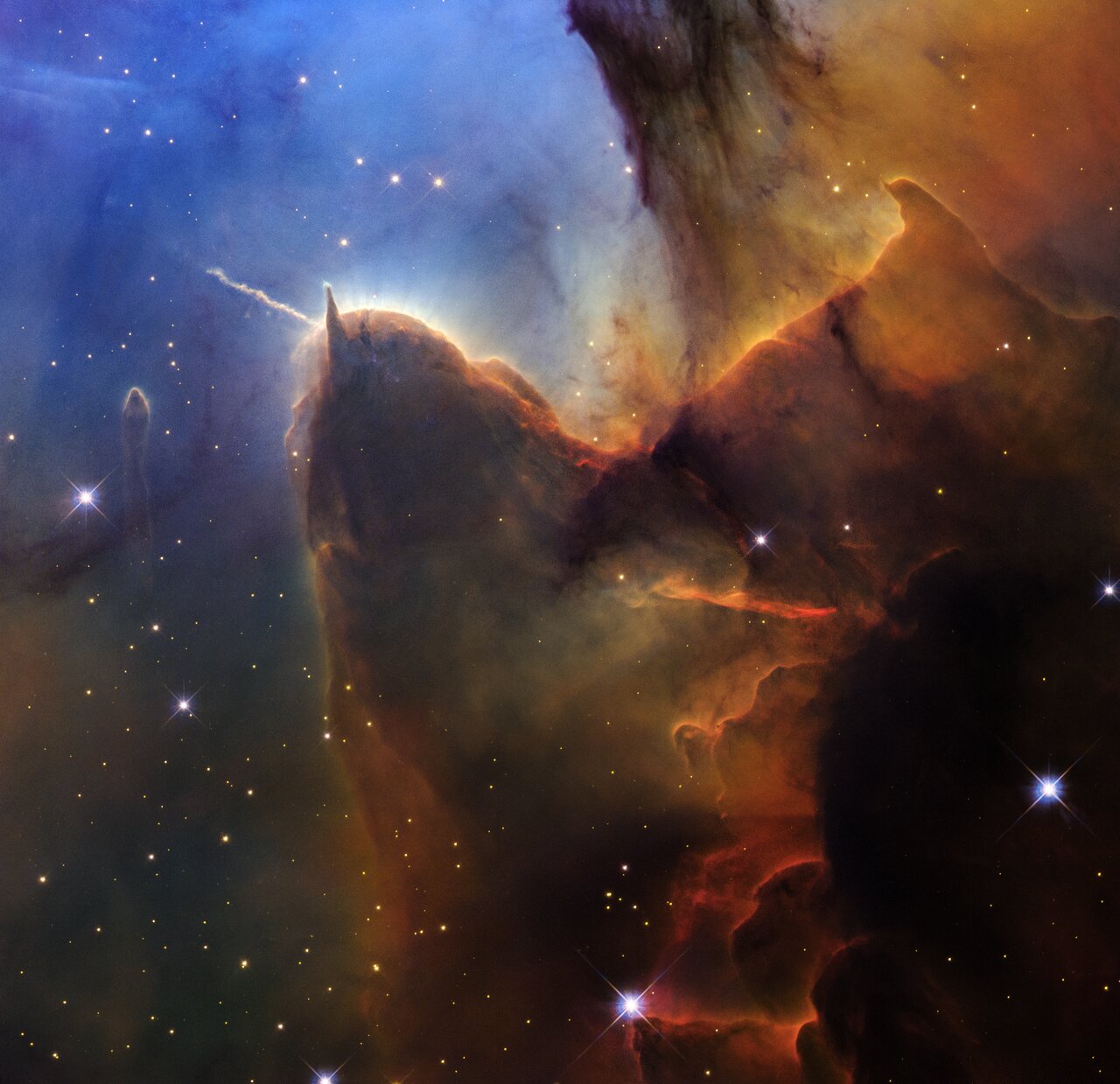
Trifid Nebula as seen by Hubble
Click for original image.

Cool image time! The picture to the right, cropped to post here, was taken by the Hubble Space Telescope and released today. It shows a small section of the Trifid Nebula, located about 5,000 light years away.

This location has been imaged numerous times in the past by Hubble. The area shown illustrates some fundamental aspects of stellar and nebula formation. The dark area in the lower right is a thick dust cloud. Several energetic O and B supermassive stars are out of view at the top. The radiation from these stars (indicated by the blue), is hitting that dust cloud and literally destroying it. It appears that the foreground “horn” exists because a larger object is blocking the radiation, allowing dust to survive in the background.

I have no explanation for the background “horn”.

This new image was taken in parallel with an image of the entire Trifid Nebula, taken by the new Rubin Telescope in Chile. Though Rubin cannot see with the same resolution as Hubble, its image is quite worthwhile viewing.

0 comments

New data from Webb suggests two of Uranus’ outer rings are starkly different

The outer two rings of Uranus as seen by Webb in the infrared
Click for original image.

Using new infrared data obtained by the Webb Space Telescope in February 2025 and combined with optical data previously obtained by the ground-based Keck Observatory in 2007 and the Hubble Space Telescope in 2003 and 2013, astronomers now think that two adjacent outer rings of Uranus are completely different from each other, with one ring largely created by icy material thrown off the moon Mab.

The infrared image to the right was taken by Webb, and shows the two subject rings, dubbed v and μ.

Though they orbit the same planet, Uranus’s μ and ν rings are fundamentally different. Prior observations with the combined Keck Observatory and HST showed that the μ ring appeared blue, a signature of extremely small particles, while the ν ring’s reddish hue points to a more typical dusty ring. Why the rings were so different remained a mystery, though.

When JWST came on-line and observed Uranus, the research team used all its data, taken at different infrared wavelengths, in combination with Keck Observatory and HST observations to construct a complete spectrum from the visible through to infrared. By analyzing how sunlight reflects off the rings, the team identified a strong absorption feature near a wavelength of 3 microns (3 millionths of a meter) visible in the infrared for both rings. Beyond that shared feature, the differences become clear when simulating the detailed spectra: the μ ring closely matches the spectral signature of water ice, while the ν ring is clearly composed of rocky material, mixed with approximately 10–15% carbon-rich organic compounds commonly found in the outer solar system.

The μ ring seems to be made up of tiny icy grains knocked off the planet’s small (12-km sized) moon, Mab, by micrometeorite impacts. Interestingly, the icy composition of the μ ring also confirms that the moon Mab is composed mostly of water-ice.

According to the paper’s abstract, the v ring is dusty and, “like typical dusty rings, is sourced from collisions between, and micrometeoroid impacts on, larger but as yet unseen parent bodies orbiting within this ring. These bodies must be composed in part of organic materials [molecules with carbon as one component].”

This data really only raises more questions than it answers. For one, what are those larger objects within the v ring? Without a nearby orbiter there is no way to find them. For another, this new data really doesn’t explain why these two adjacent rings are so different. What processes force such a distinct distribution of materials?

0 comments

Voyager-2 discovered Neptune to be a planet of quickly changing weather

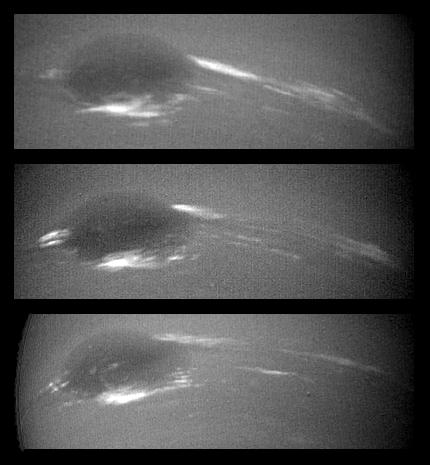
Neptune's fast changing weather
Click for source.

Cool image time! When Voyager-2 flew past Uranus in 1986, the data showed the gas giant’s weather to be relatively sedate and quiet, with little changing during the fly-by. Scientists expected this: Uranus’s distance from the Sun meant it got little energy to fuel an active climate, with any activity produced by internal heating due to the gravitational pressure of its mass. And Uranus did not produce that much heat internally.

When Voyager-2 passed Neptune three year later, the scientists expected something similar, or even less, due to Neptune’s greater distance from the Sun. Instead, Voyager-2’s data showed Neptune’s weather patterns to be changing constantly and quickly, as illustrated by the three images of the Great Dark Spot to the right, the biggest storm on Neptune at that time and located in the planet’s southern mid-latitudes.

The bright cirrus-like clouds of Neptune change rapidly, often forming and dissipating over periods of several to tens of hours. In this sequence spanning two rotations of Neptune (about 36 hours) Voyager 2 observed cloud evolution in the region around the Great Dark Spot at an effective resolution of about 60 miles per pixel. The surprisingly rapid changes which occur over the 18 hours separating each panel shows that in this region Neptune’s weather is perhaps as dynamic and variable as that of the Earth. However, the scale is immense by our standards — the Earth and the [Great Dark Spot] are of similar size.

In Neptune’s frigid atmosphere, where temperatures are as low as 55 degrees Kelvin (-360 F), the cirrus clouds are composed of frozen methane rather than Earth’s crystals of water ice.

Subsequent observations by the Hubble Space Telescope in 1994 found this Great Dark Spot was gone, replaced by a comparable storm in the northern hemisphere. Further Hubble observations found Neptune’s storms tend to last about two years, fading as they drifted towards the equator. Those observations however also detected storms drifting away from the equator. Other research suggested the storms might be influenced by the Sun’s sunspot cycle.

All of the data post-Voyager-2 remains very coarse and uncertain, as we are looking at Neptune at a great distance. Thus, no theory about what is happening carries much weight, especially because we do not know why Neptune produces so much more internal heat than Uranus, fueling this fast-changing weather. For example, Neptune gets 1/20th of the energy received by Jupiter, yet its atmosphere appears even more active and variable.

2 comments

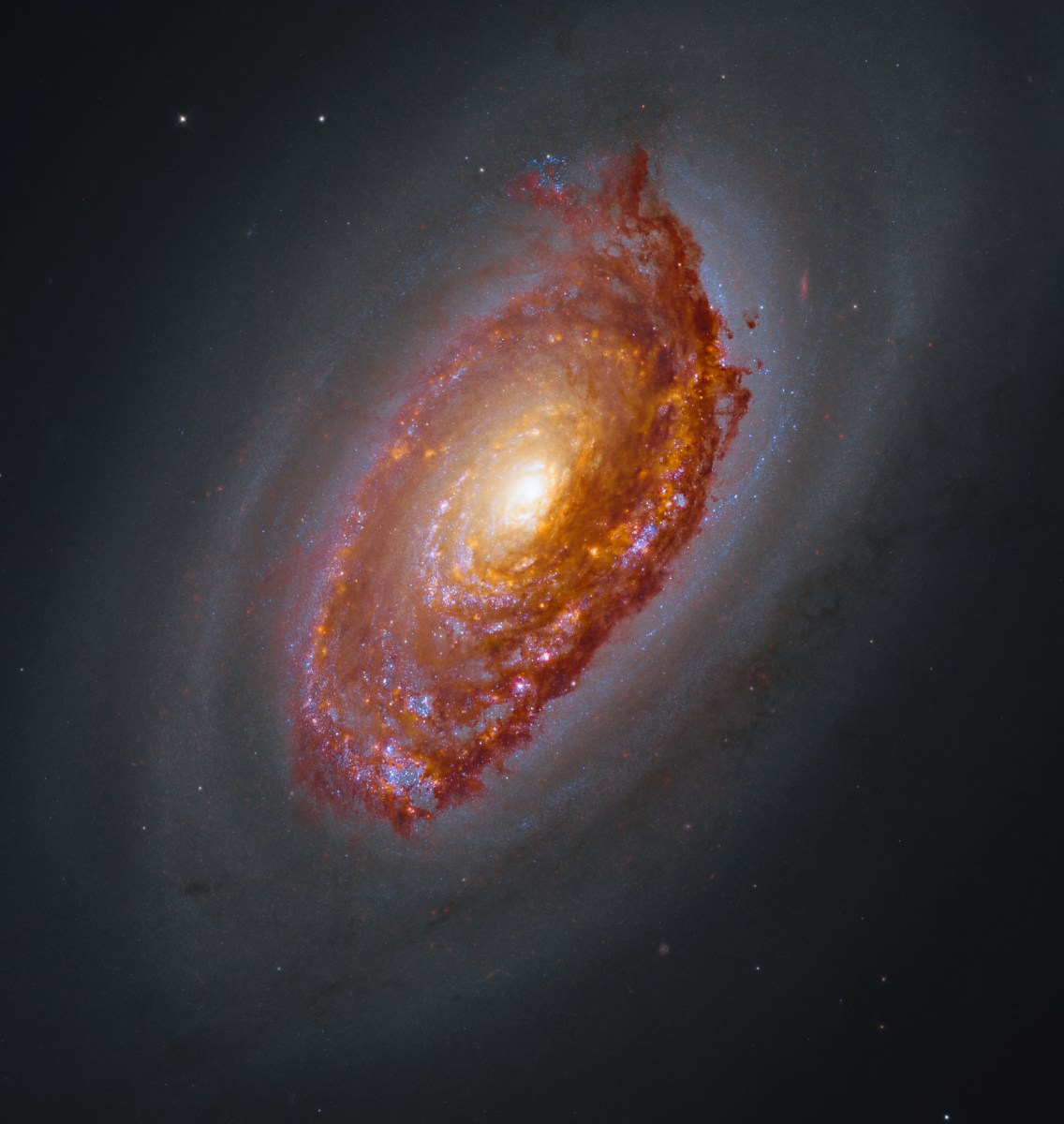
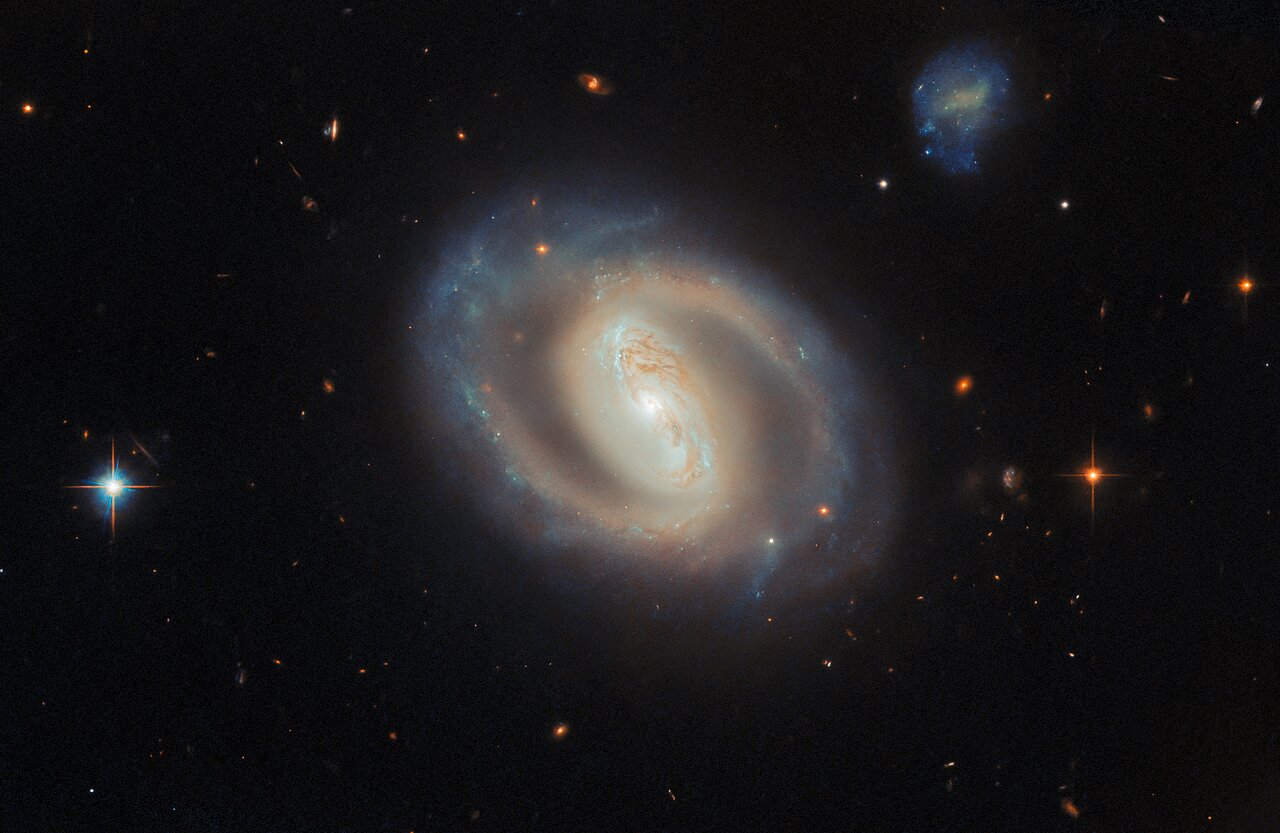
A soft barred galaxy with an active nucleus

A barred galaxy with an active galactic nucleus
Click for original image.

Cool image time! The picture to the right, cropped, reduced, and sharpened to post here, was taken by the Hubble Space Telescope as part of two different surveys aimed at studying galaxies with what scientists call active galactic nuclei.

IC 486 lies right on the edge of the constellation Gemini (the Twins), around 380 million light-years from Earth. Classified as a barred spiral galaxy, it features a bright central bar-shaped structure from which its spiral arms unfurl, wrapping around the core in a smooth, almost ring-like pattern.

…At the galaxy’s center a noticeable white glow outshines the starlight around it. This is light given off by IC 486’s active galactic nucleus (AGN), powered by a supermassive black hole more than 100 million times the mass of the Sun. Every sufficiently large galaxy hosts a supermassive black hole at its center, but some of these black holes are particularly ravenous, marshaling vast amounts of gas and dust into swirling accretion discs from which they feed. The intense heat generated by the orbiting disc of material generates intense radiation up to and including X-rays, which can outshine the entire rest of the galaxy. In these cases, the galaxy is known as an active galaxy, with an AGN at its center.

For comparison, the relatively inactive supermassive black hole at the center of the Milky Way has a mass of about four million Suns, considerably smaller than IC 486’s. Why one is active and the other not however is not yet truly understood, though their different masses might provide part of the explanation.

0 comments

Astronomers detect the first comet whose nucleus’ reversed its rotation

Astronomers using data collected by the orbiting Gehrels Swift and Hubble space telescopes now think the nucleus of a small comet reversed its rotation sometime in 2017, caused by the force of the material sublimated off its surface.

From the abstract of their paper [pdf]:

The rotations of cometary nuclei are known to change in response to outgassing torques. The nucleus of the Jupiter-family comet 41P/Tuttle–Giacobini–Kresak exhibited particularly dramatic rotational changes when near perihelion in 2017 April. Here, we use archival Hubble Space Telescope observations from 2017 December to study the postperihelion lightcurve of the nucleus and to assess the nucleus size.

From both Hubble photometry and nongravitational acceleration measurements, we find a diminutive nucleus with effective radius 500 ± 100 meters. Systematic optical variations are consistent with a two-peaked (i.e., rotationally symmetric) lightcurve with period 0.60 ± 0.01 days, substantially different from periods measured earlier in 2017. The spin of the nucleus likely reversed between perihelion in 2017 April and December as a result of the outgassing torque.

In plain English: the thrust of the material being thrown from the surface as the comet made its close approach to the Sun was sufficient to slow and then reverse the nucleus’s rotation. This process was helped by the relatively small size of the nucleus compared to the material being sublimated from it.

The data also suggests the nucleus was once much larger, and has been whittled down to its present small size as it made its multiple close fly-bys of the Sun during the past 1,500 years. Rather than break-up, as most comets do at some point as their nucleus gets smaller, this comet’s nucleus simply kept shrinking, to the point that the thrust of that material could change its rotation.

0 comments

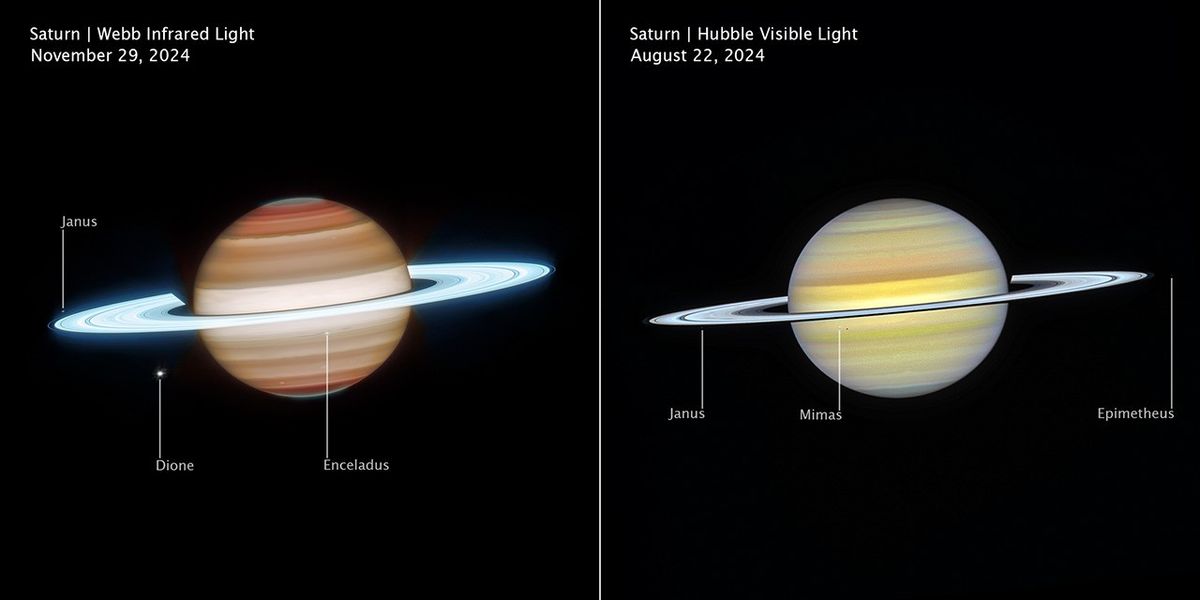
Webb and Hubble take a look at Saturn

Saturn seen by Webb and Hubble

Astronomers using both the Hubble Space Telescope and the Webb Space Telescope have produced new complementary views of the ringed planet Saturn.

Those photographs are shown above, with Webb’s false-color infrared image to the left and Hubble’s optical image to the right. From the press release:

In the Webb image, a long-lived jet stream known as the “ribbon wave” meanders across the northern mid-latitudes, influenced by otherwise undetectable atmospheric waves. Just below that, a small spot represents a lingering remnant from the “Great Springtime Storm” of 2010 to 2012. Several other storms dotting the southern hemisphere of Saturn are visible in Webb’s image, as well. All these features are shaped by powerful winds and waves beneath the visible cloud deck, making Saturn a natural laboratory for studying fluid dynamics under extreme conditions.

…In Webb’s infrared image, the rings are extremely bright because they are made of highly reflective water ice. In both images, we’re seeing the sunlit face of the rings, a little less so in the Hubble image, hence the shadows visible underneath on the planet.

There are also subtle ring features such as spokes and structure in the B ring (the thick central region of the rings) that appear differently between the two observatories. The F ring, the outermost ring, looks thin and crisp in the Webb image, while it only slightly glows in the Hubble image.

The press release says little about the Hubble image, mostly because it shows little new by itself. It however is part of an on-going decade-long survey using Hubble to track Saturn’s changing weather patterns.

While both images are valuable, they also highlight our present limits in observing Saturn. Views from Earth can only see so much. It is like trying to watch a football game from ten miles away, with binoculars. And sadly, no mission is presently planned to return to Saturn.

1 comment

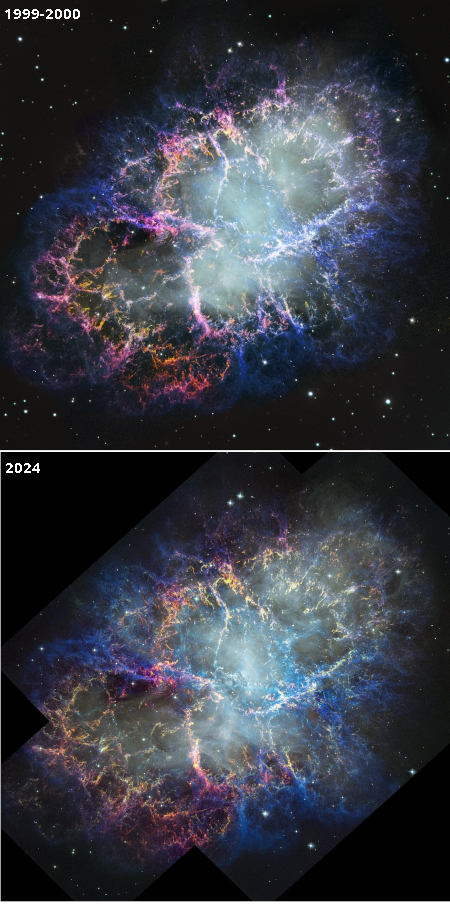
Changes to the Crab Nebula after a quarter century

The Crab Nebula, changes after a quarter century
For original images go here and here.

Using the Hubble Space Telescope, astronomers have obtained a new high resolution image of the Crab Nebula, and by comparing it with earlier Hubble images taken in 1999/2000 have been able to track the continuing expansion and evolution of this supernova remnant over a period now covering almost a quarter century.

The supernova itself became visible on Earth in 1054, though it actually erupted about 6,500 years earlier, as the Crab Nebula is 6,500 light years away. In the 25 years Hubble has been tracking the remnant’s expansion astronomers estimate it is expanding at about 3.4 million miles per hour.

[William Blair of Johns Hopkins University] noted that filaments around the periphery of the nebula appear to have moved more compared to those in the center, and that rather than stretching out over time, they appear to have simply moved outward. This is due to the nature of the Crab as a pulsar wind nebula powered by synchrotron radiation, which is created by the interaction between the pulsar’s magnetic field and the nebula’s material. In other well-known supernova remnants, the expansion is instead driven by shockwaves from the initial explosion, eroding surrounding shells of gas that the dying star previously cast off.

The new, higher-resolution Hubble observations are also providing additional insights into the 3D structure of the Crab Nebula, which can be difficult to determine from a 2D image, Blair said. Shadows of some of the filaments can be seen cast onto the haze of synchrotron radiation in the nebula’s interior. Counterintuitively, some of the brighter filaments in the latest Hubble images show no shadows, indicating they must be located on the far side of the nebula.

A movie showing the changes between these two images can be seen here. It is worth your while to take a look. These optical images will be further enhanced as the Webb Space Telescope gathers infrared data.

1 comment

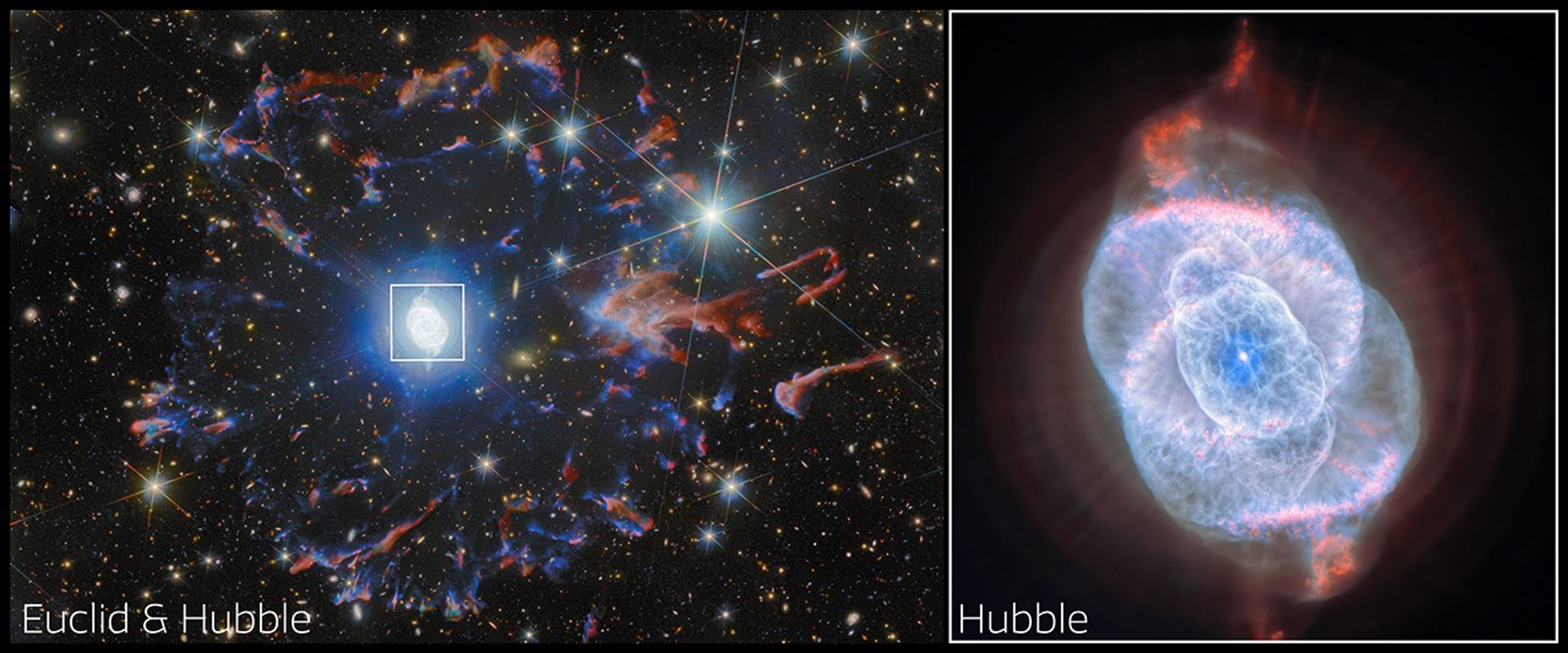
Old and new optical space telescopes team up to view the Cat’s Eye

Cat's Eye Nebula as seen by both Hubble and Euclid
Click for original images.

Astronomers using both NASA’s long established Hubble Space Telescope and Europe’s new Euclid space telescope have produced new optical/infrared images of the Cat’s Eye planetary nebula.

Those images are to the right, cropped, reduced, and sharpened to post here. The Hubble image at bottom shows the complex structure of the nebula itself, located about 4,400 light years away and believed created by the inner orbital motions of a binary star system that act almost like the blades in a blender, mixing the material thrown off by one or both of the stars as they erupt in their latter stages of life.

In Euclid’s wide, near-infrared, and visible light view, the arcs and filaments of the nebula’s bright central region are situated within a halo of colorful fragments of gas zooming away from the star. This ring was ejected from the star at an earlier stage, before the main nebula at the center formed. The whole nebula stands out against a backdrop teeming with distant galaxies, demonstrating how local astrophysical beauty and the farthest reaches of the cosmos can be seen together with Euclid.

Euclid has a primary mirror 1.2 meters in diameter, about half that of Hubble. Though it can’t zoom in with the same resolution, its view is as sharp since it is in space above the atmosphere. It thus provides a wider view, which in this case helps provide a larger context to the detailed close-up view provided by Hubble.

In many ways Euclid is Hubble’s replacement, produced by the European Space Agency, as NASA and the American astronomy community has not been able to get together to build their own new optical orbiting telescope.

2 comments

Webb imaged a star before it went supernova

Webb detection of a supernova progenitor
Click for original image.

One of the biggest challenges facing astronomers for more than four centuries has been the detection of a star prior to its going supernova. Until very recently, no such detection had ever happened, and so astronomers could only guess at the kind of stars or binary systems that might result in these gigantic stellar explosions.

In recent years the improvement in telescopes, both in orbit and on the ground, has produced some successes, whereby the progenitor star was imaged in archival imagery and found after the explosion. The sample however has been small, and the data limited to only a few wavelengths.

Now, the Webb Space Telescope has made its first detection of a supernova progenitor, in the infrared. That image is to the right, showing the star prior to the June 2025 supernova explosion.

By carefully aligning Hubble and Webb images taken of NGC 1637, the team was able to identify the progenitor star in images taken by Webb’s MIRI (Mid-Infrared Instrument) and NIRCam (Near-Infrared Camera) in 2024. They found that the star appeared surprisingly red – an indication that it was surrounded by dust that blocked shorter, bluer wavelengths of light. “It’s the reddest, most dusty red supergiant that we’ve seen explode as a supernova,” said graduate student and co-author Aswin Suresh of Northwestern University.

This excess of dust could help explain a long-standing problem in astronomy that could be described as the case of the missing red supergiants. Astronomers expect the most massive stars that explode as supernovas to also be the brightest and most luminous. So, they should be easy to identify in pre-supernova images. However, that hasn’t been the case.

One potential explanation is that the most massive aging stars are also the dustiest. If they’re surrounded by large quantities of dust, their light could be dimmed to the point of undetectability. The Webb observations of supernova 2025pht support that hypothesis.

You can read the peer-reviewed paper here [pdf].

1 comment

First visual detection of another star’s heliosphere

A baby star's heliosphere
Click for full image.

Using both the Hubble Space Telescope and the Chandra X-ray Observatory, astronomers have made the first visual detection of another star’s heliosphere, in both X-rays and in the infrared.

The image to the right, cropped to post here.

Astronomers have nicknamed the HD 61005 star system the “Moth” because it is surrounded by large amounts of dust patterned similarly to the shape of a moth’s wings when viewed through infrared telescopes. The wings are formed from material left behind after the formation of the star, similar to the Kuiper Belt in our own solar system. Observations of these wings with NASA’s Hubble Space Telescope showed that the interstellar matter surrounding HD 61005 is about a thousand times denser than that around the Sun.

The wings are the points to the left and right. The star’s young heliosphere, which they dub an “astrosphere,” is the purple glow above and below. From the caption:

In this composite image of HD 61005 in the inset, X-rays from Chandra (purple and white) have been combined with infrared data from Hubble (blue and white). Chandra reveals a bright source of X-rays in the center of the image, which is the star itself surrounded by the star’s astrosphere. The wing-like structure sweeping away from the star in the infrared image is dusty material that remained behind after the formation of the star. These wings have been swept backwards as they fly through space.

As this star and its solar system are very young, what we have is a very dusty accretion disk interacting with a very temperamental baby star.

0 comments

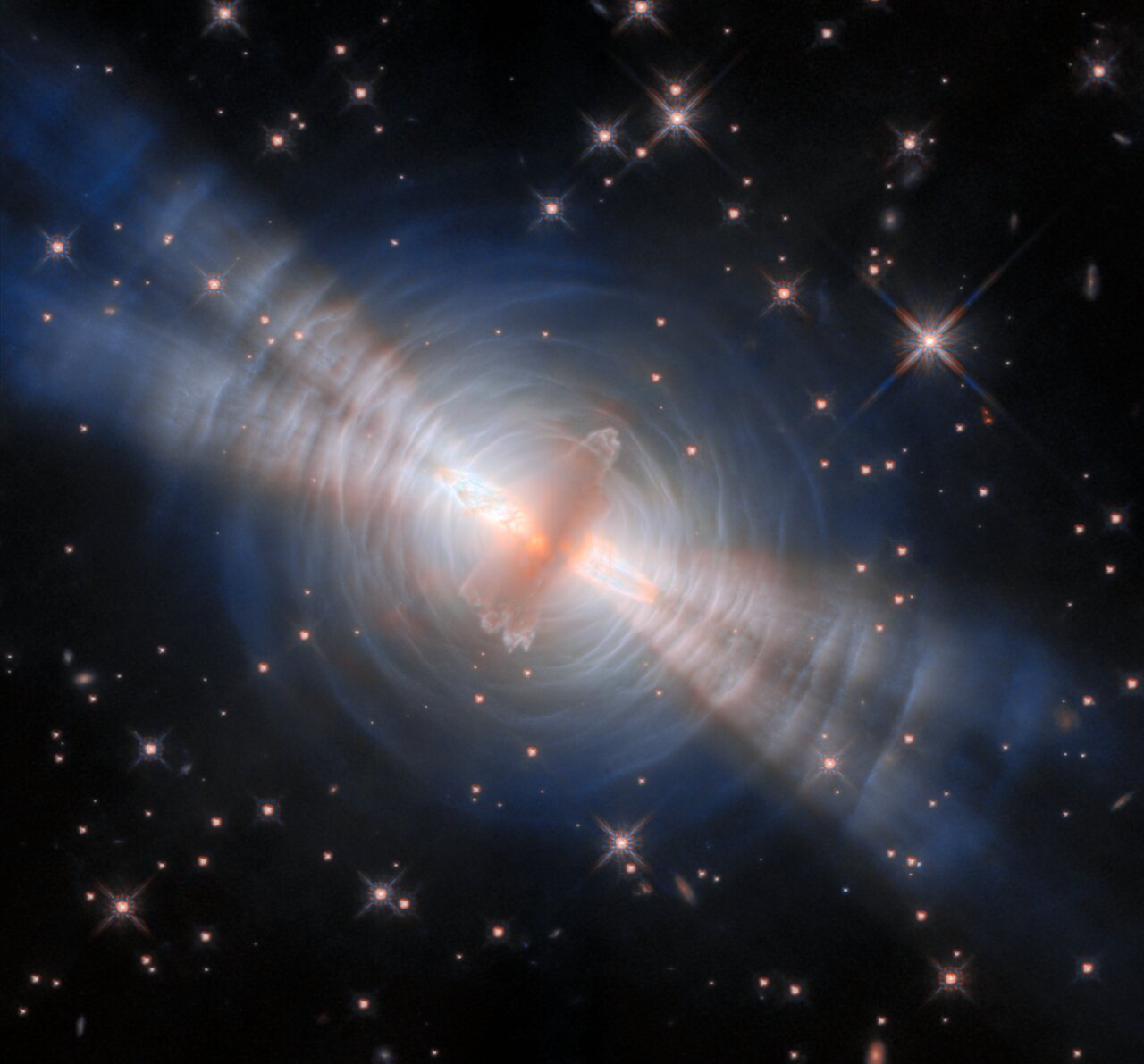
Hubble eyes the Egg Nebula

Hubble eyes the Egg Nebula
Click for original image.

Cool image time! The picture to the right, reduced to post here, was taken by the Hubble Space Telescope as part of a study of “preplanetary nebula,” the initial stages of a planetary nebula that forms as some star types begin dying. From the caption:

Many preplanetary nebulae are relatively dim and hard to spot. They are made of layers of gas ejected by the star, but that star is not yet hot enough to ionise the gas and cause it to glow. The Egg Nebula is relatively unique, easily visible as a sparkling jewelled egg in space. Powerful beams of starlight blast out of the inner cloud, two a-side, giving a breathtaking illumination to this cosmic structure. Fast-moving outflows of hot molecular hydrogen also emerge from within the dust cloud, visible just at the base of the searchlight beams. These outflows glow with infrared light, which is shown in this image by orange highlights.

The central cloud of dust is surrounded by concentric rings, themselves made up from thin, faint arcs of gas. These were created by successive outbursts from the central star, which ejected a little more material from its outer surface every few hundred years. The beams of starlight are reflected by these layers of gas, creating an appearance like ripples on the surface of water. The way that gas molecules reflect and scatter light gives a bluish colour to the arcs. The reflected starlight reveals important details about the central star, which is impossible to view directly in its dusty shell.

Many planetary nebula get their spectacular shapes because they have a binary star system in their center, that act like the blades in a blender as they circle each other, mixing the materials the stars’ eject to form those shapes. Because of those surrounding shells, it is often impossible to determine with the nebula has a single central star, or a binary system.

0 comments

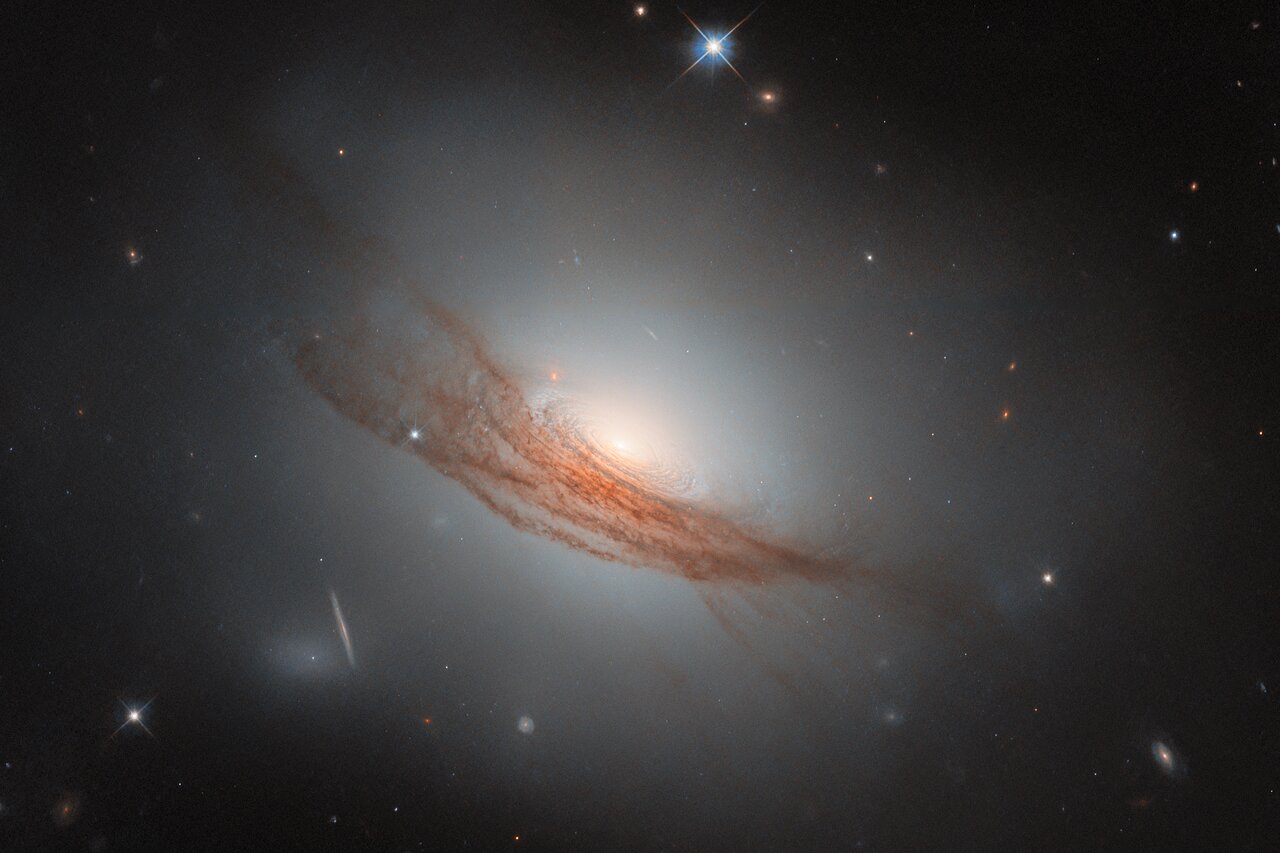
A galaxy’s swirling dust lanes

A galaxy with swirling dust lanes
Click for original image.

Cool image time! The picture to the right, cropped, reduced, and enhanced to post here, was taken by the Hubble Space Telescope as part of follow-up observations of a now faded supernovae that occurred there two years earlier.

This was on purpose: the aim of the observations was to witness the aftereffects of the supernova and examine its surroundings, which can only be done once the intense light of the explosion is gone.

The galaxy itself, NGC 7722, is 187 million light years away, and is unusual in itself.

A “lenticular”, meaning “lens-shaped”, galaxy is a type that sits in between the more familiar spiral galaxies and elliptical galaxies. It is also less common than these — partly because when a galaxy has an ambiguous appearance, it can be hard to determine if it is actually a spiral, actually an elliptical galaxy, or something in between. Many of the known lenticular galaxies sport features of both spiral and elliptical galaxies. In this case, NGC 7722 lacks the defined arms of a spiral galaxy, while it has an extended, glowing halo and a bright bulge in the center similar to an elliptical galaxy. Unlike elliptical galaxies, it has a visible disc — concentric rings swirl around its bright nucleus. Its most prominent feature, however, is undoubtedly the long lanes of dark red dust coiling around the outer disc and halo.

The streak in the lower left is a very distant background galaxy, seen on edge.

1 comment

Astronomers use AI to discover hundreds of weird galaxies in Hubble archive

Weird galaxies in the Hubble archive, found with AI
Click for original image.

In what is a perfect example of the proper use of artificial computer intelligence (AI), astronomers have now used this programming to analyze almost 100 million images taken by the Hubble Space Telescope over the decades to find any galaxies hidden there that have “anomalies” or unusual shapes.

The team analyzed nearly 100 million image cutouts from the Hubble Legacy Archive, each measuring just a few dozen pixels (7 to 8 arcseconds) on a side. They identified more than 1,300 objects with an odd appearance in just two and a half days — more than 800 of which had never been documented in scientific literature.

The six galaxies to the right are just a small sample. All six were previously unidentified, and include “three lenses with arcs distorted by gravity, one galactic merger, one ring galaxy, and one galaxy that defied classification” (the galaxy at the top left). From the European Space Agency’s (ESA) press release:

The strange, bi-polar galaxy seen here is certainly anomalous, with its compact, swirling core and two open lobes at the sides. Exactly what kind of galaxy it is is unclear, and it was not previously known to astronomers.

As noted in the first link, the volume of data that astronomers are now collecting from ground-based and orbiting telescopes — many of which are survey telescopes that photograph the entire sky repeatedly — has actually become a problem. They have great data, but don’t have the time or human resources to study it sufficiently. Even employing large numbers of ordinary citizens, working at home with their own computers, can’t get the job done.

This is the kind of grunt work that AI is ideally made for. It can quickly review the data and identify objects that don’t fit normal expectations. Humans then can do the real work, finding the most interesting of these strange objects, such as the top left galaxy, and devote human creativity to studying it.

2 comments

Billionaire to fund construction of an orbiting optical telescope larger than Hubble

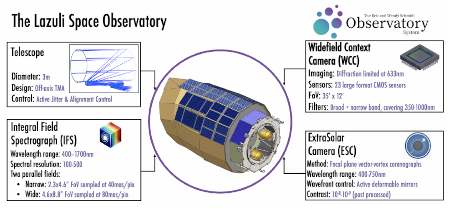
Lazuli
Figure 1 from the proposal paper [pdf].

Schmidt Sciences, a foundation created by one of Google’s founders, announced yesterday it is financing the construction of four new research telescopes, one of which will be an orbiting optical telescope with a mirror 3.1 meters in diameter, larger than the 2.4 meter primary mirror on the Hubble Space Telescope.

Today at a meeting of the American Astronomical Society, Schmidt Sciences, a foundation backed by billionaires Eric and Wendy Schmidt, announced one of the largest ever private investments in astronomy: funding for an orbiting observatory larger than NASA’s Hubble Space Telescope, along with funds to build three novel ground-based observatories. The project aims to have all four components up and running by the end of the decade.

“We’re providing a new set of windows into the universe,” says Stuart Feldman, president of Schmidt Sciences, which will manage the observatory system. Time on the telescopes will be open to scientists worldwide, and data harvested by them will be available in linked databases. Schmidt Sciences declined to say how much it is investing but Feldman says the space telescope, called Lazuli, alone will cost hundreds of millions of dollars.

Eric Schmidt was once CEO of Google, and in recent years has been spending his large fortune (estimated to exceed $50 billion) on space ventures. For example, in March 2025 he acquired control of the rocket startup Relativity.

While the three new ground-based telescopes will do important work, the Lazuli space telescope is by far the most important, not only scientifically but culturally. » Read more

29 comments

Detection of the wake of Betelgeuse’s companion star

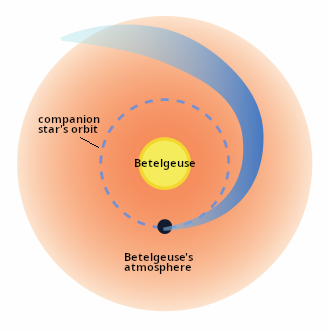
The wake of Betelgeuse's companion star

Astronomers believe they have detected evidence of the wake created by Betelgeuse’s companion star as it plows through the primary star’s vast atmosphere.

You can read their paper here [pdf]. The cartoon to the right, annotated by me to post here, is figure 5 of the paper, looking down at Betelgeuse’s pole. It is not to scale. The scientists have nicknamed the companion Siwarha.

The team detected Siwarha’s wake by carefully tracking changes in the star’s light over nearly eight years. These changes show the effects of the previously unconfirmed companion as it plows through the outer atmosphere of Betelgeuse. This discovery resolves one of the biggest mysteries about the giant star, helping scientists to explain how it behaves and evolves while opening new doors to understanding other massive stars nearing the end of their lives.

Located roughly 650 light-years away from Earth in the constellation Orion, Betelgeuse is a red supergiant star so large that more than 400 million Suns could fit inside. Because of its enormous size and proximity, Betelgeuse is one of the few stars whose surface and surrounding atmosphere can be directly observed by astronomers, making it an important and accessible laboratory for studying how giant stars age, lose mass, and eventually explode as supernovae.

Using NASA’s Hubble and ground-based telescopes at the Fred Lawrence Whipple Observatory and Roque de Los Muchachos Observatory, the team was able to see a pattern of changes in Betelgeuse, which provided clear evidence of a long-suspected companion star and its impact on the red supergiant’s outer atmosphere. Those include changes in the star’s spectrum, or the specific colors of light given off by different elements, and the speed and direction of gases in the outer atmosphere due to a trail of denser material, or wake. This trail appears just after the companion crosses in front of Betelgeuse every six years, or about 2,100 days, confirming theoretical models.

Betelgeuse is essentially a giant blob that undulates like a blob of water floating in weightlessness on ISS. Knowing the location and orbit of this companion will help astronomers better understand the central star’s periodic inexplicable changes.

4 comments

Hubble images gigantic protoplanetary disk

Largest known protoplanetary disk
Click for original image.

Cool image time! The picture to the right, rotated, cropped, and reduced to post here, was taken by the Hubble Space Telescope on February 8, 2025, and shows what scientists believe is the largest protoplanetary disk so far measured.

Located roughly 1,000 light-years from Earth, IRAS 23077+6707, nicknamed “Dracula’s Chivito,” spans nearly 400 billion miles — 40 times the diameter of our solar system to the outer edge of the Kuiper Belt of cometary bodies. The disk obscures the young star within it, which scientists believe may be either a hot, massive star, or a pair of stars. And the enormous disk is not only the largest known planet-forming disk; it’s also shaping up to be one of the most unusual.

…The impressive height of these features wasn’t the only thing that captured the attention of scientists. The new images revealed that vertically imposing filament-like features appear on just one side of the disk, while the other side appears to have a sharp edge and no visible filaments. This peculiar, lopsided structure suggests that dynamic processes, like the recent infall of dust and gas, or interactions with its surroundings, are shaping the disk.

You can read the peer-reviewed paper here [pdf]. The structure of this system has left them with more questions than answers. They can’t see the central star due to the dust. They don’t know if any planets exist as yet in the system. They don’t really understand the structural details that they can see.

1 comment

Two very different galaxies

Two very different galaxies.
Click for original.

Cool image time! The picture to the right, reduced and sharpened to post here, was released today as the Hubble picture of the week. From the caption:

The trick is that these galaxies are not actually very close. The large blue galaxy MCG-02-05-050 is located 65 million light-years from Earth; its brighter smaller companion MCG-02-05-050a, at 675 million light-years away, is over ten times the distance! Owing to this, MCG-02-05-050a is likely the larger galaxy of the two, and MCG-02-05-050 comparatively small. Their pairing in this image is simply an unlikely visual coincidence.

The smaller blue galaxy, also called Arp 4, has an active nucleus that emits a lot of energy, suggesting the presence of a supermassive black hole. Less is known about the more distant orange galaxy.

0 comments

The beginnings of a planetary nebula

Calabash Nebula
Click for original image.

Cool image time! The picture to the right, reduced and sharpened to post here, was taken by the Hubble Space Telescope back in 2017 but released this week by NASA’s PR department. It shows what astronomers have nicknamed the Calabash Nebula. From the Wikipedia page:

The Calabash Nebula, also known as the Rotten Egg Nebula or by its technical name OH 231.84 +4.22, is a protoplanetary nebula (PPN) 1.4 light years (13 Pm) long and located some 5,000 light years (47 Em) from Earth in the constellation Puppis. The name “Calabash Nebula” was first proposed in 1989 in an early paper on its expected nebular dynamics, based on the nebula’s appearance.[5] The Calabash is almost certainly a member of the open cluster Messier 46, as it has the same distance, radial velocity, and proper motion.[6] The central star is QX Puppis, a binary composed of a very cool Mira variable and an A-type main-sequence star.

The star in the center is an ancient red giant that is in the initial stages of dying. As it does so it periodically erupts, sending out jets of material from its poles. The result is this elongated shape. According to the release, “the gas shown in yellow is moving close to a million kilometers an hour.”

Over the next few thousand years these eruptions will shape the planetary nebula. Since the central star is actually a binary, those two stars will likely act like the blades in a mixer, adding more interesting forms to the material as it is shot out to form this nebula.

2 comments

A small galaxy with lots of massive stars

A small galaxy with many massive stars
Click for original image.

Cool image time! The picture to the right, cropped, reduced, and sharpened to post here, was taken by the Hubble Space Telescope and released this week as the European Space Agency’s (ESA) Hubble picture of the week.

This dwarf galaxy, 13 million light years away, is called Markarian 178 (Mrk 178). Though much smaller than the Milky Way, it is packed with massive stars. From the caption:

While the bulk of the galaxy is blue owing to an abundance of young, hot stars with little dust shrouding them, Mrk 178 gets a red hue from a collection of massive stars, which are especially concentrated in the brightest, reddish region near the galaxy’s edge. This azure cloud is home to a large number of rare objects called Wolf–Rayet stars. Wolf–Rayet stars are massive stars that are casting off their atmospheres through powerful winds. Because Mrk 178 contains so many Wolf–Rayet stars, the bright emission lines from these stars’ hot stellar winds are etched upon the galaxy’s spectrum. Particularly ionised hydrogen and oxygen appear as a red colour to Mrk 178 in this photo, observed using some of Hubble’s specialised light filters.

Massive stars enter the Wolf–Rayet phase just before they collapse into black holes or neutron stars. Because Wolf–Rayet stars last for only a few million years, researchers know that something must have triggered a recent burst of star formation in Mrk 178. At first glance, it’s not clear what could be the cause — Mrk 178 doesn’t seem to have any close galactic neighbours that could have stirred up its gas to form new stars. Astronomers believe that it was triggered by the interaction with a smaller satellite, as revealed by the presence of low surface brightness tidal features detected around Mrk 178 in deep imaging acquired with the Large Binocular Telescope.

And yet, these observations do not see this small satellite galaxy. It has either been completely absorbed into Mrk 178, or maybe this theory for explaining this dwarf galaxy’s make-up is flawed.

1 comment
1 2 3 15