A new hotspot map of Io, based on Juno data

Hot spot map of Io
Click for original figure.

Scientists have compiled a new map of the many volcanic hotspots on the Jupiter moon Io, based on data obtained by Juno, including 23 spots previously undetected. From the paper’s abstract:

We mapped the hot spot distribution on Io’s surface by analyzing the images acquired by the JIRAM instrument onboard the Juno spacecraft. We identified 242 hot spots, including 23 not present in other catalogs. A large number of the new hot spots identified are in the polar regions, specifically in the northern hemisphere. The comparison between our work and the most recent and updated catalog reveals that JIRAM detected 82% of the most powerful hot spots previously identified and half of the intermediate-power hot spots, thus showing that these are still active. JIRAM detected 16 out of the 34 faint hot spots previously reported.

The map above is taken from figure 2 of the paper. The data, when compared to other earlier data, confirms that many of these hot spots are long-lived, and have been erupting now for decades.

1 comment

Largest volcanic eruption in years detected on Io

Using instruments on a ground-based telescope, one scientist based at the Planetary Science Institute (PSI) in Arizona has detected the largest volcanic eruption in years on the Jupiter moon Io.

PSI Senior Scientist [Jeff] Morgenthaler has been using IoIO, located near Benson, Arizona to monitor volcanic activity on Io, since 2017. The observations show some sort of outburst nearly every year, but the largest yet was seen in the fall of 2022. Io is the innermost of Jupiter’s four large moons and is the most volcanic body in the Solar System thanks to the tidal stresses it feels from Jupiter and two of its other large satellites, Europa and Ganymede.

IoIO uses a coronagraphic technique which dims the light coming from Jupiter to enable imaging of faint gases near the very bright planet. A brightening of two of these gases, sodium and ionized sulfur, began between July and September 2022 and lasted until December 2022. The ionized sulfur, which forms a donut-like structure that encircles Jupiter and is called the Io plasma torus, was curiously not nearly as bright in this outburst as previously seen. “This could be telling us something about the composition of the volcanic activity that produced the outburst or it could be telling us that the torus is more efficient at ridding itself of material when more material is thrown into it,” Morgenthaler said.

The material released by this eruption could impact Juno during future close approaches of Jupiter.

0 comments

Juno snaps heat image of Jupiter’s volcano-covered moon Io

Io's volcanoes
Click for full image.

The image to the right, cropped and reduced to post here, was taken on July 5, 2022 by one of the infrared instruments on the Jupiter orbiter Juno of the moon Io, known for having many many active volcanoes.

This infrared image was derived from data collected by the Jovian Infrared Auroral Mapper (JIRAM) instrument aboard Juno. In this image, the brighter the color the higher the temperature recorded by JIRAM.

Each bright spot is an active volcano, some of which have been in the past photographed during eruptions. In fact, the first such photo was taken in March 1979 by the Voyager-1 spacecraft just after its fly-by of Jupiter, and was the first time any active volcano outside of Earth had ever been identified.

What made that discovery more profound was that only a week earlier scientists had published a paper predicting active volcanoes on Io, caused by the strong tidal forces from Jupiter’s gravity.

Since then planetary scientists have been studying Io’s volcanism repeatedly, tracking the evolution of specific volcanoes over time as they erupt and then become dormant.

1 comment

Dunes on Jupiter’s volcano moon Io?

Dunes on Io?
Click for full image.

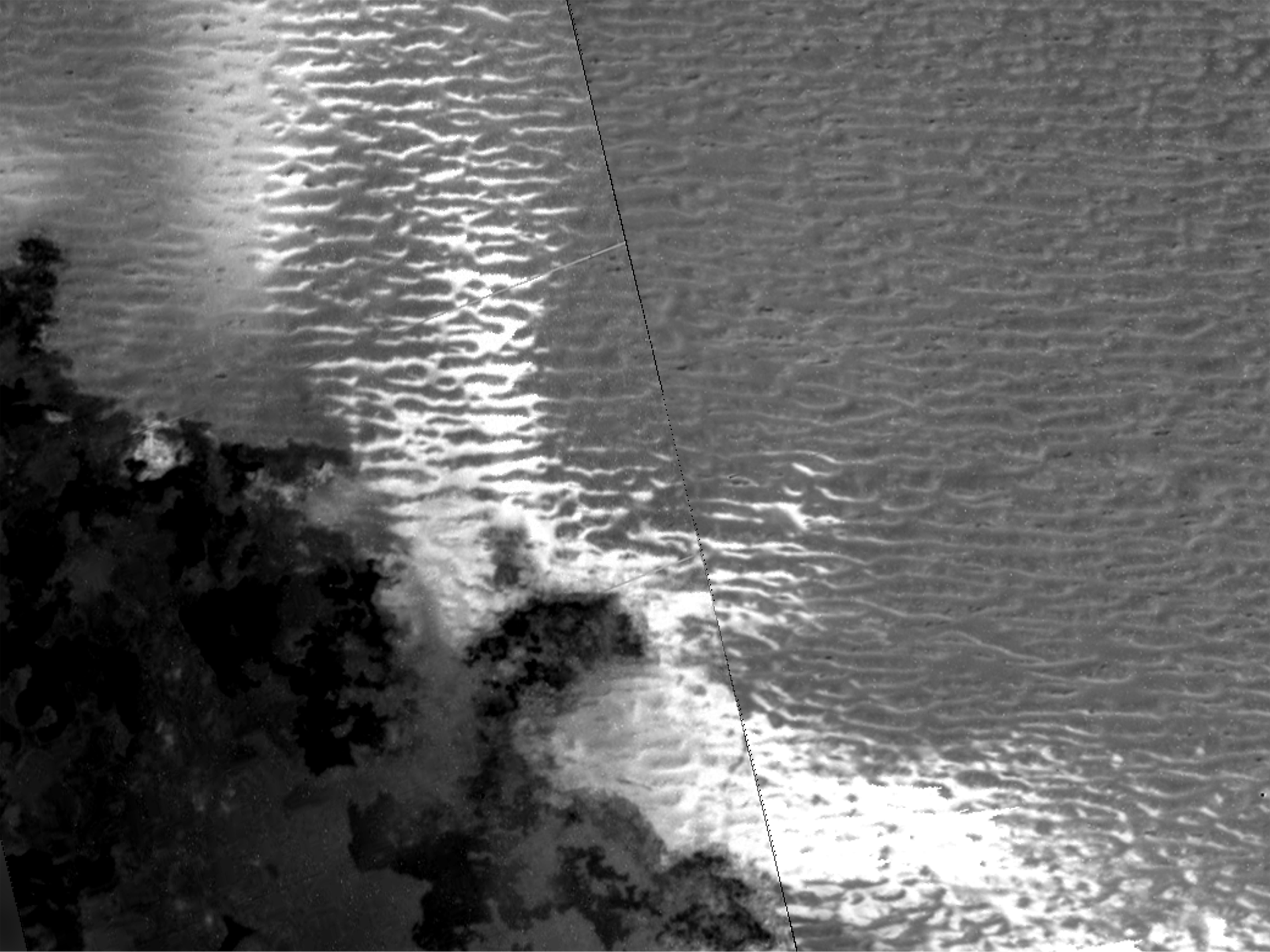
The uncertainty of science: According to a just published paper, scientists now propose that the dune-like ridges long known to exist on Io, Jupiter’s volcano-covered moon, might actually be dunes, even though Io has no real atmosphere.

The photo to the right, cropped, reduced, and annotated to post here, was taken by the Galileo while it orbited Jupiter from 1995 to 2003. It illustrates what the scientists believe is the proposed process:

McDonald and his colleagues used mathematical equations to simulate the force required to move grains on Io and calculated the path those grains would take. The study simulated the movement of a single grain of basalt or frost, revealing that the interaction between flowing lava and sulfur dioxide beneath the moon’s surface creates venting that is dense and fast moving enough to form large dune-like features on the moon’s surface, according to the statement.

In what might be a monumental understatement about the reality of interplanetary geology, McDonald said this in the press release: “This work tells us that the environments in which dunes are found are considerably more varied than the classical, endless desert landscapes on parts of Earth.”

Damn right. The possibility of unexpected geology of all kinds on the millions of planets, moon, and asteroids not yet studied is endless, and guaranteed.

3 comments

NASA extends mission of Juno and InSight probes

NASA has decided to extend the missions of Juno and InSight probes, giving both several more years to gather data.

InSight main goal for the two-year extension will be to gather more seismic data of Mars. They will also continue their efforts to get the heat sensor into the ground, but that will have a lower priority.

Juno will be able to slowly adjust its orbit to better study Jupiter’s north polar regions, thus developing a more complete first rough map of the gas giant’s internal structure and atmosphere. The changing orbit will also allow the first close fly-bys of some of Jupiter’s moons, the first in more than twenty years.

The moon flybys could begin in mid-2021 with an encounter with Ganymede, Jupiter’s largest moon, at a distance of roughly 600 miles (1,000 kilometers), Bolton said last year.

After a series of distant passes, Juno will swoop just 200 miles (320 kilometers) above Europa in late 2022 for a high-speed flyby. Only NASA’s Galileo spacecraft, which ended its mission in 2003, has come closer to Europa.

There are two encounters with Jupiter’s volcanic moon Io planned in 2024 at distances of about 900 miles (1,500 kilometers), according to the flight plan presented by Bolton last year. Juno will be able to look for changes on the surfaces of Jupiter’s moons since they were last seen up close by NASA’s Voyager and Galileo probes.

While it will take images, Juno’s camera is not particularly high resolution. The main effort will be to use its instruments to study the surface make-up of the moons.

9 comments

Io’s shadow on Jupiter

Io's shadow on Jupiter
Click for full image.

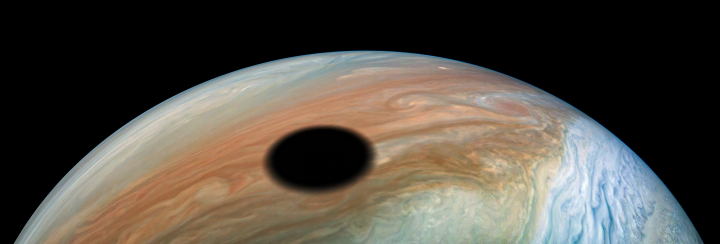
Citizen scientists Kevin Gill and Tanya Oleksuik have used raw images from Juno to create several really cool images of the eclipse shadow of Io moving across the face of Jupiter. The image above, by Gill, is what I think is the most dramatic. The other images are here, here, here, here, and here.

Oleksuik notes that the colors are not true, and are enhanced for drama. Also, the shadow in many of the images are much too large relative to the globe of Jupiter. The last link above gives a better sense of the true size of that shadow against Jupiter’s giant sphere. Io’s shadow only covers a tiny part of the surface. The reason it appears larger is that the whole image does not see the entire hemisphere.

1 comment

Io volcano erupts like Ol’ Faithful

Having determined that Io’s largest volcano appears to erupt on a regularly schedule, scientists have predicted that a new eruption should occur sometime in the next week or so.

The volcano Loki is expected to erupt in mid-September, 2019, according to a poster by Planetary Science Institute Senior Scientist Julie Rathbun presented today.

“Loki is the largest and most powerful volcano on Io, so bright in the infrared that we can detect it using telescopes on the Earth,” Rathbun said. Based on more than 20 years of observations, Loki undergoes periodic brightenings when it erupts on a relatively regular schedule. In the 1990s, that schedule was approximately every 540 days. It currently appears to be approximately every 475 days. Rathbun discovered the 540-day periodicity, described in her 2002 paper “L. Loki, Io: A periodic volcano” that appeared in Geophysical Research Letters.

These same scientists successfully predicted Loki’s last eruption based on this data, but also warn that there is no guarantee the volcano will do what they say. As stock brokers are required to say, past performance is no guarantee of future results.

0 comments

Scientists catch a big volcano eruption on Io

Scientists reviewing twenty year old data from the Galileo orbiter that studied Jupiter and its moons in the 1990s have identified the most intense volcanic eruption yet found on Io.

While looking through the NIMS temperature data, Davies and his colleagues spotted a brief but intense moment of high temperatures that cooled oddly quickly. This signal showed up as a spike in heat from a region in the southern hemisphere called Marduk Fluctus. First, the researchers saw a heat signal jump to 4–10 times higher than background, or relatively normal, levels. Then just a minute later, the signal dropped about 20%. Another minute later, the signal dropped another 75%. Twenty-three minutes later, the signal had plummeted to the equivalent of the background levels.

This signature resembled nothing Davies had seen before from Io. The lava flows and lava lakes are familiar: Their heat signals peter out slowly because as the surface of a lava flow cools, it creates a protective barrier of solid rock over a mushy, molten inside. Heat from magma underneath conducts through this newly formed crust and radiates from Io’s surface as it cools, which can take quite a long time.

This new heat signature, on the other hand, represents a process never before seen on Io, Davies said: something intense, powerful, and—most important—fast.

There’s only one likely explanation for what the instruments saw, explained Davies, whose volcanic expertise starts here on Earth. Large, violent eruptions like those seen at Stromboli are capable of spewing huge masses of tiny particles into the air, which cool quickly.

The article makes it sound like we’ve never seen this kind of eruption on Io before, which isn’t really true. Such eruptions have been imaged, but this is the first time that infrared data of their temperature spike was captured, thus confirming its nature.

0 comments

Io’s atmosphere freezes and reinflates daily

New data from the ground-based Gemini telescope suggests that Io’s sulfur dioxide atmosphere freezes and then reinflates each time the moon flies through Jupiter’s shadow.

A study led by SwRI’s Constantine Tsang concluded that Io’s thin atmosphere, which consists primarily of sulfur dioxide (SO2) gas emitted from volcanoes, collapses as the SO2 freezes onto the surface as ice when Io is shaded by Jupiter. When the moon moves out of eclipse and ice warms, the atmosphere reforms through sublimation, where ice converts directly to gas.

The data is somewhat uncertain, however, as it based on only two observations.

7 comments

The location of the volcanoes on Titan are not where scientists had expected them to be.

The uncertainty of science: The location of the volcanoes on Titan are not where scientists had expected them to be.

As Io moves closer to Jupiter, the planet’s powerful gravity pulls hard on the moon, deforming it. This force decreases as Io retreats, and the moon bounces back. This cycle of flexing creates friction in Io’s interior, which in turn generates enormous amounts of volcano-driving tidal heat. Common sense suggests that Io’s volcanoes would be located above the spots with the most dramatic internal heating. But Hamilton and his colleagues found that the volcanoes are significantly farther to the east than expected.

Many of the news headlines, including the article above, have trumpeted how the volcanoes on Io are in the wrong place. (See also this article.) Not. The theories were wrong, not the volcanoes. Nature does what it wants to do. It is our job to figure out why.

0 comments

The discovery of volcanoes on Io

discovery image

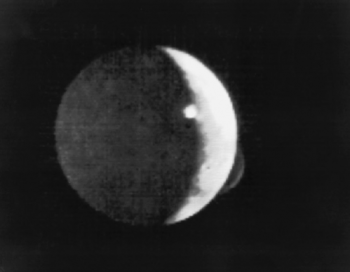
On March 8, 1979, as Voyager 1 was speeding away from Jupiter after its historic flyby of the gas giant three days earlier, it looked back at the planet and took some navigational images. Linda Morabito, one of the engineers in charge of using these navigational images to make sure the spacecraft was on its planned course, took one look at the image on the right, an overexposed image of the moon Io, and decided that it had captured something very unusual. On the limb of the moon was this strange shape that at first glance looked like another moon partly hidden behind Io. She and her fellow engineers immediately realized that this was not possible, and that the object was probably a plume coming up from the surface of Io. To their glee, they had taken the first image of an eruption of active volcano on another world!

Today, on the astro-ph preprint website, Morabito has published a minute-by-minute account of that discovery. It makes for fascinating reading, partly because the discovery was so exciting and unique, partly because it illustrated starkly the human nature of science research, and partly because of the amazing circumstances of that discovery. Only one week before, scientists has predicted active volcanism on Io in a paper published in the journal Science. To quote her abstract:
» Read more

0 comments

Scientists have published the first complete global geological map of the Jupiter moon Io.

Scientists have published the first complete global geological map of the Jupiter moon Io.

The highly detailed, colorful map reveals a number of volcanic features, including: paterae (caldera-like depressions), lava flow fields, tholi (volcanic domes), and plume deposits, in various shapes, sizes and colors, as well as high mountains and large expanses of sulfur- and sulfur dioxide-rich plains. The mapping identified 425 paterae, or individual volcanic centers. One feature you will not see on the geologic map is impact craters. “Io has no impact craters; it is the only object in the Solar System where we have not seen any impact craters, testifying to Io’s very active volcanic resurfacing,” says Williams.

You can download the map here.

0 comments
1 2