
First picture of hole that occurred on Soyuz in December

Hole in First picture of hole that occurred on Soyuz in December
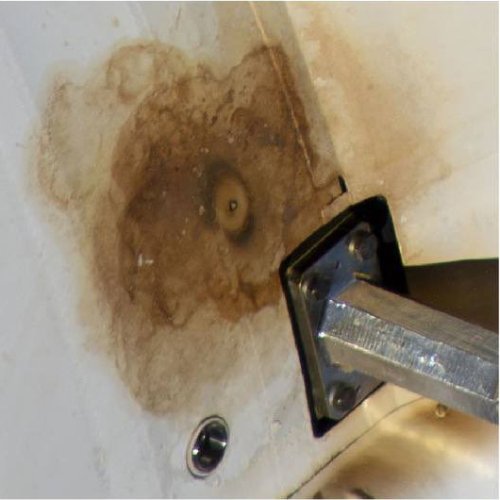
Russia has now released an image taken using the robot arm on ISS of the leak that occurred on its Soyuz capsule docked to ISS in December.

The picture to the right, cropped and reduced to post here, is that image. This is not the coolant leak hole on the Progress freighter on February 11th, this past weekend. As of now no image of that hole has ever been released.

No interpretation of this hole and the stain around it has as yet been released. However, Russia has now postponed the launch of the next Soyuz capsule from February 19th until early March in order “to give investigators time to rule out similar issues in the upcoming mission.” This Soyuz was to launch unmanned to replace the Soyuz that leaked in December and provide the astronauts that launched on that leaking Soyuz a safe lifeboat that they could come home on.

Meanwhile, all communications with ISS have now been shifted to the private channels, so the public cannot hear them.

All these actions strongly suggest that both the Russians and Americans are now seriously considering the possibility of sabotage or damage to the coolant systems on all Russian spacecraft, before they leave the factory and are launched.
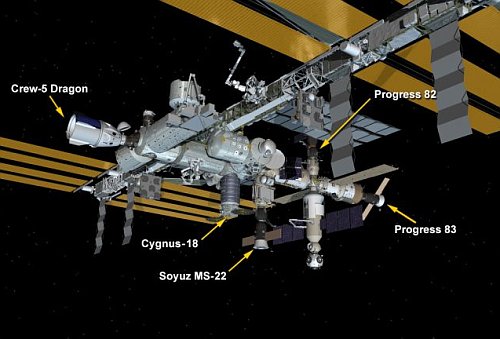
ISS as of February 11, 2023

To clarify the situation, the image to the right shows all the spacecraft presently docked to ISS. Progress 82 is the spacecraft that experienced a leak in its coolant system on February 11th. Soyuz-MS22 experienced a leak in its coolant system in December. At the moment the only safe vehicle for returning the seven astronauts on ISS is Crew-5 Dragon, SpaceX’s Endurance spacecraft. Should a major catastrophe occur requiring an immediate evacuation of the station, the plan right now is for five astronauts to come home on Endurance, and two Russians to come home on the damaged Soyuz. (The thinking is that having only two men on board will prevent too much of a temperature rise during the return to Earth because of the lack of its coolant system.)

With the delay in the launch of the replacement Soyuz lifeboat, this emergency plan will be in place for at least three weeks longer.

15 comments

Shortly after new Progress freighter docks with ISS, older Progress loses internal pressure

ISS as of February 11, 2023

Shortly after a new Progress freighter docked with ISS early today (shown as Progress 83 in the graphic to the right), the older Progress 82 lost internal pressure, possibly in its coolant system.

On February 11, Roskosmos, citing data from mission control, said that the Progress MS-21 cargo ship docked at the station lost pressure. According to the State Corporation, the hatch connecting the ship’s pressurized compartment with the rest of the station was closed and the vehicle was fully isolated from the ISS’ habitable volume.

…According to unofficial sources, the spacecraft lost all its cooling fluid from its Thermal Control System, SOTR. Several hours after the incident, NASA confirmed that the breach had been limited to the cooling system. At the same time, the US space agency said that the hatches between the cargo ship and the station had remained open, while temperatures and pressures aboard the outpost had remained normal. The subsequent publicly available exchange between the NASA mission control in Houston and a US astronaut Frank Rubio, aboard the ISS, indicated that the coolant system of the Progress MS-21 spacecraft had been completely emptied before the leak stopped.

The report is very unclear. In the first paragraph it suggests the freighter’s atmosphere had leaked out, while its hatches were closed and it was isolated from the station. The second paragraph suggests it only lost pressure and coolant from its coolant system, and the hatches had been open during the event.

Either way, this is the second Russian ferry spacecraft to experience such an event since mid-December, when the Soyuz capsule attached to ISS lost its coolant from what is believed to have been a small impact.

This particular Progress freighter is slated to be undocked from ISS on February 18th, when it will be de-orbited, burning up in the atmosphere over the Pacific. Thus, this leak appears to pose a relatively small risk to the station, as it probably has already been filled with station garbage and was likely ready for disposal anyway.

This incident however raises larger concerns. If it was caused by an impact from an external object, either micrometeorite or space junk, it suggests that the station might face a new increased risk of such events, quite possibly from debris from the Russian anti-satellite test in November 2021. As of November 2022 it was estimated that there were 444 objects still in orbit, with all but 18 expected to fall back to earth by 2025. It could be that one of those tracked objects hit ISS, or a different object that has not been tracked.

Or possibly we are seeing evidence of some quality control problem in the construction of these spacecraft, in Russia. Russia and NASA have still not revealed the results of the investigation into the hole that was drilled into the hull of a Soyuz capsule in 2018. Could there be some sabotage going on the ground in Russia that has not been identified that is designed to cause such leaks sometime after launch?

Some clarity on this issue is now becoming essential.

11 comments

Progress freighter launched to ISS

Russia today completed its second launch of 2023, successfully using its Soyuz-2 rocket to send a Progess freighter on its way to ISS.

The capsule will dock with the leaking Zvezda module on ISS on February 11th.

The 2023 launch race:

9 SpaceX
5 China
2 Russia
1 Rocket Lab
1 Japan

American private enterprise still leads China 10 to 5 in the national rankings, and the entire world combined 10 to 8.

0 comments

Russian Progress freighter successfully launches to ISS

Using its Soyuz-2 rocket Russia tonight successfully launched a new Progress freighter to ISS.

The spacecraft will take two days to rendezvous and dock with ISS, thus delivering 2.5 tons of cargo.

The leaders in the 2022 launch race:

48 SpaceX
45 China
18 Russia
8 Rocket Lab
7 ULA

American private enterprise still leads China 68 to 45 in the national rankings, though it now trails the rest of the world combined 72 to 68.

0 comments

Russia successfully launches Progress with new docking hub for ISS

Russia today successfully launched a new Progress freighter carrying Prichal, a new docking hub for the Russian half of ISS.

If all goes as planned, Prichal will dock to Nauka in two days.

The leaders in the 2021 launch race:

43 China
26 SpaceX
19 Russia
5 Europe (Arianespace)

China still leads the U.S. 43 to 41 in the national rankings. This launch was the 111th successful launch in 2021, which tied the number from 2018 that had been the highest since the 1990s.

4 comments

Russia launches Progress freighter to ISS

Using its Soyuz-2 rocket, Russia today successfully launched a Progress freighter to ISS, carrying more than 5,000 pounds of cargo.

The freighter is scheduled to dock with ISS Friday evening at 9:34 pm (Eastern). It will dock with the port on the 20-year-old Zvezda module, which has remained unused for the past six months because of concerns that the docking and undocking at the port was causing stress fractures in the sections of Zvezda closest to the port. The Russians have decided to do this docking for the express purpose of studying its impact on the module.

The Progress MS-18 spacecraft will link up with the rear docking port on Zvezda. With the help of cosmonauts on the station, Russian engineers have traced a small air leak on the station to the transfer compartment leading to Zvezda’s rear port. The compartment has been sealed from the rest of the space station since the departure of a previous Progress spacecraft from the rear docking port in April. But cosmonauts will re-open the compartment to unload cargo delivered by the Progress MS-18 spacecraft.

The leaders in the 2021 launch race:

38 China
23 SpaceX
18 Russia
4 Northrop Grumman
4 ULA
4 Arianespace (Europe)

China remains ahead of the U.S. 38 to 36 in the national rankings.

7 comments

Russian engineers to dock next Progress to Zvezda to test it

Russian engineers have decided that they will dock the next Progress freighter flying to ISS and scheduled to launch tomorrow to the Zvezda module in order to find out if the stress of that docking will cause more cracks in the module’s aft section.

Scheduled for launch in early hours of October 28, 2021, the Progress MS-18 cargo ship will be on a two-day trip to the International Space Station, aiming to dock at the aft port of the Zvezda Service Module, ISS. That particular docking mechanism was unoccupied for half a year, because it is connected to the rest of the outpost via the PrK transfer compartment, which had been leaking air despite all efforts to seal tiny cracks in its walls. Progress MS-18 should confirm that the PrK chamber could be used safely.

This is not crazy, it actually makes a great deal of sense. The engineers need to know if a docking results in more cracks. If so, it will confirm the cause and also provide them the data they need to prevent such things on future manned space vessels.

1 comment

Russia: Progress freighter and SpaceX rocket/satellite to have near miss

According to a Russia news outlet, their just launched Progress freighter will have a near miss today prior to its docking with ISS with two SpaceX objects, a Falcon 9 upper stage and a decommissioned Starlink satellite.

The Progress spacecraft, which carries about 3,600 lbs. (1,633 kilograms) of cargo including food, fuel and other supplies to the orbital outpost, launched from Roscomos’ Baikonur cosmodrome in Kazakhstan at 7:27 p.m. EDT (2327 GMT) on Tuesday (June 29). Progress 78 will approach the two objects about three and a half hours before its docking at the International Space Station, which is scheduled for 9:02 p.m. EDT on July 1 (0102 July 2 GMT).

The close approach, which triggered a potential collision alert, was detected by the Roscosmos TsNIIMash Main Information and Analytical Center of the Automated System for Warning of Hazardous Situations in Near-Earth Space (ASPOS OKP), Roscosmos said in the statement issued on the space agency’s website Wednesday (June 30) at 7:47 a.m. EDT (1147 GMT).

Based on preliminary calculations, the Starlink 1691 satellite will be just 0.9 miles (1.5 kilometers) away from Progress 78 on Thursday (July 1) at 5:32 p.m. EDT (2132 GMT). Three minutes later, a fragment of a Falcon 9 rocket booster left in orbit in 2020 is expected to approach the spaceship within 0.3 miles (500 meters).

Based on that timetable, the near miss has already occurred. No word yet on whether there were any issues.

What is interesting is that Russia should have known this prior to launch. It is routine procedure to consider known orbital objects in scheduling liftoffs. Either they knew and decided to purposely fly this close for political reasons (it allows them to slam SpaceX while also touting the dangers of space junk) or had not done their due diligence before launch.

1 comment

Russians launch Progress freighter; Virgin Orbit launches seven commercial satellites

This morning two launches occurred. First the Russians successfully launched a Progress freighter to ISS, using their Soyuz-2 rocket.

Second, Virgin Orbit successfully completed its second orbital launch with its air-launched LauncherOne rocket, which was its first operational commercial launch, placing seven smallsats into orbit for three customers. This was also its second launch in 2021.

If all goes as planned, SpaceX will complete a third launch today also, placing more than 80 smallsats in orbit with its Falcon 9 rocket. Until then, however, the leaders in the 2021 launch race are as follows:

19 SpaceX
18 China
10 Russia
3 Northrop Grumman

The U.S. now leads China 28-18 in the national rankings.

0 comments

Russia launches Progress freighter to ISS

Russia today successfully launched a new Progress freighter to ISS using its Soyuz-2 rocket, bring almost three tons of supplies to the station..

The 2021 launch race:

4 SpaceX
3 China
2 Russia
1 Rocket Lab
1 Virgin Orbit

The U.S. still leads China 6 to 3 in the national rankings. That lead should widen this week with three American launches scheduled, two Starlink launches from SpaceX and one Cygnus freighter from Northrop Grumman.

4 comments

Russia launches Progress freighter to ISS

Russia tonight successfully launched a new Progress freighter to ISS using its Soyuz-2 rocket.

The leaders in the 2020 launch race:

6 China
6 SpaceX
6 Russia

The U.S. now leads both China and Russia 10 to 6 in the national rankings. This is the first time that Russia has been able to keep up with China in launches in several years. Since China had expected to launch more times than Russia in 2020, this suggests that China’s launch rate has been reduced because of the Wuhan flu. It at least appears that many of their smaller launch rockets have suspended launches.

We have also heard nothing recently about China’s planned mid- to late-April first launch of its Long March 5B. With only six days left in the month, one wonders if this launch too has been delayed.

1 comment

Successful Russia and Rocket Lab launches

Two launches successfully took place in the early morning hours today. First Rocket Lab launched seven small satellites into orbit, including one that will release an artificial meteor shower. During that launch they also obtained telemetry of their first stage as it fell to Earth.

Rocket Lab CEO Peter Beck just tweeted that the Electron’s first stage performed well during today’s re-entry experiment. β€œElectron made it through wall! Solid telemetry all the way to sea level with a healthy stage. A massive step for recovery!!” Beck tweeted.

Russia in turn launched a Progress cargo capsule to ISS.

The leaders in the 2019 launch race:

27 China
19 Russia
12 SpaceX
7 Europe (Arianespace)
6 Rocket Lab

China now leads the U.S. 27 to 25 in the national rankings.

0 comments

“Damaged cable” causes Russians to delay Progress launch

Because of the discovery of a “damaged cable” on a Progress freighter, the Russians have delayed its launch from December 1 to December 6.

On the morning of November 25, Roskosmos announced that issues had been found during the preparations of Progress MS-13 for launch. “Problems are now resolved and the checks of onboard systems are ongoing,” the State Corporation said. “There will be a separate announcement on the launch date…” the announcement said, hinting that the planned December 1 launch window was no longer valid. Before the end of the work day in Moscow on November 25, Roskosmos posted an update announcing that the launch of Progress MS-13 had been rescheduled for December 6, 2019, at 12:34 Moscow Time, due to an issue with an onboard cable found by specialists from RKK Energia. The problem was resolved after the replacement of the cable, the company said. According to a posting on the online forum of the Novosti Kosmonavtiki magazine, specialists spent past two days trying to find a source of electric charge on the body of the spacecraft and then discovered a damaged cable in the vehicle’s instrument compartment. [emphasis mine]

Considering the drillhole found in an earlier Soyuz capsule, I cannot help wondering if this damage was intentional. The Russians never revealed if they had identified the culprit of that earlier damage, and the reports from Russia today are somewhat vague about this new damage.

This Progress launch had earlier been rescheduled from December 6 to avoid a conflict with the launch of a Dragon cargo capsule. There is no word yet on how that conflict will be mitigated now that the launch is back on that date.

1 comment

Russia launches and docks new Progress freighter to ISS

Russia today launched and quickly docked a new Progress freighter, to ISS, with the trip taking slightly over three hours.

I think this might have been the fastest flight to ISS, though if not it is certainly among the fastest.

The leaders in the 2019 launch race:

11 China
11 Russia
9 SpaceX
5 Europe (Arianespace)
4 India

The U.S. continues to lead in the national rankings, 15-11.

0 comments
1 2 3 4 5