China reveals its plans for the damaged Shenzhou-20 capsule docked to Tiangong-3

The Tiangong-3 station, as presently configured
The Tiangong-3 station, as presently configured,
with two Shenzou capsules docked at either end.

Having successfully docked Shenzhou-22 as a lifeboat to its Tiangong-3 space station last week, China’s state-run press yesterday outlined its plans for the damaged Shenzhou-20 capsule that is still docked to the station but cannot be used by its crew because of cracks in one viewport.

First, China’s space operations have decided to attempt a return of the capsule back to Earth, unmanned, so the damage can be inspected in greater detail. Before that happens however the astronauts on board the station will do their own inspection, including the possibility of adding a patch.

During a subsequent spacewalk, the Shenzhou-21 crew, who are now undertaking a six-month orbital stay, may be tasked with inspecting the cracked viewport. They may also perform protective work on it using specialized devices delivered by the Shenzhou-22 launch — a procedure still being validated in ground tests, said Ji in a recent CCTV interview.

A day prior to their planned return on Nov. 5, the Shenzhou-20 crew spotted an anomaly on the viewport’s edge — a triangular, paint-like mark. They photographed it from multiple angles and under different lights, while the station’s robotic arm cameras were employed to take supplemental external pictures.

The flaw was later identified as “penetrating cracks,” said Jia Shijin, chief designer of the crewed spaceship system from China Academy of Space Technology. “The space debris responsible is preliminarily judged to be less than a millimeter in size, but struck with extremely high speed.”

This description of the damage is the most detailed China as yet revealed. These details certainly fit the description of an impact from an outside source, though considering China’s general lack of transparency some skepticism should still be retained. For example, we still do not know if these “penetrating cracks” mean the capsule is no longer holding its atmosphere, or if the crew has closed the capsule’s hatch to keep the air loss to a minimum.

Either way, it appears China’s engineers are concerned that this damage could cause a major break-up of the capsule during re-entry, and are thus considering options for covering it during that return.

Is China preparing to return its stranded astronauts in its damaged Shenzhou capsule?

According to reports from China, it appears they are preparing to return the three-person Shenzhou-20 crew on their damaged Shenzhou-20 capsule on November 14, 2025, rather than launch a replacement capsule as had been rumored previously.

China has issued a temporary airspace restriction over Inner Mongolia for 3:20 to 3:50 a.m. Eastern (0820-0850 UTC, or 4:20-4:50 p.m. Beijing time) Nov. 14, according to a Notice to Airmen (NOTAM) published by the Hohhot Flight Information Region under the Civil Aviation Administration of China (CAAC).

The airspace closure notice matches an area covering the Dongfeng landing site, an area in Inner Mongolia roughly 60 to 90 kilometers to the east-southeast of the Jiuquan Satellite Launch Center, which has been used for all Shenzhou crewed spacecraft returns since 2021.

None of this is confirmed as yet, as China’s state-run press continues to be very secretive about this entire affair. It as yet not released any details about the damage to Shenzhou-20, nor has it been forthcoming with any details about the next steps it plans to take.

China launches weather satellite, dumps debris near Taiwan

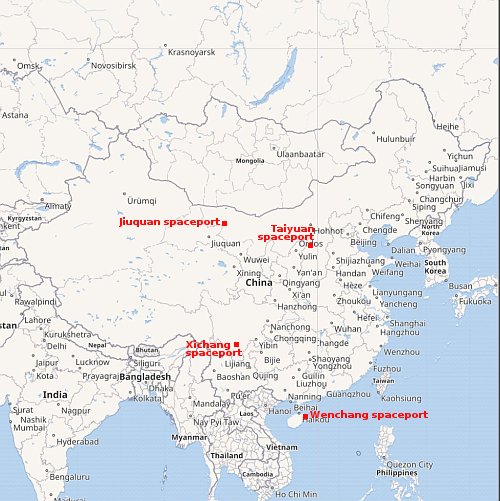
China's spaceports
China’s spaceports

China today successfully used its Long March 4D rocket to put a weather satellite into orbit, launching from its Jiuquan Satellite Launch Center in northwest China.

A short clip of the launch is available here [Hat tip Jay]. The material falling from the rocket are insulation panels that are intended to fall off in this manner.

Apparently, the flight path took it over Taiwan.

For six hours, air and maritime traffic was disrupted north of Taiwan. The maritime safety administration of Fujian, the Chinese province located opposite Taiwan, warned of a “possible fall of debris from a launcher.”

Taiwan’s Ministry of National Defense said it monitored what it described as a military launch and confirmed having “detected some debris falling into the northern waters of Taiwan.” 33 flights were affected, Taiwan’s Civil Aeronautics Administration said, quoted by Reuters.

The leaders in the 2023 launch race:

24 SpaceX
16 China
6 Russia
3 Rocket Lab

American private enterprise still leads China 27 to 16 in the national rankings, though it is now tied with the rest of the world combined at 27.