An Impulse tug using Starfish equipment has successfully completed autonomous rendezvous maneuvers
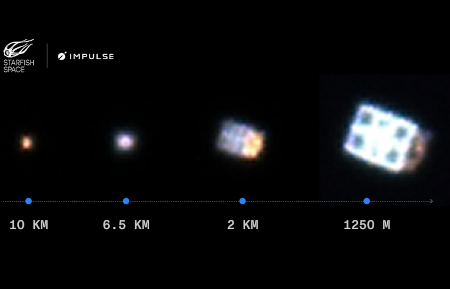
Images taken by Starfish’s camera.
A Mira orbital tug built by the startup Impulse Space has successfully completed rendezvous and proximity operations near a previously launched Mira tug, using software and equipment provided by the startup Starfish Space.
The Remora mission marked an industry first: a fully autonomous rendezvous executed by Starfish with a single lightweight camera system and closed-loop guidance, navigation and control software running on a peripheral flight computer.
Starfish and Impulse conducted the mission using Impulse’s Mira spacecraft that was flown on the Impulse LEO Express 2 mission. Starfish’s payloads enabled Mira to perform close-proximity maneuvers with another Impulse Mira spacecraft on orbit, which had been previously used for the LEO Express 1 mission. During operations in LEO, Starfish software autonomously controlled the LEO Express 2 Mira, guiding the satellite through a series of maneuvers which ultimately brought it to within approximately 1,250 meters of the LEO Express 1 Mira.
The significance of this test is its simplicity. Starfish has now demonstrated rendezvous technology that cubesats can use. Previously such precise maneuvers could only be done by larger satellites using more complex equipment. Starfish has orbital tug contracts using its own Otter tug, and will use this technology on those missions.
Impulse meanwhile demonstrated the maneuverability of its own Mira tug. And both companies demonstrated the ability to put this mission together quickly, in about nine months, and then launch it on a SpaceX rocket.
Images taken by Starfish’s camera.
A Mira orbital tug built by the startup Impulse Space has successfully completed rendezvous and proximity operations near a previously launched Mira tug, using software and equipment provided by the startup Starfish Space.
The Remora mission marked an industry first: a fully autonomous rendezvous executed by Starfish with a single lightweight camera system and closed-loop guidance, navigation and control software running on a peripheral flight computer.
Starfish and Impulse conducted the mission using Impulse’s Mira spacecraft that was flown on the Impulse LEO Express 2 mission. Starfish’s payloads enabled Mira to perform close-proximity maneuvers with another Impulse Mira spacecraft on orbit, which had been previously used for the LEO Express 1 mission. During operations in LEO, Starfish software autonomously controlled the LEO Express 2 Mira, guiding the satellite through a series of maneuvers which ultimately brought it to within approximately 1,250 meters of the LEO Express 1 Mira.
The significance of this test is its simplicity. Starfish has now demonstrated rendezvous technology that cubesats can use. Previously such precise maneuvers could only be done by larger satellites using more complex equipment. Starfish has orbital tug contracts using its own Otter tug, and will use this technology on those missions.
Impulse meanwhile demonstrated the maneuverability of its own Mira tug. And both companies demonstrated the ability to put this mission together quickly, in about nine months, and then launch it on a SpaceX rocket.