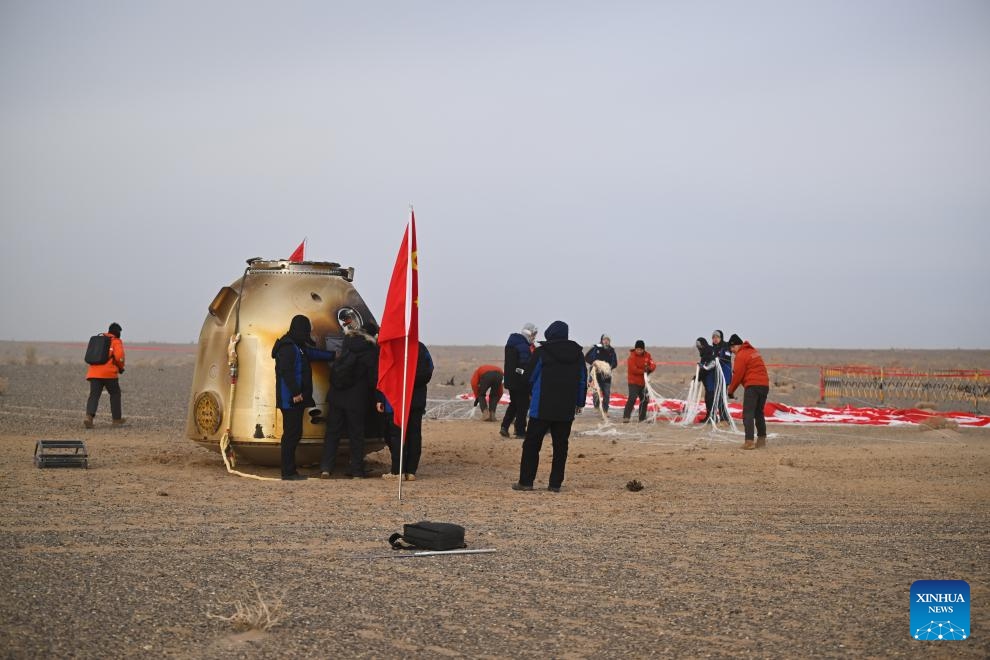
Chinese astronauts complete spacewalk inspecting damaged Shenzhou capsule

Two Chinese astronauts yesterday completed their first spacewalk since arriving on China’s Tiangong-3 space station, during which they inspected the damaged viewport on the Shenzhou-20 capsule as well as installed a cover to protective that damage when the capsule returns to Earth.

Shenzhou-21 mission commander Zhang Lu and rookie crewmate Wu Fei began an extravehicular activity (EVA) at 9:28 p.m. Eastern, Dec. 8 (0228 UTC, Dec. 9), when Zhang opened the Wentian experiment module airlock hatch and exited the Tiangong space station.

The more than eight-hour EVA concluded at 5:42 a.m. Eastern (1042 UTC) Dec. 9, with the pair safely back inside Tiangong. Zhang and Wu, wearing Feitian EVA suits with red and blue markings respectively, were assisted by the space station’s robotic arm, crewmate Zhang Hongzhang from inside Tiangong, and teams in mission control. New, upgraded Feitian suits were delivered to Tiangong via the July Tianzhou-9 cargo mission.

The first series of tasks centered on the Shenzhou-20 spacecraft, the return module of which suffered a suspected debris impact to a viewport window, rendering the spacecraft unsafe to return its three-astronaut crew to Earth in early November. At around 12:19 a.m. Eastern, Zhang Lu approached the viewport window of the Shenzhou-20 return module while attached to the Tiandong robotic arm and photographed and assessed the damage.

China has said that the damage was caused by a millimeter-sized object that impacted at high speed. It has yet however to release any images of the damage, and provided no other details.

Thus, we still do not know the damage’s exact nature, other than what that state-run press has told us. It could very well be that this damage was caused by some other factor that China does not wish to reveal.

NOTE: This is a recreation of a post published on December 10, 2025 that was lost during this morning’s server outage.

China reveals its plans for the damaged Shenzhou-20 capsule docked to Tiangong-3

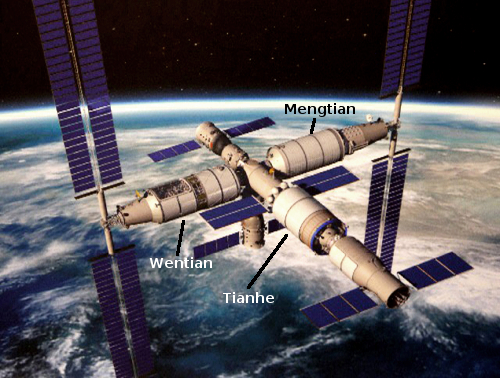
The Tiangong-3 station, as presently configured
The Tiangong-3 station, as presently configured,
with two Shenzou capsules docked at either end.

Having successfully docked Shenzhou-22 as a lifeboat to its Tiangong-3 space station last week, China’s state-run press yesterday outlined its plans for the damaged Shenzhou-20 capsule that is still docked to the station but cannot be used by its crew because of cracks in one viewport.

First, China’s space operations have decided to attempt a return of the capsule back to Earth, unmanned, so the damage can be inspected in greater detail. Before that happens however the astronauts on board the station will do their own inspection, including the possibility of adding a patch.

During a subsequent spacewalk, the Shenzhou-21 crew, who are now undertaking a six-month orbital stay, may be tasked with inspecting the cracked viewport. They may also perform protective work on it using specialized devices delivered by the Shenzhou-22 launch — a procedure still being validated in ground tests, said Ji in a recent CCTV interview.

A day prior to their planned return on Nov. 5, the Shenzhou-20 crew spotted an anomaly on the viewport’s edge — a triangular, paint-like mark. They photographed it from multiple angles and under different lights, while the station’s robotic arm cameras were employed to take supplemental external pictures.

The flaw was later identified as “penetrating cracks,” said Jia Shijin, chief designer of the crewed spaceship system from China Academy of Space Technology. “The space debris responsible is preliminarily judged to be less than a millimeter in size, but struck with extremely high speed.”

This description of the damage is the most detailed China as yet revealed. These details certainly fit the description of an impact from an outside source, though considering China’s general lack of transparency some skepticism should still be retained. For example, we still do not know if these “penetrating cracks” mean the capsule is no longer holding its atmosphere, or if the crew has closed the capsule’s hatch to keep the air loss to a minimum.

Either way, it appears China’s engineers are concerned that this damage could cause a major break-up of the capsule during re-entry, and are thus considering options for covering it during that return.

China launches unmanned Shenzhou-22 capsule to its Tiangong-3 station

UPDATE: The capsule successfully docked with Tiangong-3 as planned, thus giving its three astronauts a lifeboat again.

China tonight (November 25, 2025 Chinese local time) successfully launched an unmanned Shenzhou-22 capsule to its Tiangong-3 station, its Long March 2F rocket lifting off from its Jiuquan spaceport in northwest China.

China moved very fast to get this rocket and capsule integrated and stacked and ready to launch, less than three weeks. This speed was essential because the three-person crew on Tiangong-3 had no usable lifeboat capsule which they could use should something go wrong and they needed to evacuate. Their capsule, Shenzhou-21, had been used by the previous crew to get back to Earth because that crew’s capsule, Shenzhou-20, had been damaged by “space debris,” according to China’s state-run press.

The capsule is scheduled to dock with Tiangong-3 later in the day, about six hours after launch.

No word by China’s press where the rocket’s lower stages crashed inside China.

The leaders in the 2025 launch race:

154 SpaceX
73 China (a new record)
15 Rocket Lab
13 Russia

SpaceX still leads the rest of the world in successful launches, 154 to 121.

Will China launch a rescue Shenzhou capsule to Tiangong-3 in one week?

The Tiangong-3 station, as presently configured

According to this report at Space News late yesterday, China has issued a road closure notice for its Jiuquan spaceport in northwest China suggesting it will launch a Long March 2F rocket carrying a rescue Shenzhou capsule to Tiangong-3 on November 25, 2025, one week from today.

An airspace closure notice issued Nov. 17 indicates that China is preparing the Shenzhou-22 spacecraft and a Long March 2F rocket for launch at around 11:10 p.m. Eastern Nov. 24 (0410 UTC, Nov. 25) from Jiuquan Satellite Launch Center in the Gobi Desert. China’s human spaceflight agency has yet to publicly announce the plan. [emphasis mine]

This rescue mission is necessary because the Shenzhou-20 capsule that brought the previous crew to the station is now unusable, having sustained damage in one window from an impact of “space debris.” That crew came back to Earth last week on the Shenzhou-21 that ferried the present crew to space, leaving that present crew without a lifeboat.

The highlighted sentence is important, because it is very possible that road closure notice could be for a different launch not yet announced by China. It is quite routine for China to keep the specifics of a launch secret until the last minute, which means it is dangerous to assume this road closure is specifically for the Long March 2F rocket set to carry the Shenzhou-22 capsule to Tiangong-3.

Previous reports only yesterday had noted that preparing that rocket and capsule would likely take at a minimum 10 to 20 days, and even that schedule would be “difficult.” Getting ready in only one week thus seems unlikely.

At the same time, there is great urgency to launch, as the three-person crew presently on Tiangong-3 has no lifeboat there should anything serious go wrong.

Expect China’s state-run press to clarify the situation, when it decides to do so.

China begins hurried preparations to launch rescue Shenzhou capsule to Tiangong-3

The Tiangong-3 station, as presently configured

According to China’s state run press, it has begun emergency procedures to quickly launch the Shenzhou-22 capsule — originally scheduled to carry the next crew to its Tiangong-3 station in April 2026 — in order to provide the present station crew a lifeboat and a return capsule.

The China Manned Space Agency has started preparations for the launch of an unmanned spacecraft to carry a full cargo load, including provisions for astronauts and equipment for the Tiangong space station, according to a senior engineer. Zhou Yaqiang, who works with the agency’s general technical bureau, told China Central Television on Saturday that all systems involved in the upcoming Shenzhou-22 cargo mission “are busy getting ready for it, testing the rocket and the spaceship and preparing the payloads”.

The Shenzhou-22 spacecraft will be launched in due course to dock with the Tiangong space station, the agency said.

The report provided no details on when this launch would occur, though another Chinese report said getting the rocket (a Long March 2F) and capsule ready in the next 10 to 20 days would be “difficult.”

At the moment, the three astronauts on Tiangong-3 have no lifeboat. Should anything go wrong at the station before that launch they will have no way to get back to Earth, unless they use the damaged Shenzhou-21 capsule still docked to the station. That capsule has cracks in a window, caused by what the Chinese think was an impact from “space debris.” The Chinese have already determined it is not safe for human travel. Thus, using it in an emergency would be a desperate act.

Since the first space station, Salyut-1, was launched and occupied in 1971, this is the first time that a crew has been in space with absolutely no way to get home. The press last year repeatedly claimed the Starliner crew was “stranded” on ISS, but that wasn’t so. They could have always come home on their Starliner craft, as was proven when it returned unmanned with no problems. NASA had simply made the decision to be cautious and wait for the launch of next Dragon to bring them home instead.

China’s Shenzhou-20 crew on Tiangong-3 returns on Shenzhou-21 capsule

The Tiangong-3 station, as presently configured

After about a week of analysis, China today announced that the Shenzhou-20 capsule was too badly damaged to bring its crew back from its Tiangong-3 space station.

In making that announcement China finally revealed some details about the damage.

Tiny cracks have been found in the return capsule’s viewport window, which are most probably caused by external impact from space debris, according to the [China Manned Space Agency (CMSA).]

To get that crew home, which had already spent almost seven months in orbit, China had them board the Shenzhou-21 capsule that had only launched two weeks earlier on October 31, 2025 and use it to return to Earth today.

This leaves the present three astronauts on Tiangong-3 without any way to get back to Earth should something go wrong with the station.

China apparently had limited options. It doesn’t have enough docking ports on Tiangong-3 to dock three Shenzhou capsules to it, so one capsule had to undock and leave the station to make room for a replacement capsule.

Undocking Shenzhou-21 however is puzzling. Why didn’t China instead undock the damaged Shenzhou-20 capsule and de-orbit it? Had it done so, the six astronauts would have had only one lifeboat for three, but the docking port would have been opened for a new rescue capsule. There have been indications that China is preparing the next Shenzhou-22 capsule and a Long March 2F rocket for launch, though China has not provided any information about when that launch will occur.

With Shenzhou-21 gone, the three remaining Tiangong-3 astronauts are truly stranded in space, with no way home.

Is China preparing to return its stranded astronauts in its damaged Shenzhou capsule?

According to reports from China, it appears they are preparing to return the three-person Shenzhou-20 crew on their damaged Shenzhou-20 capsule on November 14, 2025, rather than launch a replacement capsule as had been rumored previously.

China has issued a temporary airspace restriction over Inner Mongolia for 3:20 to 3:50 a.m. Eastern (0820-0850 UTC, or 4:20-4:50 p.m. Beijing time) Nov. 14, according to a Notice to Airmen (NOTAM) published by the Hohhot Flight Information Region under the Civil Aviation Administration of China (CAAC).

The airspace closure notice matches an area covering the Dongfeng landing site, an area in Inner Mongolia roughly 60 to 90 kilometers to the east-southeast of the Jiuquan Satellite Launch Center, which has been used for all Shenzhou crewed spacecraft returns since 2021.

None of this is confirmed as yet, as China’s state-run press continues to be very secretive about this entire affair. It as yet not released any details about the damage to Shenzhou-20, nor has it been forthcoming with any details about the next steps it plans to take.

China delays return of Shenzhou 20 crew due to possible capsule damage from “space debris”

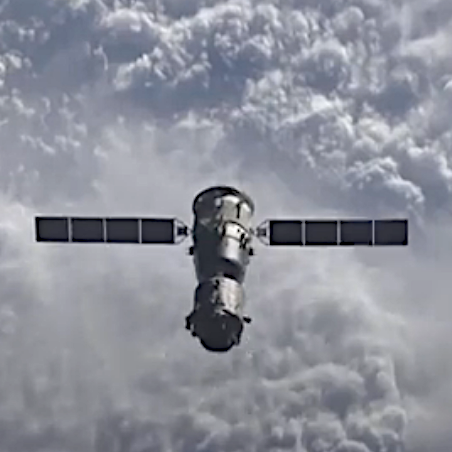
Shenzhou-16 after undocking in 2023
Shenzhou-16 after undocking in 2023. Click for source.

In a very brief statement today by China’s state-run press, it announced the planned return on November 6, 2025 of the Shenzhou-20 crew that has just completed their six month mission on the Tiangong-3 space station has been delayed indefinitely due to “a suspected impact from tiny space debris” on their Shenzhou capsule.

According to the statement “impact analysis and risk assessment are under way.”

A new crew arrived at the station on October 31, 2025 on the Shenzhou 21-capsule, and after a few days transition were to take over operations while the crew of Shenzhou-20 returned home.

We do not know the extent of the damage or even when it was first detected. Depending on the damage, China has several options. First, after review it could decide to return the crew on Shenzhou-20.

Second, it could decide that a fresh replacement capsule needs to be launched. If so, the old crew’s mission might be extended for a few months, as happened to a Soyuz crew on ISS in 2023 because of a leaking coolant system. First Russia launched a new empty capsule to ISS, and then the damaged capsule returned unoccupied. That way a lifeboat was always docked for that stranded crew.

It might also be possible to patch the damage, depending on its size and location.

In every case, the situation should not be critical. I am assuming the station is well stocked at this time, so that a crew of six instead of three could manage there for about three months. I am also assuming China has more Shenzhou capsules in the pipeline and can prepare a new one relatively quickly. Finally, I am also assuming China’s Shenzhou capsules can dock autonomously, as do their unmanned Tianzhou freighters.

And then again, if any of my assumptions are wrong, this situation could become more serious.

China launches three astronauts to its Tiangong-3 space station

China today successfully launched a new crew of three astronauts to its Tiangong-3 space station, its Long March 2F rocket lifting off from its Jiuquan spaceport in northwest China.

No word from China’s state-run press where the rocket’s lower stages, which use very toxic hypergolic fuels, crashed. The Shenzhou capsule is expected to dock with the station later today, which is tomorrow in China.

With this launch, China also tied the record it set in 2023 for the most successful launches in a single year, 66. The leaders in the 2025 launch race:

141 SpaceX
66 China
13 Russia
13 Rocket Lab

SpaceX still leads the rest of the world in successful launches, 141 to 108.

China launches cargo ship to its Tiangong-3 space station

China today successfully launched a new Tianzhou cargo ship to its Tiangong-3 space station, its Long March 7 rocket lifting off from its coastal Wenchang spaceport.

The freighter subsequently docked with the station about three hours later.

The leaders in the 2025 launch race:

86 SpaceX
37 China
10 Rocket Lab
8 Russia

SpaceX still leads the rest of the world in successful launches, 86 to 64.

China reports discovery of new microbe on its Tiangong-3 space station

China’s state-run press yesterday announced the discovery of a new microbe on its Tiangong-3 space station that appears designed to survive in the harsh environment of space.

In May 2023, the Shenzhou-15 crew collected surface microbial samples using sterile wipes, preserving them at low temperatures in orbit. Subsequent ground analysis revealed the novel Niallia tiangongensis species, confirmed through multidisciplinary methods including morphological analysis, genome sequencing, phylogenetic studies and metabolic profiling, the CMSA said.

…Niallia tiangongensis demonstrates exceptional stress resistance, maintaining cellular redox balance and ensuring robust growth in extreme conditions by regulating bacillithiol (BSH) biosynthesis to counteract space-induced oxidative stress, according to the CMSA. It exhibits distinctive capabilities in biofilm formation and radiation damage repair, making it a highly adaptable “all-rounder” for space environments.

More information here. This new microbe has characteristics both different and similar to microbes found on ISS. Its discovery is also not that unique, a it appears such unusual and new biology has been found in other space-related environments, such as the clean rooms on Earth used to build spacecraft. For example, dozens were found in clean room for the Phoenix Mars lander in the early 2000s.

China hints that it is moving forward with expansion of Tiangong-3 space station

According to a statement by one Chinese official, China will use its Long March 5B rocket to soon launch more modules to its Tiangong-3 space station, expanding the station’s size considerably.

“According to the plan, the Long March 5B rocket will also carry out the future launches of additional modules for the crewed space station,” Wang Jue from China Aerospace Science and Technology Corporation (CASC) told China Central Television (CCTV) April 30. No official timeline has been released for the missions, but the comments appear to confirm plans to add modules to Tiangong, a T-shaped, three-module orbital outpost constructed across 2021-2022.

In 2022 China had hinted on this same plan, but it is three years later and nothing has yet happened. It could be this statement was an attempt at lobbying by this official, trying to convince the government to finance the new modules. Or it could be the first new module, a hub with six docking ports that will allow the additional fullsize modules to be attached, is nearing completion and launch.

Who knows? One must take all such proclamations from China with a grain of salt.

The article also notes the revisions to the Long March 5B rocket so that its core stage no longer reaches orbit to subsequently crash uncontrolled somewhere on Earth. Instead, the upper stage has been upgraded so that it gets the payload into orbit and the core stage shuts down earlier and thus falls into the ocean immediately after launch.

Hat tip to BtB’s stringer Jay.

Chinese crew returns safely after six months in space

A Chinese crew of three safely landed in northern China today after completing a six month mission on China’s Tiangong-3 space station.

The return capsule of the Shenzhou-19 crewed spaceship, carrying astronauts Cai Xuzhe, Song Lingdong and Wang Haoze, touched down at the Dongfeng landing site in north China’s Inner Mongolia Autonomous Region on Wednesday. The three astronauts are all in good health condition, according to the China Manned Space Agency.

Lots of pictures of the landing and recovery at the link, but that’s pretty much the entire text of the press release from China’s state-run press. As that state-run press does routinely, it repeats that same text as the caption under every picture, over and over again, changing it only slightly for the close-up pictures of each astronaut.

A new crew took over for this one on Tiangong-3, beginning their own six month mission. At the moment China has completed three years of continuous occupation out of a planned ten-year mission.

China launches three astronauts to Tiangong-3 space station

China today successfully launched a new crew of three astronauts for a six-month mission on its Tiangog-3 space station, its Long March 2F rocket lifting off from its Jiuquan spaceport in northwest China.

The crew’s Shenzhou capsule will dock autonomously with the station later today. This was China’s fifteenth manned mission and ninth to the station, which it has now occupied continuously for more than three and a half years.

The rocket’s core stage and four strap-on boosters crashed somewhere inside China. No word on where or whether they crashed near any habitable areas.

The leaders in the 2025 launch race:

46 SpaceX
21 China
5 Rocket Lab
5 Russia

SpaceX now leads the rest of the world in successful launches, 46 to 36.

China launches Tianzhou cargo freighter to its Tiangong-3 space station

China today successfully launched a new Tianzhou cargo freighter to its Tiangong-3 space station, its Long March 7 rocket lifting off from its coastal Wenchang spaceport.

The leaders in the 2024 launch race:

114 SpaceX
53 China
13 Russia
12 Rocket Lab

American private enterprise still leads the rest of the world combined in successful launches 132 to 79, while SpaceX by itself leads the entire world, including American companies, 114 to 97.

Three Chinese astronauts return to Earth

Three Chinese astronauts safely landed in Mongolia today after completing a six month mission on China’s Tiangong-3 space station.

Ye Guangfu, on his second flight, and two rookies, Li Cong and Li Guansu, lifted off on April 25, 2024 at 8:59 am EDT and docked about six-and-a-half hours later. They’ve been aboard the past six months conducting scientific experiments and performing maintenance activities including a space walk.

They landed today, November 3, at 12:24 pm EST at the Dongfeng landing site in the Inner Mongolia Autonomous Region. China is 13 hours ahead of EST, so it was a nighttime landing there at 1:34 am November 4. China’s CGTN television network provided live coverage. Descent and touchdown were captured by infrared cameras.

A new crew has taken over occupancy of Tiangong-3, and has now started its own six month mission.

China launches new crew to its space station

China today successfully launched a new three-person crew to its Tiangong-3 space station, its Long March 2F rocket lifting off from its Jiuquan spaceport in northwest China.

No word on where the rocket’s side boosters or lower stages, using toxic hypergolic fuel, crashed inside China. The crew will dock with the station mid-day tomorrow.

The leaders in the 2024 launch race:

105 SpaceX
49 China
11 Russia
11 Rocket Lab

American private enterprise still leads the rest of the world combined in successful launches 122 to 72, while SpaceX by itself still leads the entire world, including American companies, 105 to 89.

China launches three astronauts to its space station

Earlier today China successfully launched a three-person crew to its Tiangong-3 space station, its Long March 2F rocket lifting off from its Jiuquan spaceport in the northwest of China.

No word on where the four strap-on boosters, the payload fairing, the core stages, and the upper stage crashed inside China, using very toxic hypergolic fuels. This new crew will replace the present crew, who are completing a six-month tour. The new crew will complete a similar-length mission.

The leaders in the 2024 launch race:

42 SpaceX
17 China
6 Russia
5 Rocket Lab

American private enterprise still leads the rest of the world combined in successful launches 49 to 29, while SpaceX by itself still leads the rest of the world, including other American companies, 42 to 36.

Chinese astronauts do spacewalk to repair Tiangong-3 solar panel

Two Chinese astronauts yesterday completed a 7.5 hour spacewalk on that country’s Tiangong-3 space station to test a repair technique to what the state-run press said was minor damage on a solar panel from micrometeorites.

The EVA posed new challenges for the astronauts, according to Dong Nengli, deputy chief designer of China’s human spaceflight program. “For the previous extravehicular activities, the major tasks for astronauts were to install and check. This round of extravehicular activities on Thursday we call experimental servicing,” Dong told CCTV. “This time the astronauts operated on one of the solar wings. It is flexible, to a certain extent, and also very thin, which limits the space of operation to a certain degree,” Dong said.

Dong added that the successful EVA meant the teams had mastered the ability for some extravehicular repairs. Success was thus, “laying a solid foundation for us to guarantee the space station’s safety and reliability in the future.”

It must be noted that no specific details about what was done were provided, nor did the short video released by China showing highlights of the spacewalk show the specific repair work.

Nonetheless, there is an aspect of China’s space station that makes it a far more powerful national symbol than ISS: It is China’s alone, built, launched, occupied, and maintained by China alone. It fuels national pride in a way that ISS never has, because President Bill Clinton decided to use it in the 1990s for foreign policy concerns by giving the Russians an equal partnership. Neither the U.S. nor Russia have obtained the same kind of prestige at home and abroad because neither really built ISS on their own. It was a shared effort, which meant neither could claim it.

China delays till ’25 the launch of its Hubble-class optical space telescope

China today revealed that it is delaying the the launch of its Xuntian space telescope from early next year to 2025.

Zhan Hu, project scientist of Xuntian space telescope system, revealed that the delay was necessary for the team to finalize a preflight “engineering qualification model.” This model will undergo rigorous performance tests early next year. Despite the setback, China is making significant strides by domestically developing all five instruments for Xuntian, a first for the country, Scientific American reported.

The optical telescope, designed to somewhat comparable to Hubble, is intended to fly close to China’s Tiangong-3 space station where astronauts will periodically fly over to do maintenance and repair. Its primary mirror, two meters in diameter, is only slightly smaller than Hubble’s 2.4 meter mirror.

The article says the launch was supposed to happen before the end of this year, but that is incorrect. The launch has been targeting the spring of 2024 since February.

During landing Shenzhou’s single parachute appeared damaged

A closer look at imagery during the descent by parachute of China’s manned Shenzhou capsule, bringing three astronauts back from Tiangong-3 after a five month mission on October 31, 2023, shows that the capsule’s single parachute had a ripped hole.

In some of the footage, a patch of blue sky can be seen through the red-and-white-banded parachute. Inside the capsule were Shenzhou 16 mission commander Jing Haipeng and crewmates Zhu Yangzhu and Gui Haichao — the latter pair returning to Earth after their first mission to space.

Such a sizable hole, which was visible before a white cloud of vented propellant left the Shenzhou capsule, has not been reported during earlier missions. It did not, however, seem to affect operations.

The landing however was very rough, with the capsule tumbling several times after hitting the ground.

Considering that China presently as three astronauts on Tiangong-3 that have to come home in their own Shenzhou capsule, using this same parachute system, finding out what happened seems imperative. Developing its next generation larger capsule, which will return using three parachutes, also appears essential.

Chinese crew completes five-month mission on Tiangong-3 after return to Earth

The new colonial movement: A three-man Chinese crew successfully landed today in north China in their Shenzhou capsule, completing a five-month mission on the Tiangong-3 space station.

The full mission length was 154 days. China claims that one of the astronauts was a civilian, but that really means nothing considering the security required to participate in these missions.

The crew that has taken over on Tiangong-3 are expected to do a mission of comparable length, probably pushing the length to six-months.

China launches new three-man crew to its Tiangong-3 space station

The new colonial movement: China today successfully used its Long March 2F rocket to place a Shenzhou manned capsule into orbit, carrying a new three-man crew to its Tiangong-3 space station and lifting off from its Jiuquan spaceport in northwest China.

Though relatively little specific information about the crew’s mission has been revealed, it is expected they will do a six month mission, as have previous crews, and conduct spacewalks and maintenance on the station. Meanwhile, the present crew on board will spend about a week transferring duties to the new crew, and then return to Earth after completing its own six-month mission.

No word on where the Long March 2F first stage and its four side boosters crashed in the interior of China, all of which use toxic hypergolic fuels.

The leaders in the 2023 launch race:

76 SpaceX
48 China
13 Russia
7 Rocket Lab
7 India

American private enterprise still leads China 88 to 48 in successful launches, and the entire world combined 88 to 76. SpaceX by itself is now tied at 76 with the rest of the world (excluding American companies).

Tianzhou unmanned freighter completes month-long free flight, re-docks with Tiangong-3

Engineers today successfully re-docked a Tianzhou unmanned freighter to China’s Tiangong-3 space station after 33 days flying in formation with the station.

As is usual, China released no information about the reasoning behind this free flight, though some reasons are obvious. The station has two docking ports, and during that 33-day time period the station also completed a crew swap, with one Shenzhou capsule docking with three new astronauts while the previous crew and its Shenzhou capsule was still docked. The Tianzhou freighter had to undock to provide a port during this time period for the two manned capsules.

This formation free flight and docking was also likely testing the kind of routine maneuvers China plans to do when it launches its Hubble-class optical space telescope next year. That telescope will fly freely near the station during most of its operations. For maintenance and repair however it is my understanding that it will be brought back to the station and docked with it. The just completed independent flight of the Tianzhou freighter demonstrated this capability.

Three astronauts return to Earth safely from China’s Tiangong-3 space station

After completing six months in space on China7s Tiangong-3 space station, three astronauts safely returned to Earth yesterday, with their Shenzhou capsule touching down in inner Mongolia.

This mission was the first full six month mission on the station. During their mission they completed four spacewalks. Though little was published about what was accomplished on those EVAs, it is likely it involved completing the construction of the station as well as installing some exterior experiments.

Chinese launch yesterday set record for number of humans in space

The launch yesterday of three Chinese astronauts to that country’s Tiangong-3 space station established a new record, seventeen, for the number of humans in space.

The launch of the next crew to China’s Tiangong space station late Monday (U.S. time) added three astronauts to the population of humans in space, which reached a record number of 17 people in orbit — six Chinese citizens, five Americans, three Russians, two Saudis, and one Emirati astronaut.

The arrival of Chinese astronauts Jing Haipeng, Zhu Yangzhu, and Gai Haichao in space following their launch atop a Long March rocket broke the previous record of 14 people in orbit at one time.

Meanwhile, the four-person crew of the commercial AX-2 mission to ISS, has undocked from ISS, with SpaceX’s Freedom capsule expected to splashdown in the Gulf of Mexico at 11:09 pm (Eastern) tonight.

China sends a new crew to its Tiangong-3 space station

Using its Long March 2F rocket, China today (May 30th in China) sent a new three-man crew to its Tiangong-3 space station for a five month mission.

The launch was from the Juiquan spaceport in the interior of China, so both the four side strap-on boosters as well as the core stage crashed somewhere in China. No word of any damage or injuries.

The Shenzhou capsule is expected to dock with the station about six hours after launch. The old crew’s stay will overlap with this new crew for a short time before returning to Earth.

The leaders in the 2023 launch race:

35 SpaceX
20 China
8 Russia
5 Rocket Lab

American private enterprise still leads China 40 to 20 in the national rankings, and the entire world combined 40 to 36. SpaceX alone now trials the rest of the world combined 35 to 36, but trails the entire world including American companies 35 to 41.

China unveils next Shenzhou launch date and crew to its space station

China today revealed the next three-man crew to occupy its Tiangong-3 space station, with a planned launch in a Shenzhou crew capsule targeting May 30, 2023, Chinese time.

Because of time differences, that launch will occur tonight at 6:28 pm tonight, Pacific time. The rocket will be a Long March 2F taking off from China’s western interior Jiuquan spaceport. The rocket’s lower stages will therefore crash somewhere in China.

The crew will remain on board the station for five months, and with one astronaut the first Chinese to fly in space four times.

China launches cargo freighter to its Tiangong-3 space station

Using its Long March 7 rocket launching from its coastal Wenchang spaceport, China today successfully placed into orbit a Tianzhou cargo freighter to resupply the Tiangong-3 space station.

The leaders in the 2023 launch race:

29 SpaceX (with a launch scheduled for later today)
17 China
6 Russia
4 Rocket Lab

American private enterprise still leads China 33 to 17 in the national rankings, and the entire world combined 33 to 29.

1 2