April 5, 2023 Quick space links

Courtesy of BtB’s stringer Jay.


  • Tianzhou freighter will fly in formation with China’s Tiangong-3 space station
  • The plan is to periodically redock the freighter to the station “when inventories stored inside are needed.” Jay wonders whether this is a test of the similar formation flying that will be required when China’s space telescope arrives next year to orbit near the station for periodic maintenance and repair. I think he is correct.

January 18, 2023 Quick space links

Courtesy of Jay, BtB’s intrepid stringer.


China’s possible plans for expanding Tiangong-3

Though the plans have apparently not been approved, the designers of China’s Tiangong-3 space station are now considering expanding the station with additional large modules.

“Following our current design, we can continue to launch an extension module to dock with the forward section of the space station, and the extension module can carry a new hub for docking with the subsequent space vehicles,” [Wang Xiang, commander of the space station system at the China Academy of Space Technology (CAST)] told CCTV following the return to Earth of the Shenzhou-14 crew Dec. 4.

With a new docking hub, the Chinese would actually have the potential of doubling the station’s size by duplicating its present configuration with one central module (with the hub) and two side modules.

The station’s design, an upgrade of the Soviet Union’s Mir station, also allows for relatively easy replacement of modules as they age. Though the station only has a planned ten-year life, do not be surprised if it remains operational for many decades beyond that.

China launches Tianzhou freighter to Tiangong-3 space station

Earlier today China successfully used its Long March 7 rocket to launch the fifth Tianzhou freighter to its Tiangong-3 space station.

At 12:10 p.m., Tianzhou-5 conducted a fast automated rendezvous and docking at the rear docking port of the space station’s core module Tianhe. This is the first time that China’s cargo craft has completed a fast automated rendezvous and docking in about two hours, setting a world record, according to Pan Weizhen, a designer of the cargo craft system from the China Academy of Space Technology.

The leaders in the 2022 launch race:

52 SpaceX
49 China
19 Russia
9 Rocket Lab
8 ULA

American private enterprise now leads China 75 to 49 in the national rankings, and trails the rest of the world combined 77 to 75.

Tianzhou-4 freighter undocks from Tiangong-3, while Tianzhou-5 prepares for launch

Chinese engineers have undocked the Tianzhou-4 unmanned freighter from their Tiangong-3 space station, even as other engineers complete the stacking of Tianzhou-5 on its rocket and move it to its launch site.

Tianzhou-4 remains in orbit. At some point it will be de-orbited to burn up over the ocean, but China’s state-run press has not said when. In the past engineers have kept these cargo freighters in orbit after undocking for long periods in order to test their capabilities.

Though the launch date for Tianzhou-5 on its Long March 7 rocket was also not revealed by today’s press report, earlier reports suggest the launch is targeting November 12th.

Mengtian moved to its permanent port on Tiangong-3

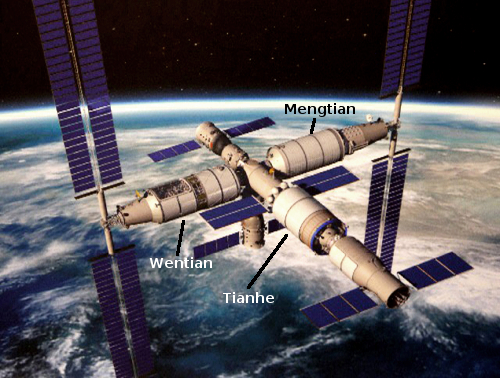
Tiangong-3 station, when completed

Chinese engineers today successfully shifted the new Mengtian module from its docking port to its permanent port to the side, thus completing the assembly of the major components of the Tiangong-3 space station. Shortly thereafter the six astronauts on board the station opened the hatch and entered the module.

The graphic to the right shows the station’s final arrangement, T-shaped. The station however is not fully complete, as the large vertical solar panels have not yet been installed. Based on past station work, these will probably have to be shipped up later, and installed during space walks.

Mengtian module docks with China’s Tiangong-3 space station

Tiangong-3 station, when completed

The new Mengtian module has docked with the main port of China’s Tiangong-3 space station.

The graphic to the right shows the planned design of the station. Mengtian however is not yet in its side port as shown, but in the main docking port in line with the core module where a Shenzhou crew capsule is shown docked. At some point soon the astronauts on board will use a small robot arm to move Mengtian from the main port to its side port. (This system is very similar to one the Russian’s used on Mir.)

Furthermore, the large vertically oriented solar panels have not yet been installed on the station. These will likely need to be delivered, and require spacewalks to deploy.

China’s Long March 5B rocket with new space station module is now at launchpad

China’s Long March 5B rocket had now been rolled out to its launchpad, carrying the new Mengtian module for China’s Tiangong-3 space station.

The launch is presently scheduled for October 31, 2022. Assuming China has not upgraded the engines on the rocket’s core stage, that stage will tumble back to Earth, uncontrolled, sometime in the following week. Since it is large enough to survive re-entry, it will hit the ground, thus threatening every habitable location under its orbital path. By allowing this to happen China violates the Outer Space Treaty, to which it is a signatory.

Nor will this likely be the last time China does this. Though this module completes China’s station, as presently designed, this will not be the last Long March 5B launch. China plans to use it put its Hubble-class space telescope into orbit, as well as other things.

September 15, 2022 Quick space links

Courtesy of BtB’s stringer Jay, who trolls Twitter so I don’t have to.

September 13, 2022 Quick space links

Courtesy of stringer Jay.

September 12, 2022 Quick space links

Courtesy of stringer Jay.

Chinese astronauts complete first spacewalk using new Wentian module

The new colonial movement: Chinese astronauts yesterday completed their first spacewalk using the airlock on the new Wentian module that was recently launched to that nation’s Tiangong-3 space station.

The spacewalk lasted six hours, and was mostly designed to test the airlock itself as well as do the first tests of Wentian’s own robot arm. It appears they also installed an “extended pump set”, whatever that is, and did other work near the hatch. More here.

August 31, 2022 Quick space links

Thanks to BtB’s stringer Jay.

That’s nice, but years have passed and the first Dream Chaser cargo spacecraft, Tenacity, has still not flown. It is well past time for this company to finally get off the ground.

This also be the first spacewalk using the airlock on the space station’s new Wentian module.

It appears to be built by the pseudo-company Orienspace.

August 24, 2022 Quick space links

Links courtesy of BtB’s stringer Jay.

Indian research project for China’s space station threatened by Chinese-India military conflict

A science instrument from India, slated to fly on a Chinese rocket to China’s Tiangong-3 space station, is now threatened by the military tensions between the two nations.

The project, called Spectrographic Investigation of Nebular Gas (SING), also involves collaboration with the [India] Institute of Astronomy [IIA], Russian Academy of Sciences, and has been designed and developed by research students at the IIA. The plan is to have it ready by the year end so that it can be launched in the summer of 2023. Though the plan is on schedule, scientists at the IIA are now consulting with the Indian Space Research Organisation (ISRO) as well as the Ministry of External Affairs (MEA) on whether they are in the clear to go ahead with the project.

Chinese and Indian troops have been engaged in a prolonged stand-off in eastern Ladakh. The two sides have so far held 16 rounds of Corps Commander-level talks to resolve the stand-off, which erupted on May 5, 2020, following a violent clash in the Pangong lake area.

It appears the Indian government is having second thoughts about this cooperative project. After decades of naive trust in the communists from both Russia and China, it seems India has finally realized the communists really have little interest in helping India, being more focused on using it for good PR while it steals Indian technology. Moreover, India now realizes that China has become a dangerous neighbor, willing to use its newfound power violently at the border between the two countries.

August 16, 2022 Quick space links

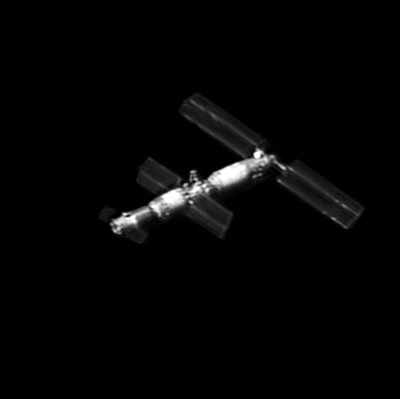
Tiangong-3 in orbit
Click to see full image.

Some quickie stories worth noting, most provided by stringer Jay:

August 14, 2022 Quick space links

Some weekend news from BtB’s top stringer, Jay.

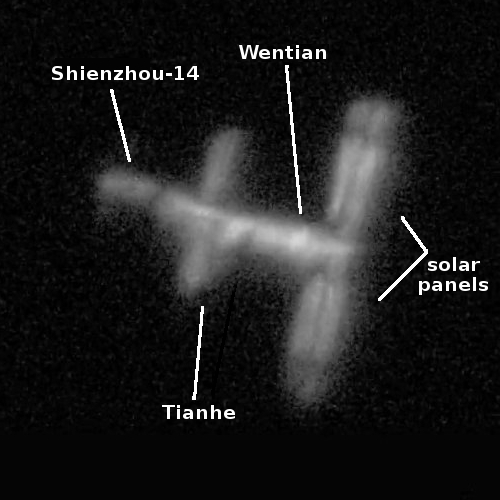
China’s Tiangong-3 space station, as seen from the ground

Tiangong-3 in orbit on July 29, 2022

The screen capture to the right was taken by a very short ground-based telescopic movie of China’s Tiangong-3 space station on July 29, 2022. I have labeled it to indicate the various parts of the station, including the new large module, Wentian, that launched to the station on July 24, 2022.

In my original post, I had mislabeled the sections. I have now corrected the image. Thanks to reader Jay for pointing out my error.

Tianhe is the original core module of the station. At present Wentian is in the forward port, so that it and Tianhe lie in a straight line. At some point shortly before the October launch of the next module, Mengtian, they will likely move it 90 degrees to its permanent port to one side, so that Mengtian can dock with the front port where Wentian now sits.

Mengtian will then be shifted 90 degrees to its permanent port on the opposite side of Wentian. At that point the station will form its planned final T-shape configuration.

This dance of spacecraft is necessary to keep the station as balanced as possible to aid in attitude control.

China successfully launches new large module to its Tiangong space station

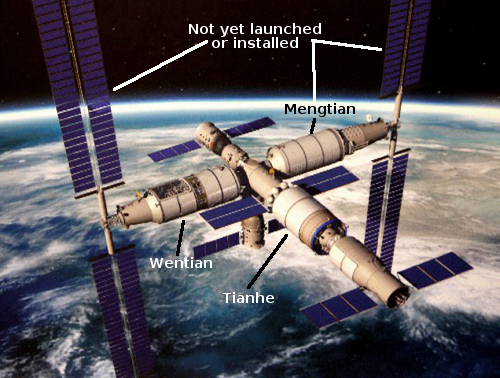
Tiangong-3, completed
Tiangong-3 station, when completed

The new colonial movement: China on July 24, 2022 (China time) has successfully used its Long March 5B rocket to put into orbit its Wentian module, the next large section that will dock with the Tiangong station in the next day or so.

According to one announcer, the core stage will not crash to Earth in an uncontrolled manner, as in previous Long March 5B launches. However, this is China, and his statement cannot be taken at face value. We shall find out in the coming days if this is so, or whether the core stage will be a threat to habitable areas as its orbit decays.

The leaders in the 2022 launch race:

32 SpaceX
24 China
9 Russia
5 Rocket Lab
4 ULA

The U.S. still leads China 45 to 24 in the national rankings, as well as the entire globe combined 45 to 40.

Watch China’s launch of next big module to its Tiangong space station

The launch of the next big module to China’s Tiangong space station, dubbed Wentian, is scheduled for 2:15 am (eastern) tonight, using its Long March 5B rocket.

The live stream is embedded below if you want to watch. It begins at about an hour before launch.

I have added a live stream in English, below the first. One detail of importance that this broadcast has already revealed: According to one technical expert being interviewed, the core stage will not crash to Earth uncontrolled. They will be able to bring it down where and when they want.
» Read more

Astronauts return from Chinese station; China launches satellite

Late yesterday China’s Shenzhou descent capsule successfully brought home three astronauts from its Tiangong-3 space station after spending six months in space.return from Chinese station.

During their stay they completed two spacewalks and prepared the station for the arrival of two more large modules in the next six months.

China yesterday also used its Long March 4C rocket to launch a new radar satellite designed to observe the Earth’s atmosphere.

The leaders in the 2022 launch race:

13 SpaceX
11 China
5 Russia
2 ULA
2 Rocket Lab

The U.S. still leads China 20 to 11 in the national rankings. Note that at this moment the U.S. total is more than all other nations combined (19).

China’s astronauts to return after six month mission

The new colonial movement: The three astronauts who have been on China’s Tiangong space station are about to return to Earth after completing a record six month mission.

Airspace closure notices indicate that Shenzhou-13 will return to Earth between 9:35 and 10:05 p.m. Eastern April 15 (9:35-10:05 local time, April 16) following departure from Tianhe.

The Shenzhou return capsule is planned to set down in a designated landing zone near Dongfeng in the Gobi Desert, Inner Mongolia.

Previous landings occurred in the grasslands of Siziwang, Inner Mongolia. Factors for the change include increasing population density around Siziwang, and the need to optimize for astronaut recovery as the duration of China’s spaceflight missions increases.

I suspect the change in landing location to inside China is also for security reasons. Tensions created by the Ukraine War has probably made China’s leaders reluctant to have their astronauts land anywhere but in China itself.

The article also outlines the upcoming plans for the next crew to Tiangong, which will be on board during the arrival of the station’s next two large modules.

The three-person Shenzhou-14 crew will be aboard the Tianhe space module for the arrival of two new modules, named Wentian and Mengtian, which will complete the three-module, T-shaped Chinese space station, later in the year.

Both of these large modules will be launched by China’s Long March 5B rocket. The previous launches of this rocket resulted in the crash of an out-of-control core stage because once it reached orbit it could not restart its engines to control its de-orbit. Though there have been hints that China may have upgraded the core stage’s engines, we do not know yet for certain if that includes the ability to restart it. If not, China should once again be prepared for some bad press as it threatens populated areas worldwide with these stages.

China’s three astronauts land safely

The new colonial movement: China’s three astronauts safely returned to Earth today after spending 91 days in space and 90 days on China’s new space station.

During their stay they did two spacewalks preparing the station for additional modules and later missions.

China is expected to send the robotic Tianzhou 3 cargo spacecraft toward Tianhe around Sept. 20. And the next crewed mission to the module, the six-month-long Shenzhou 13, is apparently scheduled to launch in mid-October. (Exact target dates are hard to come by with Chinese missions, because the nation tends not to announce many details of its spaceflight plans in advance.)

China will also in the next year launch two more large modules to attach to the station, using its Long March 5B rocket. Assuming they have not redesigned that rocket, expect the very large upper stage on both launches to once again crash out-of-control somewhere on the Earth, possibly in habitable areas.

China reveals its space station launch schedule

The new colonial movement: According to its chief designer, China will complete the assembly of its first multi-module space station over a two year period beginning in early 2021.

The first module for the Chinese space station will launch next year, said Zhou Jianping, chief designer of China’s human spaceflight program, on the sidelines of a political conference in Beijing Tuesday. Launch of the Tianhe core module on a Long March 5B could take place at Wenchang in early 2021. This will be followed by a crewed Shenzhou flight, from Jiuquan, and a Tianzhou cargo mission. The first of two experiment modules will then launch for docking with Tianhe.

In total 11 launches will be conducted to complete the construction of the space station by around 2023, Zhou said (Chinese). These will be the launch of the core and two experiment modules, as well as four crewed spacecraft and four cargo spacecraft. The intensive launch plan was revealed following the successful test flight of the Long March 5B heavy-lift rocket May 5. The missions will be conducted using Long March 5B, Long March 2F and Long March 7 launch vehicles.

They will first launch in 2020 their Mars Tianwen-1 orbiter/lander/rover and their Chang’e-5 lunar sample mission, both using the Long March 5B rocket.

Unless they experience a launch failure along the way, I expect this schedule to occur, as outlined.

Let’s fantasize: If SpaceX can get Starship/Super Heavy operational by 2023 (the company’s present somewhat unrealistic goal), they could send it up to swallow the station whole and bring it back to Earth, just like a James Bond movie.

China’s space station

The new colonial movement: China’s propaganda news services today released an article outlining in a somewhat superficial manner the overall design and program of its first full-sized space station, Tiangong-3.

The article does not really provide any new information that was not already reported back in 2016, except for this intriguing detail:

The Long March-2F carrier rocket and Shenzhou manned spacecraft will be used to transport crew and some materials between Earth and the space station. The Shenzhou can carry three astronauts and be used as a rescue spacecraft in emergency.

Earlier reports had suggested they would be using their as-yet unnamed second generation manned capsule and the Long March 5B for these functions. It now appears that they are planning to use both manned ships, probably beginning with the Shenzhou and transitioning to the new manned capsule over time.

The article also describes again their plan to launch and fly in formation with the station a two-meter optical telescope, maintaining it in orbit during the 10-year life of the station using crew from the station. This concept was one that NASA actually considered when it was first conceiving Hubble, but put aside when it was realized that the U.S. station would not launch in time.

Note also that this Chinese space telescope is only slightly smaller than Hubble, its mirror 2 meters across compared to Hubble’s 2.4 meter diameter. It will thus be the second largest optical telescope ever launched, and if it works will allow for astronomical research that will dwarf all the giant ground-based telescopes western astronomers have spent all their time and millions building in the past two decades, rather than launch several Hubble twins.

An update on the Chinese manned program.

An update on the Chinese manned program.

The original script called for [the space station] Tiangong 1 to be followed by Tiangong 2, which would have been a module of the same basic design as Tiangong 1. Tiangong 2 was expected to have tested more advanced life-support systems than Tiangong 1, but there would be no major changes to the spacecraft. It was expected that two or three crews would be launched to this module.

Towards the end of the decade, China would then launch Tiangong 3, which was slated to be an entirely different class of spacecraft. It would be larger and more capable. Tiangong 3 was expected by some analysts to be a precursor to the types of modules to be used in China’s future space station, slated for launch around 2020.

According to Yang’s presentation, we can forget about Tiangong 2. Or at least, we can forget about Tiangong 2 as it was originally planned. China still plans to launch a mission with this name, but it would seem that the large laboratory module originally known as “Tiangong 3” has now been designated as the new Tiangong 2.

In other words, China is accelerating the admittedly slow pace of their manned program.

1 2