New data from VLT uncovers numerous debris disks around stars
A sampling of debris disks
Click for original

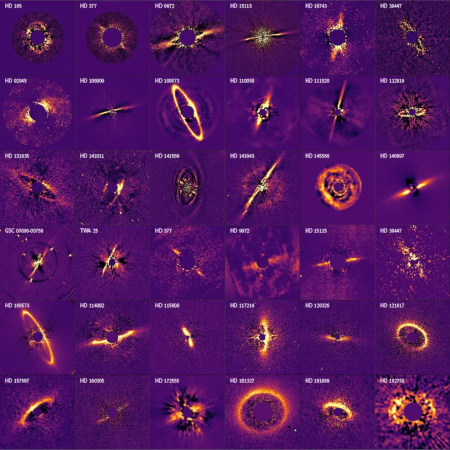
Using a new instrument on the Very Large Telescope (VLT) in Chile, astronomers have compiled a catalog of 51 potential exoplanet solar systems, all with intriguing debris disks surround the stars with features suggesting the existence of asteroids and comets.

The image to the right shows a sampling of those systems. From the press release:

“To obtain this collection, we processed data from observations of 161 nearby young stars whose infrared emission strongly indicates the presence of a debris disk,” says Natalia Engler (ETH Zurich), the lead author of the study. “The resulting images show 51 debris disks with a variety of properties — some smaller, some larger, some seen from the side and some nearly face-on – and a considerable diversity of disk structures. Four of the disks had never been imaged before.”

Comparisons within a larger sample are crucial for discovering the systematics behind object properties. In this case, an analysis of the 51 debris disks and their stars confirmed several systematic trends: When a young star is more massive, its debris disk tends to have more mass as well. The same is true for debris disks where the majority of the material is located at a greater distance from the central star.

Arguably the most interesting feature of the SPHERE debris disks are the structures within the disks themselves. In many of the images, disks have a concentric ring- or band-like structure, with disk material predominantly found at specific distances from the central star. The distribution of small bodies in our own solar system has a similar structure, with small bodies concentrated in the asteroid belt (asteroids) and the Kuiper belt (comets).

The data from various telescopes both on the ground and in space is increasingly telling us that our solar system is not unique, and that the galaxy is filled with millions of similar systems, all in different states of formation. This hypothesis is further strengthened by the appearance of interstellar comet 3I/Atlas, which despite coming from outside our solar system is remarkably similar to the comets formed here.

Webb captures spiraling shells around massive binary star system

Webb's false color image of shells
Click for original.

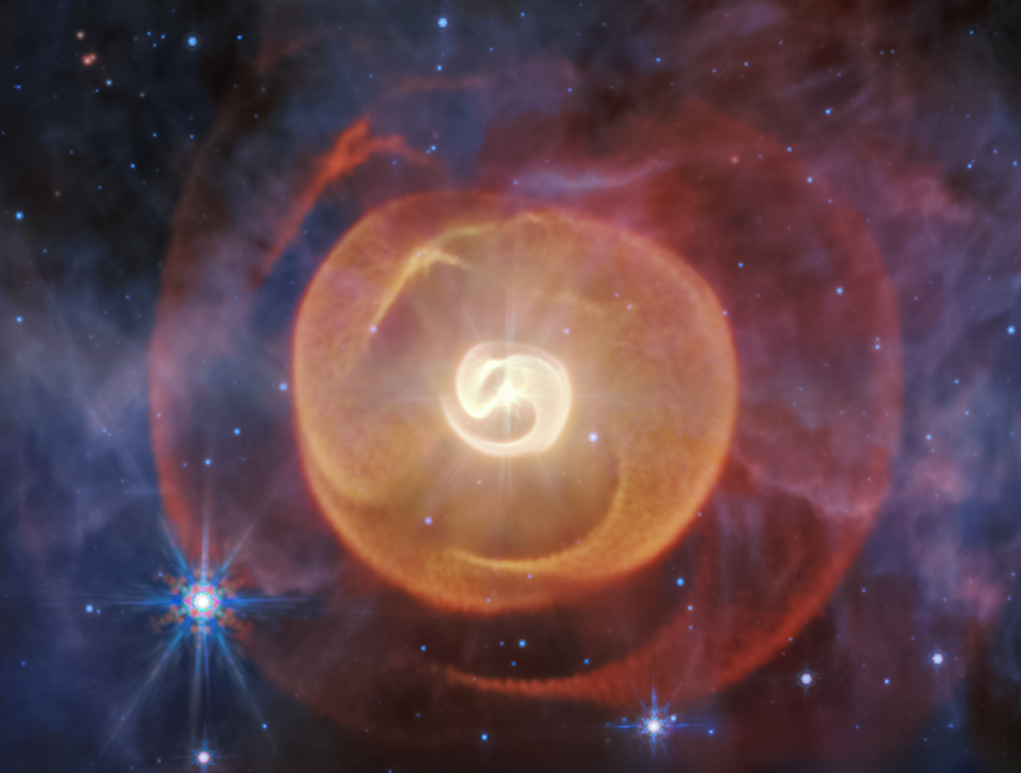
Using the Webb Space Telescope, astronomers have been able to produce a reasonably detailed map of the four shells that surround a triple-star system of two massive Wolf-Rayet (W-R) stars and an as-yet unseen supergiant, produced by the interaction of the winds that come off the two W-R stars combined with the interaction of the third.

The image to the right is that Webb false-color infrared image, combined with the data from the ground-based Very Large Telescope in Chile. It has been reduced to post here. The researchers have also produced a 3D simulation mapping out those shells, which you can view here.

The scientists have dubbed this system Apep after the Egyptian god of chaos. From the conclusion of the research paper [pdf]:

We imaged the colliding-wind W-R binary Apep with [Webb] and [the Very Large Telescope]. The JWST images detected four concentric dust shells with highly regular and detailed structures surrounding Apep. The mean expansion speed of the dust shells is 90 ± 4 mas yr−1 and the mean spacing between neighboring shells is 17.30″ ± 0.17″ [in degree seconds]. The shell spacing and expansion speed together suggest an orbital period of 193 ± 11 years, which is independent of uncertainties on the distance, and that the dust structure observed was produced over the past 700 years.

It is believed that Wolf-Rayet stars are primary candidates to eventually go supernova. The data for this system also suggests this system could produce a gamma ray burst as well. At present the astronomers estimate the distance to this system to be about 15,000 light years, which means such an explosion would likely poses no risk to us. It would however give scientists a great view of the event, better by many magnitudes compared to previous such explosions.

Astronomers discover supernovae that apparently exploded twice

Double detonation supernova
Click for original picture.

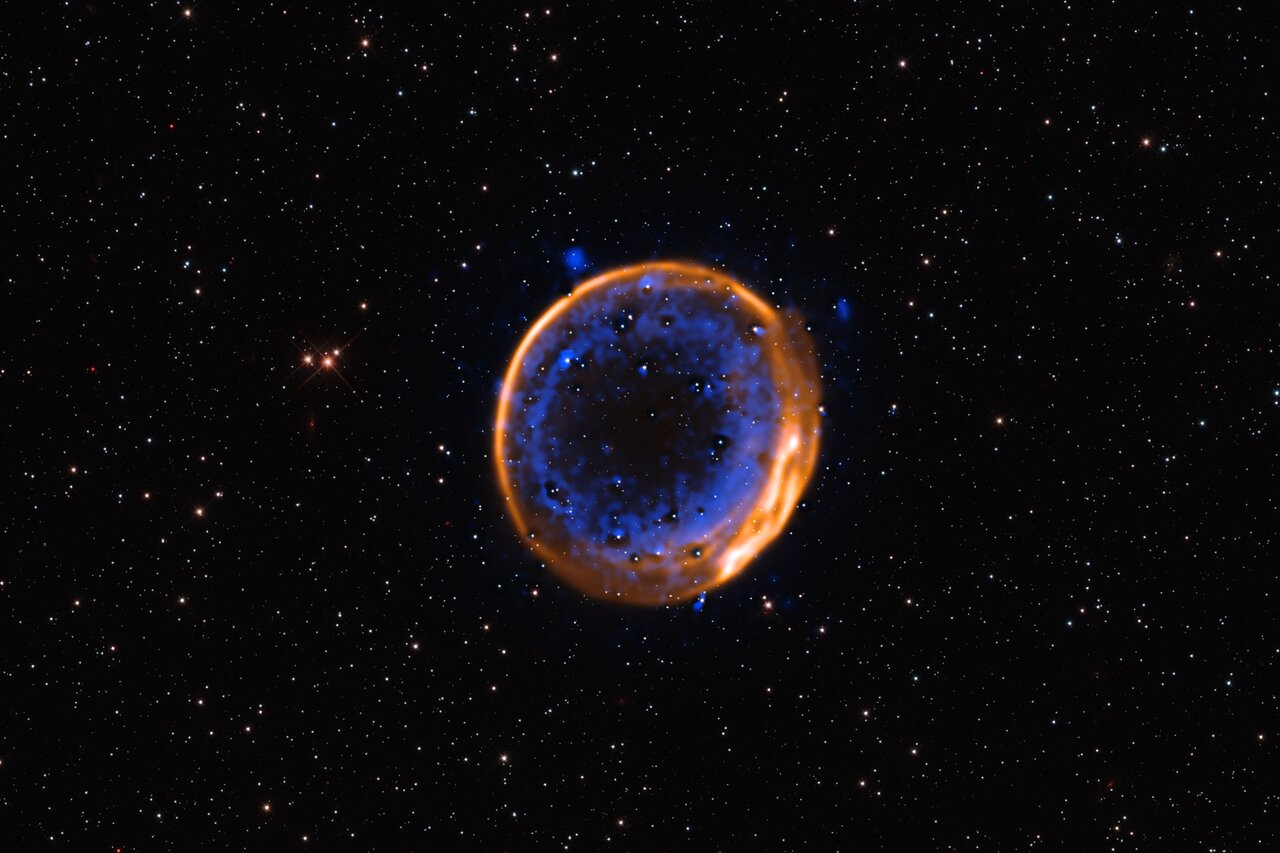
Using the ground-based Very Large Telescope (VLT) in Chile, astronomers have discovered evidence suggesting a star apparently exploded twice went it went supernova several hundred years ago.

They detected this possibility by looking at the remnant of that blast, shown to the right. It shows a double halo, indicated by the blue and orange colors. The blue however is seen in both shells. As noted by the VLT’s press notice:

Calcium is shown in blue, and it is arranged in two concentric shells. These two layers indicate that the now-dead star exploded with a double-detonation.

This type of supernova, dubbed type 1a, occurs when a white dwarf sucks matter from its closely orbiting stellar companion. That material piles up on the surface of the star until it reaches critical mass and explodes, causing the supernova.

The two shells, suggesting a double detonation, fits a theory proposed for this process. From the paper’s abstract:

Our analysis reveals that the outer calcium shell originates from the helium detonation at the base of the outer envelope, while the inner shell is associated with the carbon–oxygen core detonation. This morphological distribution of intermediate-mass elements agrees qualitatively with the predicted signature of the double detonation of a sub-Chandrasekhar-mass white dwarf from a hydrodynamical explosion simulation.

In other words, the outer shell resulted from the explosion caused by the helium ripped from the companion star, with the resulting shockwave detonating the second explosion inside the white dwarf’s core.

That’s the theory at least. This data supports it, but it certainly doesn’t prove it.

Astronomers detect exoplanet half as massive as the Earth around second closest star system

Using the Very Large Telescope (VLT) in Chile, astronomers have detected evidence of an exoplanet about half as massive as the Earth orbiting Barnard’s Star, only six light years away and the second closest star system.

Barnard’s Star is a prime target in the search for exoplanets due to its proximity and its status as a red dwarf, a common type of star where low-mass planets are often found. Despite a promising signal detected in 2018, no planet had been definitively confirmed around it until now. The ESPRESSO spectrograph [on VLT] … enabled the astronomers to detect Barnard b, a subterrestrial planet that orbits the star in 3.15 days. The team also identified signals indicating the possible presence of three other candidate exoplanets, which have yet to be confirmed.

Back in the 1960s using the less precise instruments of the time, astronomers thought they had detected an exoplanet orbiting Barnard’s Star. That detection however proved false. The detection is real, however, and adds weight to the growing evidence that planets can form around red dwarf stars, the most common stars in the universe with the longest lifespan, predicted to be many tens of billions of years. Having planets around such stars significantly increases the chances of habitable planets, even if those planets do not harbor life of its own.

VLT takes picture of exoplanet

VLT's picture of exoplanet
Click for original image.

The ground-based Very Large Telescope (VLT) in Chile has successfully taken a picture of an exoplanet four to six times larger than Jupiter that is circling its star at about the same distance as Saturn.

That picture, cropped to post here, is to the right. Other data from other observatories had suggested the star AF Leporis, 87.5 light years away, might have an exoplanet, so astronomers decided to focus VLT on it to see if it could spot it.

AF Leporis is about as massive and as hot as the sun, ESO wrote in the statement, and in addition to its one known planet the star also has a disk of debris similar to the solar system’s Kuiper Belt. AF Leporis is, however, much younger than the sun. At 24 million years old, it is about 200 times younger than our star. This young age makes AF Leporis and its planetary system especially intriguing for astronomers as it can provide important insights into the evolution of our own solar system.

To snap this picture, the VLT had to use adaptive optics to smooth out the fuzziness produced by the Earth’s atmosphere, while also blocking out the star’s own light (as shown by the black disk in the image).

Neptune’s cooling when it should be warming

Neptune since 2006

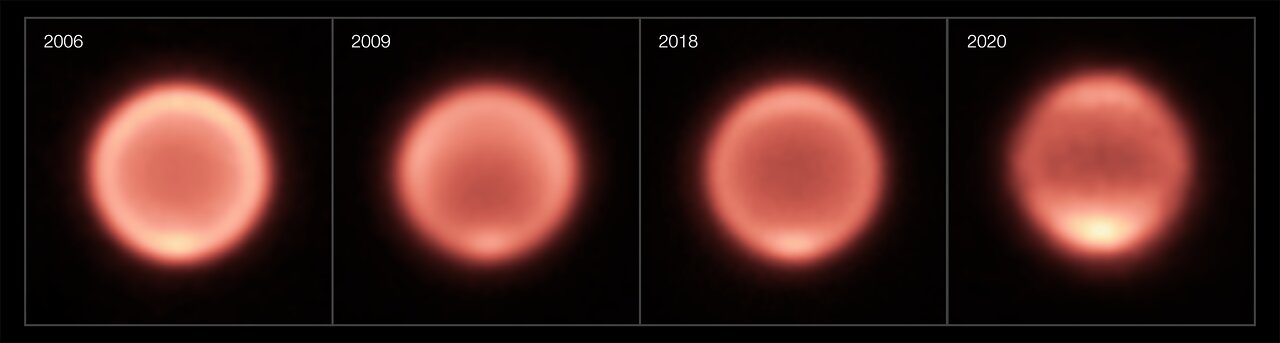
The uncertainty of science: Observations of Neptune during the past seventeen years using the Very Large Telescope have shown the planet mostly cooling during this time period, even though Neptune was moving into its summer season.

Astronomers looked at nearly 100 thermal-infrared images of Neptune, captured over a 17-year period, to piece together overall trends in the planet’s temperature in greater detail than ever before. These data showed that, despite the onset of southern summer, most of the planet had gradually cooled over the last two decades. The globally averaged temperature of Neptune dropped by 8 °C between 2003 and 2018.

The astronomers were then surprised to discover a dramatic warming of Neptune’s south pole during the last two years of their observations, when temperatures rapidly rose 11 °C between 2018 and 2020. Although Neptune’s warm polar vortex has been known for many years, such rapid polar warming has never been previously observed on the planet. “Our data cover less than half of a Neptune season, so no one was expecting to see large and rapid changes,” says co-author Glenn Orton, senior research scientist at Caltech’s Jet Propulsion Laboratory (JPL) in the US.

The sequence of photos above show that change over time. Lower latitudes generally get darker, or cooler, while the south pole suddenly brightens, getting hotter, in 2020.

The scientists have no idea why this has happened, though they have theories, ranging from simple random weather patterns to the influence of the Sun’s sunspot cycle.

Betelgeuse is closer and smaller than previously thought

Betelgeuse's fading
Images taken by Europe’s
Very Large Telescope in Chile

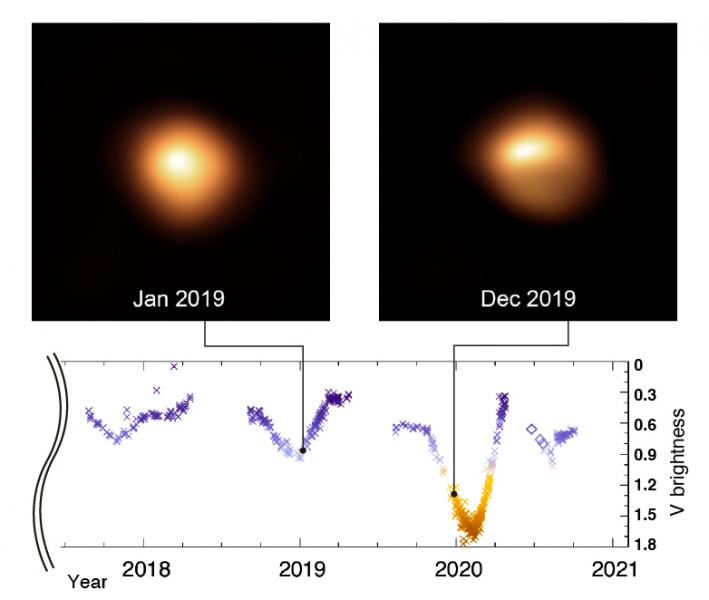
The uncertainty of science: A new analysis by scientists of Betelgeuse, triggered by its dip in brightness in 2020, has concluded that the red giant star is both closer and smaller than previously estimated.

Their analysis reported a present-day mass of 16.5 to 19 solar mass—which is slightly lower than the most recent estimates. The study also revealed how big Betelgeuse is, as well as its distance from Earth. The star’s actual size has been a bit of a mystery: earlier studies, for instance, suggested it could be bigger than the orbit of Jupiter. However, the team’s results showed Betelgeuse only extends out to two-thirds of that, with a radius 750 times the radius of the sun. Once the physical size of the star is known, it will be possible to determine its distance from Earth. Thus far, the team’s results show it is a mere 530 light years from us, or 25 percent closer than previously thought.

The research also suggested that the star is in the initial stages of burning helium rather than hydrogen, and so it likely more than 100,000 years from going supernova.

As for the dimming, the scientists concluded (as other have) that the dimming in ’20 was due to the passage of a dust cloud in front of the star.