
Many Martian mysteries in one spot

Click for original image.
Just because there are no new images coming back from Mars at this time because the Sun is in the way does not mean we can’t enjoy more cool Martian images. The picture to the right, cropped, reduced, and sharpened to post here, was taken on October 20, 2025 by the high resolution camera on Mars Reconnaissance Orbiter (MRO).
Labeled merely a “terrain sample,” this means it was taken not as part of any particular research project but to fill a gap in the camera’s schedule. The camera team needs to take regular photographs in order to maintain the camera’s proper temperature, and when there is a long gap they add a terrain sample image to the schedule. Usually they try to pick some target of interest.
In this case the target is this 2,500-foot-high cliff, in which we can see a whole range of Martian geological mysteries. First there are the slope streaks on the cliff, a feature unique to Mars but as yet unexplained. Resembling avalanches, these streaks leave no debris piles at their base, do not change the topography in any way, and can appear randomly throughout the year, fading with time. Though the streaks in this picture are dark, streaks can also be bright.
Both the parallel ridges at the base of the cliff, as well as the cliff itself, are remnants of other major geological events, at least based on present theories.
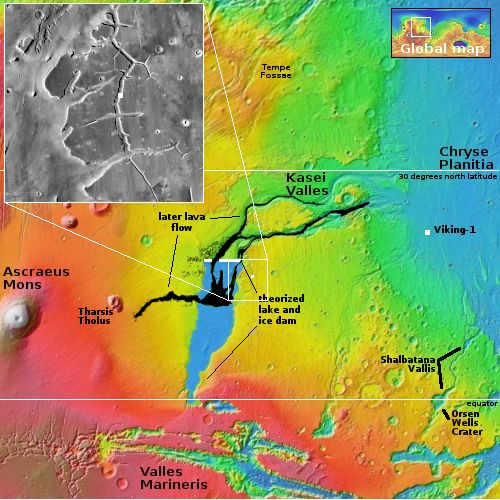
The white dot on the overview map to the right marks the location, amidst a series of large cracks on the eastern edge of the 1,500-mile-long Kasei Valles. The parallel ridges on the canyon floor are likely evidence of the theorized large lake (indicated in blue) that is believed to have filled this part of Kasei when the dry tropics of Mars were far wetter. Though this small side canyon — five miles wide — is higher in elevation than Kasei, ice or water were likely draining down into that lake during that time, producing the ridges.
The giant catastrophic flood that scientists presently believe formed Kasei itself likely formed this side canyon as well, but in a different way. As the flood washed out the main canyon, a large segment of the eastern terrain slumped downward to the west, with large sections separating to form these cracks.
The black indicates lava from a single major eruption that occurred after this region was dry and the lake was gone, flowing 1,000 miles along the already existing canyon in just a few weeks.
Today’s picture also illustrates again the grand scale of the Martian landscape. This canyon is in many ways comparable to the Grand Canyon in its lower western regions. Yet it is merely a minor canyon in the larger landscape of Mars, hardly distinct or unique.
The humans who eventually settle the Red Planet and terraform it are going to be surrounded by majestic scenery, unending in variety and size.

On Christmas Eve 1968 three Americans became the first humans to visit another world. What they did to celebrate was unexpected and profound, and will be remembered throughout all human history. Genesis: the Story of Apollo 8, Robert Zimmerman's classic history of humanity's first journey to another world, tells that story, and it is now available as both an ebook and an audiobook, both with a foreword by Valerie Anders and a new introduction by Robert Zimmerman.
The print edition can be purchased at Amazon or from any other book seller. If you want an autographed copy the price is $60 for the hardback and $45 for the paperback, plus $8 shipping for each. Go here for purchasing details. The ebook is available everywhere for $5.99 (before discount) at amazon, or direct from my ebook publisher, ebookit. If you buy it from ebookit you don't support the big tech companies and the author gets a bigger cut much sooner.
The audiobook is also available at all these vendors, and is also free with a 30-day trial membership to Audible.
"Not simply about one mission, [Genesis] is also the history of America's quest for the moon... Zimmerman has done a masterful job of tying disparate events together into a solid account of one of America's greatest human triumphs."--San Antonio Express-News
If I could ask a stupid question: Why is it necessary to take photos to maintain the temperature of the camera? Isn’t it all solid state? Something to do with current flow?
Andi: I can’t be more specific. This is what one of the members of the camera team told me when I first asked about “terrain sample” images. Nor does it surprise me, considering the large temperature ranges seen in space.
Regarding keeping the camera at some optimum temperature, 2 things:
I’ve always heard CCDs tend to have more noise in the image when cold. Why this is I have no idea, but it may be relevant here.
Also, HiRise is a reflecting telescope, not just a camera. I don’t have time at the moment to try and find it, but I’m about 95% sure I recall coming across a NASA document or article of some sort involving troubleshooting periodically blurry imagery from the camera in its early days. The culprit turned out to be the secondary mirror deforming slightly due to thermal contraction and making the instrument come of proper focus. Thus, they try to keep the system warm to prevent this. Again, this is just my recollection, but it makes sense on its face that thermal expansion / contraction would mess with high precision optics.
Argyle–
look up “quantum efficiency of CCD’s based on temperature.”
Apparently, depends heavily on sensor design and methods-employed, and they like to keep them in a specific range.
Avoids ‘warm-up” or ‘cool-down’ time and they already know how the sensor performs under pre-calibrated temps.
Wayne- thank you. I’ve got a bunch of airline flying to do over the next two days, and I’ll be looking up what you recommended at some point along the way! Thanks again for the pointer!