
The Temptations – Just My Imagination
An evening pause: I should have scheduled this for January 27. Diane will understand why.
Hat tip Edward Thelen.
An evening pause: I should have scheduled this for January 27. Diane will understand why.
Hat tip Edward Thelen.
Link here.
In 2017 Tony Heller broke the story of how NOAA and NASA have been routinely adjusting their historic global temperature records to cool the past and warm the present in order to create the illusion that the climate is warming, far more than it is.
The post by Heller at the link above focuses in on how that tampering, which erased from the temperature data the record-hot year of 1934, is then used by both NOAA and NASA to claim each year for the past decade was the hottest ever.
The raw data however tells a far different story. The raw data from 1934, as reported amply at the time, recorded big heat waves and murderous droughts and extensive dust storms, all far more extreme than anything we have experienced in the past decade. Moreover, that raw data matches well with public news stories, and also matches well with all the published science prior to the 2000s.
Since then, however, intellectual honesty and the real scientific method has been replaced by an agenda-driven political manipulations. Having 1934 be the hottest year ever cannot stand, especially if present temperatures do not exceed that year’s records. Global warming demands a correction!
The nicest interpretation we can give to these adjustments is that the scientists are innocently engaged in confirmation bias. They believe the Earth is warming due to increased carbon dioxide in the atmosphere, and thus they must find evidence of that warming, even if it requires data adjustments to past record-hot years like 1934, adjustments that they then rationalize as necessary and scientifically justified.
More likely, they have decided that their political agenda to prove human-caused global warming requires them to be intellectually dishonest and the falsify the global temperature record. If so, this is a tragedy beyond words, as it signals that the revolution in human thought that began with the Renaissance and Galileo and was reinforced and cemented by the Enlightenment and Francis Bacon, has now ended.
That revolution made possible a burst of human creativity and civilization that lasted more than five hundred years. The consequences for future generations should that revolution be rejected now cannot be good.

Click for full image.
Cool image time! The science team for the high resolution camera today posted a new captioned image, cropped by me to the right to post here, showing an active Martian dust devil as it moves across the surface of Mars.
Dust devils are rotating columns of dust that form around low-pressure air pockets, and are common on both Earth and Mars. This Martian dust devil formed on the dust-covered, volcanic plains of Amazonis Planitia. The dust devil is bright, and its core is roughly 50 meters across. The dark streak on the ground behind the dust devil is its shadow. The length of the shadow suggests the plume of rotating dust rises about 650 meters into the atmosphere!
That’s about 2,100 feet tall, almost a half mile in height. The location, Amazonis Planitia, is part of the northern lowlands of Mars, flat and somewhat featureless. It is also somewhat near the region near Erebus Montes that is the candidate landing site for SpaceX’s Starship rocket, a region that appears to have a lot of ice just below the surface.
The science team also linked to a 2012 active dust devil image that was even more spectacular. I have also posted on Behind the Black a number of other dust devil images, highlighting this very active, dramatic, and somewhat mysterious aspect of the Martian surface:
» Read more
Capitalism in space: ULA tonight successfully launched a new solar science spacecraft Solar Orbiter.
For more information about Solar Orbiter, which will take the first high resolution images of the Sun’s poles, see the link above or video I’ve embedded below the fold.
Earlier today Northrop Grumman aborted the launch of its Cygnus cargo freighter to ISS only three minutes before launch because of an issue with a ground support sensor. Right now they are are targeting a new launch date of February 13, 2020.
The status in the 2020 launch race:
3 China
2 SpaceX
1 Arianespace (Europe)
1 Rocket Lab
1 Russia
1 Japan
1 ULA
In the national ranking, the U.S. now leads China 4-3. If Northrop Grumman had launched, that lead would have been 5-3, and the U.S. total would have been comprised of four different and completely independent competing launch companies, all capable of topping the efforts of entire nations. If that doesn’t illustrate the power of freedom, capitalism, competition, and private ownership, I don’t know what does. Moreover, this is only the start. The U.S. right now has numerous other new launch companies rushing to join the competition.
Even more startling, the way we do things is freely available to every other nation in the world. All they have to do is to embrace freedom and the reduction of control and power by their governments. Sadly, very few in these times are willing to do this. In fact, even the U.S. resisted this concept for the entire last half of the 20th century. Only in the past decade have we returned to our roots, and that decision is now beginning to bear abundant fruit.
» Read more
On February 3, 2020, NOAA posted its January of its monthly graph showing the long term sunspot activity of the Sun. As I have done now every month since this webpage began in 2011, it is posted below, with annotations:
After seven months of practically no sunspot activity, the longest such stretch in probably a century, January had a tiny burst of activity, breaking that string. Of the month’s four sunspots, two had a polarity from the old solar cycle, two from the new.
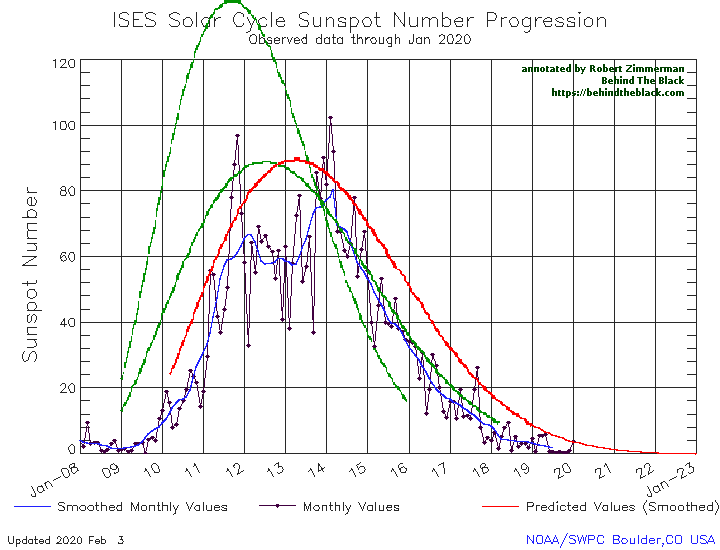
The graph above has been modified to show the predictions of the solar science community for the previous solar maximum. The green curves show the community’s two original predictions from April 2007, with half the scientists predicting a very strong maximum and half predicting a weak one. The red curve is their revised May 2009 prediction, extended in November 2018 four years into the future.
Despite their low number and general weakness, the continuing appearance of sunspots with polarities aligned with the new cycle strongly indicates that we will have a solar maximum in the next five years, not a grand minimum lasting decades that some scientists are predicting. While the year is young and it is certainly too soon to trust any trends, the fact that January saw an increase in activity over the past seven months suggests that we might have passed the low point of the minimum. We shall find out this year.
It must be remembered that the uncertainties in this field of science remain gigantic. No one really understands why the Sun’s magnetic dynamo goes through these cycles and flips in polarity. No one really understands why it produces sunspots as it does. And no one for sure yet knows exactly how the Sun’s cyclical behavior directly effects the climate. We only have circumstantial evidence, some of which can be legitimately questioned.
What is certain is that we don’t know very much, and are always in error when we forget this fact. Remember this always when some politician or scientist claims the science is settled or certain, and they know without doubt what is going to happen. They are either lying, fooling themselves, or are simply fools. In any case, such certainty in science should never be trusted.
Iran today attempted and failed to launch a small technology text cubesat into orbit.
This continues a string of launch failures with their Simorgh rocket, numbering four, since their last successful orbital launch in 2015 using their smaller Safir ballistic missile.
Japan today successfully used its H-2A rocket to place a military reconnaissance satellite into orbit.
The leaders in the 2020 launch race:
3 China
2 SpaceX
1 Arianespace (Europe)
1 Rocket Lab
1 Russia
1 Japan
The U.S. and China remained tied at 3-3 in the national rankings.
Link here. The focus when discussing the epidemic, which continues to grow, should certainly not be on how it is slowing China’s space industry. At the same time, any slow down in their space effort will give us a good indicator on how the virus is effecting their entire economy.
Anyway, it appears, at least as this moment, that the biggest effect in space is the halt of operations for the Kuaizhou smallsat rocket.
Expace, a launch service provider for solid-propellant Kuaizhou rockets, has temporarily halted work due to its proximity to the epicenter of the outbreak. A new Kuaizhou-11 rocket, larger than the Kuaizhou-1A currently in service, was reportedly scheduled for a test flight late February.
Expace is situated in the Wuhan National Space Industry Base, a hub designed to facilitate commercial space activities. The firm is a spinoff from defense contractor CASIC and its subsidiary, China Sanjiang Space Group. The Kuaizhou launch vehicle series are understood to be derived from missile technology.
Other impacts probably won’t become obvious for months, when we can gauge whether there has been a slow down in Chinese launches below the predicted 40 for 2020.
Engineers announced yesterday that Voyager-2 has resumed science operations after going into safe mode in late January.
“Mission operators report that Voyager 2 continues to be stable and that communications between Earth and the spacecraft are good,” agency officials wrote in a mission update yesterday. “The spacecraft has resumed taking science data, and the science teams are now evaluating the health of the instruments following their brief shut-off.”
Still ticking after 42 years in space. Take that, Timex!
An evening pause: Performed live 1981, with what I think is one of the strangest background dance line-up ever.
Hat tip Cotour.
At a press conference today, NASA and Boeing officials confirmed the rumors that there was a second software error during Starliner’s unmanned demo mission in December that might have caused a serious failure had it not been caught on time.
[After the first software error], engineers began reviewing other critical software sequences as a precaution and discovered yet another problem. Software used to control thruster firings needed to safely jettison the Starliner’s service module just before re-entry was mis-configured, set for the wrong phase of flight.
Had the problem not been found and corrected, the cylindrical service module’s thrusters could have fired in the wrong sequence, driving it back into the crew module and possibly triggering a tumble or even damaging the ship’s protective heat shield.
While a detailed analysis was not carried out at the time, “nothing good can come from those two spacecraft bumping back into one another,” said Jim Chilton, a senior vice president for Boeing Space and Launch.
That two different software errors were not caught prior to flight has NASA demanding a complete review of Boeing’s quality control systems. And NASA here is correct. Boeing as a company appears to have fundamental quality control issues up and down the line, in all its projects. A complete review appears warranted.

Click for full image.
Cool image time! The photo on the right, cropped and reduced to post here, was taken by the high resolution camera of Mars Reconnaissance Orbiter (MRO) on November 30, 2019. It shows a lone crater on the flat northern lowlands of Mars in a region dubbed Arcadia Planitia.
The crater is intriguing because of its concentric ridges and central pit. As this region is known to have a great deal of subsurface water ice, close to the surface, these features were probably caused at impact. My guess is that the ice quickly melted, formed the kind circular ripples you see when you toss a pebble in a pond, but then quickly refroze again, in place.
This location is also of interest in that is it just north of the region that SpaceX considers the prime candidate landing site for its Starship manned spaceship.
The science team for Europe’s exoplanet-hunting CHEOPS space telescope announced today that the telescope has successfully obtained its first pictures, and that all appears to be working correctly.
Preliminary analysis has shown that the images from CHEOPS are even better than expected. However, better for CHEOPS does not mean sharper as the telescope has been deliberately defocused. This is because spreading the light over many pixels ensures that the spacecraft’s jitter and the pixel-to-pixel variations are smoothed out, allowing for better photometric precision. “The good news is that the actual blurred images received are smoother and more symmetrical than what we expected from measurements performed in the laboratory,” says Benz. High precision is necessary for CHEOPS to observe small changes in the brightness of stars outside our solar system caused by the transit of an exoplanet in front of the star. Since these changes in brightness are proportional to the surface of the transit planet, CHEOPS will be able to measure the size of the planets. “These initial promising analyses are a great relief and also a boost for the team,” continues Benz.
I suspect the planned fuzziness of their images is why the press release did not include them.
Scientists have found that a Chernobyl fungus that eats radiation, turning it into food, is so successful that they have sent samples to ISS to see how it responses to space radiation.
By growing it in the International Space Station, where the radiation level is hiked compared to that on Earth, Venkateswaran and Professor Clay Wang of the University of Southern California were able to monitor mutation. When microorganisms are put under more stressful environments, they release different molecules, which could further out understanding of the fungi and how it can be used to develop radiation-blocking drugs for humans.
It is also possible that the fungus could be adapted for other uses.
Kasthuri Venkateswaran, a research scientist at NASA who is leading the experiments on the Cryptococcus neoformans fungi, believes that by extracting its radiation-absorbing power and manufacturing it in drug form, it could be used as a ‘sun block’ against toxic rays.
It would allow cancer patients undergoing radiation therapy, nuclear power plant engineers and airline pilots to operate without fear of absorbing a deadly dose of rays, Venkateswaran envisaged to Scientific American magazine.
The fungi’s radiation-converting power could also be used to power electrical appliances, with it being touted as a possible biological answer to solar panels.
It appears that the fungi’s high level of melanin contributes to its ability to do this.
Capitalsm in space: NASA has postponed the bidding process for both the commercially-built lander that will bring its its VIPER lunar rover as well as the smaller landers that will bring simpler science packages to the Moon.
In the first case, it appears that the commercial companies wanted more time because VIPER is a heavier and bigger payload than their landers are currently designed for. In the second case, the reasons for the postponement are less clear, leaving the companies involved somewhat puzzled and in the dark.
Capitalism in space: Comments by SpaceX’s CEO suggest the company is considering spinning off its Starlink internet operation, with the additional possibility that spin-off would go public.
SpaceX President & COO Gwynne Shotwell told a group of investors that the company may spin off its Starlink internet satellite business, possibly as a public company. “Starlink is the right kind of business that we can go ahead and take public,” Shotwell said, according to a report from Bloomberg.
…There’s no time frame yet disclosed for a potential IPO of the Starlink side of SpaceX, and the company did not immediately respond to a request for comment. It’s unlikely the whole company would go public. Elon Musk has said for years that he wouldn’t take SpaceX public until the company has been regularly launching to Mars.
Don’t start counting your chickens. While there might be good reasons for SpaceX to do this, I suspect there are other good reasons for not doing it. They will likely make the decision once the Starlink constellation is operational and they have begun providing service to customers. At that point they will see what the demand will bring, and will have a better idea what’s the best course to take.
In its quarterly meeting yesterday, NASA’s safety panel raised more questions about the software problems during the unmanned demo mission of Boeing’s Starliner manned capsule in December.
NASA’s Aerospace Safety Advisory Panel (ASAP) revealed today that a second software error was discovered during the uncrewed Boeing Starliner flight test in December. Had it gone undetected during the flight, it had the potential to cause “catastrophic spacecraft failure” during reentry. The panel wants a complete review of Boeing’s software verification processes before NASA decides whether a second uncrewed flight test is needed. In an email this evening, Boeing said it appreciates the input and is working on a plan with NASA to address all the issues and decide what comes next.
In that Boeing email it noted that it was “unclear” what the consequences would have been if this second software issue had not been fixed.
The safety panel also called for an overall organizational review of the entire Boeing company, similar to the review done to SpaceX after Elon Musk was videoed taking a toke on a joint during a podcast interview.
The decision on whether Boeing will be required to fly another unmanned demo mission is targeted for before the end of February.
One comment: While there is clear evidence here that Boeing had issues on that demo flight that must be resolved before humans fly on Starliner, we must also recognize that NASA’s safety panel has an unfortunate tendency to overstate risk, demanding margins of safety that are frequently unrealistic for an endeavor pushing the envelope of exploration. That panel has also exhibited an almost corrupt bias against private commercial space, while looking past much more serious safety issues in the NASA-built SLS and Orion programs.
At the same time, the larger corporate issues here with Boeing do appear far more systemic and concerning that those that occurred with SpaceX. A cold independent audit of the company by NASA could actually do Boeing a lot of good.
Embedded below the fold in two parts.
» Read more
An evening pause: I guarantee this will bring a smile to your face.
Hat tip Edward Thelen.
Capitalism in space: Russia’s Soyuz rocket, launching from Russia, today successfully placed 34 OneWeb satellites into orbit.
This is the first of 20 launches over the next two years to build OneWeb’s satellite constellation. A previous Soyuz launch put up six demonstration satellites.
This was also Russia’s first launch in 2020. The leaders in the 2020 launch race:
3 China
2 SpaceX
1 Arianespace (Europe)
1 Rocket Lab
1 Russia
China leads the U.S. 3 to 2 in the national rankings.