September 10, 2019 Zimmerman/Batchelor
Embedded below the fold in two parts.
» Read more
Embedded below the fold in two parts.
» Read more
An evening pause: On this day of remembrance, this song seems fitting. And as the lyrics boldly state,
I won’t be made to ever feel ashamed
that I’m American made
I got American parts
I got American faith
In America’s heart
Go on, raise the flag
I got stars in in my eyes
I’m in love with her
And I won’t apologize.
The image that best reveals what America represents, as a messenger of freedom, is that photograph of the American soldier gently cradling a baby refugee from war. Or as said in the 1993 movie Gettysburg, “We are here for something new. This has not happened much in the history of the world. We are an army out to set other men free.”
The uncertainty of science: Astronomers now believe they have detected water in the atmosphere of an exoplanet that is also in habitable zone.
A new study by Professor Björn Benneke of the Institute for Research on Exoplanets at the Université de Montréal, his doctoral student Caroline Piaulet and several of their collaborators reports the detection of water vapour and perhaps even liquid water clouds in the atmosphere of the planet K2-18b.
…This exoplanet is about nine times more massive than our Earth and is found in the habitable zone of the star it orbits. This M-type star is smaller and cooler than our Sun, but due to K2-18b’s close proximity to its star, the planet receives almost the same total amount of energy from its star as our Earth receives from the Sun.
The size and mass of the this exoplanet means life as we know it probably does not exist there, either on its surface or in its atmosphere. Nonetheless, with water and the right amount of energy, anything is still possible.
Last week, as Hurricane Dorian approached the Florida coast, President Trump held a press briefing where he showed a graph with extra markings that suggested that Alabama might be impacted by the hurricane.
Unfortunately for Trump, this path for Dorian — though initially considered a possibility in the National Weather Service models — was also considered very unlikely, and had been quickly dismissed from those models, making Trump’s graph out-of-date when he showed it.
Since then the Democratic mainstream media has put out hundreds of stories claiming some sort of corruption on Trump’s part for adding those extra markings. Trump has himself responded aggressively, defending his action and saying it was justified. The New York Times even reported — based on anonymous sources — that Commerce secretary Wilbur Ross had threatened to fire three people at the National Weather Service if they didn’t issue a statement defending Trump.
Now, three former Democratic NOAA heads, D. James Baker (appointed by Bill Clinton), Jane Lubchenco (appointed by Barack Obama), and Kathryn D. Sullivan (appointed by Barack Obama), have issued a statement condemning Trump, claiming his actions are threatening the scientific integrity of these agencies.
The National Weather Service (NWS) has always been a model of scientific integrity, ensuring that weather science is not politically driven, regardless of the administration. But the recent misleading statements by President Donald Trump about a NWS hurricane forecast and cover-up actions by the National Oceanic and Atmospheric Administration (NOAA), its parent agency, have violated those norms.
Forgive me if I don’t take very seriously this smug, self-righteous posturing by these former NOAA officials, all partisan Democratic Party political appointees. Scientific integrity suddenly means a lot to them when they can use it to attack Trump. However, when NOAA repeatedly tampered with its climate data for the past dozen years, and has provided no good explanation for that tampering, I don’t remember these high and mighty officials, all in charge of NOAA at the time, commenting then about the importance of scientific integrity.
Trump is no saint here. He as a politician wanted to cover all bets, so he added Alabama in discussing Dorian’s threat, even though his weather scientists considered that threat slim if nonexistent. He should have relied more on those scientists and not improvised.
For him however to be attacked relentless for this minor addition is absurd, since it is perfectly reasonable for weather scientists to get their predictions wrong, and as president Trump has a responsibility to try to prepare for all eventualities.
These NOAA critics are far less credible however. There are questionable things going on at NOAA in connection with its global climate dataset that requires either an explanation or a correction. This is a far more serious issue than whether a politician expanded the threat of a hurricane in one press briefing in order to cover his ass. The tampering threatens to discredit the entire NOAA climate dataset, making all research based on it untrustworthy. If these former NOAA officials really cared about scientific integrity, they would have taken action at NOAA to deal with this tampering, when they ran those agencies. They would have either gotten it stopped, or provided the public and the rest of the scientific community a reasonable explanation for it.
They did neither, proving that their sanctimonious statement today is nothing more than partisan politics. They don’t care about scientific integrity. What they care about is defeating Trump, helping the Democratic Party, and enhancing the power of the Washington swamp.
Space is hard: Eric Berger at Ars Technica reported yesterday that the parachute issues for Europe’s ExoMars 2020 mission are far more serious that publicly announced.
The project has had two parachute failures during test flights in May and then August. However,
The problems with the parachutes may be worse than has publicly been reported, however. Ars has learned of at least one other parachute failure during testing of the ExoMars lander. Moreover, the agency has yet to conduct even a single successful test of the parachute canopy that is supposed to deploy at supersonic speeds, higher in the Martian atmosphere.
Repeated efforts to get comments from the project about this issue have gone unanswered.
Their launch window opens in July 2020, only about ten months from now. This is very little time to redesign and test a parachute design. Furthermore, they will only begin the assembly of the spacecraft at the end of this year, which is very very late in the game.
When the August test failure was confirmed, I predicted that there is a 50-50 chance they will launch in 2020. The lack of response from the project above makes me now think that their chances have further dropped, to less than 25%.
An evening pause: Hat tip to Thomas Biggar, who wrote, “This piece was written by Michel Colombier and released in 1971. Emmanuel was written to honour the memory of his son who died when he was only 5 years old.”
Japan today scrubbed the launch of its unmanned HTV cargo freighter to ISS due to a launchpad fire that broke out only three and half hours before liftoff.
There is as yet no word on the cause of the fire, or how much damage it caused. Nor have they said anything about rescheduling the launch.
This would have been Japan’s second launch in 2019, a drop from the average of 4 to 6 in the last five years.

Click for full image.
The pit to the right could almost be considered the first “cool image” on Behind the Black. It was first posted on June 20, 2011. Though I had already posted a number of very interesting images, this appears to be the first that I specifically labeled as “cool.”
The image, taken by the high resolution camera on Mars Reconnaissance Orbiter (MRO), had been requested by a seventh grade Mars student team at Evergreen Middle School in Cottonwood, California, and shows a pit on the southeastern flank of the volcano Pavonis Mons, the middle volcano in Mars’ well-known chain of three giant volcanoes. A close look at the shadowed area with the exposure cranked up suggests that this pit does not open up into a more extensive lava tube.
What inspired me to repost this image today was the release of a new image from Mars Odyssey of this pit and the surrounding terrain, taken on July 31, 2019 and shown below to the right.
» Read more
Capitalism in space: SES yesterday announced that it has awarded SpaceX’s Falcon 9 the launch contract for the next seven satellites in its next generation communications constellation.
This is a big win for SpaceX, made even more clear by a briefing held yesterday with reporters by Arianespace CEO Stéphane Israel. In that briefing Israel outlined that company’s upcoming launch contracts, where he also claimed that this launch manifest is so full he had to turn down SES’s launch offer.
Because of its full manifest, Arianespace was unable to offer SES launch capacity in 2021 for its next generation of medium Earth orbit satellites, mPOWER. SES announced plans Sept. 9 to fly mPOWER satellites on SpaceX Falcon 9 rockets from Florida’s Cape Canaveral. Arianespace launched the 20 satellites in the SES O3B constellation.
It was important to SES to launch in 2021, Israel said. Given Arianespace’s full manifest, it was difficult “to offer the guarantee they were asking for,” he added.
If you believe that I have a bridge I want to sell you. Arianespace has been struggling to get launch contracts for its new Ariane 6 rocket. They have begun production on the first fourteen, but according Israel’s press briefing yesterday, Ariane 6 presently only has eight missions on its manifest. That means that six of the rockets they are building have no launch customers. I am sure they wanted to put those SES satellites on at least some of those rockets, and couldn’t strike a deal because the expendable Ariane 6 simply costs more than the reusable Falcon 9.
According to a story today in official Chinese state-run media, Yutu-2 traveled another 284.99 meters during its ninth lunar day on the surface of the Moon, and has now been placed in hibernation in order to survive the long lunar night.
The story provides no further information, including saying nothing about the strange and unusual material the rover supposedly spotted during this time period.
Vector has withdrawn from an Air Force launch contract, allowing the military to reassign the contract to another new launch startup, Aevum.
The Agile Small Launch Operational Normalizer (ASLON)-45 space lift mission had been originally awarded to Vector Launch Aug. 7. But Vector formally withdrew Aug. 26 in the wake of financial difficulties that forced the company to suspend operations and halt development of its Vector-R small launch vehicle.
The Rocket Systems Launch Program — part of the Air Force Space and Missile Systems Center Launch Enterprise — used a Federal Acquisition Regulation “simplified acquisition procedure” to expedite another agreement with a different contractor, the Air Force said in a news release. Aevum’s contract is $1.5 million higher than the one that had been awarded to Vector.
The full scope of Vector’s problems still remain unclear. My industry sources tell me that there was absolutely no malfeasance at all behind the resignation of former CEO Jim Cantrell. From what I can gather, the problems appear to stem from issues of engineering with their rocket, combined with an investor pull-back due to those problems.
Either way, Vector is no longer among the leaders in the new smallsat launch industry, and in fact appears to be fading fast.
An evening pause: The last line however is the real point.
Hat tip Cotour.
Embedded below the fold in two parts.
The first segment is especially worth listening to, as I blast the leftist mob rule that is killing TNT, advocating climate fraud, and is now trying to use that climate fraud, mostly by Democratic politicians, to advocate the destruction of freedom and our capitalist society. In fact, after we finished that segment John Batchelor took me to task for calling these Democrats “fascists” twice. John didn’t dispute my use of the word, nor was he trying to shut me up. He merely said using the word twice in one segment isn’t good radio, and to this I kind of agree.
Then again, these Democrats are fascists, and more people should be saying it.
» Read more
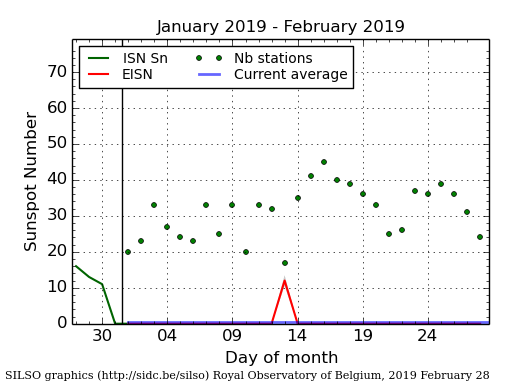
Last month I titled my sunspot update “Almost no sunspots,” as there were only two sunspots for the entire month of July, with one having the polarity for the next solar maximum.
August however beat July, with only one sunspot for the month, and none linked to the next maximum. To the right is the Silso graph of sunspot activity for August, showing just one sunspot for the month, on only one day, August 13.
Below is NOAA’s August graph of the overall sunspot cycle since 2009, released by NOAA today and annotated to give it some context.
» Read more
A new theory proposes that some of the smaller high rimmed methane lakes on Titan were formed when underground nitrogen warmed and exploded, forming the basin in which the methane ponded.
Most existing models that lay out the origin of Titan’s lakes show liquid methane dissolving the moon’s bedrock of ice and solid organic compounds, carving reservoirs that fill with the liquid. This may be the origin of a type of lake on Titan that has sharp boundaries. On Earth, bodies of water that formed similarly, by dissolving surrounding limestone, are known as karstic lakes.
The new, alternative models for some of the smaller lakes (tens of miles across) turns that theory upside down: It proposes pockets of liquid nitrogen in Titan’s crust warmed, turning into explosive gas that blew out craters, which then filled with liquid methane. The new theory explains why some of the smaller lakes near Titan’s north pole, like Winnipeg Lacus, appear in radar imaging to have very steep rims that tower above sea level – rims difficult to explain with the karstic model.
This is a theory that has merit. It also must be treated with skepticism, as our knowledge of Titan remains at this time very superficial, even with the more detailed information garnered from Cassini.
According to K. Sivan, the head of ISRO, India’s space agency, their Chandrayaan-2 orbiter has captured a thermal image of Vikram on the lunar surface, pinpointing the lander’s location.
They have not released the image. According to reports today, they do not yet know the lander’s condition, and have not regained communications. Reports late yesterday had quoted K.Sivan as saying “It must have been a hard-landing.” That quote is not in today’s reports.
In watching the landing and the subsequent reports out of India, it appears that India is having trouble dealing with this failure. To give the worst example, I watched a television anchor fantasize, twenty minutes after contact had been lost, that the lander must merely be hovering above the surface looking for a nice place to land. Most of the reports are not as bad, but all seem to want to minimize the failure, to an extreme extent.
Their grief is understandable, because their hopes were so high. At the same time, you can’t succeed in this kind of challenging endeavor without an uncompromising intellectual honesty, which means you admit failure as quickly as possible, look hard at the failure to figure out why it happened, and then fix the problem. If India can get to that place it will be a sign that they are maturing as a nation. At the moment it appears they are not quite there.
An evening pause: Kinda calm and relaxing.
Hat tip Thomas Biggar Rex Ridenoure of Ecliptic Enterprises.
Both have been generous with their suggestions, I just got them confused for this particular pause.
Vikram, India’s first attempt to soft land on the Moon, apparently has failed, with something apparently going wrong in the very last seconds before landing.
As I write this they have not officially announced anything, but the live feed shows a room of very unhappy people.
It is possible the lander made it and has not yet sent back word, but such a confirmation should not take this long.
India’s prime minister, Narendra Modi, was given a very short briefing by K. Sivan, head of ISRO, and then apparently left without comment. This I found an interesting contrast to the actions of Israel’s prime minister Benjamin Netanyahu when its lunar lander Beresheet failed in landing earlier this year. Netanyahu came out to comfort the workers in mission control, congratulating them for getting as far as they had. Modi apparently simply left. UPDATE: Modi has reappeared to talk to the children who had won a contest to see the landing as well as people in mission control. After making a public statement he has now left.
They are now confirming that communications was lost at 2.1 kilometers altitude, which was just before landing. They are analyzing the data right now to figure out what went wrong.
The new colonial movement: I have embedded below the live stream of India’s attempt today to land its Vikram lander on the Moon, broadcast by one of their national television networks.
The landing window is from 4:30 to 5:30 pm Eastern. This live stream is set to begin about 3 pm Eastern.
If you want to watch ISRO’s official live stream you can access it here.
Some interesting details: Vikram is named after Vikram A. Sarabhai, who many consider the founder of India’s space program. The lunar rover that will roll off of Vikram once landing is achieved is dubbed Pragyan, which means “wisdom” in Sanskrit. Both are designed to operate on the Moon for one lunar day.
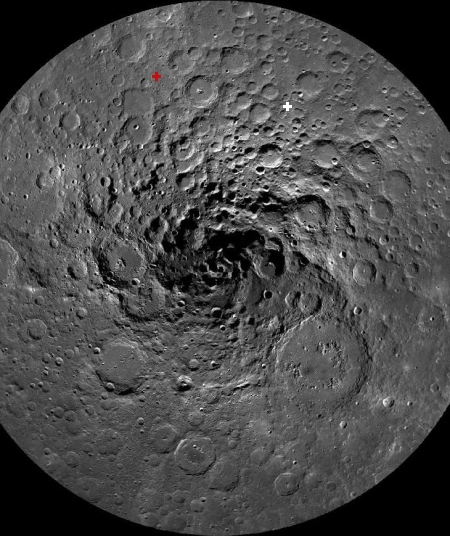
The landing site will be about 375 miles from the south pole.
That spot is a highland that rises between two craters dubbed Manzinus C and Simpelius N. On a grid of the moon’s surface, it would fall at 70.9 degrees south latitude and 22.7 degrees east longitude.
The white cross on the image to the right is where I think this site is. The secondary landing site is indicated by the red cross.
According to FAA regulatory documents, SpaceX has updated its development plan for Starship, including changes in its overall plans for its Boca Chica facility.
The document also lays out a three-phase test program, which it says “would last around 2 to 3 years”:
Phase 1: Tests of ground systems and fueling, a handful of rocket engine test-firings, and several “small hops” of a few centimeters off the ground. The document also includes graphic layouts, like the one above, showing the placement of water tanks, liquid methane and oxygen storage tanks (Starship’s fuels), and other launch pad infrastructure.
Phase 2: Several more “small hops” of Starship, though up to 492 feet (150 meters) in altitude, and later “medium hops” to about 1.9 miles (3 kilometers). Construction of a “Phase 2 Pad” for Starship, shown below, is also described.
Phase 3: A few “large hops” that take Starship up to 62 miles (100 kilometers) above Earth — the unofficial edge of space — with high-altitude “flips,” reentries, and landings.
The first phase is now complete, with the company shifting into Phase 2.
Boca Chica meanwhile is no longer being considered a spaceport facility. Instead, its focus will now be a development site for building Starship and Super Heavy.