The profound life’s work of Richard Rodgers
Sometimes in art there are times when culture, timing, talent, and teamwork combine to produce a magic that is eternal and beyond measure. For Richard Rodgers and Oscar Hammerstein, that time occurred from 1943 to 1959, when these two men created a string of musicals so grand that each
would become not just familiar but universally beloved, played over and over again until the words and melodies had become meshed, it seemed, with one’s very existence. To have one’s complete score memorized by a whole population would, it would seem for a composer, to have been all that life has to offer.
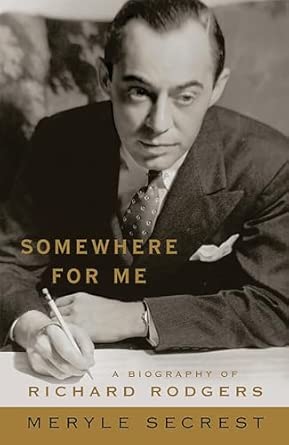
This quote comes from Meryle Secrest’s fine 2001 biography of Richard Rodgers, Somewhere for me: a biography of Richard Rodgers. It tells a story of a man who from childhood was obsessed with writing music, who struggled for decades to write musicals where the music and song flowed naturally from the plot and characters, and who changed with time as time changed him. Outside of his music and his commitment to it, he was however a very normal man, with a marriage that at times was stormy but held together despite those storms.
But it is Rodgers’ best music — written for the lovely words of Oscar Hammerstein — for which we most remember him. I grew up in the 1950s and 1960s, so I lived at a time when these Rodgers and Hammerstein musicals were being memorized by a whole population. As a child my parents subscribed to a musical record club, which sent them a new album every month. I would spend hours listening to the songs from Oklahoma, South Pacific, The Sound of Music, the King and I, and Carousel. And on television I got to see Julie Andrews in a live production of Cinderella.
In listening to these songs, I quickly realized, even as a child, that there was something deeply profound in those words and music, touching something deeper than mere beauty, a more fundamental but utterly inexplicable aspect of our existence. As I wrote in 2018 when I posted an evening pause of Juanita Hall singing Bali Ha’i from South Pacific,
The song is about the draw of love and desire, which is what Bali Ha’i partly represents. However, Hammerstein’s lyrics refer to more, to the greater magic hidden in life everywhere, the mystery that lies behind the black, you might say. It is a theme he repeated in many of the songs he wrote for Richard Rodgers.
Both Rodgers and Hammerstein had been in the musical theater business for decades, though until Oklahoma had almost never worked together. Both had created numerous successful musicals, some of which were turned into movies in the 1930s. Yet none of these earlier works carried this deeper meaning, represented by Bali Ha’i, which was fundamentally typical of everything they created as a team.
What made the music so popular and profound? First it was the team itself. Hammerstein produced lyrical poetry focused on love and existence, a perfect match for the romantic beauty of Rodgers’ musical style. Before, both could create great work, but only together could the best parts of each man’s talents be augmented by the other. It was as if 2 plus 2 now equaled 6.
Second, their choice of subject matter was deeper and more profound that their earlier work. True they still wrote musicals about love stories, with plots as simple as “boy-meets-girl, boy-loses-girl, boy-wins-girl,” but they now placed every story in a larger historical and cultural context. Oklahoma’s love story captured the changing American west, shifting from wild cowboys, saloons, and cattle drives to towns, farms, and families. South Pacific and The Sound of Music both told their love stories in the context of World War II and the moral dilemmas it forced every person to face. And The King and I was about the clash of cultures as western civilization began to force its influence globally in the 1800s.
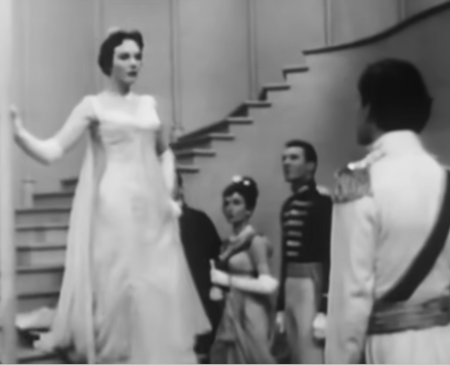
Julie Andrews as Cinderella, making her grand entrance
in the live 1957 television production. Click for movie.
Carousel meanwhile told a dark story about failed love, but with a hope that even in failure there is a greater God overlooking all life, whilc Cinderella reminded us that we must never let the nay-sayers crush our spirit.
For the world is full of zanies and fools
Who don’t believe in sensible rules
And won’t believe what sensible people say
And because these daft and dewey-eyed dopes keep building up impossible hopes
Impossible things are happening every day!
Finally, their choices of subject matter fit perfectly with their time. People after World War II had learned to see their lives in the greater context of world history, and wanted their art to reflect that profound experience. Rodgers and Hammerstein recognized this, felt it themselves, and thus gave the public what it wanted.
Such art is rare in life. When it arrives we should never dismiss it, but enjoy it to the fullest. Sadly, modern culture too often now treats the musicals of Rodgers and Hammerstein as passe and overly sentimental, a very unfair criticism illustrating more the ignorance and close-mindedness of the critic than anything about the work of Rodgers and Hammerstein.
I say, enjoy these masterpieces as often as you can, because greatness comes your way only rarely in life.

On Christmas Eve 1968 three Americans became the first humans to visit another world. What they did to celebrate was unexpected and profound, and will be remembered throughout all human history. Genesis: the Story of Apollo 8, Robert Zimmerman's classic history of humanity's first journey to another world, tells that story, and it is now available as both an ebook and an audiobook, both with a foreword by Valerie Anders and a new introduction by Robert Zimmerman.
The print edition can be purchased at Amazon or from any other book seller. If you want an autographed copy the price is $60 for the hardback and $45 for the paperback, plus $8 shipping for each. Go here for purchasing details. The ebook is available everywhere for $5.99 (before discount) at amazon, or direct from my ebook publisher, ebookit. If you buy it from ebookit you don't support the big tech companies and the author gets a bigger cut much sooner.
The audiobook is also available at all these vendors, and is also free with a 30-day trial membership to Audible.
"Not simply about one mission, [Genesis] is also the history of America's quest for the moon... Zimmerman has done a masterful job of tying disparate events together into a solid account of one of America's greatest human triumphs."--San Antonio Express-News
I think American culture nowadays doesn’t handle beauty very well-it’s too inefficient, doesn’t allow for ‘diversity,’ and can seem like a distraction-but we are starving for it more than ever. Roger Scruton spoke quite eloquently about it: https://vimeo.com/549715999
Not directly on topic, but does anyone know if Hello Dolly was the apotheosis of the Musical genre or a deliberate joke? It’s so wildly overdone that I can see it being either.
Good Mr. Zimmerman,
Thanks again for your excellent website. You may enjoy the Great Performances Season 51 Episode 14: Rodgers and
Hammersteins 80th Aniversary.
And not a mention of Lorenz Hart. Richard Rodger’s first collaborator and in my opinion the best lyricist ever.
Jerry Greenwood: Yup. I think Hart was excellent, but I also think Rodgers’ best and most enduring work occurred under Hammerstein.
For example, Diane and I watched Pal Joey last night. First time I’d ever seen it. Great music and a very sophisticated story and characters. Nonetheless, Hart’s lyrics just don’t lock themselves into your brain as Hammerstein’s do.
In my humble opinion.
I’m not very much a fan of “South Pacific”. The artistry is of course great. But it perpetuates many dangerous falsehoods about things like romance, war and prejudice. A crush on someone does not mean they are meant for you or that any relationship with them could be successful, or even possible. The “pacific war” was not romantic in any way. It was hell on earth. The South Pacific is not paradise if you have to actually live there, unless you are in modern times and have enough time and money to leave at will. For everyone else, it sucked. Spacex used to launch from a pacific island. The only ones who enjoyed that were the ones who could spend a few days and then leave. More seriously, prejudice does not have to “carefully taught”. It is baked into human nature. Teaching can direct it at a specific group, but does not have to create it.
Hammerstein would have been among the giants of American musical theater even absent all of his work with Richard Rogers. The same is true of Richard Rogers absent all of his work with Hammerstein. So when their remarkable collaborations are added in, the pair are unmatched as contributors to the corpus of American theater art of the 20th century. As a collaboration, only Andrew Lloyd Webber and Tim Rice and Rogers, himself, with pre-Hammerstein partner Lorenz Hart come anywhere within hailing distance.
He also wrote all the music for the TV series “Victory At Sea.”
R&H’s “Cinderella” is strangely under rated.
Thank you. Yes, Rogers and Hammerstein produced fantastic music that made people listen. Before the descent of Hollywood into… what it is now. If you’re not a total barbarian, the songs are still singable today. And reading this brought a smile.
There is a (possibly apocryphal) story that at their meeting, the very first thing Hammerstein recited to Rodgers was a lyric he was working on that began, “There’s a cool gray mist on the meadow…”
My high school did South Pacific as a class play, back in 1969. I was in the pit orchestra. I was also in the pit orchestra for a school production of The Music Man. Around the same time, as a community project, I was in the pit orchestra for Handel’s Messiah. Neither venue was designed for this type of event, so the orchestra players were almost literally in the audience’s laps. Very different musical experiences, immersive in the art but in a different way from being on-stage in either a play or a symphony concert.
Perhaps the work with Hammerstein resulted in theater that will be performed for long. But a list of the popular songs done with Hart is enough to see that, for musicians the Rodgers and Hart songs are far more interesting and performable.. The Hammerstein songs live in their shows, but without the theater they are no where near as appealing. Bewitched Bothered and Bewildered, Blue Moon, Dancing on the Ceiling, Easy to Remember, Everything I’ve Got Belongs to You, Falling in Love with Love, Hqve you Met Miss Jones, I could write a book, I Didn’t KNow what TIme it was, He Was to Good to me, .. , That’s up to “I”. There are that many more of the most memorable.
Rodgers is often given public credit for Victory at Sea, but others say nearly all the credit for the music for that series should rightly be given to Robert Russell Bennett. Rodgers came up with themes, but Bennett did the work to make them full scores.
ON CREATIVITY AND “IT”, WHAT EXACTLY IS “IT”?
https://www.sigma3ioc.com/post/on-creativity-and-it-what-exactly-is-it
On creativity and “IT”:
Where does “IT” come from?
What exactly is “IT”?
“IT” is that rationally unexplainable capability that expresses itself through human creativity and genius in the arts, music, poetry, writing, science, technology and the like.
Where does “IT” come from?
You get hit in the head or you are struck by lightning, you are clinically dead for whatever reason for a time and “IT” emerges and becomes manifest. There are many documented and verified stories throughout history that bear this out as fact, it is information, it is data.
And to be sure there are plenty of naturally gifted people in the world that come prewired with their talents and access to “IT” without such a dramatic event befalling them.
I had listened to this NDE experience before, and it is quite interesting and compelling. A doctor is struck by lightning while making a phone call at a summer party and he takes a “trip” while he lays dead on the floor. He sees everyone around his lifeless body, but they cannot see him and he moves on to having his unique life altering experience.
And after he is returned to his body Dr. Cicoria becomes obsessed with playing the piano and the music that came to play incessantly in his head afterwards.
Dr. Tony Cicoria tells his NDE experience story: https://youtu.be/bbQK5rOMvF0?si=3RoUSO98r4i4Hwwk 60 min.
Where does this transfer of information which you have no direct previous access to come from? I do not know, what I do know is that there is something rather than nothing. That is my conclusion.
As an interesting note to this story, I am working on a book related to lucid dreams and information / data that is transferred during these experiences which I have several inexplicable documented and verified personal stories. That is the parting line between everyday nonsensical dreams and lucid dreams that come to play out and manifest themselves through the transferred relevant information during these experiences. Lucid dreams and transferred information have much in common with NDE’s in my opinion.
It happens and it is way beyond just coincidence, again, in my opinion anyway.
As an additional element to this story Dr. Cicoria in his extended interview about his story reveals that due to his NDE experience he became a patient of Dr. Oliver Sacks the author of “AWAKENINGS” and several other books about the brain, consciousness and their mysterious workings.
Coincidentally Dr. Sacks was a customer of mine as he lived in my small community in the Bronx during his medical career and investigations into the mysteries of the mind in New York City. He was a very nice and genteel man with a precise classic English accent.
Not a slight man he was beefy at the time when I first noticed him, thinking “who is this guy?”. I distinctly remember him riding his Raleigh 3 speed bicycle with a basket on the front down the middle of the avenue while wearing his Bermuda shorts, black dress shoes, white dress socks and white tee shirt. Back ram rod straight head held high and a nest of curly graying hair on top of his head, wearing glasses and a big smile. That is my first recollection of seeing Dr. Oliver Sacks.
This is the introduction story to my coming book on my Lucid dream experiences: I HAVE DREAMS: GINNY SAYS HELLO
And believe me this story above is but a mild introductory lower-level example of my personal experiences, you will be scratching your head.
Are You Paying Attention Yet America? JGL all rights reserved 1/27/26
https://static.wixstatic.com/media/e691e8_75dbed98ae344cc18c3f223b3433e493~mv2.png/v1/fill/w_853,h_508,al_c,lg_1,q_90,enc_avif,quality_auto/e691e8_75dbed98ae344cc18c3f223b3433e493~mv2.png
I remember as a kid in the late 50s listening to a local Sunday evening AM radio show that featured a different musical each week. Wonderful, even if it was over a primitive transistor radio as I went to sleep.
The Sherman brothers (Disney’s in-house composers) wrote more motion-picture musical song scores than any other songwriting team in film history.
I’m not sure which musical pair — Rodgers and Hart, Rodgers and Hammerstein, Andrew Lloyd Webber and Tim Rice, or the Sherman brothers — would be said to be “best”, being that “best” means different things to different people.
Bob
I’ve sent a sampler of Rodgers and Hart. Listen how he weaves the lyrics. How he plays with words.
Enjoy.
I’m proud to say, as someone who wasn’t born until the late 60’s, that I well know most every song by Rogers and Hart and Rogers and Hammerstein. I’m not sure why, but I know most of the American song book. Thanks for the post, I will have to read that book.
Jerry Greenwood: I am puzzled. My essay said nothing about Hart because my focus was Rodgers and what I think is his most famous work, the musicals he did with Hammerstein. My goal was not to denigrate Hart, who did great work. I just personally prefer Hammerstein’s lyrics.
Hart was witty and often tickled one’s funny bone. Hammerstein was profound and often tugged on one’s heartstrings. Rogers was a genius writing with either.
‘Victory at Sea’ was mentioned. Here’s a piece of it.
Rogers also wrote the magnificent ‘Slaughter on Tenth Avenue’ piece for the Rogers and Hart show ‘On Your Toes.’ Here is an interesting video that intercuts a 2012 London Proms performance of the orchestration done for the 1954 Broadway revival of ‘On Your Toes’ with the spectacular dance number by Vera Ellen and Gene Kelly that was part of the 1948 Rogers and Hart bio-pic ‘Words and Music’ which starred Tom Drake as Rogers and Mickey Rooney as Hart.
Jerry Greenwood: The “Ella Fitzgerald sings Rodgers and Hart” collection arrived today. Thank you. Diane and I will enjoy it. Rodgers and Hart did great stuff.
I repeat, I simply prefer Rodgers and Hammenstein, for a whole range of reasons.