A new commercial smallsat space telescope is now operational and offering its data to scientists
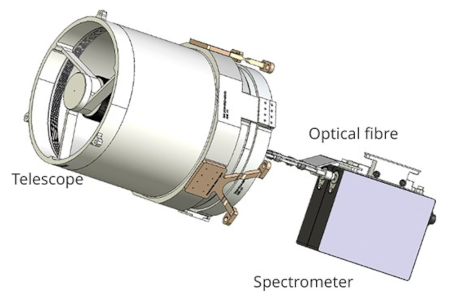
Mauve space telescope. Click for source.
Capitalism in space: A new commercial optical space telescope with a 5-inch-wide mirror and dubbed the Mauve Telescope is now operational in orbit, with its private owner, UK startup Blue Skies, offering its data to scientists for an annual subscription fee.
Blue Skies is in the process of commissioning the Mauve and plans to start delivering data to scientists in early 2026. Customers include Boston University, Columbia University, INAF’s Osservatorio Astrofisico di Arcetri, Konkoly Observatory, Kyoto University, Maynooth University, the National Astronomical Observatory of Japan, Rice University, Vanderbilt University, and Western University.
The spacecraft’s three-year mission is to study flares from stars and their impact on the habitability of planets around them. From low Earth orbit, it hosts a telescope that can collect data in the ultraviolet to visual light range (200-700 nm spectrum).
With such a small mirror Mauve is not going to be able to do a lot of ground-breaking work, though there are definitely observations of value it can accomplish, such as those listed above. Its main purpose is as a demonstration project to attract a bigger round of new investment capital, from universities like the ones listed above, for launching a larger private telescope with greater capabilities.
This is how all telescopes were funded in the U.S. until World War II, through private funds privately built. Blue Skies effort here suggests we are heading back to that model, with government budgets increasingly constrained. The company is already working on a second and larger space telescope, dubbed Twinkle with a 18-inch primary mirror. It hopes over time to continue to scale up its orbital telescopes until it is matching Hubble and Webb, and doing so faster and at far less cost.
And for profit no less!

On Christmas Eve 1968 three Americans became the first humans to visit another world. What they did to celebrate was unexpected and profound, and will be remembered throughout all human history. Genesis: the Story of Apollo 8, Robert Zimmerman's classic history of humanity's first journey to another world, tells that story, and it is now available as both an ebook and an audiobook, both with a foreword by Valerie Anders and a new introduction by Robert Zimmerman.
The print edition can be purchased at Amazon or from any other book seller. If you want an autographed copy the price is $60 for the hardback and $45 for the paperback, plus $8 shipping for each. Go here for purchasing details. The ebook is available everywhere for $5.99 (before discount) at amazon, or direct from my ebook publisher, ebookit. If you buy it from ebookit you don't support the big tech companies and the author gets a bigger cut much sooner.
The audiobook is also available at all these vendors, and is also free with a 30-day trial membership to Audible.
"Not simply about one mission, [Genesis] is also the history of America's quest for the moon... Zimmerman has done a masterful job of tying disparate events together into a solid account of one of America's greatest human triumphs."--San Antonio Express-News
Mauve space telescope. Click for source.
Capitalism in space: A new commercial optical space telescope with a 5-inch-wide mirror and dubbed the Mauve Telescope is now operational in orbit, with its private owner, UK startup Blue Skies, offering its data to scientists for an annual subscription fee.
Blue Skies is in the process of commissioning the Mauve and plans to start delivering data to scientists in early 2026. Customers include Boston University, Columbia University, INAF’s Osservatorio Astrofisico di Arcetri, Konkoly Observatory, Kyoto University, Maynooth University, the National Astronomical Observatory of Japan, Rice University, Vanderbilt University, and Western University.
The spacecraft’s three-year mission is to study flares from stars and their impact on the habitability of planets around them. From low Earth orbit, it hosts a telescope that can collect data in the ultraviolet to visual light range (200-700 nm spectrum).
With such a small mirror Mauve is not going to be able to do a lot of ground-breaking work, though there are definitely observations of value it can accomplish, such as those listed above. Its main purpose is as a demonstration project to attract a bigger round of new investment capital, from universities like the ones listed above, for launching a larger private telescope with greater capabilities.
This is how all telescopes were funded in the U.S. until World War II, through private funds privately built. Blue Skies effort here suggests we are heading back to that model, with government budgets increasingly constrained. The company is already working on a second and larger space telescope, dubbed Twinkle with a 18-inch primary mirror. It hopes over time to continue to scale up its orbital telescopes until it is matching Hubble and Webb, and doing so faster and at far less cost.
And for profit no less!
On Christmas Eve 1968 three Americans became the first humans to visit another world. What they did to celebrate was unexpected and profound, and will be remembered throughout all human history. Genesis: the Story of Apollo 8, Robert Zimmerman's classic history of humanity's first journey to another world, tells that story, and it is now available as both an ebook and an audiobook, both with a foreword by Valerie Anders and a new introduction by Robert Zimmerman.
The print edition can be purchased at Amazon or from any other book seller. If you want an autographed copy the price is $60 for the hardback and $45 for the paperback, plus $8 shipping for each. Go here for purchasing details. The ebook is available everywhere for $5.99 (before discount) at amazon, or direct from my ebook publisher, ebookit. If you buy it from ebookit you don't support the big tech companies and the author gets a bigger cut much sooner.
The audiobook is also available at all these vendors, and is also free with a 30-day trial membership to Audible.
"Not simply about one mission, [Genesis] is also the history of America's quest for the moon... Zimmerman has done a masterful job of tying disparate events together into a solid account of one of America's greatest human triumphs."--San Antonio Express-News
First a collider, now this.
Maybe call the first one Nance Grace, screaming at anything it doesn’t like…
We still have a second NRO telescope mirror waiting for a mission:
https://en.wikipedia.org/wiki/2012_National_Reconnaissance_Office_space_telescope_donation_to_NASA
While I do think Mars is over-represented—the Red Planet is probably the best use of this asset…we have seen two comets come quite close to Mars, and the wiki link suggests it might be good for asteroid work there.
I’d prefer these cheaper scopes to be sent farther afield. If one such Jovian probe ‘scope got cooked–Juno style–no great loss.
The last NRO asset is perfect for Mars…. orbital craft last a long time there, or so it seems.
“Mauve” is impressive for being only a 16U cubesat, but looking at their website, their upcoming “Twinkle” is like a mini-Webb telescope with all the instruments on board. The subscription service kind of reminds me of renting time on an old mainframe.
I do wonder how they get all the telemetry down. Starlink? Downlinks with all the participating universities?
The Keith Cowings of the world are going to hate this. No matter how much you point out to various people that funding telescopes through NASA projects is not the only way to do it they refuse to believe it.
For them, NASA is the ONLY way to do space science.
I think i proposed here on this site years ago when the idea of putting our new telescopes in space first came up
I was told it was not possible because it cost to much and the resolution was not good enough. And various other reasons I can’t remember.
I just watched a video on the mars helicopter Ingenuity.
It was built with all off the shelf electronics and batteries. Not a single thing “hardened” for space. They literally took 16 cell phone processors and radiation tested them. The ones that survived with no damage were chosen to go to mars.
Its all still working as far as anyone knows.
Telescopes like this could be launched for fee (Tax write off for the launching company) as side loads.
I would like to see amateur radio satellites go up this cheap also, but Ham Radio is dropping off in popularity.
This is the way. If I won the lottery, I wouldn’t tell anyone, but there would be signs. Launching a grand space telescope for profit would be one of them. Only problem is I’m getting old and I don’t buy lottery tickets.