Abstract art produced by nature within Mars’ north pole ice cap
Click for original
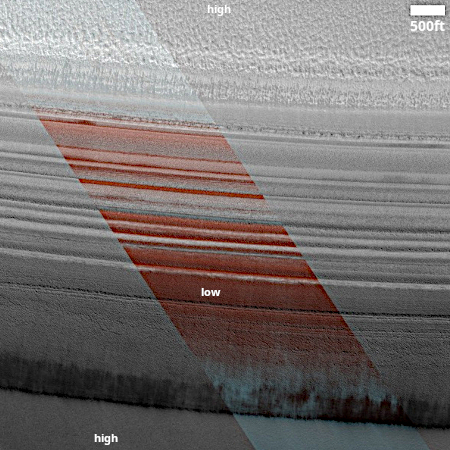
Cool image time! The picture to the right, cropped, reduced, sharpened, and annotated to post here, was taken on October 27, 2025 by the high resolution camera on Mars Reconnaissance Orbiter (MRO). I have also rotate the image so that north is to the top.
The science team labels this “Exposure of North Polar Layered Deposits,” an apt description of the horizontal red and grey and blue layers that dominate the image and make this geology look more like an abstract painting than a natural landscape. What we are actually looking at is a canyon 800-to-1,200 feet deep within the north polar ice cap of Mars.
The picture was taken in the summer with the Sun about 12 degrees above the horizon to the south. Thus, the northern cliff face is illuminated, revealing its many colored layers, while the south face is mostly in shadow, hiding those layers.
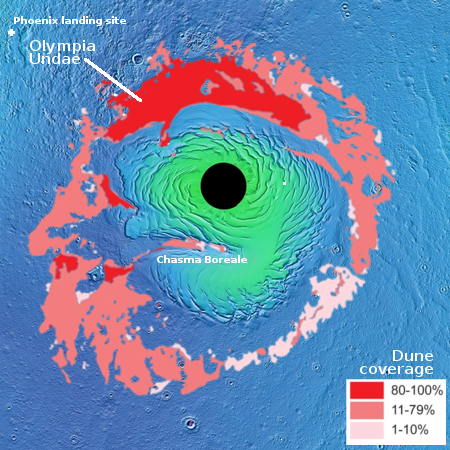
The white dot on the overview map to the right marks the location, well within the north pole ice cap. This cap is about 600 miles across and about 7,000 feet deep, made up of many layers, mostly a mixture of water ice and cemented dust and sand. From a 2019 post describing what we know of this ice cap:
The very top layers, dubbed the residual icecap, is about three to six feet thick made up of frozen water having a volume about half of Greenland’s icecap. While this water could sublimate away, data suggests it is, like the icecaps on Earth, in a steady state, neither gaining or losing volume with each Martian year.
The deeper different-colored layers are likely the result of Mars’ endless climate cycles, produced by the planet’s wide swings in its obliquity, or rotational tilt, from 11 to 60 degrees. Right now it is inclined about 25 degrees, not much different than Earth. Scientists think that when the tilt is high, more than 45 degrees, the poles are warmer than the mid-latitudes, so its ice sublimates away to fall as snow in the mid-latitudes. At that time the glaciers there grow and the ice cap shrinks.
When the tilt is low, less than 20 degrees, the reverse is the case. The mid-latitudes are warm, its glaciers shrink, and the water falls as snow at the poles. When that happens, another layer is put down on top of the ice cap. We thus get this layered pattern, the different colors likely the result of changes in the atmosphere and planet’s volcanic activity, bringing different amounts and types of dust to the pole with each cycle.
To really map this geological-climate history with accuracy, we will need to drill deep cores in this ice cap. And as I reported yesterday, scientists are already pushing the idea of using Starship to get big drilling rigs to Mars to do exactly that.
This mapping however will have more significance that simply documenting Mars’ geological and climate history. Unlike the Earth, which because of its very active atmosphere has lost most of that early history to erosion, Mars actually preserves almost the entire history of the solar system on its surface. If we can map what happened there we will almost certainly at the same time map the early formation process of our solar system itself, as well as the early history of the Earth.
Good times are coming for knowledge and human understanding of our place in the universe. We need only have the courage to grasp it whole-heartedly.

On Christmas Eve 1968 three Americans became the first humans to visit another world. What they did to celebrate was unexpected and profound, and will be remembered throughout all human history. Genesis: the Story of Apollo 8, Robert Zimmerman's classic history of humanity's first journey to another world, tells that story, and it is now available as both an ebook and an audiobook, both with a foreword by Valerie Anders and a new introduction by Robert Zimmerman.
The print edition can be purchased at Amazon or from any other book seller. If you want an autographed copy the price is $60 for the hardback and $45 for the paperback, plus $8 shipping for each. Go here for purchasing details. The ebook is available everywhere for $5.99 (before discount) at amazon, or direct from my ebook publisher, ebookit. If you buy it from ebookit you don't support the big tech companies and the author gets a bigger cut much sooner.
The audiobook is also available at all these vendors, and is also free with a 30-day trial membership to Audible.
"Not simply about one mission, [Genesis] is also the history of America's quest for the moon... Zimmerman has done a masterful job of tying disparate events together into a solid account of one of America's greatest human triumphs."--San Antonio Express-News
Click for original
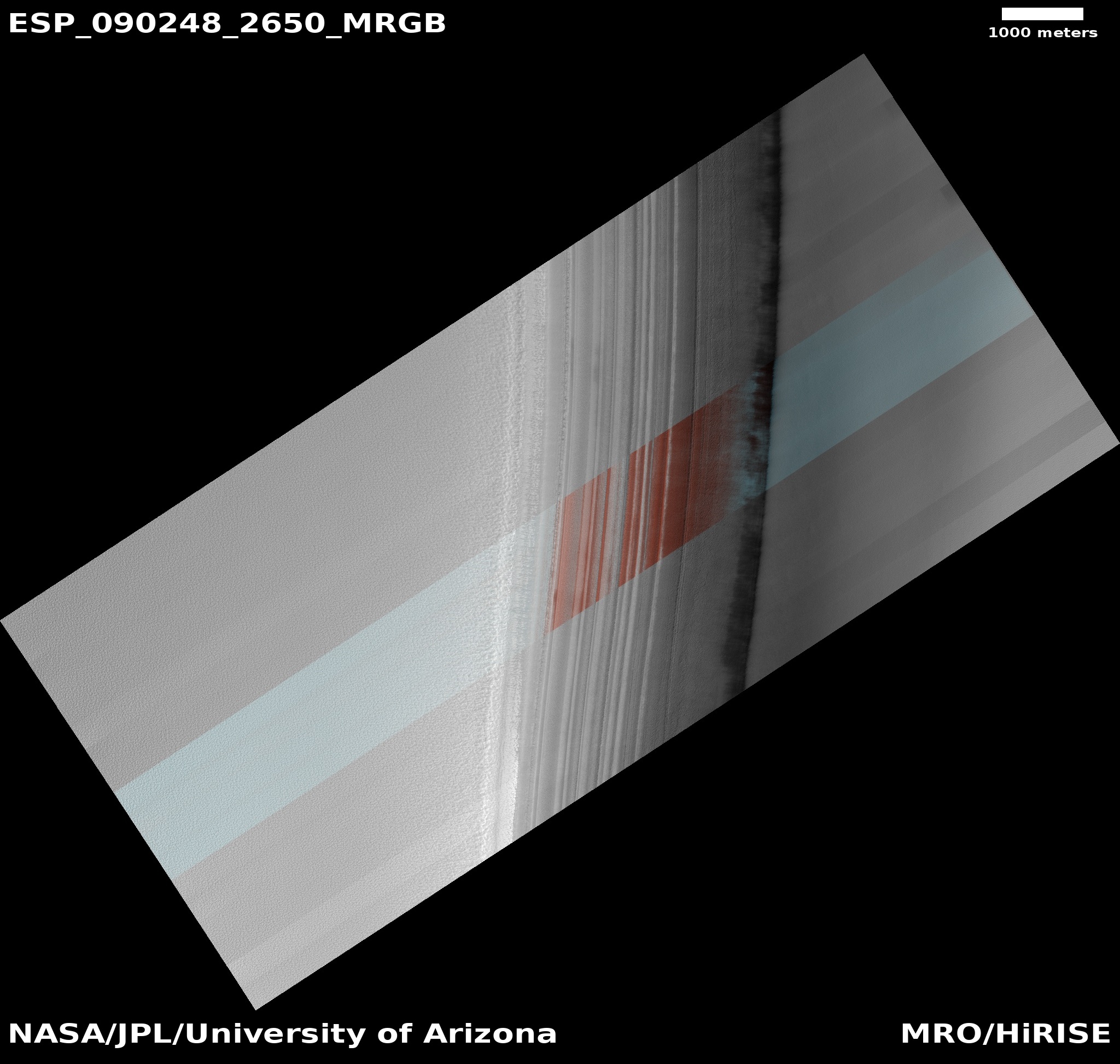
Cool image time! The picture to the right, cropped, reduced, sharpened, and annotated to post here, was taken on October 27, 2025 by the high resolution camera on Mars Reconnaissance Orbiter (MRO). I have also rotate the image so that north is to the top.
The science team labels this “Exposure of North Polar Layered Deposits,” an apt description of the horizontal red and grey and blue layers that dominate the image and make this geology look more like an abstract painting than a natural landscape. What we are actually looking at is a canyon 800-to-1,200 feet deep within the north polar ice cap of Mars.
The picture was taken in the summer with the Sun about 12 degrees above the horizon to the south. Thus, the northern cliff face is illuminated, revealing its many colored layers, while the south face is mostly in shadow, hiding those layers.
The white dot on the overview map to the right marks the location, well within the north pole ice cap. This cap is about 600 miles across and about 7,000 feet deep, made up of many layers, mostly a mixture of water ice and cemented dust and sand. From a 2019 post describing what we know of this ice cap:
The very top layers, dubbed the residual icecap, is about three to six feet thick made up of frozen water having a volume about half of Greenland’s icecap. While this water could sublimate away, data suggests it is, like the icecaps on Earth, in a steady state, neither gaining or losing volume with each Martian year.
The deeper different-colored layers are likely the result of Mars’ endless climate cycles, produced by the planet’s wide swings in its obliquity, or rotational tilt, from 11 to 60 degrees. Right now it is inclined about 25 degrees, not much different than Earth. Scientists think that when the tilt is high, more than 45 degrees, the poles are warmer than the mid-latitudes, so its ice sublimates away to fall as snow in the mid-latitudes. At that time the glaciers there grow and the ice cap shrinks.
When the tilt is low, less than 20 degrees, the reverse is the case. The mid-latitudes are warm, its glaciers shrink, and the water falls as snow at the poles. When that happens, another layer is put down on top of the ice cap. We thus get this layered pattern, the different colors likely the result of changes in the atmosphere and planet’s volcanic activity, bringing different amounts and types of dust to the pole with each cycle.
To really map this geological-climate history with accuracy, we will need to drill deep cores in this ice cap. And as I reported yesterday, scientists are already pushing the idea of using Starship to get big drilling rigs to Mars to do exactly that.
This mapping however will have more significance that simply documenting Mars’ geological and climate history. Unlike the Earth, which because of its very active atmosphere has lost most of that early history to erosion, Mars actually preserves almost the entire history of the solar system on its surface. If we can map what happened there we will almost certainly at the same time map the early formation process of our solar system itself, as well as the early history of the Earth.
Good times are coming for knowledge and human understanding of our place in the universe. We need only have the courage to grasp it whole-heartedly.
On Christmas Eve 1968 three Americans became the first humans to visit another world. What they did to celebrate was unexpected and profound, and will be remembered throughout all human history. Genesis: the Story of Apollo 8, Robert Zimmerman's classic history of humanity's first journey to another world, tells that story, and it is now available as both an ebook and an audiobook, both with a foreword by Valerie Anders and a new introduction by Robert Zimmerman.
The print edition can be purchased at Amazon or from any other book seller. If you want an autographed copy the price is $60 for the hardback and $45 for the paperback, plus $8 shipping for each. Go here for purchasing details. The ebook is available everywhere for $5.99 (before discount) at amazon, or direct from my ebook publisher, ebookit. If you buy it from ebookit you don't support the big tech companies and the author gets a bigger cut much sooner.
The audiobook is also available at all these vendors, and is also free with a 30-day trial membership to Audible.
"Not simply about one mission, [Genesis] is also the history of America's quest for the moon... Zimmerman has done a masterful job of tying disparate events together into a solid account of one of America's greatest human triumphs."--San Antonio Express-News