Exposed weirdness on floor of Martian crater
Click for original image.
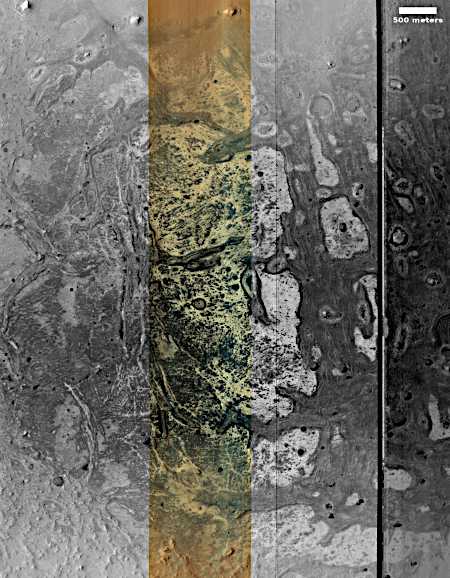
Cool image time! The picture to the right, rotated, cropped, reduced, and sharpened to post here, was taken on November 27, 2025 by the high resolution camera on Mars Reconnaissance Orbiter (MRO).
The science team labels this “exposed crater floor materials”. While properly vague, that hardly suffices. This image could easily fall into my “What the heck?!” category of Martian geology that is difficult to understand, no less explain.
The color strip suggests that dust dominates near the top and bottom, though dust is also present in the middle. The patches with the bluish tint in the middle suggests these lighter swirls and patches are bedrock.
Of course, none of that explains the weird shapes of these patches, nor why they exist at all.
Before delving into those weird shapes, we must note the two vertical black strips to the right of the color strip, indicating a gap in data. Such gaps have been appearing more frequently of late, suggesting MRO’s age, almost a decade in orbit around Mars, is beginning to show itself. A failure in 2023 in one filter band of the high resolution camera already leaves blank the color swath in black and white images. These new blank strips indicate further issues, warning us that we must be prepared for the loss of this camera and orbiter in the somewhat near future.
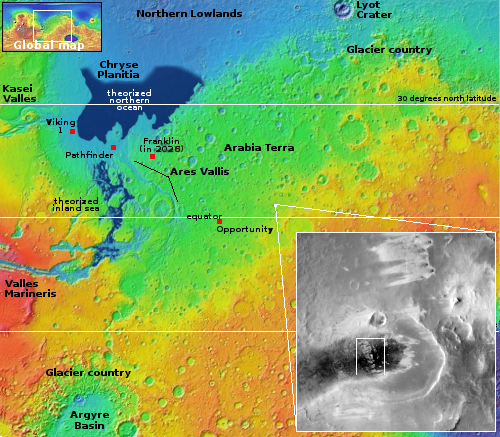
The white dot on the overview map to the right marks the location, close to the equator and about 600 miles east of where the rover Opportunity roamed. Thus, the features in the picture are not related to near surface ice, as this location is in the dry equatorial regions where there is none.
The inset provides some clues. Note the light streaks that appear to flow westward from high points, and the dark streaks that flow westward from low points. Clearly the prevailing winds here are to the west. This suggests the wind is blowing the dark volcanic dust that had previously been trapped in this very eroded ancient shallow crater, escaping out the gap where its western rim used to be. For some reason, however, that dust is not sticking to the patches of bedrock.
Earlier research in this part of Mars has found similar weird features. That research has also found evidence of possible ancient springs. That however does not mean these patches are evidence of ancient hot springs.
It is also possible we are looking at ancient lava deposits, which might explain why this crater appears partly buried. This doesn’t however provide a good explanation for those strange shapes.
Ah mysteries! Ain’t science fun?

On Christmas Eve 1968 three Americans became the first humans to visit another world. What they did to celebrate was unexpected and profound, and will be remembered throughout all human history. Genesis: the Story of Apollo 8, Robert Zimmerman's classic history of humanity's first journey to another world, tells that story, and it is now available as both an ebook and an audiobook, both with a foreword by Valerie Anders and a new introduction by Robert Zimmerman.
The print edition can be purchased at Amazon or from any other book seller. If you want an autographed copy the price is $60 for the hardback and $45 for the paperback, plus $8 shipping for each. Go here for purchasing details. The ebook is available everywhere for $5.99 (before discount) at amazon, or direct from my ebook publisher, ebookit. If you buy it from ebookit you don't support the big tech companies and the author gets a bigger cut much sooner.
The audiobook is also available at all these vendors, and is also free with a 30-day trial membership to Audible.
"Not simply about one mission, [Genesis] is also the history of America's quest for the moon... Zimmerman has done a masterful job of tying disparate events together into a solid account of one of America's greatest human triumphs."--San Antonio Express-News

Click for original image.
Cool image time! The picture to the right, rotated, cropped, reduced, and sharpened to post here, was taken on November 27, 2025 by the high resolution camera on Mars Reconnaissance Orbiter (MRO).
The science team labels this “exposed crater floor materials”. While properly vague, that hardly suffices. This image could easily fall into my “What the heck?!” category of Martian geology that is difficult to understand, no less explain.
The color strip suggests that dust dominates near the top and bottom, though dust is also present in the middle. The patches with the bluish tint in the middle suggests these lighter swirls and patches are bedrock.
Of course, none of that explains the weird shapes of these patches, nor why they exist at all.
Before delving into those weird shapes, we must note the two vertical black strips to the right of the color strip, indicating a gap in data. Such gaps have been appearing more frequently of late, suggesting MRO’s age, almost a decade in orbit around Mars, is beginning to show itself. A failure in 2023 in one filter band of the high resolution camera already leaves blank the color swath in black and white images. These new blank strips indicate further issues, warning us that we must be prepared for the loss of this camera and orbiter in the somewhat near future.

The white dot on the overview map to the right marks the location, close to the equator and about 600 miles east of where the rover Opportunity roamed. Thus, the features in the picture are not related to near surface ice, as this location is in the dry equatorial regions where there is none.
The inset provides some clues. Note the light streaks that appear to flow westward from high points, and the dark streaks that flow westward from low points. Clearly the prevailing winds here are to the west. This suggests the wind is blowing the dark volcanic dust that had previously been trapped in this very eroded ancient shallow crater, escaping out the gap where its western rim used to be. For some reason, however, that dust is not sticking to the patches of bedrock.
Earlier research in this part of Mars has found similar weird features. That research has also found evidence of possible ancient springs. That however does not mean these patches are evidence of ancient hot springs.
It is also possible we are looking at ancient lava deposits, which might explain why this crater appears partly buried. This doesn’t however provide a good explanation for those strange shapes.
Ah mysteries! Ain’t science fun?
On Christmas Eve 1968 three Americans became the first humans to visit another world. What they did to celebrate was unexpected and profound, and will be remembered throughout all human history. Genesis: the Story of Apollo 8, Robert Zimmerman's classic history of humanity's first journey to another world, tells that story, and it is now available as both an ebook and an audiobook, both with a foreword by Valerie Anders and a new introduction by Robert Zimmerman.
The print edition can be purchased at Amazon or from any other book seller. If you want an autographed copy the price is $60 for the hardback and $45 for the paperback, plus $8 shipping for each. Go here for purchasing details. The ebook is available everywhere for $5.99 (before discount) at amazon, or direct from my ebook publisher, ebookit. If you buy it from ebookit you don't support the big tech companies and the author gets a bigger cut much sooner.
The audiobook is also available at all these vendors, and is also free with a 30-day trial membership to Audible.
"Not simply about one mission, [Genesis] is also the history of America's quest for the moon... Zimmerman has done a masterful job of tying disparate events together into a solid account of one of America's greatest human triumphs."--San Antonio Express-News