France’s space agency CNES found liable for environmental damage at French Guiana spaceport
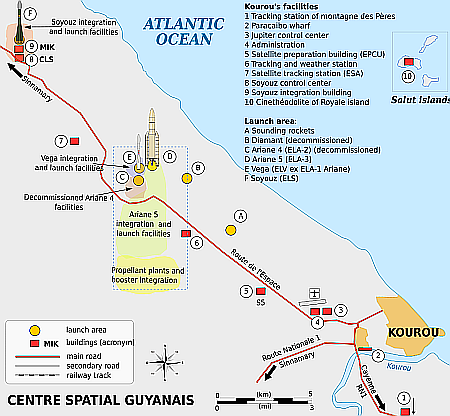
The French Guiana spaceport. The Diamant launchsite is labeled “B.”
Click for full resolution image. (Note: The Ariane-5 pad is now the
Ariane-6 pad.)
France’s space agency CNES, which has taken back management from Arianespace of the French Guiana spaceport it owns, has now been found liable for destroying a protected habitat as it began construction to upgrade the old abandoned Diamant rocket launch site into a pad for several of Europe’s new commercial rocket startups.
In March 2022, the regional environmental authority of French Guiana (DGTM) formally informed CNES that it could not begin demolition or earthworks at the Diamant site without first securing the legally required species and water-law authorisations. Despite this, the agency leveled the area in the preceding weeks, with the environmental NGO CERATO discovering the destruction in April 2022.
In August 2022, the DGTM carried out an unannounced inspection of the Diamant site and found further destruction of protected habitats linked to the agency’s PV2 solar farm project. In October 2022, the PV2 project manager informed DGTM that CNES had known about the presence of protected species on the PV2 site since 1 July 2022, yet began earthworks anyway.
In response to repeated flouting of DGTM procedures, the Prefect of French Guiana, the top regional authority, issued a stop-work order requiring CNES to halt all works at both sites.
It appears this stop-work order has contributed to delays in construction. The news now is that the case appears to have been settled.
The agency has been ordered to repair the damage within three years or face a fine of €50,000. It will also be required to finance ecological compensation actions elsewhere on the grounds of the Guiana Space Centre. The conclusion of the lawsuit will allow the agency to fully resume construction at the site, which it had been ordered to stop in late 2022.
In other words, CNES has been told to spend money elsewhere at the spaceport to make the local environmental authorities happy. It remains unclear how these delays have or even will impact the plans of the Spanish rocket startup PLD, which hopes to do the first orbital launch of its Miura-5 rocket from this site in 2026. PLD expects the first flight-worthy Miura-5 to be delivered to French Guiana early next year, so the delays in French Guiana have not yet effected its plans. That might now change if the site won’t be ready as planned.
This whole story however does indicate a fundamental problem within all of Europe’s space regulatory infrastructure that in the future is likely to hinder the development of its new commercial space industry. Europe’s leadership likes its red tape, and has done nothing to reduce it as it has shifted from the government-run model (where it controls and owns everything) to the capitalism model (where it buys what it needs from an independent competing private sector).

On Christmas Eve 1968 three Americans became the first humans to visit another world. What they did to celebrate was unexpected and profound, and will be remembered throughout all human history. Genesis: the Story of Apollo 8, Robert Zimmerman's classic history of humanity's first journey to another world, tells that story, and it is now available as both an ebook and an audiobook, both with a foreword by Valerie Anders and a new introduction by Robert Zimmerman.
The print edition can be purchased at Amazon or from any other book seller. If you want an autographed copy the price is $60 for the hardback and $45 for the paperback, plus $8 shipping for each. Go here for purchasing details. The ebook is available everywhere for $5.99 (before discount) at amazon, or direct from my ebook publisher, ebookit. If you buy it from ebookit you don't support the big tech companies and the author gets a bigger cut much sooner.
The audiobook is also available at all these vendors, and is also free with a 30-day trial membership to Audible.
"Not simply about one mission, [Genesis] is also the history of America's quest for the moon... Zimmerman has done a masterful job of tying disparate events together into a solid account of one of America's greatest human triumphs."--San Antonio Express-News

The French Guiana spaceport. The Diamant launchsite is labeled “B.”
Click for full resolution image. (Note: The Ariane-5 pad is now the
Ariane-6 pad.)
France’s space agency CNES, which has taken back management from Arianespace of the French Guiana spaceport it owns, has now been found liable for destroying a protected habitat as it began construction to upgrade the old abandoned Diamant rocket launch site into a pad for several of Europe’s new commercial rocket startups.
In March 2022, the regional environmental authority of French Guiana (DGTM) formally informed CNES that it could not begin demolition or earthworks at the Diamant site without first securing the legally required species and water-law authorisations. Despite this, the agency leveled the area in the preceding weeks, with the environmental NGO CERATO discovering the destruction in April 2022.
In August 2022, the DGTM carried out an unannounced inspection of the Diamant site and found further destruction of protected habitats linked to the agency’s PV2 solar farm project. In October 2022, the PV2 project manager informed DGTM that CNES had known about the presence of protected species on the PV2 site since 1 July 2022, yet began earthworks anyway.
In response to repeated flouting of DGTM procedures, the Prefect of French Guiana, the top regional authority, issued a stop-work order requiring CNES to halt all works at both sites.
It appears this stop-work order has contributed to delays in construction. The news now is that the case appears to have been settled.
The agency has been ordered to repair the damage within three years or face a fine of €50,000. It will also be required to finance ecological compensation actions elsewhere on the grounds of the Guiana Space Centre. The conclusion of the lawsuit will allow the agency to fully resume construction at the site, which it had been ordered to stop in late 2022.
In other words, CNES has been told to spend money elsewhere at the spaceport to make the local environmental authorities happy. It remains unclear how these delays have or even will impact the plans of the Spanish rocket startup PLD, which hopes to do the first orbital launch of its Miura-5 rocket from this site in 2026. PLD expects the first flight-worthy Miura-5 to be delivered to French Guiana early next year, so the delays in French Guiana have not yet effected its plans. That might now change if the site won’t be ready as planned.
This whole story however does indicate a fundamental problem within all of Europe’s space regulatory infrastructure that in the future is likely to hinder the development of its new commercial space industry. Europe’s leadership likes its red tape, and has done nothing to reduce it as it has shifted from the government-run model (where it controls and owns everything) to the capitalism model (where it buys what it needs from an independent competing private sector).
On Christmas Eve 1968 three Americans became the first humans to visit another world. What they did to celebrate was unexpected and profound, and will be remembered throughout all human history. Genesis: the Story of Apollo 8, Robert Zimmerman's classic history of humanity's first journey to another world, tells that story, and it is now available as both an ebook and an audiobook, both with a foreword by Valerie Anders and a new introduction by Robert Zimmerman.
The print edition can be purchased at Amazon or from any other book seller. If you want an autographed copy the price is $60 for the hardback and $45 for the paperback, plus $8 shipping for each. Go here for purchasing details. The ebook is available everywhere for $5.99 (before discount) at amazon, or direct from my ebook publisher, ebookit. If you buy it from ebookit you don't support the big tech companies and the author gets a bigger cut much sooner.
The audiobook is also available at all these vendors, and is also free with a 30-day trial membership to Audible.
"Not simply about one mission, [Genesis] is also the history of America's quest for the moon... Zimmerman has done a masterful job of tying disparate events together into a solid account of one of America's greatest human triumphs."--San Antonio Express-News
All Greens do is cause trouble.
The fines and mitigation seem so minor to a big project that you wonder if the violations were done on purpose as a way to settle ahead of time to ensure the rest of the project goes according to plan.