Sunspot update: Ramp down to minimum continues?
Another year, another month, another sunspot update! Time to post my monthly update of the never-ending sunspot cycle on the Sun, using NOAA’s own monthly update of its graph of sunspot activity and annotating it with extra information to illustrate the larger scientific context.
The green dot on the graph below indicates the level of sunspot activity on the Sun’s Earth-facing hemisphere during the month of December. Unlike November, when activity plunged, in December the sunspot count recovered, producing more sunspots, though the number still reflected the ramp down to solar minimum that NOAA’s panel of solar scientists had predicted in April 2025 (as indicated by the purple/magenta line).
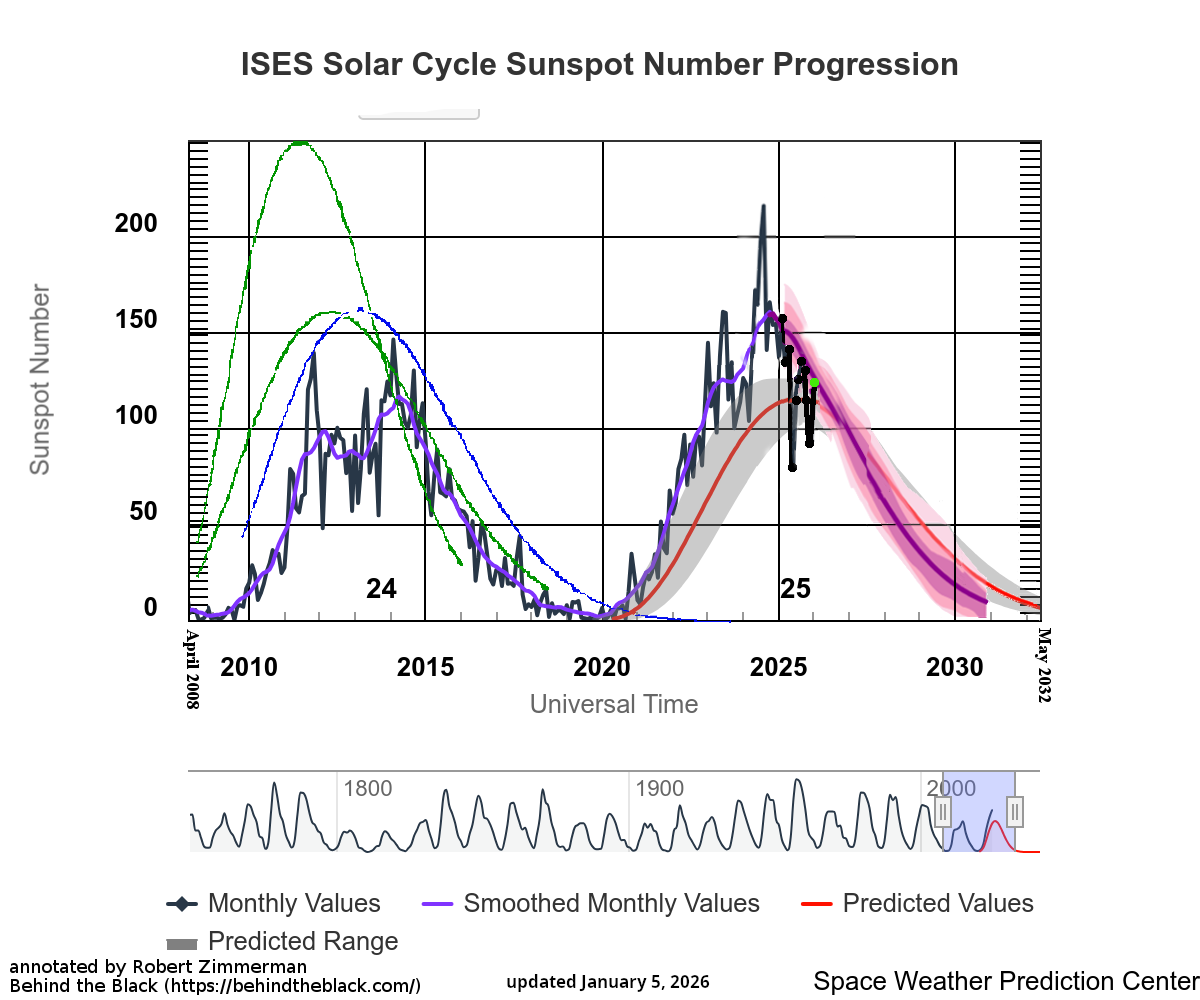
The graph above has been modified to show the predictions of the solar science community for both the previous solar maximum as well as the ongoing maximum. The green curves show the community’s two original predictions from April 2007 for the previous maximum, with half the scientists predicting a very strong maximum and half predicting a weak one. The blue curve is their revised May 2009 prediction. The red curve is the new prediction, first posted by NOAA in April 2020. At the beginning of April 2025 NOAA’s panel of solar scientists added the purple/magenta curve line, predicting that solar maximum was over, and that the ramp down to minimum had begun.
Though it does appear the Sun is following that magenta curve downward, you can also look at this graph another way. For the last 8-9 months, the sunspot activity has been relatively stable, fluctuating up and down but centered around the 125 number. While the trend seems downward, as predicted, it is still a slight chance we are in the low point of a double-peaked maximum, as occurred in the previous maximum.
This speculation on my part is not likely, but we won’t know for certain for another half year. Right now the present ramp down towards minimum will give us a very short but weak cycle, something uncommon. In the past short cycles corresponded to strong sunspot activity. If the Sun should have a short burst of activity, producing a second peak (no matter how measly), it would extend this cycle somewhat and make it less unusual.
As I have now written numerous times since I began these monthly reports in 2010, none of these predictions can be taken very seriously, as they are not based on knowledge and real understanding. As I wrote last month,
The scientists still do not understand why the Sun undergoes these cycles on a very fundamental level. Thus, if you want to believe any one of these predictions, you can only do so based on faith, and faith is not how science should be done.
Nothing has changed in the past month.

On Christmas Eve 1968 three Americans became the first humans to visit another world. What they did to celebrate was unexpected and profound, and will be remembered throughout all human history. Genesis: the Story of Apollo 8, Robert Zimmerman's classic history of humanity's first journey to another world, tells that story, and it is now available as both an ebook and an audiobook, both with a foreword by Valerie Anders and a new introduction by Robert Zimmerman.
The print edition can be purchased at Amazon or from any other book seller. If you want an autographed copy the price is $60 for the hardback and $45 for the paperback, plus $8 shipping for each. Go here for purchasing details. The ebook is available everywhere for $5.99 (before discount) at amazon, or direct from my ebook publisher, ebookit. If you buy it from ebookit you don't support the big tech companies and the author gets a bigger cut much sooner.
The audiobook is also available at all these vendors, and is also free with a 30-day trial membership to Audible.
"Not simply about one mission, [Genesis] is also the history of America's quest for the moon... Zimmerman has done a masterful job of tying disparate events together into a solid account of one of America's greatest human triumphs."--San Antonio Express-News
Another year, another month, another sunspot update! Time to post my monthly update of the never-ending sunspot cycle on the Sun, using NOAA’s own monthly update of its graph of sunspot activity and annotating it with extra information to illustrate the larger scientific context.
The green dot on the graph below indicates the level of sunspot activity on the Sun’s Earth-facing hemisphere during the month of December. Unlike November, when activity plunged, in December the sunspot count recovered, producing more sunspots, though the number still reflected the ramp down to solar minimum that NOAA’s panel of solar scientists had predicted in April 2025 (as indicated by the purple/magenta line).
The graph above has been modified to show the predictions of the solar science community for both the previous solar maximum as well as the ongoing maximum. The green curves show the community’s two original predictions from April 2007 for the previous maximum, with half the scientists predicting a very strong maximum and half predicting a weak one. The blue curve is their revised May 2009 prediction. The red curve is the new prediction, first posted by NOAA in April 2020. At the beginning of April 2025 NOAA’s panel of solar scientists added the purple/magenta curve line, predicting that solar maximum was over, and that the ramp down to minimum had begun.
Though it does appear the Sun is following that magenta curve downward, you can also look at this graph another way. For the last 8-9 months, the sunspot activity has been relatively stable, fluctuating up and down but centered around the 125 number. While the trend seems downward, as predicted, it is still a slight chance we are in the low point of a double-peaked maximum, as occurred in the previous maximum.
This speculation on my part is not likely, but we won’t know for certain for another half year. Right now the present ramp down towards minimum will give us a very short but weak cycle, something uncommon. In the past short cycles corresponded to strong sunspot activity. If the Sun should have a short burst of activity, producing a second peak (no matter how measly), it would extend this cycle somewhat and make it less unusual.
As I have now written numerous times since I began these monthly reports in 2010, none of these predictions can be taken very seriously, as they are not based on knowledge and real understanding. As I wrote last month,
The scientists still do not understand why the Sun undergoes these cycles on a very fundamental level. Thus, if you want to believe any one of these predictions, you can only do so based on faith, and faith is not how science should be done.
Nothing has changed in the past month.
On Christmas Eve 1968 three Americans became the first humans to visit another world. What they did to celebrate was unexpected and profound, and will be remembered throughout all human history. Genesis: the Story of Apollo 8, Robert Zimmerman's classic history of humanity's first journey to another world, tells that story, and it is now available as both an ebook and an audiobook, both with a foreword by Valerie Anders and a new introduction by Robert Zimmerman.
The print edition can be purchased at Amazon or from any other book seller. If you want an autographed copy the price is $60 for the hardback and $45 for the paperback, plus $8 shipping for each. Go here for purchasing details. The ebook is available everywhere for $5.99 (before discount) at amazon, or direct from my ebook publisher, ebookit. If you buy it from ebookit you don't support the big tech companies and the author gets a bigger cut much sooner.
The audiobook is also available at all these vendors, and is also free with a 30-day trial membership to Audible.
"Not simply about one mission, [Genesis] is also the history of America's quest for the moon... Zimmerman has done a masterful job of tying disparate events together into a solid account of one of America's greatest human triumphs."--San Antonio Express-News
My guess is that there are longer term cycles which can be masked by the relatively short 11 year cycle, which could lead to the double maxima we have seen.
When we lived in Manitoba near Winnipeg, we prayed for global warming; so we prayed for a strong maximum.
The Sun is also a gamma ray source
https://phys.org/news/2026-01-solar-physicists-hidden-source-gamma.html