Sunspot update: Sunspot activity again crashes far below predictions
It is the start of another month, so it is time again to post my monthly update of the never-ending sunspot cycle on the Sun, using NOAA’s own monthly update of its graph of sunspot activity and annotating it with extra information to illustrate the larger scientific context.
The green dot on the graph below indicates the level of sunspot activity on the Sun’s Earth-facing hemisphere during the month of November. And once again, the Sun surprised us, producing far less sunspots than expected, based on the April 2025 prediction by NOAA’s panel of solar scientists (as indicated by the purple/magenta line).
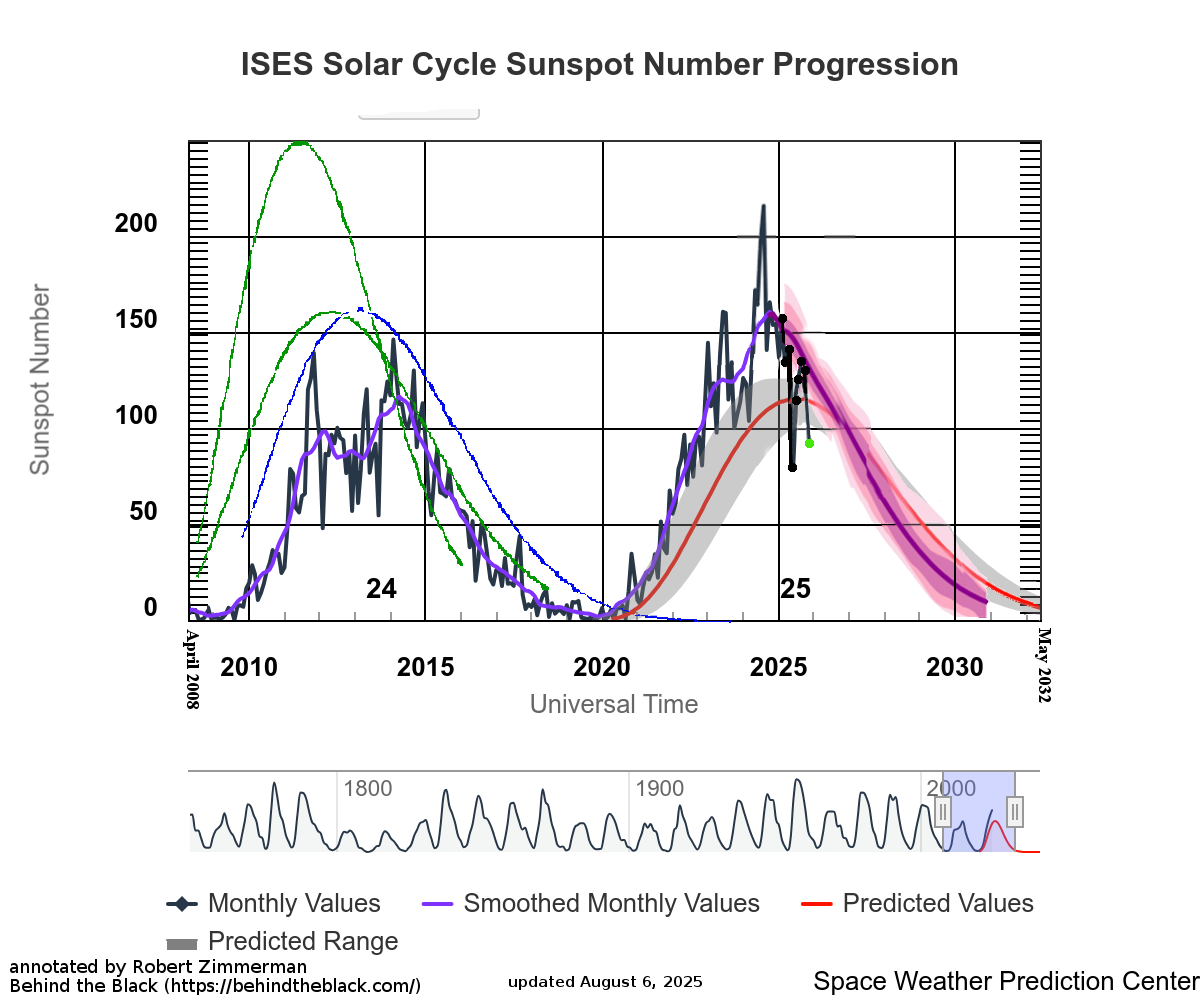
The graph above has been modified to show the predictions of the solar science community for both the previous solar maximum as well as the ongoing maximum. The green curves show the community’s two original predictions from April 2007 for the previous maximum, with half the scientists predicting a very strong maximum and half predicting a weak one. The blue curve is their revised May 2009 prediction. The red curve is the new prediction, first posted by NOAA in April 2020. At the beginning of April 2025 NOAA’s panel of solar scientists added the purple/magenta curve line, predicting that solar maximum was over, and that the ramp down to minimum had begun
As you can see, for the second time this year sunspot activity fell well below the prediction curves, both of the April 2020 prediction (the red curve) as well as the April 2025 ramp down prediction. What makes these numbers intriguing is that they are different completely from the entire trend during this solar cycle. Other than these months, sunspot activity since 2020 has consistently been greater than the predictions. Now that the Sun appears to be ramping down towards minimum, it seems to want to do it quickly, as if it is tired from all that earlier activity.
Of course, the November numbers are for just one month, which means they only represent one data point in a chaotic sequence that fluctuates randomly as it follows its predicted trend. That one month does not represent that entire trend. The Sun is just as likely to recover in the coming months.
It does increasingly appear however that the April 2025 prediction is now correct, that the solar maximum has passed, and that Sun is now heading towards a sunspot minimum. The question now is whether that minimum will occur in 2031, as predicted, making for a solar cycle with a normal length of eleven years, or will it happen sooner. If sooner, which is what appears to be happening, this cycle will be unusual in that it will be short but weak. In the past, short cycles were routinely associated with strong cycles.
We shall have to wait and see. None of these predictions can be taken based on knowledge and real understanding, as the scientists still do not understand why the Sun undergoes these cycles on a very fundamental level. Thus, if you want to believe any one of these predictions, you can only do so based on faith, and faith is not how science should be done.

On Christmas Eve 1968 three Americans became the first humans to visit another world. What they did to celebrate was unexpected and profound, and will be remembered throughout all human history. Genesis: the Story of Apollo 8, Robert Zimmerman's classic history of humanity's first journey to another world, tells that story, and it is now available as both an ebook and an audiobook, both with a foreword by Valerie Anders and a new introduction by Robert Zimmerman.
The print edition can be purchased at Amazon or from any other book seller. If you want an autographed copy the price is $60 for the hardback and $45 for the paperback, plus $8 shipping for each. Go here for purchasing details. The ebook is available everywhere for $5.99 (before discount) at amazon, or direct from my ebook publisher, ebookit. If you buy it from ebookit you don't support the big tech companies and the author gets a bigger cut much sooner.
The audiobook is also available at all these vendors, and is also free with a 30-day trial membership to Audible.
"Not simply about one mission, [Genesis] is also the history of America's quest for the moon... Zimmerman has done a masterful job of tying disparate events together into a solid account of one of America's greatest human triumphs."--San Antonio Express-News
It is the start of another month, so it is time again to post my monthly update of the never-ending sunspot cycle on the Sun, using NOAA’s own monthly update of its graph of sunspot activity and annotating it with extra information to illustrate the larger scientific context.
The green dot on the graph below indicates the level of sunspot activity on the Sun’s Earth-facing hemisphere during the month of November. And once again, the Sun surprised us, producing far less sunspots than expected, based on the April 2025 prediction by NOAA’s panel of solar scientists (as indicated by the purple/magenta line).
The graph above has been modified to show the predictions of the solar science community for both the previous solar maximum as well as the ongoing maximum. The green curves show the community’s two original predictions from April 2007 for the previous maximum, with half the scientists predicting a very strong maximum and half predicting a weak one. The blue curve is their revised May 2009 prediction. The red curve is the new prediction, first posted by NOAA in April 2020. At the beginning of April 2025 NOAA’s panel of solar scientists added the purple/magenta curve line, predicting that solar maximum was over, and that the ramp down to minimum had begun
As you can see, for the second time this year sunspot activity fell well below the prediction curves, both of the April 2020 prediction (the red curve) as well as the April 2025 ramp down prediction. What makes these numbers intriguing is that they are different completely from the entire trend during this solar cycle. Other than these months, sunspot activity since 2020 has consistently been greater than the predictions. Now that the Sun appears to be ramping down towards minimum, it seems to want to do it quickly, as if it is tired from all that earlier activity.
Of course, the November numbers are for just one month, which means they only represent one data point in a chaotic sequence that fluctuates randomly as it follows its predicted trend. That one month does not represent that entire trend. The Sun is just as likely to recover in the coming months.
It does increasingly appear however that the April 2025 prediction is now correct, that the solar maximum has passed, and that Sun is now heading towards a sunspot minimum. The question now is whether that minimum will occur in 2031, as predicted, making for a solar cycle with a normal length of eleven years, or will it happen sooner. If sooner, which is what appears to be happening, this cycle will be unusual in that it will be short but weak. In the past, short cycles were routinely associated with strong cycles.
We shall have to wait and see. None of these predictions can be taken based on knowledge and real understanding, as the scientists still do not understand why the Sun undergoes these cycles on a very fundamental level. Thus, if you want to believe any one of these predictions, you can only do so based on faith, and faith is not how science should be done.
On Christmas Eve 1968 three Americans became the first humans to visit another world. What they did to celebrate was unexpected and profound, and will be remembered throughout all human history. Genesis: the Story of Apollo 8, Robert Zimmerman's classic history of humanity's first journey to another world, tells that story, and it is now available as both an ebook and an audiobook, both with a foreword by Valerie Anders and a new introduction by Robert Zimmerman.
The print edition can be purchased at Amazon or from any other book seller. If you want an autographed copy the price is $60 for the hardback and $45 for the paperback, plus $8 shipping for each. Go here for purchasing details. The ebook is available everywhere for $5.99 (before discount) at amazon, or direct from my ebook publisher, ebookit. If you buy it from ebookit you don't support the big tech companies and the author gets a bigger cut much sooner.
The audiobook is also available at all these vendors, and is also free with a 30-day trial membership to Audible.
"Not simply about one mission, [Genesis] is also the history of America's quest for the moon... Zimmerman has done a masterful job of tying disparate events together into a solid account of one of America's greatest human triumphs."--San Antonio Express-News
After years of following these monthly posts I’ve come to the conclusion that the good folks at NOAA are running a perpetual football type office pool.
Everyone puts down five bucks and draws a number out of a hat. At the end of the year the lucky one gets to go home with the cash.
Jerry Greenwood: I think it works the same for hurricane prediction.
Jerry Greenwood and Blair Ivey: I think you guys are both right!
On the other hand, I thank Bob for diligently going over the data every month. We know there is some sort of link between the solar cycle and planetary climate. The loss of glaciers, on a planetary scale, is somewhat small. On a one by one scale it can e large. I go back to the Athabasca glacier where we learned crevasse rescue using 60′ deep crevasses that now are bare rock, or the loss of the “Skyladder” on Mt Andromeda etc, But to be noted is that the rate of retreat reduced after 1950 as marked by Parks Canada’s monitoring of the Athabasca’s toe.