The auroras of Jupiter and Ganymede
According to two different university press releases in the past month, new details have been discovered about the auroras found on Jupiter as well as its largest moon, Ganymede, caused by the interaction of Jupiter’s powerful magnetic field not only with Ganymede’s weak one but with the motion of all four Galilean moons as they orbit the gas giant.
The first study used data from Juno when it made a close fly-by of Ganymede in 2021. It not only showed how the aurora was caused by interaction between the magnetic fields of Jupiter and Ganymede, it found that Ganymede’s auroras were similar to those on Earth.
Similar structures, known as ‘beads’, have been observed in the auroras of Earth and Jupiter, where they are linked to sub-storms and dawn storms, large-scale rearrangements of the magnetosphere that release enormous amounts of energy and produce intense auroral activity,” explains Alessandro Moirano, post-doctoral researcher at LPAP.
Ganymede interacts with Jupiter’s space environment in a similar way to how Earth interacts with the solar wind; therefore, the discovery of auroral patches on Ganymede similar to those on Earth suggests that the fundamental physical process(es) could be generally induced in the coupling between any celestial body, its magnetosphere, and external forces.
The auroral footprints of Io and Europa
on Jupiter
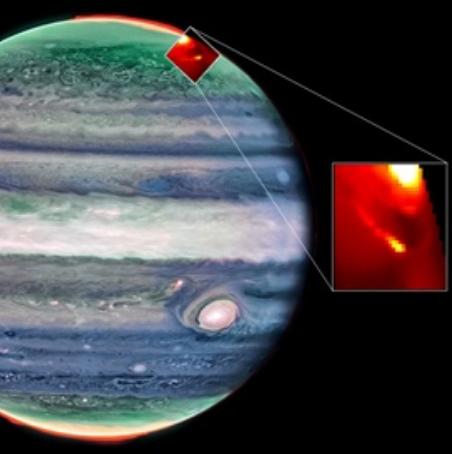
The second study, released yesterday, used the Webb Space Telescope to a get a more detailed look at Jupiter’s auroras, caused as the four Galilean moons — Io, Europa, Ganymede, and Callisto — travel through Jupiter’s powerful magnetic field, causing energetic particles to following Jupiter’s magnetic field lines down to its poles, there creating the auroras.
Webb’s data found that the auroral footprints on Jupiter caused by each moon were different from Jupiter’s own aurora.
However, the footprints created by Io and Europa, did not have the characteristics expected from Jupiter’s main aurora, which contains a lot of hot material. Instead, in one snapshot, they discovered a cold spot within Io’s auroral footprint that registered temperatures much lower than expected, with extraordinarily high densities.
As the data was limited to a single 22-hour window, the results are very uncertain. More observations are planned, covering a longer time period, to see if this phenomenon can be captured again.
All of these results are very tantalizing, but to really get a handle on what is going on will require continuous observations over years, from many spacecraft devoted exclusively to Jupiter. And that isn’t going to happen for quite some time.

On Christmas Eve 1968 three Americans became the first humans to visit another world. What they did to celebrate was unexpected and profound, and will be remembered throughout all human history. Genesis: the Story of Apollo 8, Robert Zimmerman's classic history of humanity's first journey to another world, tells that story, and it is now available as both an ebook and an audiobook, both with a foreword by Valerie Anders and a new introduction by Robert Zimmerman.
The print edition can be purchased at Amazon or from any other book seller. If you want an autographed copy the price is $60 for the hardback and $45 for the paperback, plus $8 shipping for each. Go here for purchasing details. The ebook is available everywhere for $5.99 (before discount) at amazon, or direct from my ebook publisher, ebookit. If you buy it from ebookit you don't support the big tech companies and the author gets a bigger cut much sooner.
The audiobook is also available at all these vendors, and is also free with a 30-day trial membership to Audible.
"Not simply about one mission, [Genesis] is also the history of America's quest for the moon... Zimmerman has done a masterful job of tying disparate events together into a solid account of one of America's greatest human triumphs."--San Antonio Express-News
According to two different university press releases in the past month, new details have been discovered about the auroras found on Jupiter as well as its largest moon, Ganymede, caused by the interaction of Jupiter’s powerful magnetic field not only with Ganymede’s weak one but with the motion of all four Galilean moons as they orbit the gas giant.
The first study used data from Juno when it made a close fly-by of Ganymede in 2021. It not only showed how the aurora was caused by interaction between the magnetic fields of Jupiter and Ganymede, it found that Ganymede’s auroras were similar to those on Earth.
Similar structures, known as ‘beads’, have been observed in the auroras of Earth and Jupiter, where they are linked to sub-storms and dawn storms, large-scale rearrangements of the magnetosphere that release enormous amounts of energy and produce intense auroral activity,” explains Alessandro Moirano, post-doctoral researcher at LPAP.
Ganymede interacts with Jupiter’s space environment in a similar way to how Earth interacts with the solar wind; therefore, the discovery of auroral patches on Ganymede similar to those on Earth suggests that the fundamental physical process(es) could be generally induced in the coupling between any celestial body, its magnetosphere, and external forces.
The auroral footprints of Io and Europa
on Jupiter
The second study, released yesterday, used the Webb Space Telescope to a get a more detailed look at Jupiter’s auroras, caused as the four Galilean moons — Io, Europa, Ganymede, and Callisto — travel through Jupiter’s powerful magnetic field, causing energetic particles to following Jupiter’s magnetic field lines down to its poles, there creating the auroras.
Webb’s data found that the auroral footprints on Jupiter caused by each moon were different from Jupiter’s own aurora.
However, the footprints created by Io and Europa, did not have the characteristics expected from Jupiter’s main aurora, which contains a lot of hot material. Instead, in one snapshot, they discovered a cold spot within Io’s auroral footprint that registered temperatures much lower than expected, with extraordinarily high densities.
As the data was limited to a single 22-hour window, the results are very uncertain. More observations are planned, covering a longer time period, to see if this phenomenon can be captured again.
All of these results are very tantalizing, but to really get a handle on what is going on will require continuous observations over years, from many spacecraft devoted exclusively to Jupiter. And that isn’t going to happen for quite some time.
On Christmas Eve 1968 three Americans became the first humans to visit another world. What they did to celebrate was unexpected and profound, and will be remembered throughout all human history. Genesis: the Story of Apollo 8, Robert Zimmerman's classic history of humanity's first journey to another world, tells that story, and it is now available as both an ebook and an audiobook, both with a foreword by Valerie Anders and a new introduction by Robert Zimmerman.
The print edition can be purchased at Amazon or from any other book seller. If you want an autographed copy the price is $60 for the hardback and $45 for the paperback, plus $8 shipping for each. Go here for purchasing details. The ebook is available everywhere for $5.99 (before discount) at amazon, or direct from my ebook publisher, ebookit. If you buy it from ebookit you don't support the big tech companies and the author gets a bigger cut much sooner.
The audiobook is also available at all these vendors, and is also free with a 30-day trial membership to Audible.
"Not simply about one mission, [Genesis] is also the history of America's quest for the moon... Zimmerman has done a masterful job of tying disparate events together into a solid account of one of America's greatest human triumphs."--San Antonio Express-News