
Lunar Gateway dead as NASA announces major changes to its future space station, lunar, and Mars plans
Capitalism in space As part of the reshaping of NASA being pushed by NASA administrator Jared Isaacman, the agency today announced major changes to its future programs in low Earth orbit, on the Moon, and in exploring Mars. Video of these changes can be viewed here and here.
The Moon
NASA will now focus all work in its lunar program on getting to the surface of the Moon. Lunar Gateway is “paused,” though the language of NASA’s press release suggests more strongly that it is dead, with the agency already trying to figure out ways to “repurpose” its already built components. NASA will instead ask for proposals from private industry and its international Artemis partners to ramp up as soon as possible a phased program to establish the infrastructure on the Moon needed for the lunar base. This new focus begins with “up to 30 robotic landings in three years, starting in 2027,” and at least two manned landings per year beginning in 2028.
The graph below, presented during today’s announcement, shows the basic plan for the next few Artemis missions, which will act as the manned foundation for this entire surface-focused program. The overall program will build out the lunar base in three phases, first to test some basic infrastructure using these smaller lunar landers, second to begin establishing the base’s foundational components with intermittent manned missions, and third to begin long-term human occupancy.
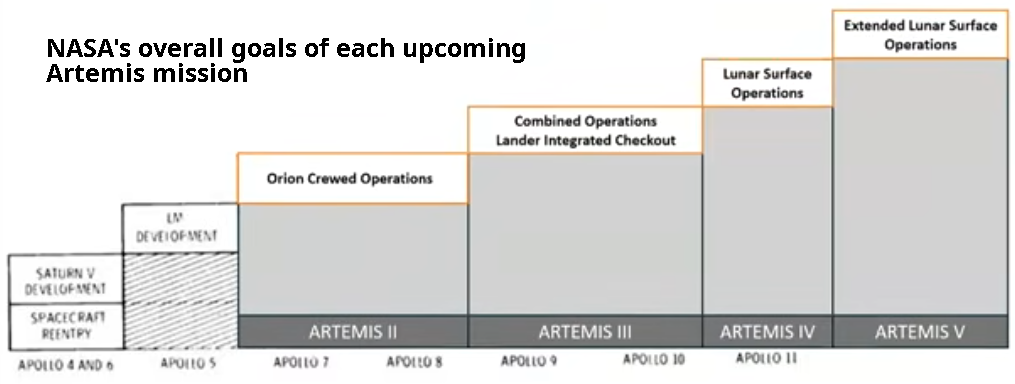
The manned missions above are scheduled through ’28. For the three-phase program to build that lunar base the agency hopes to reach its third phase by 2033. And while it states it wants to work with its international partners in doing this work, it will mostly depend on the American private sector to come up with ways to achieve it.
In many ways the timeline for this program resembles an Elon Musk timeline. The overall plan makes great sense, but it will likely take longer than anticipated to achieve. Its greatest virtue however is that it is properly focused on the Moon. Gone is NASA’s ridiculous Lunar Gateway, that only served to slow development on the Moon as well as making it harder to get there. It also appears the plan is designed to phase out SLS as soon as possible, shifting to relying on privately-owned rockets instead.
Most important, the program is structured logically, building upward from small first efforts to increasingly greater challenges, something that NASA management before Isaacman did not do.
Building a replacement for ISS
The program to replace ISS is being restructured for two reasons. 1. NASA doesn’t have the funds to fund two private stations in a manner the agency considers sufficient or safe. It says its present budget is about $250 million per year. The agency also does not think there is enough commercial market to make up the difference.
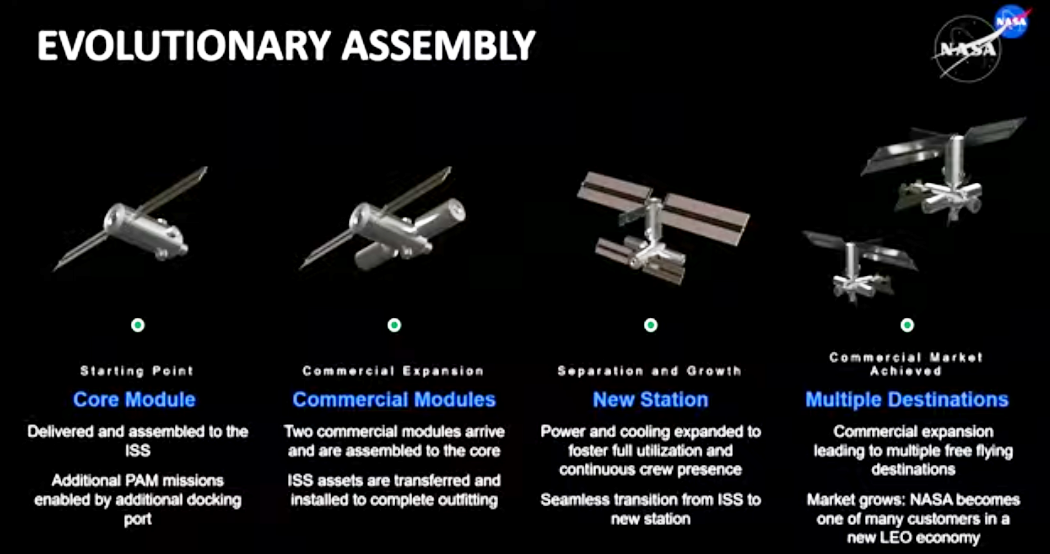
To overcome this shortfall as well as fuel a private space station industry, the agency is considering a different approach. Rather than award a single insufficient contract to a private company to build a new station, it is proposing launching what it calls a new government-owned “core module” to attach initially to ISS, and later become the hub for multiple private modules. It would have six docking ports to allow more commercial tourist missions to the station as well as the later attachment of new commercial modules. Once this core module has grown enough, it would later separate from ISS when the station is retired, and serve as a core to help generate the development of one or multiple commercial separate stations.
The graphic below, from today’s presentation, shows this step-by-step process.
In many ways, it appears NASA is copying Axiom’s plan for its space station. Whether this supplants or supplements Axiom remains unknown. It is also very likely Axiom could quickly revise its station design to grab the contract for this core stage, as proposed.
The basic concept, however, is to provide a more cost effective way for NASA to build a foundational hub to help multiple private space station companies develop and build their own stations, with NASA as a major customer to all. And once again, this approach is aimed at encouraging a private sector, not building a giant NASA project. In this more than anything else the plan appears to be good news for the future of the American space industry.
Mars
NASA is proposing a new Mars mission, dubbed Space Reactor-1 Freedom, using nuclear propulsion to carry a fleet of Ingenuity-class helicopters to the Red Planet, with the goal of launching this mission by the end of 2028.
Of all the proposals announced today, this one project appears the least connected to the private sector. The nuclear engine is being built by a partnership of NASA and the Energy Department. The helicopter fleet appears to be basically Ingenuity multiplied, something that NASA can do on its own.
Only the ship itself, carrying the engine and the helicopters, could come from the private sector, with SpaceX’s Starship the prime candidate.
Thus, as a mostly government run project, I believe it will be the least likely to happen, as promised. That Isaacman seems personally committed to it, however, says my pessimistic prediction will be wrong.
Final thoughts
Overall, these program changes appear sensible and more realistic than any major NASA manned program in decades. Though it does appear to want to elevate NASA’s status across the entire landscape of American space exploration, it also does so by relying mostly on the private sector to get the job done. And it lays out a rational manned program for both low Earth orbit as well as the Moon.
There is one dangerous caveat to this logical program. NASA is still going to send four astronauts on a ten-day around the Moon in just a few weeks, using a Orion capsule with a questionable heat shield and a untested life support system. That mission remains irrational and out of place, an apparently leftover from NASA’s previous management that planned nothing in a sensible way.
If it fails and those astronauts die, it is very unclear what impact that will have Isaascman’s entire program as announced today.

On Christmas Eve 1968 three Americans became the first humans to visit another world. What they did to celebrate was unexpected and profound, and will be remembered throughout all human history. Genesis: the Story of Apollo 8, Robert Zimmerman's classic history of humanity's first journey to another world, tells that story, and it is now available as both an ebook and an audiobook, both with a foreword by Valerie Anders and a new introduction by Robert Zimmerman.
The print edition can be purchased at Amazon or from any other book seller. If you want an autographed copy the price is $60 for the hardback and $45 for the paperback, plus $8 shipping for each. Go here for purchasing details. The ebook is available everywhere for $5.99 (before discount) at amazon, or direct from my ebook publisher, ebookit. If you buy it from ebookit you don't support the big tech companies and the author gets a bigger cut much sooner.
The audiobook is also available at all these vendors, and is also free with a 30-day trial membership to Audible.
"Not simply about one mission, [Genesis] is also the history of America's quest for the moon... Zimmerman has done a masterful job of tying disparate events together into a solid account of one of America's greatest human triumphs."--San Antonio Express-News
I knew that if I read long enough, I would find the word “seamless”!
I wonder what the odds are that the already built gateway components could be sold to one of the private space station companies. At first glance that would seem to be a nice boost to the timeline to getting something operational, but I’m sure there are lots of devils in the details.
It’s almost strange seeing a NASA administrator making reasonable, forward-looking announcements, rather than roll over for Congress and accept billions in misspent funds every year to go nowhere and do nothing. I’m skeptical on how much of this will get accomplished, but at least Isaacman is actually thinking ahead rather than treating spaceflight as a series of disconnected jerks and leaps, where no one step ever seems to build on anything else.
Nate P: What stands out under Isaacman is the lack of blather and jargon. He and everyone on the podium with him spoke directly and answered questions clearly.
In only one case: When asked if this plan is designed to phase SLS out after Artemis-5, Lori Glaser blathered in order to avoid answering the question. Very clearly the plan is phasing out SLS, but no NASA officials wish to say this outright at this time. Better to get in line the commercial rocket replacements first.
How does this fit with the plans SpaceX has put forward recently for a moon base? Likewise, how does the new ISS fit with the plan to put data centers in space? I can’t figure it out hardly at all.
Steve White: This new NASA program is what the government wishes to get accomplished, using the private sector. The data centers in orbit and on the Moon are what the private sector wants to get accomplished, independent of the government.
The two are inter-related, but not identical. The former will help fund the development of the latter, but based on what I presently see, the latter will happen even without that government help.
Nate P, yep. After listening to my comments on the presentations (I watched all three) my wife asked “do you want a divorce so you can marry Jared Isaacman?” :)
And Steve White, yep again. Just in particular, 8 tons of payload per landing in the mid-2030s, while SpaceX is confidently predicting 100 tons? A couple possibilities: 1) the numbers referred to CLPS contractors and intentionally excluded “the big boys” SpaceX and perhaps Blue, or 2) NASA still can’t get its collective head around Starship. Hope it’s the former.
David Eastman, the Gateway PPE is being repurposed as the propulsion for the SR-1 nuke mission to Mars. And there was a lot of talk about repurposing various other Gateway systems for surface applications. None of the international partners are going to lose money or jobs with this change—probably the opposite.
So much info it will take some time to process. What a day.
I finally finished the second half of the Ignition presentation and I do not believe they will be able to get SR-1 Freedom done in 2028. I know it is a small 20kw prototype, it is very aggressive project, but I do not think the timeline is realistic. They want to go to NEP (Nuclear Electric Propulsion) when we have all this engineering done with NTR (Nuclear Thermal Rocket, yes I showed the acronyms since some people yelled at me about not doing it). NEP has a longer burn time, but a lower thrust compared to NTR.
I will have to read up more on SR-1, but what happens to it when it is done delivering the “Skyfall” payloads? Will it sit in orbit? Burn up? Return to Earth?
What is the status on the idea to use Starship to propel Orion to the moon, and use SLS only to orbit Orion?
Gets on NSF Flametrench were pretty negative about the basic physics of the idea of pushing Orion using the nose hatch on Starship!!
Why not just use a Dragon to ferry crew up to Starship that was loaded with propellant, fly the whole mission in Starship except Earth re-entry, and use a Dragon to ferry the crew down? Enough delta-v? Maybe a refill in lunar orbit? This avoids crew on Starship for launch, which should help man-rating.
Ray Van Dune: The plan as laid out will have SLS take Orion to lunar orbit where the manned lunar landers will take over for the landing.
I will have more to say about this in an essay tomorrow, as well as on The Space Show tonight. Much of Isaacman’s actions since taking over NASA are very cleverly designed to persuade Congress to allow major changes in the program. And that has involved some very delicate step-by-step maneuvering.
“Gets on NSF Flametrench were pretty negative about the basic physics of the idea of pushing Orion using the nose hatch on Starship!!”
I mean, this is basically what the Constellation architecture was going to do: the Earth Departure Stage had the Altair lunar lander mounted on top, and the Orion docked to the Altair, nose down, for Trans Lunar Injection (TLI). Are we supposed to imagine that the structure of Starship is weaker than that of Altair?
But I assume the guys at Hawthorne have been thinking about this possibility for years now.
Bob, I am pretty sure I heard that the new plan was to have SLS take Orion only to low Earth orbit. Now, I am not sure if I heard that anywhere else but NSF, but they were quite definite about it, and didn’t think it would work to do TLI, because of structural limitations of any Starship docking port in the nose.
Also, I was under the impression that SLS did not have the oomph to take Orion to Low Lunar Orbit, which is the reality that necessitated the near-rectilinear halo obit and a gateway in the first place.
Ray Van Dune: Y’know, it is quite possible everyone is right, that NASA officials were unclear about their plans because they themselves don’t know yet. I thought for sure they talked about using SLS to get Orion to the Moon, but others might have heard otherwise because some NASA official said otherwise also.
Bottom line: the program is now moving in a rational direction, and THAT is what is really important. These questions are really only relatively minor details.
Listening to the presentations, I have some takeaways:
1) NASA is getting back into the business of achieving the “near impossible.” It sounds like NASA intends to break ground for commercial space operations. I agree with this strategy. Government encouraging expansion in a way similar to the Homestead Acts of the nineteenth century.
2) Neither of the companies providing the Human Landing System wanted to deal with the Near Rectilinear Halo Orbit, which had been made necessary by SLS’s inadequate design, which came from the lack of mission when Congress designed the rocket.
3) NASA is finally thinking ahead to the actual lunar facilities needed for a lunar outpost. This phase of planning has been lacking. In fact, now that they are doing this kind of planning, it seems NASA really is serious about going to the Moon to stay. Up to now, it seemed more like trying to relive past glories, but this announcement sounds like a desire for creating new glories. It is what we have been expecting for more than half a century. Good for Isaacman for getting NASA on the ball with the actual goal for the U.S. space program.
4) NASA is trying to regain the national space program from SpaceX. SpaceX has its own space program, but the nation once again has real goals. NASA probably won’t ever again surpass the combined space programs of commercial space, but it is creating a reason for scientists, engineers, and technicians to hire into NASA, again.
5) NASA owns the proposed space station core module, but what is the ability of the attached commercial modules to do profitable manufacturing and other for-profit operations? NASA does not allow manufacture for profit aboard ISS, but will they allow it on this new combined space staton?
6) NASA does not yet see commercial space stations as being profitable enough to be self sustaining. I think this is incorrect. I believe that there are many nations that are eager to put there own astronauts in space stations for their own national research and manufacturing. The limiting factor that I see is the transportation to those space stations. Dragon is limited in number and the existing capsules will eventually age out. Starship is too large for most currently proposed space stations. Starliner is the only other alternate, and there are no other alternates in the pipeline. We need more manned spacecraft to serve the coming commercial space stations.
7) The talk about moving current equipment aboard ISS suggests to me that NASA plans to put their core module in the same orbit as ISS.
8) It looks to me that Isaacman has reestablished NASA’s role in America. Rather than be a jobs program for Congressional fundraising and elections, NASA is returning to its mission to assure America leads in space exploration and operations, especially in the commercial space industry.
Hello Edward,
Eager Space/Trabolical made the case for skepticism about the near term business case prospects for commercial space stations:
1. https://www.youtube.com/watch?v=2G60Y3ydtqY
2. https://youtu.be/v58M3TcrP2g
But to be even more direct about it, the leadership of every commercial space station company (Axiom, Vast, Voyager) has continued to insist that they need a NASA CLD contract to close their cases, at least initially.
None of this means we can rule out that a business case that doesn’t involve NASA as a client, or at least not as a major one, couldn’t eventually come into being at some point in the 2030’s. But I find it reasonable to think Jared Isaacman has come to agree with the station companies’ CEO’s for a good reason. Whether his new solution is the best way to square that circle . . . we will have to see.
Eric Berger likes the developments.
https://x.com/SciGuySpace/status/2036766652193202429?s=20
Jay asks, “I will have to read up more on SR-1, but what happens to it when it is done delivering the “Skyfall” payloads? Will it sit in orbit? Burn up? Return to Earth?”
There is a hint of an answer at the very end of this post from SPACE.com: https://www.space.com/astronomy/mars/nasas-1st-nuclear-powered-interplanetary-spacecraft-will-send-skyfall-helicopters-to-mars-in-2028
“If [it] goes according to plan, the mission will launch in December 2028 and arrive at Mars about a year later. And that might not be the end of the line for SR-1 Freedom; NASA may decide to keep flying the spacecraft out into the solar system after it deploys the Skyfall choppers, according to Sinacore. The mission architecture, like much of NASA’s exploration portfolio, is not yet finalized.”
Like the storied Pioneer spacecraft, why not have a second objective, if only to test out the hardware in a long duration deep space mission?
One thing I missed in the initial reporting on this (I have not had a chance to watch the Ignition presentation):
So it sounds like the new plan is not *definite* yet — it is one of two options that NASA is looking at. But while input from the commercial vendors is being sought, it does sound like this is the way Isaacman is leaning — that input is more likely to be used, at most, to adjust and modify this “Option B,” rather than steer NASA back to its current program of record.
There are obvious questions and obvious difficulties here, though, not least for Voyager’s Starlab, which seems more ill-suited to this approach than that of Axiom and Vast with their smaller modular designs. Starlab is an all-in-one station, though. It’s also a lot bigger. But that aside, here are other things that occur to me:
* What design changes will be forced on each vendor to adjust to this new architecture?
* One can see how this approach would give each space station operator a chance to develop experience and expertise at station operations and logistics, but it is less clear how it gets them to close business cases. Whether the stations are attached to this central module or free-flying, they’re still wasting assets if paying customers are not flying up and actually using them with sufficient regularity.
* This approach forces all commercial stations to use the exact same orbital inclination as ISS, whether they like it or not.
* Who is going to build the core module, and what will it cost? And is it really feasible that it could be ready and operational by 2030?
But I am sure these issues are going to be discussed at length during this feedback period.
Okay. Forget I mentioned Dragon, but it is man-rated, cheap, and actually works like a charm as an LEO ferry. Other than that it’s useless.
My real point is: DON’T try to make Starship into something that launches and lands with people on board! It is a misdirection of effort and will ultimately tempt us to try human flight on it without launch / landing escape systems. Use ferries. Like Dragon. Or give Boeing a cost-plus contract to build another one.
Yes a Starship tanker has to land to refill, but landing a giant set of empty of tanks is a lot different than landing a long-duration human habitation… full of humans. So real Starships don’t need fins or heat shields, at least until we need to figure out Mars.
As for landing Starship on the moon… I think we need to trust Elon’s engineering. We’re going to have to land some humongous cargo there at some point, beyond what the other guy’s PowerPoint-ships will carry.
Richard M: On yesterday’s The Space Show I discussed at length the potential consequences of NASA’s core module concept to the five planned space stations. Of the five stations, four would probably be able to benefit in some manner from this approach. Listen to the podcast for those details.
Starlab, as you note, was the exception. My immediate thought is that it might make itself Europe’s space station instead, as it already has extensive partnership deals with ESA and Airbus.
We must remember however that everything right now is in flux. NASA officials were very clear that they were discussing these plans with the private sector, and were begging that sector for honest feedback.
Robert Zimmerman: the lack of equivocation, and a willingness to take responsibility, is refreshing. The last is quite nice, I know so many people who reject taking any responsibility for their actions, while still demanding the benefits of that responsibility.
Thank you Milt for the link!
It would be a waste not to use it after the mission.
The Gateway segments could perhaps end up at Mars, the electric propulsion certainly
Why are we keeping the high-inclination orbit for the ISS replacement? The only reason for it was to allow Russia to participate, and they are no longer needed or really even able to contribute meaningfully. How much more mass would we be able to deliver at the same cost with a flatter trajectory?
Jeff Wright, you are correct! They have already chosen to use the Gateway PPE as the engine section of the SR-1 Mars mission.
Steve White,
Other than being in the same general area on the Moon, I don’t expect there to be a huge amount of overlap between the new NASA concept for a lunar base and what Elon will have to build. Elon’s base will be much larger, will grow far more quickly and will have a lot more people present. There will also be a lot more traffic to and from.
The ISS will play no role anent data centers in space. These things are disjoint sets.
Data centers in space will only start appearing about the time the ISS is decommissioned. Individual satellites in data center constellations will come and go, but the constellations themselves will, like Starlink or Amazon Leo, be Ships of Theseus – all of their parts will be replaced over time, but the constellations will have indefinite lifetimes.
The ISS, on the other hand, is a single item and will be de-orbited sometime between 2030 and 2032. It is in an orbit inclined 51.64 degrees to the equator at an altitude that varies between 413 and 422 km. The plans for data centers in space call for the satellites to fly in Sun Synchronous Orbits (SSO). These have inclinations of around 97 degrees. The altitudes proposed for the data center satellites range from 500 to 2,000 km.
There is also the matter of the ISS being a government station while the orbital data center satellites will all be privately owned and operated.
Jay,
The SR-1 launch is scheduled for Dec. 2028 which is 33 months from now. The Power and Propulsion Element (PPE) already built for Gateway will provide the push for SR-1. The reactor is, according to NASA’s Mr. Sinacore, already 80% complete and the technology for the rest of the vehicle already exists. The schedule is tight, but seems makeable.
No decision has apparently yet been made about where SR-1 will go or what it will do after dropping off the Skyfall payload at Mars. But the Ignition presentations provided strong hints that it is likely to be sent to one of the outer planets post-Mars. Rest assured SR-1 will have a post-Mars itinerary in-hand by the time it departs.
Ray Van Dune,
I wouldn’t pay those armchair structural engineers at NSF any mind. Starship noses are plenty strong. SpaceX used to pick entire Starships up by their noses when moving them from stand to stand in the Megabays or placing them on transport stands prior to moving them to the launch area. That’s the Starship nose supporting 120 tonnes of mass. The shape of the Starship nose should be even stronger in compression than in tension.
The question of SLS’s future role in Orion’s Trans-Lunar Injection (TLI) was raised in a Bloomberg News article. The idea was that HLS (Human Landing System) Starship would meet Orion in LEO and that it, and not the SLS 2nd stage, would do the TLI burn. That would probably work for missions where SpaceX provides the lander but it probably would not work for missions where the lander was Blue Origin’s much smaller and less powerful Blue Moon Mk2.
I suspect nothing was said about this during the Ignition presentations because no firm decision has been made about this change of TLI mode yet. Artemis 4, where SpaceX is notionally providing the lander, could be flown either with SLS doing the TLI honors as originally planned or with the new meet-in-LEO-beforehand method. The new method would certainly provide a nicer travel experience for the crew on the outbound leg of their mission as they could spend it in the roomy and better-appointed HLS lander, but that might not be the deciding factor. Artemis 5, for which Blue Origin is notionally to supply the lander, will likely have to be flown in the way previously intended with the crew in Orion on both the outbound and return legs of the mission.
The biggest change to the previous mission profile for both Artemis 4 and 5 will be that the Orion’s parking orbit will be a lot more Apollo-like than the wretched Near-Rectilinear Halo Orbit (NRHO), which was only chosen because of delta-V limitations of the Space Launch System’s (SLS) Interim Cryogenic Propulsion Stage (ICPS), Orion’s European Service Module (ESM) and the Gateway itself. Subbing in the Centaur V upper stage in place of ICPS for Artemis 4 and 5 allows Orion to be sent much closer to the Moon. And, with no Gateway in the picture at all, that critter’s station-keeping limitations will not be an issue in picking an orbit much nearer the Moon.
Finally, no, the Dragon 2 is not “cheap” in any absolute sense, it’s just cheaper than any current alternative. In discussing space station economics during the Ignition news conference, Administrator Isaacman said that over half the annual cost of operating the ISS is that of sending crews and cargo to and from it. A significantly cheaper alternative would greatly improve the operating economics of any or all ISS follow-on stations.
That alternative should be Starship – and any comparable manned and reusable upper stage/vehicle Blue Origin can eventually develop. Operating as a combination city transit bus and Fed Ex van, Starship could allow for Transporter-like rideshare crew and cargo missions to multiple stations in LEO on, say, a quarterly basis, especially if all the stations to be served are in a shared orbit. This would radically lower the costs of crew rotations and upmass/downmass cargo transport. It could potentially eliminate any requirement for the “core module” scheme outlined by Isaacman as a possible alternative to the Commercial LEO Destinations (CLD) program as presently envisioned. It would actually make the cost of such routine transport missions lower the more LEO stations existed to use it.
You, of course, would have to get over your long-standing case of the yips about Starship “having no escape system.” Starship is its own escape system. It routinely executes an “escape” maneuver every time it hot stages in normal operation. It easily outruns a Super Heavy even with its center three engines still running. All one would have to do is chill in the Starship’s engines on the pad for Starships carrying crew instead of a minute or so after launch and Bob’s your Uncle.
This is actually more of an escape system than that preposterous giant lawn dart atop the SLS-Orion stack. That thing is only really intended to save a crew from the possible explosion of an SLS Solid Rocket Booster (SRB). Shortly after the SLS’s SRBs jettison, so does the “escape tower.” After that, crew survival is strictly a matter of how reliable the liquid-fueled RS-25 core stage engines and the RL-10 upper stage engines are. They’re pretty reliable. Raptor 3s will be too with a bit more in-flight experience.
Edward,
About your point 6, see the last part of my comment above to Mr. Van Dune.
About your point 7, the notional NASA core stage would not only be in the same orbit as ISS, it would start out by being attached to ISS.
What happens if Artemis II ends in disaster? In the short term, the Dems and their media allies would demonize Jared Isaacman. Since he was nominated by President Trump, they would try to use him to create a link between Donald Trump and dead astronauts. No doubt they would find some disgruntled NASA staffers willing to claim that they knew it was unsafe but Trump’s evil capitalist lackey made them go ahead anyway.
The harsh logic of political survival suggests that Trump would then have to fire Isaacman to break that link. However, Isaacman appears to be a man of integrity, so it’s likely that he would accept that the administrator had to take ultimate responsibility for the decision to launch, and so he would probably resign of his own accord.
But once the political circus was over, the requirements for the Artemis program would remain the same and so would the technology available to do it. Therefore, it’s likely that Isaacman’s revised plan for Artemis would continue largely unchanged because it would still be the most realistic approach.
In the long term, once NASA had reached the Artemis V stage and established a base on the lunar surface, Artemis II would probably be remembered in the same way as Apollo 1. It would be seen as a tragic and avoidable mishap before a great triumph that redeemed all previous failures. At that point, Isaacman would be credited with laying the foundations for this success, and any remaining criticism would be that he wasn’t ruthless enough in junking all the sub-standard legacy hardware immediately.
It also maximizes launch trajectories, Earth observation.
Gateway is hardened a bit for BEO use.
“I wouldn’t pay those armchair structural engineers at NSF any mind. Starship noses are plenty strong.”
The NSF guys were reading from the spec sheet for the Orion docking adapter, not the nosecone of the Starship. They were concerned about the relatively low maximum lateral thrust limits, and how they might be exceeded by Starship during TLI, as the engines were gimballed.
It is true that ISS docking adapters take the thrust used to raise ISS perigee by Russian Progress and U.S. Cygnus and Dragon spacecraft, but there are some important caveats.
1. Even though the ISS is much more massive than Orion, the delta-v being imparted is minuscule compared to a TLI boost, and it is imparted very gently over an extended period of time.
2. According to the NSF guys, during perigee raise, the ISS itself maintains orientation with its own thrusters, in a manner that eliminates torque on the docking adapter. During an Orion TLI, orientation would presumably be performed by the Starship, leading to torques being applied through the adapter to Orion.
At any rate I’m sure NASA and SpaceX will engineer this correctly, but don’t be surprised if there has to be a different method than the one depicted so far.
Richard M,
“But I find it reasonable to think Jared Isaacman has come to agree with the station companies’ CEO’s for a good reason.”
That reason could be that the CEOs are who he asked. However, several countries are training astronauts, who can fly with Russia, China, SpaceX, or Boeing. Russia and China have their own astronauts to fly, but SpaceX and Boeing are in the business of flying other people’s astronauts.
The bottleneck that I see is not the desire for renting space on space stations but the ability to get there, because SpaceX has limited opportunities for Dragon launches. It would be less limited if the company had more Dragons to fly, but it does not. Boeing is having certification trouble, but once that is resolved, there could be less bottleneck.
Starship could conceivably be used for transport, but its size and mass would make the station’s attitude control system work extra hard. Docking that much mass to the space station could be hard on the structure and may result in damage similar to what is happening to the Zvezda module on ISS. If you think some Progress capsules are hard on a structure, what about a 120+ ton Starship?
_________
Gary,
Berger didn’t say that he liked the developments, but he said that Isaacman has succeeded in making changes that some or many thought impossible. He said that he thinks Isaacman has a chance of success with this plan, too. I see that as acknowledgement of success and expectation of future success rather than agreement with that success.
_________
A. Nonymous asked: “Why are we keeping the high-inclination orbit for the ISS replacement? The only reason for it was to allow Russia to participate, and they are no longer needed or really even able to contribute meaningfully.”
It appears that NASA wants to move some equipment from ISS to their next space station, the proposed government-commercial hybrid. It would be difficult to move that equipment if the orbital plane were different.
“How much more mass would we be able to deliver at the same cost with a flatter trajectory?”
Dragon 2 cargo craft can take 3,300 kg to ISS or 6,000 kg to 28° low Earth orbit, 80% more.
_________
AndrewZ,
You asked: “What happens if Artemis II ends in disaster?”
You may be right, but a couple of months ago there was a very public discussion about the safety (or lack thereof) of the Orion spacecraft for the Artemis II mission. Neither Congress nor the President took part, with the implication being that they approve of running the mission despite the risks. They will have a difficult time pointing fingers after any disaster. This is not like Apollo 1, Challenger, or Columbia in which the risks were not known to the public, Congress, or the President. The warnings were made by the people concerned about the risks, analyses were publicized that stated the problem and the thoughtfulness behind taking the risk, and the decision to go ahead was not disputed by anyone in power. We all have accepted the fact that the mission will go ahead in the next week or so, despite our stated concerns. Those who can cast blame and recriminations and can prosecute resignations would be called out for not having protested before launch. Blame would extend to everyone who had a say in whether or not it flew, all the way to Congress and the President.
I do not see Isaacman resigning or being fired if Artemis II ends in disaster. There could be others resigning in protest, but I didn’t hear anyone currently at NASA protesting the launch. I would expect a whole lot of “I told you so” thrown about, and I could be one of them.
Edward wrote, “Docking that much mass to the space station could be hard on the structure and may result in damage similar to what is happening to the Zvezda module on ISS. If you think some Progress capsules are hard on a structure, what about a 120+ ton Starship?”
I think you are forgetting that the shuttle docked multiple times with Mir, and the weight ratio between Mir and the shuttle was not much different than what it would be with the other stations and Starship.
It can work. If there is money to be made the companies will find a way.
What will NASA do to minimize the regolith plume that is created by a large rocket landing on the moon?
Is there a plan land small vehicles that have surface-graders that will create a landing pad?
Landing the moon will be the easy part. Operating on the lunar surface will be difficult.
This is why the HLS version of Starship plans to employ smaller hot gas thrusters high up on the fuselage for final approach and takeoff. That won’t reduce regolith plume to zero, but it will reduce it a lot from what the Raptors would generate.
(I am less clear on just how the Blue Moon lander will deal with this problem.)
Longer term solution is to pave out actual landing pads at the location of the Moon Base.
Phil Metzger has done a lot of work on this question — worth checking out his recent papers on this.
Hello Bob,
Thanks for the heads up. I wil try to give it a listen this weekend, if I can.
Robert Zimmerman,
“I think you are forgetting that the shuttle docked multiple times with Mir, and the weight ratio between Mir and the shuttle was not much different than what it would be with the other stations and Starship.”
And it docked with the ISS, too, although the ISS docking port and the U.S. modules were certainly built with Shuttle docking in mind. Mir may have suffered from stresses that were greater than intended. Some of the commercial space stations have made agreements or have assumed that Dragon, Starliner, or both would be the astronaut transporters, and Cygnus and Dream Chaser may have been assumed as additional cargo transporters, so they may not be designed for Starship servicing missions. This does not mean that Starship cannot or should not dock to them, but it suggests that Starship could degrade their lifespans. My larger worry is attitude control with the large and massive Starship docked to significantly less massive stations. Propellant supplies could be greatly consumed during these missions.
These are the kinds of picky details that engineers have to consider when designing hardware to endure long duration missions. These are the kinds of things that NASA wants to learn from the Request For Information (RFI) that they kept talking about during Tuesday’s Ignition conference. How do we get enough transporters to sustain all the missions to all the space stations?
Ten years ago, we thought that by now there would be two certified commercial manned spacecraft types, but we only have one, and people are thinking that Boeing may abandon its version. A couple of years ago, we thought that by now Dream Chaser would be carrying cargo to the ISS and would be a manned spacecraft in another few years, but it appears that Sierra Space has abandoned both versions.
The successes of the Falcons and Dragons, of the Electron, and of Cygnus may leave us forgetting that space is still hard and still dangerous. I like to compare spacecraft to submarines, with obvious difference, and in this case both have inherent dangers and require careful operation.
A downside to the changes in plans that Isaacman has NASA going through, right now, is that they still are limited by the hardware that exists and that is being developed. It is similar to the decision to perform the Artemis project or the Asteroid Retrieval Mission (a deviation from the original idea of visiting an asteroid). NASA was limited by the hardware that they had, and the problem is similar now, too. The difference is that NASA is asking the industry for ideas to make it all work, which they hadn’t done when creating ideas for using SLS.
Another downside is that changing the plan in the middle of executing it easily leads to trouble. Once in trouble, the best advice is to revert to the basics and stop being fancy or innovative.
_________
Jon of Idaho,
Good questions. Richard M covered the Starship plan, but as far as I know, Blue Moon does something similar to the Apollo lunar landers.
I wouldn’t call the dust a plume, because without air the dust falls right down, but it also acts more like bullets and is rather dangerous that way. Landing pads will have to be designed to prevent such bullets from going much beyond the pad site. I don’t see how they can keep the pads dust-free, since foot traffic or vehicles will necessarily travel from dusty regions onto the landing pads to reach the landers.