The mysterious spokes in Saturn’s rings
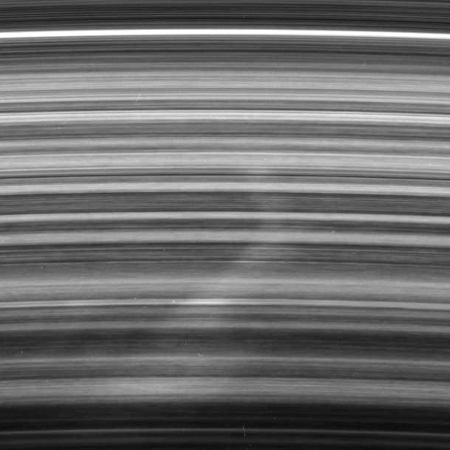
Click for original.
Cool image time! When Voyager-1 did its fly-by of Saturn in December 1980, its cameras captured something in the gas giant’s rings that no one had predicted or expected, spokes of brightness pointing outward along the surface of the rings at right angles to the planet. Even more puzzling, these spokes actually appeared to rotate around Saturn, always pointing away from it.
The picture to the right, cropped, reduced, and enhanced to post here, was taken on March 7, 2007 by the Saturn orbiter Cassini. It shows a close-up of one such spoke, though in this case it is bent. From the press release:
A bright spoke extends across the unilluminated side of Saturn’s B ring about the same distance as that from London to Cairo. The background ring material displays some azimuthal (i.e., left to right) asymmetry. The radial (outward from Saturn) direction is up in this view. A noticeable kink in the spoke occurs very close to the radius where ring particles orbit the planet at the speed of Saturn’s magnetic field. Such a connection is most intriguing to scientists studying these ghostly ring phenomena.
If gravity alone were affecting the spoke material, there would be no kink and the entire spoke would be angled toward right, like the bottom portion. That it bends to the left above the kink indicates that some other force, possibly related to the magnetic field, is acting on the spoke material. The shape might also indicate that the spoke did not form in a radial orientation, thus challenging scientists’ assumptions about these features.
In other words, the spokes exist because of multiple factors, some still unknown, that cause these streaks of brightness in the rings. For some reason, the millions of tiny ice particles that comprise the rings are brightened along these spokes, and it isn’t just gravity that is causing it.

On Christmas Eve 1968 three Americans became the first humans to visit another world. What they did to celebrate was unexpected and profound, and will be remembered throughout all human history. Genesis: the Story of Apollo 8, Robert Zimmerman's classic history of humanity's first journey to another world, tells that story, and it is now available as both an ebook and an audiobook, both with a foreword by Valerie Anders and a new introduction by Robert Zimmerman.
The print edition can be purchased at Amazon or from any other book seller. If you want an autographed copy the price is $60 for the hardback and $45 for the paperback, plus $8 shipping for each. Go here for purchasing details. The ebook is available everywhere for $5.99 (before discount) at amazon, or direct from my ebook publisher, ebookit. If you buy it from ebookit you don't support the big tech companies and the author gets a bigger cut much sooner.
The audiobook is also available at all these vendors, and is also free with a 30-day trial membership to Audible.
"Not simply about one mission, [Genesis] is also the history of America's quest for the moon... Zimmerman has done a masterful job of tying disparate events together into a solid account of one of America's greatest human triumphs."--San Antonio Express-News
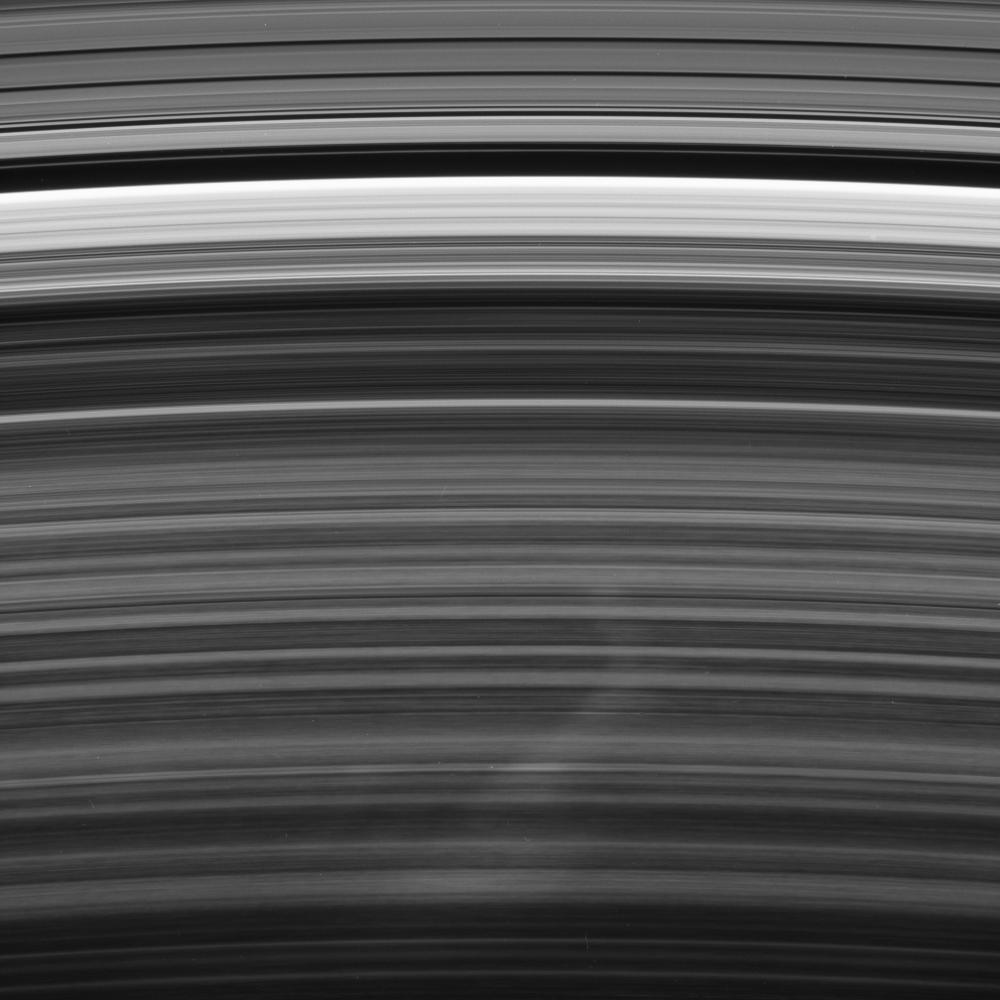
Click for original.
Cool image time! When Voyager-1 did its fly-by of Saturn in December 1980, its cameras captured something in the gas giant’s rings that no one had predicted or expected, spokes of brightness pointing outward along the surface of the rings at right angles to the planet. Even more puzzling, these spokes actually appeared to rotate around Saturn, always pointing away from it.
The picture to the right, cropped, reduced, and enhanced to post here, was taken on March 7, 2007 by the Saturn orbiter Cassini. It shows a close-up of one such spoke, though in this case it is bent. From the press release:
A bright spoke extends across the unilluminated side of Saturn’s B ring about the same distance as that from London to Cairo. The background ring material displays some azimuthal (i.e., left to right) asymmetry. The radial (outward from Saturn) direction is up in this view. A noticeable kink in the spoke occurs very close to the radius where ring particles orbit the planet at the speed of Saturn’s magnetic field. Such a connection is most intriguing to scientists studying these ghostly ring phenomena.
If gravity alone were affecting the spoke material, there would be no kink and the entire spoke would be angled toward right, like the bottom portion. That it bends to the left above the kink indicates that some other force, possibly related to the magnetic field, is acting on the spoke material. The shape might also indicate that the spoke did not form in a radial orientation, thus challenging scientists’ assumptions about these features.
In other words, the spokes exist because of multiple factors, some still unknown, that cause these streaks of brightness in the rings. For some reason, the millions of tiny ice particles that comprise the rings are brightened along these spokes, and it isn’t just gravity that is causing it.
On Christmas Eve 1968 three Americans became the first humans to visit another world. What they did to celebrate was unexpected and profound, and will be remembered throughout all human history. Genesis: the Story of Apollo 8, Robert Zimmerman's classic history of humanity's first journey to another world, tells that story, and it is now available as both an ebook and an audiobook, both with a foreword by Valerie Anders and a new introduction by Robert Zimmerman.
The print edition can be purchased at Amazon or from any other book seller. If you want an autographed copy the price is $60 for the hardback and $45 for the paperback, plus $8 shipping for each. Go here for purchasing details. The ebook is available everywhere for $5.99 (before discount) at amazon, or direct from my ebook publisher, ebookit. If you buy it from ebookit you don't support the big tech companies and the author gets a bigger cut much sooner.
The audiobook is also available at all these vendors, and is also free with a 30-day trial membership to Audible.
"Not simply about one mission, [Genesis] is also the history of America's quest for the moon... Zimmerman has done a masterful job of tying disparate events together into a solid account of one of America's greatest human triumphs."--San Antonio Express-News
We can never get enough Cassini cool images Thank you.
I wonder if one of the Large Language Models (LLM) algorithms could collect every Cassini image in order, and produce a video of the entire 13 year trek in and out of the Saturn system.
Just a thought
If the spokes aren’t a mass / gravity driven effect, I would posit that it is an electromagnetic (EM) driven effect. The bend in the spoke in the photos would tend to confirm that conclusion. Why it happens is anyone’s guess so far. Cheers –
I do believe it was first proposed that they are caused by the huge magnetic influence from the planet.
The color change could come from the small particles aligning with this magnetic field. A sun bleached side facing one direction and the none bleached side turning to the other side.
Just a guess of mine.
Or its the solar systems largest advertising sign from the aliens. It spells out something like Eat At Joes.
Occam’s razor.
It may be no more complicated then the reflection of polarized crystals in sunlight. It reminds me of a Sunset with light reflecting off a ocean wave.
What caught my eye was the unusual extremely white band surrounded by darker further out… and at least 10 spheres/blobs that are just visible randomly inside the rings.
Ronaldus Magnus considered: “. . . could collect every Cassini image in order, and produce a video of the entire 13 year trek in and out of the Saturn system.”
I thought that this might not be difficult in procuring the images: look’em up; load’em down. NASA or ESA must surely have an online library of these publicly-funded images. And, they do, but you have to specifically search for ‘raw’ images. That is the code to this page: https://solarsystem.nasa.gov/cassini-raw-images/; where you can use an amazing variety of filters to sort all of the quarter-million images from orbital approach, to final pictures. You can download the images, but the site warns that any downloads over 50 images requires a written (emailed) request, and ‘you will be notified’ when your download is ready.
I had thought to ‘stack’ the images by date, and insert them into a film program. 50 images is certainly enough to test the idea. You would need AI for image processing and matching. The raw images are decidedly lo-res, and not nearly as pretty as the ones polished for consumption. Most of the project would be doing what computers were built to do: repetitive tasks, quickly. I could see someone with ability and semi-pro equipment putting together a rough-cut in a couple of years. It would be a passion-project, though, as you would not be able to profit from it.
From the early images, one can see that the team played tourist, looking at various moons, before focusing on the planet.
It really like une of my LPs (minus the scratches).G
I think this may be similar to rays from impacts on the Moon.
A glancing blow on shepherd moons with have debris off in a cone…part of which impinges upon the rings.
Since they revolve at different speeds, the ray distorts mechanically, perhaps.
On the Moon, the rays fall rather straight.
Jeff Wright: that’s an intriguing idea.
I don’t think Jeff Wright’s theory works. The rays rotate, and they radiate out from Saturn, with the distortions sometimes seen in the image to the right. They also come and go, much faster than the rays on the Moon.
More point, the lunar rays are on solid ground. The rings of Saturn behave much more like liquid. Any theory has to take the fluctuations of liquid into account.