
Triton: Neptune’s largest moon

Click for original image.
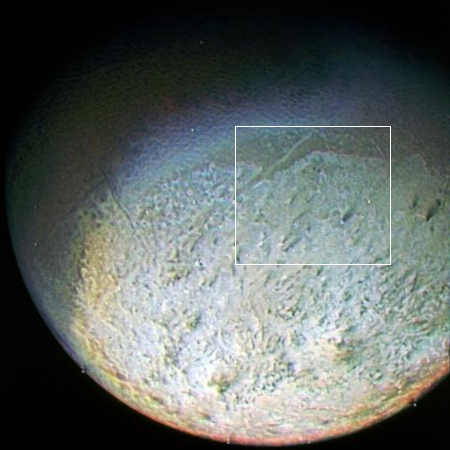
Today’s cool image begins a new tour I plan on doing over the next week or so of the few close-up photographs we have of Neptune and its moons, sent back by Voyager-2 when it did its close fly-by of this distant planet on August 25, 1989. That fly-by was almost 37 years ago, and it remains our only close look. While at the time it shined a quick flashlight of new knowledge on Neptune, its moons, and its ring system, we remain generally in the dark about what’s there, despite some good imagery produced in subsequent years by Hubble and some ground-based telescopes.
The image above, cropped and enhanced to post here, shows a portion of the southern mid-latitudes of Triton, Neptune’s largest moon, as Voyager-2 made its closest pass at a distance of about 25,000 miles. The photo to the right, cropped and reduced, shows a more global view to provide some context, with the box indicating the approximate area covered by the upper image. It was taken when Voyager-2 was on approach, at a distance of about 330,000 miles. The top picture captures several dozen black plumes that appear to vent material from below. From the caption:
The plumes originate at very dark spots generally a few miles in diameter and some are more than 100 miles long. The spots which clearly mark the source of the dark material may be vents where gas has erupted from beneath the surface and carried dark particles into Triton’s nitrogen atmosphere. Southwesterly winds then transported the erupted particles, which formed gradually thinning deposits to the northeast of most vents.
It is possible that the eruptions have been driven by seasonal heating of very shallow subsurface deposits of volatiles, and the winds transporting particles similarly may be seasonal winds. The polar terrain, upon which the dark streaks have been deposited, is a region of bright materials mottled with irregular, somewhat dark patches. The pattern of irregular patches suggests that they may correspond to lag deposits of moderately dark material that cap the bright ice over the polar terrain.
As we only have a few images of this planet, and those provided views of only about 40% of its surface, any theory that tries to explain the weird geology here is certain to be wrong to some degree.
More to come in the next few days. As much as we think we know, these pictures are going instead highlight how sparse that knowledge really is.

On Christmas Eve 1968 three Americans became the first humans to visit another world. What they did to celebrate was unexpected and profound, and will be remembered throughout all human history. Genesis: the Story of Apollo 8, Robert Zimmerman's classic history of humanity's first journey to another world, tells that story, and it is now available as both an ebook and an audiobook, both with a foreword by Valerie Anders and a new introduction by Robert Zimmerman.
The print edition can be purchased at Amazon or from any other book seller. If you want an autographed copy the price is $60 for the hardback and $45 for the paperback, plus $8 shipping for each. Go here for purchasing details. The ebook is available everywhere for $5.99 (before discount) at amazon, or direct from my ebook publisher, ebookit. If you buy it from ebookit you don't support the big tech companies and the author gets a bigger cut much sooner.
The audiobook is also available at all these vendors, and is also free with a 30-day trial membership to Audible.
"Not simply about one mission, [Genesis] is also the history of America's quest for the moon... Zimmerman has done a masterful job of tying disparate events together into a solid account of one of America's greatest human triumphs."--San Antonio Express-News

Click for original image.
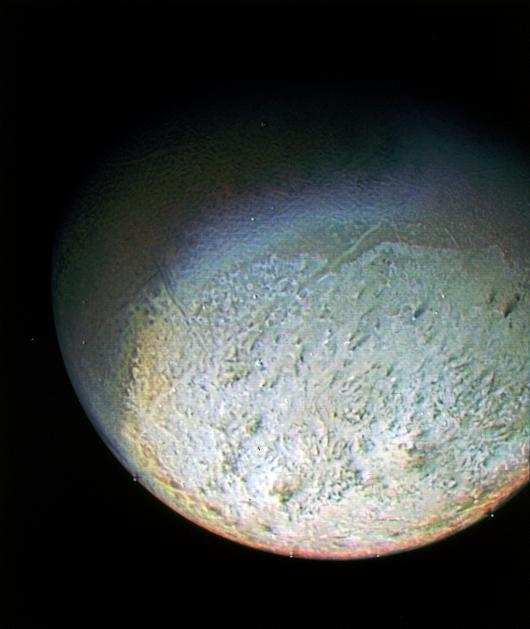
Today’s cool image begins a new tour I plan on doing over the next week or so of the few close-up photographs we have of Neptune and its moons, sent back by Voyager-2 when it did its close fly-by of this distant planet on August 25, 1989. That fly-by was almost 37 years ago, and it remains our only close look. While at the time it shined a quick flashlight of new knowledge on Neptune, its moons, and its ring system, we remain generally in the dark about what’s there, despite some good imagery produced in subsequent years by Hubble and some ground-based telescopes.
The image above, cropped and enhanced to post here, shows a portion of the southern mid-latitudes of Triton, Neptune’s largest moon, as Voyager-2 made its closest pass at a distance of about 25,000 miles. The photo to the right, cropped and reduced, shows a more global view to provide some context, with the box indicating the approximate area covered by the upper image. It was taken when Voyager-2 was on approach, at a distance of about 330,000 miles. The top picture captures several dozen black plumes that appear to vent material from below. From the caption:
The plumes originate at very dark spots generally a few miles in diameter and some are more than 100 miles long. The spots which clearly mark the source of the dark material may be vents where gas has erupted from beneath the surface and carried dark particles into Triton’s nitrogen atmosphere. Southwesterly winds then transported the erupted particles, which formed gradually thinning deposits to the northeast of most vents.
It is possible that the eruptions have been driven by seasonal heating of very shallow subsurface deposits of volatiles, and the winds transporting particles similarly may be seasonal winds. The polar terrain, upon which the dark streaks have been deposited, is a region of bright materials mottled with irregular, somewhat dark patches. The pattern of irregular patches suggests that they may correspond to lag deposits of moderately dark material that cap the bright ice over the polar terrain.
As we only have a few images of this planet, and those provided views of only about 40% of its surface, any theory that tries to explain the weird geology here is certain to be wrong to some degree.
More to come in the next few days. As much as we think we know, these pictures are going instead highlight how sparse that knowledge really is.
On Christmas Eve 1968 three Americans became the first humans to visit another world. What they did to celebrate was unexpected and profound, and will be remembered throughout all human history. Genesis: the Story of Apollo 8, Robert Zimmerman's classic history of humanity's first journey to another world, tells that story, and it is now available as both an ebook and an audiobook, both with a foreword by Valerie Anders and a new introduction by Robert Zimmerman.
The print edition can be purchased at Amazon or from any other book seller. If you want an autographed copy the price is $60 for the hardback and $45 for the paperback, plus $8 shipping for each. Go here for purchasing details. The ebook is available everywhere for $5.99 (before discount) at amazon, or direct from my ebook publisher, ebookit. If you buy it from ebookit you don't support the big tech companies and the author gets a bigger cut much sooner.
The audiobook is also available at all these vendors, and is also free with a 30-day trial membership to Audible.
"Not simply about one mission, [Genesis] is also the history of America's quest for the moon... Zimmerman has done a masterful job of tying disparate events together into a solid account of one of America's greatest human triumphs."--San Antonio Express-News
Uh, Triton?
Triton?
All: The moon’s name is fixed. Thank you. Dumb error on my part. My brains says one thing but more and more my fingers type something else.