
Jay Proctor (Jay & the Techniques) – Apple, Peaches, Pumpkin Pie
An evening pause: Performed live on television, 1999.
Hat tip Edward Thelen.
An evening pause: Performed live on television, 1999.
Hat tip Edward Thelen.
It seems that the so-called clamp down on press releases and announcement by the Trump administration is not that unusual and is actually comparable to what was done when Obama took power.
The memo at the USDA was especially routine, despite the reports.
Similar news came out about a “gag order” for a small branch of the Department of Agriculture, which led to Buzzfeed to report “USDA Scientists Have Been Put On Lockdown Under Trump.” “Starting immediately and until further notice” the Agricultural Research Service “will not release any public-facing documents,” reads the memo obtained by Buzzfeed. The memo was rescinded Tuesday after a media firestorm.
But Trump never ordered the “lockdown.” In fact, the memo to USDA researches was sent by Agriculture Sec. Tom Vilsack, President Obama’s appointee. “This memo is not some sort of creative writing exercise,” Michael Young, acting deputy secretary of the Agriculture Department, told NYT. “This is almost exactly what was issued eight years ago. I just updated it a bit.”
As much as I want such a clamp down, especially for those agencies that have become badly politicized, it does appear that the only thing happening here is a bit of panic by the left, by the media (I repeat myself), and by some federal workers. Essentially, they are squealing like pigs out of fear that they will no longer have their way, and the press is picking up the oinks and running with it.
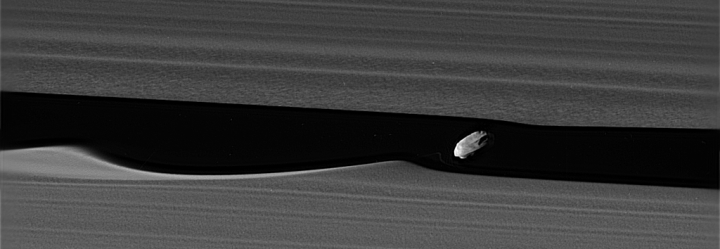
Cool image time! The image above, taken on January 16, 2017 during one of Cassini’s ring-grazing passes as it enters its last year at Saturn, has been reduced and cropped to post here. It shows clearly the waves caused by the gravity of the moon Daphnis as its travels within a gap in the rings of Saturn.
Daphnis (5 miles or 8 kilometers across) orbits within the 42-kilometer (26-mile) wide Keeler Gap. Cassini’s viewing angle causes the gap to appear narrower than it actually is, due to foreshorteneing. The little moon’s gravity raises waves in the edges of the gap in both the horizontal and vertical directions.
The image also shows many details about Daphnis itself, including a ridge at its equator that is thought to be an accumulation of material gathered from the rings.
The strangeness of Saturn’s rings is well illustrated here. Though made up of many solid particles, as a group the rings act almost like liquid. Note for example the ring on the far side of Daphnis. Its edge gets pulled out slightly as the moon goes by, but then the gravity of the rest of the ring pulls it back.
The universe is a wonderful place, as it is. No need to make up stuff (such as faces on Mars or fake civilizations on the Moon), as our imagination is probably insufficient to match the weirdness that is really out there.
Not good: In a tweet late Tuesday President Trump threatened to send federal officials to Chicago if that city doesn’t do something to reduce its out-of-control homicide rates.
No one knows what Trump really meant, since this was merely a tweet on Twitter, but to suggest that he thinks the federal government has a place fixing local police crime is very inappropriate. Even if the federal government succeeded once in shutting down Chicago’s crime rate, it would set a bad precedent, expanding terribly the power of the federal government into very local matters.
Trump has enough problems to fix at the federal level, in his own executive branch. He should stay focused on that.
Why I don’t use Twitter: Researchers have discovered the existence of large networks of fake twitter accounts, some numbering in the hundreds of thousands.
The largest network ties together more than 350,000 accounts and further work suggests others may be even bigger. UK researchers accidentally uncovered the lurking networks while probing Twitter to see how people use it. Some of the accounts have been used to fake follower numbers, send spam and boost interest in trending topics.
What this story tells me is that almost everything you read from Twitter is not to be trusted.
The competition heats up: The five finalists for the Google Lunar X-Prize have now been set.
Five teams remain in the running: Israel’s SpaceIL, Florida-based Moon Express, an international team known as Synergy Moon, India’s Team Indus and Japan’s Hakuto.
SpaceIL plans to fly on a SpaceX Falcon 9 rocket, which recently returned to flight following a launch pad accident. Team Indus and Hakuto will share a ride on an Indian PSLV launcher. Moon Express is banking on a launch from startup Rocket Lab, which is developing a small rocket called Electron. Whether it wins the XPrize or not, Moon Express is building a business to provide lunar transportation and services, such as research and mineral extraction, Chief Executive Bob Richards said in an interview. Synergy Moon is counting on one of its partners, Mojave, Calif.-based Interorbital Systems, for its launch aboard a new rocket known as Neptune.
To win, one of these teams must fly its mission before the end of 2017.
Confirmed: As a result of its investigation into the problems during a June 9, 2016 launch, Roscosmos has now grounded its Proton rocket for at least the next six months due to the discovery of systemic quality control problems throughout the entire Proton construction process.
On January 23, the Kazakh-based division of the Interfax news agency reported the likelihood of an unusually lengthy delay with Proton missions, which could last several months. A day later, the Kommersant newspaper reported that a recent firing test had revealed technical problems with RD-0210 and RD-0212 engines, which propel the second and third stage of the Proton rocket respectively. The failure of the engine was reportedly traced to illegal replacement of precious heat-resistant alloys within the engine’s components with less expensive but failure-prone materials. The report in the Kommersant echoed the results of the investigation into the 2015 Proton failure, which found that low-quality material in the turbo-pump shaft of the engine had led to the accident.
On Jan. 20, 2017, Head of Roskosmos Igor Komarov chaired a meeting of the top managers at the Voronezh Mechanical Plant, VMZ, which manufactures rocket engines, including those used on the third stage of the Soyuz rocket and on the second and third stages of Proton. The high-profile meeting followed a decision to return already manufactured RD-0110 engines from Soyuz rockets back to Voronezh, after such an engine had been suspected as the culprit in the loss of the Progress MS-04 cargo ship on Dec. 1, 2016, as it ascended to orbit onboard a Soyuz-U rocket. [emphasis mine]
The worst part of this story, from an American perspective, is that it might result in a complete grounding of Russia’s entire rocket fleet, since some of these issues involve the Soyuz rocket as well. All manned flights to ISS will stop, which might force us to abandon it for a time.
Read the article. It suggests that Russia’s space industry is now in big big trouble.
Update: The Russians are replacing the entire Soyuz capsule that they had planned to use for the March manned mission to ISS.
“Spaceship No. 734 may be replaced by spacecraft No. 735 over a leak in the descent module [of the 734th space vehicle]. This is not yet known for sure. The spacecraft will be returned for a check,” the source said.
Embedded below the fold. A look at what I see are the first real hints at Trump’s NASA policy, both in terms of space exploration and climate.
» Read more
Link here. As noted at the link:
In 1960, V. Strukova and V. Shevchenko wrote a story, illustrated by L. Smekhov, about the Soviet Union in 2017. The date was not fortuitously chosen– it marked the 100th anniversary of the October Revolution that brought the Communists to power. The authors believed that people in 2017 would be fortunate to live in a world liberated by Soviet science, where the climate could be controlled, the flow of the northern rivers could be controlled, and Alpha Centauri was a flight destination. The Moscow-based newspaper The Moscow Times described as follows Strukova and Shevchenkos’s story: “A hundred years ago, the men and women who brought Communism to the Tsarist Empire had big plans. Decades into that experiment, the U.S.S.R. was leading the world’s ‘Space Race’ and it seemed there was nothing the country couldn’t do. In 1960, the Soviet movie studio ‘Diafilm’ released a filmstrip titled ‘In the Year 2017,’ by V. Strukova and V. Shevchenko, depicting a vision of the U.S.S.R. set 57 years in the future.
While the story, with illustrations, is essentially a pro-Soviet science fiction tale written for school children, it still expresses the boundless hope for the future that filled the cultures of both the Soviet Union and the United States at that time. All dreams were possible, and given time all would come true.
This historical piece however does illustrate again the tragic but consistent failure of communism and socialist thought, wherever it has been tried. The Soviet culture of Russia dreamed big, and did accomplish much, but they were crippled by a political and economic system that guaranteed bankruptcy, leading to the collapse of that system well before its 100th anniversary.
It is a continuing tragedy that so many people today continue to believe in that system, even after so many failures.
The undercover videos released last week by Project Veritas, showing evidence that anti-Trump protesters were planning violent acts of terrorism during the Trump inauguration, have now led to one arrest.
More important, the police think the videos acted to stop much of the mayhem the protesters were planning.
A D.C. police spokesman has confirmed that a secret video recording made Dec. 18 by one of O’Keefe’s operatives led to the arrest of one man and foiled an alleged plot to spread acid at the DeploraBall for Trump supporters at the National Press Club. It was not clear whether the alleged plotters ever obtained the acid.
Law enforcement authorities said they think that the successful penetration of DisruptJ20, an umbrella organization for a number of groups that police said sought to wreak havoc at the inauguration, forced it to abandon plans to try to shut down Metro trains and block entrances into the District, according to two law enforcement officials with knowledge of the investigation.
The police are also looking for two other men on the videos.
As part of their effort to gain control of the executive branch, the new Trump administration has ordered a range of federal agencies to cease all press releases and other forms of public communications.
New restrictions on social media use and interaction with press and lawmakers at the Environmental Protection Agency (EPA) and the departments of Commerce, Health and Human Services, Agriculture and the Interior have sparked concerns of a President Trump-backed effort to silence dissenting views.
The Trump administration’s newly imposed communications rules vary at different agencies. At the EPA, staffers were ordered to stop issuing press releases, blog updates and social media posts, according to a memo to employees. The Agriculture Department’s research arm was reportedly told by its chief of staff to stop issuing news releases, photos and other “public-facing” documents — although the agency disavowed the order late Tuesday, saying that new guidance would replace it.
The new prohibitions come as Trump seeks to reverse many of former President Barack Obama’s policies, which requires the cooperation of a federal workforce that is broadly perceived to be hostile to him.
As is typical for an article written by a mainstream Washington news outlet, the story does whatever it can to take the side of these federal employees, all of whom work for us and for the President. They don’t have a say in this. If they don’t like Trump’s policies, then they can quit and find jobs in some leftwing Democratic political organization, not paid for by tax dollars.That is their right, just as it is Trump’s right to clamp down on their leftwing advocacy.
Or they can be fired, as will likely happen to many managers at the National Park Service, based on the following quotes from the article:
In an apparent act of defiance, the official Twitter account for Badlands National Park in South Dakota on Tuesday afternoon posted information about climate change.
And this:
The moves come after Trump was reportedly infuriated over reporting on the turnout at his inauguration, which included a viral photo comparison showing Friday’s crowd next to the one that attended Obama’s 2009 swearing-in. The tweet was retweeted by the National Park Service (NPS).
In the first case whoever runs the official Twitter National Park service account at Badlands acted in outright defiance of his employer, certain grounds for firing anywhere in the real world. In the second case the Park Service very clearly was pushing a political agenda, something that is none of their business, and also justifiable grounds for dismissal.
Then again, the management at the National Park Service has been working for the Democratic Party and its political goals for years. Firing the entire upper management there would probably be entirely appropriate, even if they didn’t do something defiant at this particular moment.
An evening pause: Hat tip Danae.
The competition heats up: Japan today successfully launched its first military satellite.
Faced with an increased military challenge from China, even as the U.S. is becoming less willing to provide it military support, Japan has upped its military program significantly. This success is especially welcome, considering the string of engineering failures that Japan has experienced recently.
The Tuesday launch marks the successful resumption of a programme that was halted last year by an embarrassing mishap. The first of the three satellites, which was meant to go into space from Europe’s Space port in French Guiana, was crushed during a flight from Japan after a blue tarpaulin covering its transport box blocked valves meant to equalize the internal air pressure as the cargo aircraft descended. The accident damaged sensitive antennas, government sources told Reuters in July.
The first Russian Proton launch since June and presently scheduled for February 2nd could possibly be delayed again, possibly for months this time.
The launch of a Proton carrier rocket with the EchoStar-21 satellite could be postponed yet again, a source at Baikonur cosmodrome told Interfax on Monday. “Preparations continue for the launch of the Proton carrier rocket. However, given a combination of factors, a lengthy pause cannot be ruled out which may lead the launch to be postponed by several months,” the source said. It was reported that the Proton launch with the EchoStar-21 satellite was slated for February 2 but then postponed again by a week for non-technical reasons.
It is very unclear what is causing these repeated delays which has produced possibly the longest gap between Proton launches in quite awhile.
An evening pause: From the 1949 musical comedy Neptune’s Daughter, with Esther Williams, Ricardo Montalbán, Red Skelton, and Betty Garrett.
Hat tip Edward Thelen.
It appears that the first budget Trump administration is putting together will include some dramatic budget cuts and the outright elimination of many government agencies, and are based on numerous recommendations made by a variety of conservative policy proposals.
Overall, the blueprint being used by Trump’s team would reduce federal spending by $10.5 trillion over 10 years. The proposed cuts hew closely to a blueprint published last year by the conservative Heritage Foundation, a think tank that has helped staff the Trump transition. Similar proposals have in the past won support from Republicans in the House and Senate, who believe they have an opportunity to truly tackle spending after years of warnings about the rising debt. Many of the specific cuts were included in the 2017 budget adopted by the conservative Republican Study Committee (RSC), a caucus that represents a majority of House Republicans. The RSC budget plan would reduce federal spending by $8.6 trillion over the next decade.
Read the article. I can’t quote it all here, but the cuts would dramatically weaken the Washington leftwing community’s ability to push its agenda. More important, the generally conservative make-up of Congress means that, for the first time in decades there is a real chance these cuts will happen.
The competition heats up: China has scheduled for November its next mission to the Moon, the first lunar sample return mission since the American Apollo manned missions and the first robotic sample return mission since the Soviets did it in 1976.
China has announced that its Chang’e-5 automated Moon surface sampling and return mission will launch in late November 2017. The 8.2-tonne probe will launch on a Long March 5 rocket from the Wenchang Satellite Launch Centre on Hainan island, and attempt the first lunar sample return since the Soviet Union’s Luna 24 mission in 1976.
The mission will be complex, with some of the key technologies and techniques involved will also be applicable for a Chinese Mars sample return mission, planned for around 2030, as well as future crewed journeys to the lunar surface. “The lunar probe is comprised of four parts: an orbiter, a return module, an ascender and a lander,” state media Xinhua quoted Ye Peijian, one of China’s leading aerospace experts, as saying.
Having soft-landed on the Moon and drilled for and collected samples, an ascent module will perform an automated docking with an orbiter in a lunar orbit 380,000 km away from Earth. The orbiter will then head on a trajectory for home, with the return module separating from the orbiter close to Earth and making a high speed atmospheric ‘skip’ reentry.
Without question the Chinese program is ramping up, and it is doing so in a very rational and pragmatic manner. It is also clear that they are carefully developing the technologies necessary to later launch manned missions to the Moon, which could also include sending their first space stations on lunar orbital missions.
A memo released January 20 from NASA’s acting administrator accepting the job also announced the first Trump appointees to NASA. The history and policy positions of those two appointees I think once again give us a very clear indication of where NASA might be going in the coming years.
[Acting administrator Robert] Lightfoot, in the memo, said that the administration has appointed Erik Noble to serve as White House senior advisor and Greg Autry to be White House liaison. The two are the first members of the so-called “beachhead team” of administration staffers assigned to NASA, at least on a short-term basis.
Autry is an assistant professor of entrepreneurship at the University of Southern California who has been a proponent of commercial space activities. Autry was one of eight members of the agency review team, or “landing team,” assigned to NASA by the transition office of then President-elect Trump.
Noble did not serve on the landing team, but worked on the Trump campaign as a political data analyst. Noble, who earned a Ph.D. in environmental studies from the University of Colorado, spent seven years at the NASA Goddard Institute of Space Studies in New York, working on weather and climate models. [emphasis mine]
Autry, believes strongly in private space, and has also been a critic of SLS/Orion. Being placed at NASA as Trump’s first appointee strongly suggests that a Trump administration is going to accelerate the commercial space push that was begun by the Bush administration and then strongly supported by the Obama administration. It also suggests that the SLS and Orion projects are going to face a difficult future and will likely be phased out.
Noble’s appointment is more important. As a former scientist at the Goddard Institute, he is now well positioned to possibly appoint a new head to that organization, or even become its head himself. The present person in charge there, Gavin Schmidt, has increasingly become suspect as a scientist, instead appearing more as global warming political advocate. Since he took over that Institute, the climate data there has been increasingly tampered with, with past data being cooled and recent data being warmed, thus creating the impression that the Earth’s climate has been warming more than indicated by all previous research. Schmidt’s explanations for these “adjustments” (the term he uses) have never been satisfactory. He then uses the results from these “adjustments” to make annual press releases declaring each year as the “hottest” ever, though the raw data shows no such thing.
Even if Noble does not replace Schmidt, Noble appears well positioned to force Schmidt to either finally justify his data adjustments, or remove them from the data stream so that the raw data will be allowed to dominate policy decisions once again.
Embedded below the fold. A review of my rover update as well as a review of SpaceX’s upcoming launch schedule.
» Read more
The uncertainty of science: Researchers have found evidence that suggests that planes flying at higher latitudes can sometimes fly through concentrated pockets of high cosmic radiation.
“We have flown radiation sensors onboard 264 research flights at altitudes as high as 17.3 km (56,700 ft) from 2013 to 2017,” says Kent Tobiska, lead author of the paper and PI of the NASA-supported program Automated Radiation Measurements for Aerospace Safety (ARMAS). “On at least six occasions, our sensors have recorded surges in ionizing radiation that we interpret as analogous to localized clouds.”
…Conventional wisdom says that dose rates should vary smoothly with latitude and longitude and the height of the aircraft. Any changes as a plane navigates airspace should be gradual. Tobiska and colleagues have found something quite different, however: Sometimes dose rates skyrocket for no apparent reason. “We were quite surprised to see this,” says Tobiska.
All of the surges they observed occurred at relatively high latitudes, well above 50 degrees in both hemispheres. One example offered in their paper is typical: On Oct 3, 2015, an NSF/NCAR research aircraft took off from southern Chile and flew south to measure the thickness of the Antarctic ice shelf. Onboard, the ARMAS flight module recorded a 2x increase in ionizing radiation for about 30 minutes while the plane flew 11 km (36,000 feet) over the Antarctic Peninsula. No solar storm was in progress. The plane did not abruptly change direction or altitude. Nevertheless, the ambient radiation environment changed sharply. Similar episodes have occurred off the coast of Washington state.
The theories proposed to explain this at the link are not very convincing, and suggest to me that they really do not know what causes this. All we do know is that it likely associated with the interaction of the Earth’s magnetic field and cosmic radiation.