
China launches nine more satellites in Guowang constellation
Last night China successfully placed nine more satellites for the Guowang (or Satnet) internet-of-things constellation, its Long March 8A rocket lifting off from its Wenchang coastal spaceport, The constellation now has 128 satellites in orbit out of a planned 13,000. Though the rocket’s lower stages all fell in the ocean, some landed within the Philippines, once again requiring that government to warn its citizens to avoid the drop zones.
China’s last night also scrubbed a launch of its solid-fueled Smart Dragon-3 (also Jielong-3) rocket, set to lift off from a launch platform off the coast of northeastern China. The launch was rescheduled for December 28th. China also had a Long March 3B launched scheduled for this morning, but no news about that launch as yet been published.
The leaders in the 2025 launch race:
168 SpaceX
87 China (a new record)
18 Rocket Lab
16 Russia
SpaceX still leads the rest of the world in successful launches, 168 to 146.
Last night China successfully placed nine more satellites for the Guowang (or Satnet) internet-of-things constellation, its Long March 8A rocket lifting off from its Wenchang coastal spaceport, The constellation now has 128 satellites in orbit out of a planned 13,000. Though the rocket’s lower stages all fell in the ocean, some landed within the Philippines, once again requiring that government to warn its citizens to avoid the drop zones.
China’s last night also scrubbed a launch of its solid-fueled Smart Dragon-3 (also Jielong-3) rocket, set to lift off from a launch platform off the coast of northeastern China. The launch was rescheduled for December 28th. China also had a Long March 3B launched scheduled for this morning, but no news about that launch as yet been published.
The leaders in the 2025 launch race:
168 SpaceX
87 China (a new record)
18 Rocket Lab
16 Russia
SpaceX still leads the rest of the world in successful launches, 168 to 146.

On Christmas Eve 1968 three Americans became the first humans to visit another world. What they did to celebrate was unexpected and profound, and will be remembered throughout all human history. Genesis: the Story of Apollo 8, Robert Zimmerman's classic history of humanity's first journey to another world, tells that story, and it is now available as both an ebook and an audiobook, both with a foreword by Valerie Anders and a new introduction by Robert Zimmerman.
The print edition can be purchased at Amazon or any other book seller. If you want an autographed copy the price is $60 for the hardback and $45 for the paperback, plus $8 shipping for each. Go here for purchasing details. The ebook is available everywhere for $5.99 (before discount) at amazon, or direct from my ebook publisher, ebookit you don't support the big tech companies and the author gets a bigger cut much sooner.
The audiobook is also available at all these vendors, and is also free with a 30-day trial membership to Audible.
"Not simply about one mission, [Genesis] is also the history of America's quest for the moon... Zimmerman has done a masterful job of tying disparate events together into a solid account of one of America's greatest human triumphs."--San Antonio Express-News
Former ULA CEO Tory Bruno now working for Blue Origin
In a tweet on X, Blue Origin today announced that former ULA CEO Tory Bruno is now working for them, acting as president for its “newly formed National Security Group.”
Blue Origin’s CEO, David Limp, quickly chimed in with his own tweet, endorsing the hire.
My guess is that Limp felt Blue Origin needed someone with experience dealing with the military, and Bruno brings that capability, having managed ULA’s military launch contracts for years. It also means Blue Origin is very serious about grabbing a larger market share of those launches once its New Glenn rocket begins launching regularly.
I also wonder if Bruno grew tired of the culture at ULA, which has appeared resistant to building reusable rockets. Bruno sold Vulcan initially with the idea of quickly upgrading it to recover its engines for reuse, but by all signs the company has been very unenthusiastic about the idea. (The idea itself might not be viable, but overall ULA has shown no interest in developing a reusable rocket of any sort.) Bruno might have decided he’d rather work with a company enthused by reusability, especially as this is the future. Once ULA completes its large Amazon Leo launch contract it faces a bleak future, with many newer cheaper reusable rockets coming on line.
It could also be that Bruno was made an offer he couldn’t refuse. Money is always a powerful incentive.
In a tweet on X, Blue Origin today announced that former ULA CEO Tory Bruno is now working for them, acting as president for its “newly formed National Security Group.”
Blue Origin’s CEO, David Limp, quickly chimed in with his own tweet, endorsing the hire.
My guess is that Limp felt Blue Origin needed someone with experience dealing with the military, and Bruno brings that capability, having managed ULA’s military launch contracts for years. It also means Blue Origin is very serious about grabbing a larger market share of those launches once its New Glenn rocket begins launching regularly.
I also wonder if Bruno grew tired of the culture at ULA, which has appeared resistant to building reusable rockets. Bruno sold Vulcan initially with the idea of quickly upgrading it to recover its engines for reuse, but by all signs the company has been very unenthusiastic about the idea. (The idea itself might not be viable, but overall ULA has shown no interest in developing a reusable rocket of any sort.) Bruno might have decided he’d rather work with a company enthused by reusability, especially as this is the future. Once ULA completes its large Amazon Leo launch contract it faces a bleak future, with many newer cheaper reusable rockets coming on line.
It could also be that Bruno was made an offer he couldn’t refuse. Money is always a powerful incentive.
Japanese bank invests in Starlab
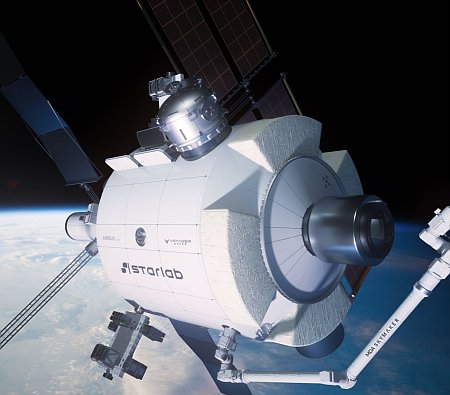
The Starlab design in 2025. Click
for original image.
The consortium building the Starlab space station today announced that the Sumitomo Mitsui Trust Bank of Japan has invested in the project.
Through this investment, SuMi TRUST Bank will support Starlab’s efforts to develop and commercialize space station technologies, while exploring opportunities for collaboration that contribute to the advancement of space-related industries and broader industrial development in Japan and globally.
The press release provided no other information, other than this boilerplate PR jargon. The amount invested was not mentioned.
Regardless, the investment tells us two things: First, Starlab has now raised more than $400 million in investment capital, and appears in a solid position to begin work on its large single module station to be launched on Starship.
Second, the investment in this American-based space project by this Japanese bank speaks volumes about the sad state of Japan’s own commercial space industry. Other than the lunar lander Ispace, Japan has seen little success from any other major rocket startups. One rocket startup, Interstellar, has obtained some investment capital, but the development of its rocket seemingly stopped for the past five years. Another, Space One, has had one launch failure. And though Honda has completed a successful vertical take-off and landing of a small rocket prototype, it doesn’t expect to attempt an orbital launch until 2030.
Meanwhile, the two rockets owned by Japan’s space agency JAXA, the H3 and Epsilon, are grounded because of launch failures.
It appears this bank believes it is more likely to earn profits from this American project than from these other Japanese space efforts.

The Starlab design in 2025. Click
for original image.
The consortium building the Starlab space station today announced that the Sumitomo Mitsui Trust Bank of Japan has invested in the project.
Through this investment, SuMi TRUST Bank will support Starlab’s efforts to develop and commercialize space station technologies, while exploring opportunities for collaboration that contribute to the advancement of space-related industries and broader industrial development in Japan and globally.
The press release provided no other information, other than this boilerplate PR jargon. The amount invested was not mentioned.
Regardless, the investment tells us two things: First, Starlab has now raised more than $400 million in investment capital, and appears in a solid position to begin work on its large single module station to be launched on Starship.
Second, the investment in this American-based space project by this Japanese bank speaks volumes about the sad state of Japan’s own commercial space industry. Other than the lunar lander Ispace, Japan has seen little success from any other major rocket startups. One rocket startup, Interstellar, has obtained some investment capital, but the development of its rocket seemingly stopped for the past five years. Another, Space One, has had one launch failure. And though Honda has completed a successful vertical take-off and landing of a small rocket prototype, it doesn’t expect to attempt an orbital launch until 2030.
Meanwhile, the two rockets owned by Japan’s space agency JAXA, the H3 and Epsilon, are grounded because of launch failures.
It appears this bank believes it is more likely to earn profits from this American project than from these other Japanese space efforts.

Now available in hardback and paperback as well as ebook!
From the press release: In this ground-breaking new history of early America, historian Robert Zimmerman not only exposes the lie behind The New York Times 1619 Project that falsely claims slavery is central to the history of the United States, he also provides profound lessons about the nature of human societies, lessons important for Americans today as well as for all future settlers on Mars and elsewhere in space.
Conscious Choice: The origins of slavery in America and why it matters today and for our future in outer space, is a riveting page-turning story that documents how slavery slowly became pervasive in the southern British colonies of North America, colonies founded by a people and culture that not only did not allow slavery but in every way were hostile to the practice.
Conscious Choice does more however. In telling the tragic history of the Virginia colony and the rise of slavery there, Zimmerman lays out the proper path for creating healthy societies in places like the Moon and Mars.
“Zimmerman’s ground-breaking history provides every future generation the basic framework for establishing new societies on other worlds. We would be wise to heed what he says.” —Robert Zubrin, founder of the Mars Society.
All editions are available at Amazon, Barnes & Noble, and all book vendors, with the ebook priced at $5.99 before discount. All editions can also be purchased direct from the ebook publisher, ebookit, in which case you don't support the big tech companies and the author gets a bigger cut much sooner.
Autographed printed copies are also available at discount directly from the author (hardback $29.95; paperback $14.95; Shipping cost for either: $6.00). Just send an email to zimmerman @ nasw dot org.
Brigham Young University Choir & Orchestra – Oh Come All Ye Faithful
An evening pause: I hope all my Christian readers had a wonderful and joyous Christmas, from your Jewish but very secular host. With good will to all!
Hat tip Judd Clark.
The Pied Piper of Hamelin
An afternoon pause: This TV movie, the first ever, was produced by NBC and first aired in 1957. It subsequently played every Christmas season for most of the next decade. It has been forgotten in the ensuing years, something I think must be rectified, especially for the children of today. It is clever, sophisticated, innocent, entertaining, and above all, firmly American in every way.
Thus, I will now renew that past tradition.
An afternoon pause: This TV movie, the first ever, was produced by NBC and first aired in 1957. It subsequently played every Christmas season for most of the next decade. It has been forgotten in the ensuing years, something I think must be rectified, especially for the children of today. It is clever, sophisticated, innocent, entertaining, and above all, firmly American in every way.
Thus, I will now renew that past tradition.
Leaving Earth: Space Stations, Rival Superpowers, and the Quest for Interplanetary Travel, can be purchased as an ebook everywhere for only $3.99 (before discount) at amazon, Barnes & Noble, all ebook vendors, or direct from my ebook publisher, ebookit.
If you buy it from ebookit you don't support the big oppressive tech companies and I get a bigger cut much sooner.
Winner of the 2003 Eugene M. Emme Award of the American Astronautical Society.
"Leaving Earth is one of the best and certainly the most comprehensive summary of our drive into space that I have ever read. It will be invaluable to future scholars because it will tell them how the next chapter of human history opened." -- Arthur C. Clarke
December 25, 2025 Quick space links
Courtesy of BtB’s stringer Jay. This post is also an open thread. I welcome my readers to post any comments or additional links relating to any space issues, even if unrelated to the links below.
- The past flight history of the segments being used for the Artemis-2 mission, launching no later than April 2026
Almost nothing new, but then, NASA had been reusing these throughout the shuttle program.
- SpaceX shows off the fully stacked Superheavy prototype #19, delivered and assembled in only 28 days
It will fly on the next orbital test flight. The contrast with SLS, which takes more than a year to assemble, is striking.
- APL touts the Parker Solar Probe
The press release the tweet links to however is from July 2024, so this PR reveals nothing new.
- The story behind NORAD’s Santa Claus tracker
The live tracker is found here.
Courtesy of BtB’s stringer Jay. This post is also an open thread. I welcome my readers to post any comments or additional links relating to any space issues, even if unrelated to the links below.
- The past flight history of the segments being used for the Artemis-2 mission, launching no later than April 2026
Almost nothing new, but then, NASA had been reusing these throughout the shuttle program.
- SpaceX shows off the fully stacked Superheavy prototype #19, delivered and assembled in only 28 days
It will fly on the next orbital test flight. The contrast with SLS, which takes more than a year to assemble, is striking.
- APL touts the Parker Solar Probe
The press release the tweet links to however is from July 2024, so this PR reveals nothing new.
- The story behind NORAD’s Santa Claus tracker
The live tracker is found here.
Charles Dickens’ A Christmas Carol
A mid-day pause: As I now do practically every Christmas, I bring you the classic 1951 version of Charles Dickens’ A Christmas Carol, starring Alastair Sim. In my opinion still by far the best adaption of the book and a truly wonderful movie.
And as I noted in a previous year:
Dickens did not demand the modern version of charity, where it is imposed by governmental force on everyone. Instead, he was advocating the older wiser concept of western civilization, that charity begins at home, that we as individuals are obliged as humans to exercise good will and generosity to others, by choice.
It is always a matter of choice. And when we take that choice away from people, we destroy the good will that makes true charity possible.
And in 2016 I said this:
I watched this again and felt like weeping, not because of the sentimentality of the story itself but because it is so seeped in a civilized world that increasingly no longer exists. There was a time when this was our culture. I fear it is no longer so. As noted by the Spirit of Christmas Present, “This boy is ignorance, this girl is want. Beware them both, but most of all beware this boy.”
It seems for the past few decades we have not heeded that warning, and are now reaping the whirlwind.
A mid-day pause: As I now do practically every Christmas, I bring you the classic 1951 version of Charles Dickens’ A Christmas Carol, starring Alastair Sim. In my opinion still by far the best adaption of the book and a truly wonderful movie.
And as I noted in a previous year:
Dickens did not demand the modern version of charity, where it is imposed by governmental force on everyone. Instead, he was advocating the older wiser concept of western civilization, that charity begins at home, that we as individuals are obliged as humans to exercise good will and generosity to others, by choice.
It is always a matter of choice. And when we take that choice away from people, we destroy the good will that makes true charity possible.
And in 2016 I said this:
I watched this again and felt like weeping, not because of the sentimentality of the story itself but because it is so seeped in a civilized world that increasingly no longer exists. There was a time when this was our culture. I fear it is no longer so. As noted by the Spirit of Christmas Present, “This boy is ignorance, this girl is want. Beware them both, but most of all beware this boy.”
It seems for the past few decades we have not heeded that warning, and are now reaping the whirlwind.
The SpaceX alumni that are reshaping the space industry
Link here. The article provides a very comprehensive list of the many former SpaceX employees who have left SpaceX to form their own companies, most of which in space or related industries, raising $3 billion in private investment capital.
The list includes a lot of very small operations doing work on the periphery, such as in the health industry or software for a variety of industries, not just space. It also includes some new major space players, such as the orbital tug company Impulse, and the recoverable capsule company Varda.
For some reason the article refers to this new generation of space entrepreneurs as the “SpaceX Mafia”, as if they are teaming up like mobsters to eliminate any competition. This is beyond false. Instead, they are the epitome of competition and the American dream, each forming their own company to push new ideas.
Take a look. It provides a nice and very hopeful overview of the future.
Link here. The article provides a very comprehensive list of the many former SpaceX employees who have left SpaceX to form their own companies, most of which in space or related industries, raising $3 billion in private investment capital.
The list includes a lot of very small operations doing work on the periphery, such as in the health industry or software for a variety of industries, not just space. It also includes some new major space players, such as the orbital tug company Impulse, and the recoverable capsule company Varda.
For some reason the article refers to this new generation of space entrepreneurs as the “SpaceX Mafia”, as if they are teaming up like mobsters to eliminate any competition. This is beyond false. Instead, they are the epitome of competition and the American dream, each forming their own company to push new ideas.
Take a look. It provides a nice and very hopeful overview of the future.
Avio wins launch contract from Taiwan to launch four satellites
The Italian rocket company Avio has won a $81 million launch contract from Taiwan’s space agency TASA to use its Vega-C rocket to launch four Earth observation satellites.
FORMOSAT-8 will be a constellation of six high-resolution optical Earth observation satellites. The first was launched aboard a SpaceX Falcon 9 rocket in November. The next, FORMOSAT-8B, which does not yet have a publicly announced launch services provider, is, according to TASA, slated for launch in December 2026. The FORMOSAT-9 constellation will be made up of two synthetic aperture radar (SAR) satellites, which are expected to be launched in 2028 and 2030, respectively.
All four satellites will be launched aboard Vega C rockets from the Guiana Space Centre in French Guiana.
It is not clear if this contract involves four separate launches, or two (one for Formosat-8A and B, and a second for Formosat-9A and B). It is also not clear if this contract is one of the two launch contracts Avio had previously announced, without revealing the customers.
The Italian rocket company Avio has won a $81 million launch contract from Taiwan’s space agency TASA to use its Vega-C rocket to launch four Earth observation satellites.
FORMOSAT-8 will be a constellation of six high-resolution optical Earth observation satellites. The first was launched aboard a SpaceX Falcon 9 rocket in November. The next, FORMOSAT-8B, which does not yet have a publicly announced launch services provider, is, according to TASA, slated for launch in December 2026. The FORMOSAT-9 constellation will be made up of two synthetic aperture radar (SAR) satellites, which are expected to be launched in 2028 and 2030, respectively.
All four satellites will be launched aboard Vega C rockets from the Guiana Space Centre in French Guiana.
It is not clear if this contract involves four separate launches, or two (one for Formosat-8A and B, and a second for Formosat-9A and B). It is also not clear if this contract is one of the two launch contracts Avio had previously announced, without revealing the customers.
Russia launches classified weather satellite
Russia today successfully placed a long delayed first satellite in a new series of weather radar satellites, its Soyuz-2 rocket lifting off from the Plesetsk spaceport in northeast Russia.
The satellite, Obzor-R1, was originally proposed in 2015 for launch in 2019. It was placed in a polar orbit, so the rocket’s lower stages all landed in the oceans north of Russia.
The leaders in the 2025 launch race:
168 SpaceX
86 China
18 Rocket Lab
16 Russia
SpaceX still leads the rest of the world in successful launches, 168 to 145.
Russia today successfully placed a long delayed first satellite in a new series of weather radar satellites, its Soyuz-2 rocket lifting off from the Plesetsk spaceport in northeast Russia.
The satellite, Obzor-R1, was originally proposed in 2015 for launch in 2019. It was placed in a polar orbit, so the rocket’s lower stages all landed in the oceans north of Russia.
The leaders in the 2025 launch race:
168 SpaceX
86 China
18 Rocket Lab
16 Russia
SpaceX still leads the rest of the world in successful launches, 168 to 145.
Hanna-Barbera – Good Will To Men
A morning pause: Apropos of my essay earlier this week on the need for more good will between everyone, here’s a Christmas cartoon from 1955, made by a generation still close to World War II and trapped in the Cold War.
A morning pause: Apropos of my essay earlier this week on the need for more good will between everyone, here’s a Christmas cartoon from 1955, made by a generation still close to World War II and trapped in the Cold War.
Kathy Mattea – Mary did you know
An evening pause: Another reprise, this time from 2020. As I wrote then: “This song honoring Jesus I think really speaks of every child born on Earth, and how every parent should see them. As Wordsworth said, they come ‘trailing clouds of glory.'”
Did you know that your baby boy has walked where angels trod?
When you kissed your little baby then you kissed the face of god.
December 24, 2025 Quick space links
Courtesy of BtB’s stringer Jay. This post is also an open thread. I welcome my readers to post any comments or additional links relating to any space issues, even if unrelated to the links below.
- Russia patents space station designed to generate artificial gravity
And I have a bridge in Brooklyn I can sell you cheap! The chances of Russia building this in the next decade is nil. Nor does this patent have any force of law outside Russia. The idea is not original.
- Apollo 8 entered lunar orbit this week
Nice picture at the link, but if you really want to know what happened on this mission, you need to read Genesis: The story of Apollo 8.
Courtesy of BtB’s stringer Jay. This post is also an open thread. I welcome my readers to post any comments or additional links relating to any space issues, even if unrelated to the links below.
- Russia patents space station designed to generate artificial gravity
And I have a bridge in Brooklyn I can sell you cheap! The chances of Russia building this in the next decade is nil. Nor does this patent have any force of law outside Russia. The idea is not original.
- Apollo 8 entered lunar orbit this week
Nice picture at the link, but if you really want to know what happened on this mission, you need to read Genesis: The story of Apollo 8.
Layers in the biggest canyon in the solar system


Click for original image.
Cool image time! The picture to the right, rotated, cropped, reduced, and sharpened to post here, was taken on October 24, 2025 by the high resolution camera on Mars Reconnaissance Orbiter (MRO).
The white dot on the overview map above marks the location, on the lower slopes of the south rim of Valles Marineris, the largest canyon on Mars and by far the largest so far discovered in the solar system. From the rim to the floor the elevation drop here is about 23,000 feet, with the layers shown in the picture to be about 5,000 feet above the canyon floor.
Those layers cover about 500 feet of that elevation drop. Each layer suggests a past event, possibly volcanic eruptions. The curved headwall near the upper left also suggests that some layers were avalanches or mass wasting events flowing downhill to the northeast, one on top of another.
As always, the scale of Valles Marineris is hard to imagine. The rim is 20 miles to the south, but the canyon’s opposite rim is from 140 to 300 miles to the north. You could fit two to five Grand Canyons in this part of Valles Marineris and each would look small in comparison.

Click for original image.
Cool image time! The picture to the right, rotated, cropped, reduced, and sharpened to post here, was taken on October 24, 2025 by the high resolution camera on Mars Reconnaissance Orbiter (MRO).
The white dot on the overview map above marks the location, on the lower slopes of the south rim of Valles Marineris, the largest canyon on Mars and by far the largest so far discovered in the solar system. From the rim to the floor the elevation drop here is about 23,000 feet, with the layers shown in the picture to be about 5,000 feet above the canyon floor.
Those layers cover about 500 feet of that elevation drop. Each layer suggests a past event, possibly volcanic eruptions. The curved headwall near the upper left also suggests that some layers were avalanches or mass wasting events flowing downhill to the northeast, one on top of another.
As always, the scale of Valles Marineris is hard to imagine. The rim is 20 miles to the south, but the canyon’s opposite rim is from 140 to 300 miles to the north. You could fit two to five Grand Canyons in this part of Valles Marineris and each would look small in comparison.
Next Starship/Superheavy launch in March?
According to this detailed update on SpaceX’s work at Boca Chica by NASASpaceflight.com, we should expect the next orbital test flight of Starship/Superheavy some time in March 2026.
As far as the launch date for this first flight of Block 3, sources point to March as the most likely viable timeframe. This launch will mark numerous firsts, from the vehicle, its Raptor 3 engines, and the first use of the upgraded Pad 2 architecture that will be mirrored at Pad 1, along with 39A and SLC-37 on the East Coast.
Block 3 refers to a major upgrade in Starship, which will fly prototype #39. Meanwhile, work getting Superheavy prototype #19 prepped has moved fast, following the loss of #18 from an explosion during ground fueling tests.
Recent observations show significant milestones: after welding the liquid oxygen (LOX) tank to the engine section (including pre-installed landing tanks and transfer tube), teams added methane tank barrels and the forward dome with its integrated hot staging ring. By December 20, all barrel sections were delivered and stacked, achieving this in just 25 days from November 25 — half the 42 days required for Booster 17, the final Version 1 booster.
The report also said that a February launch is a possibility, but is less likely.
Meanwhile, news outlets are reporting that the Trump administration is considering giving SpaceX about 775 acres in a wildlife preserve adjacent to Starbase in exchange for 692 acres SpaceX owns elsewhere. If confirmed, this deal would be similar to the land swap Texas had wished to do with SpaceX the company scrapped last year.
According to this detailed update on SpaceX’s work at Boca Chica by NASASpaceflight.com, we should expect the next orbital test flight of Starship/Superheavy some time in March 2026.
As far as the launch date for this first flight of Block 3, sources point to March as the most likely viable timeframe. This launch will mark numerous firsts, from the vehicle, its Raptor 3 engines, and the first use of the upgraded Pad 2 architecture that will be mirrored at Pad 1, along with 39A and SLC-37 on the East Coast.
Block 3 refers to a major upgrade in Starship, which will fly prototype #39. Meanwhile, work getting Superheavy prototype #19 prepped has moved fast, following the loss of #18 from an explosion during ground fueling tests.
Recent observations show significant milestones: after welding the liquid oxygen (LOX) tank to the engine section (including pre-installed landing tanks and transfer tube), teams added methane tank barrels and the forward dome with its integrated hot staging ring. By December 20, all barrel sections were delivered and stacked, achieving this in just 25 days from November 25 — half the 42 days required for Booster 17, the final Version 1 booster.
The report also said that a February launch is a possibility, but is less likely.
Meanwhile, news outlets are reporting that the Trump administration is considering giving SpaceX about 775 acres in a wildlife preserve adjacent to Starbase in exchange for 692 acres SpaceX owns elsewhere. If confirmed, this deal would be similar to the land swap Texas had wished to do with SpaceX the company scrapped last year.
Italian rocket company Avio wins two launch contracts valued at $117 million total
Last week the Italian rocket company Avio announced that it has signed launch contracts for its Vega-C rocket with two different unnamed satellite customers, the value of the contracts equaling $117 million total.
The satellites to be launched will be used for Earth observation, environmental monitoring and resource management purposes for civil and scientific applications, providing high-resolution imagery as well as best-in-class geolocation accuracy. The passengers will feature a mass ranging from more than 400 to more than 1,000 kilograms and will be deployed into a ~500 km Sun-synchronous orbit.
These contracts totally secure over EUR 100 million for launch services to be scheduled between 2028 and 2031.
Though the customers remain unnamed, the Avio release indicated that one was from Europe and the other was non-European. That latter contract deal could be linked to Avio’s announcement at about the same time that it is spending $500 million to build a rocket facility in Virginia. If the non-European customer was American and its satellites were for the Pentagon, having a U.S.-based facility made that contract award far more likely.
Last week the Italian rocket company Avio announced that it has signed launch contracts for its Vega-C rocket with two different unnamed satellite customers, the value of the contracts equaling $117 million total.
The satellites to be launched will be used for Earth observation, environmental monitoring and resource management purposes for civil and scientific applications, providing high-resolution imagery as well as best-in-class geolocation accuracy. The passengers will feature a mass ranging from more than 400 to more than 1,000 kilograms and will be deployed into a ~500 km Sun-synchronous orbit.
These contracts totally secure over EUR 100 million for launch services to be scheduled between 2028 and 2031.
Though the customers remain unnamed, the Avio release indicated that one was from Europe and the other was non-European. That latter contract deal could be linked to Avio’s announcement at about the same time that it is spending $500 million to build a rocket facility in Virginia. If the non-European customer was American and its satellites were for the Pentagon, having a U.S.-based facility made that contract award far more likely.
Recovering Maven appears increasingly dim
According to a NASA update late yesterday, engineers have still not been able to recover the Maven Mars orbiter since all communications ceased suddenly on December 6, and are now facing a month-long period when the Sun will block all communications with Mars entirely.
The MAVEN team also continues to analyze tracking data fragments recovered from a Dec. 6 radio science campaign. This information is being used to create a timeline of possible events and identify likely root cause of the issue. As part of that effort, on Dec. 16 and 20, NASA’s Curiosity team used the rover’s Mastcam instrument in an attempt to image MAVEN’s reference orbit, but MAVEN was not detected. Additional analysis will continue, but planned monitoring will be affected by the upcoming solar conjunction.
Mars solar conjunction – a period when Mars and Earth are on opposite sides of the Sun – begins Monday, Dec. 29, and NASA will not have contact with any Mars missions until Friday, Jan. 16. Once the solar conjunction window is over, NASA plans to resume its efforts to reestablish communications with MAVEN.
That December 6th tracking data had suggested the spacecraft was tumbling. Though NASA management has not yet given up hope, the longer the spacecraft remains out of touch and in an uncontrolled state, the less chance there will be for it to survive. Batteries will drain, equipment will freeze, and the spacecraft will die. Right now, that appears to be its fate.
According to a NASA update late yesterday, engineers have still not been able to recover the Maven Mars orbiter since all communications ceased suddenly on December 6, and are now facing a month-long period when the Sun will block all communications with Mars entirely.
The MAVEN team also continues to analyze tracking data fragments recovered from a Dec. 6 radio science campaign. This information is being used to create a timeline of possible events and identify likely root cause of the issue. As part of that effort, on Dec. 16 and 20, NASA’s Curiosity team used the rover’s Mastcam instrument in an attempt to image MAVEN’s reference orbit, but MAVEN was not detected. Additional analysis will continue, but planned monitoring will be affected by the upcoming solar conjunction.
Mars solar conjunction – a period when Mars and Earth are on opposite sides of the Sun – begins Monday, Dec. 29, and NASA will not have contact with any Mars missions until Friday, Jan. 16. Once the solar conjunction window is over, NASA plans to resume its efforts to reestablish communications with MAVEN.
That December 6th tracking data had suggested the spacecraft was tumbling. Though NASA management has not yet given up hope, the longer the spacecraft remains out of touch and in an uncontrolled state, the less chance there will be for it to survive. Batteries will drain, equipment will freeze, and the spacecraft will die. Right now, that appears to be its fate.
India launches AST SpaceMobile’s sixth Bluebird satellite
India’s space agency ISRO today (December 24 in India) successfully launched AST SpaceMobile’s sixth Bluebird satellite into orbit, its Bahubali rocket (LVM3) lifting off from its Sriharikota spaceport on India’s eastern coast.
This Bluebird is an upgrade from the first five satellites, providing ten times the bandwidth. The constellation acts as satellite cell towers for smart phones. These Bluebird satellites have been the largest in size ever launched, and this satellite will break their previous records. It is also the heaviest satellite India’s Bahubali rocket has ever put in orbit, on its sixth launch.
For India, this is its fourth launch in 2025. The leaders in the 2025 launch race:
168 SpaceX
86 China
18 Rocket Lab
15 Russia
SpaceX still leads the rest of the world in successful launches, 168 to 144.
India’s space agency ISRO today (December 24 in India) successfully launched AST SpaceMobile’s sixth Bluebird satellite into orbit, its Bahubali rocket (LVM3) lifting off from its Sriharikota spaceport on India’s eastern coast.
This Bluebird is an upgrade from the first five satellites, providing ten times the bandwidth. The constellation acts as satellite cell towers for smart phones. These Bluebird satellites have been the largest in size ever launched, and this satellite will break their previous records. It is also the heaviest satellite India’s Bahubali rocket has ever put in orbit, on its sixth launch.
For India, this is its fourth launch in 2025. The leaders in the 2025 launch race:
168 SpaceX
86 China
18 Rocket Lab
15 Russia
SpaceX still leads the rest of the world in successful launches, 168 to 144.
Trans-Siberian Orchestra – Christmas Eve/Sarajevo
An evening pause: I posted this Judd Clark suggestion previously in December 2023, but Judd sent it to me again and I agree, it deserves a reprise. It reminds us that despite all the craziness that has happened in the world in the past half century, children still see wonderful things we have forgotten exist.
December 23, 2025 Quick space links
Courtesy of BtB’s stringer Jay. This post is also an open thread. I welcome my readers to post any comments or additional links relating to any space issues, even if unrelated to the links below.
- Sidus Space wins contract from Missile Defense Agency
The press release is very vague, par for the course for these kind of defense contract awards. It appears the program could be worth up to $151 billion, but I doubt that is all going to Sidus.
- Video from Chile shows Japan’s H3 rocket’s second stage burning up after its launch failure two days ago
The location suggests it survived just one orbit.
- Video of the Long March 12A first stage break-up prior to landing
The video doesn’t show much, other than the stage appeared to fail prior to landing.
- On this day in 1999, astronauts worked the first of three spacewalks for the third Hubble servicing mission
The crew replaced failed gyroscopes and installed a new computer and fine guidance sensor.
Courtesy of BtB’s stringer Jay. This post is also an open thread. I welcome my readers to post any comments or additional links relating to any space issues, even if unrelated to the links below.
- Sidus Space wins contract from Missile Defense Agency
The press release is very vague, par for the course for these kind of defense contract awards. It appears the program could be worth up to $151 billion, but I doubt that is all going to Sidus.
- Video from Chile shows Japan’s H3 rocket’s second stage burning up after its launch failure two days ago
The location suggests it survived just one orbit.
- Video of the Long March 12A first stage break-up prior to landing
The video doesn’t show much, other than the stage appeared to fail prior to landing.
- On this day in 1999, astronauts worked the first of three spacewalks for the third Hubble servicing mission
The crew replaced failed gyroscopes and installed a new computer and fine guidance sensor.
Hubble images gigantic protoplanetary disk
Click for original image.
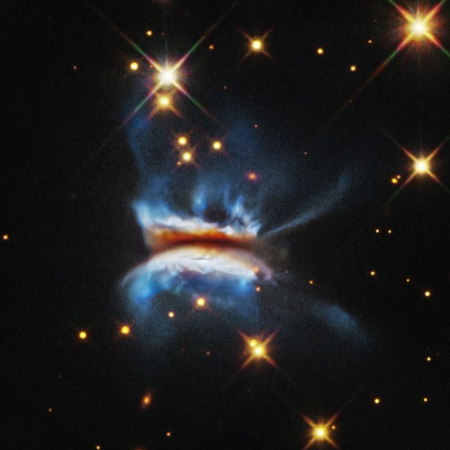
Cool image time! The picture to the right, rotated, cropped, and reduced to post here, was taken by the Hubble Space Telescope on February 8, 2025, and shows what scientists believe is the largest protoplanetary disk so far measured.
Located roughly 1,000 light-years from Earth, IRAS 23077+6707, nicknamed “Dracula’s Chivito,” spans nearly 400 billion miles — 40 times the diameter of our solar system to the outer edge of the Kuiper Belt of cometary bodies. The disk obscures the young star within it, which scientists believe may be either a hot, massive star, or a pair of stars. And the enormous disk is not only the largest known planet-forming disk; it’s also shaping up to be one of the most unusual.
…The impressive height of these features wasn’t the only thing that captured the attention of scientists. The new images revealed that vertically imposing filament-like features appear on just one side of the disk, while the other side appears to have a sharp edge and no visible filaments. This peculiar, lopsided structure suggests that dynamic processes, like the recent infall of dust and gas, or interactions with its surroundings, are shaping the disk.
You can read the peer-reviewed paper here [pdf]. The structure of this system has left them with more questions than answers. They can’t see the central star due to the dust. They don’t know if any planets exist as yet in the system. They don’t really understand the structural details that they can see.

Click for original image.
Cool image time! The picture to the right, rotated, cropped, and reduced to post here, was taken by the Hubble Space Telescope on February 8, 2025, and shows what scientists believe is the largest protoplanetary disk so far measured.
Located roughly 1,000 light-years from Earth, IRAS 23077+6707, nicknamed “Dracula’s Chivito,” spans nearly 400 billion miles — 40 times the diameter of our solar system to the outer edge of the Kuiper Belt of cometary bodies. The disk obscures the young star within it, which scientists believe may be either a hot, massive star, or a pair of stars. And the enormous disk is not only the largest known planet-forming disk; it’s also shaping up to be one of the most unusual.
…The impressive height of these features wasn’t the only thing that captured the attention of scientists. The new images revealed that vertically imposing filament-like features appear on just one side of the disk, while the other side appears to have a sharp edge and no visible filaments. This peculiar, lopsided structure suggests that dynamic processes, like the recent infall of dust and gas, or interactions with its surroundings, are shaping the disk.
You can read the peer-reviewed paper here [pdf]. The structure of this system has left them with more questions than answers. They can’t see the central star due to the dust. They don’t know if any planets exist as yet in the system. They don’t really understand the structural details that they can see.
Starlink added a million new customers in just the past month
According to a tweet by SpaceX yesterday, Starlink now has nine million active customers in 155 countries worldwide.
These numbers tell us the company is now getting more than a billion dollars per month in revenues, based on what it charges for its various plans. What make the numbers even more startling is how fast they are growing.
In a similar post from November 5, SpaceX said Starlink had 8 million customers, meaning that its customer base has expanded at a rate of more than 20,000 per day since that date.
At more than billion dollars per month, SpaceX essentially has about half the annual revenue of NASA, which it can use far more efficiently. And those numbers will only increase in the coming years, as the company opens up new markets worldwide and begins launching its upgraded Starlink satellites with Starship.
It still seems to me puzzling why, with these numbers, Musk is considering making the company public this coming summer. Though that move would bring in a gigantic amount of new investment capital from the stock sale, it would also subject the company to serious government regulation as a publicly-traded company. The Starlink revenue can only grow. Why add government interference when you can live without it?
According to a tweet by SpaceX yesterday, Starlink now has nine million active customers in 155 countries worldwide.
These numbers tell us the company is now getting more than a billion dollars per month in revenues, based on what it charges for its various plans. What make the numbers even more startling is how fast they are growing.
In a similar post from November 5, SpaceX said Starlink had 8 million customers, meaning that its customer base has expanded at a rate of more than 20,000 per day since that date.
At more than billion dollars per month, SpaceX essentially has about half the annual revenue of NASA, which it can use far more efficiently. And those numbers will only increase in the coming years, as the company opens up new markets worldwide and begins launching its upgraded Starlink satellites with Starship.
It still seems to me puzzling why, with these numbers, Musk is considering making the company public this coming summer. Though that move would bring in a gigantic amount of new investment capital from the stock sale, it would also subject the company to serious government regulation as a publicly-traded company. The Starlink revenue can only grow. Why add government interference when you can live without it?
JAXA identifies cause of H3 rocket failure
In releasing today the preliminary results of its investigation into the failure on December 21, 2025 of the upper stage of its H3 rocket, Japan’s space agency pinned the likely cause on the rocket’s fairings.
Japan Aerospace Exploration Agency officials told a science ministry panel on Dec. 23 they suspect an abnormal separation of the rocket’s payload fairing—a protective nose cone shield—caused a critical drop in pressure in the second-stage engine’s hydrogen tank.
Engineers think the fairing might have hit the rocket at separation, damaging the tank.
Japan at present has no way to launch payloads. It has no operating independent commercial rocket companies, and its JAXA-owned H3 and Epsilon-S rockets have had repeated problems. The H3 failed on its first launch in 2023, causing a year-long delay, and Epsilon-S still in limbo because of repeated failures during development.
In releasing today the preliminary results of its investigation into the failure on December 21, 2025 of the upper stage of its H3 rocket, Japan’s space agency pinned the likely cause on the rocket’s fairings.
Japan Aerospace Exploration Agency officials told a science ministry panel on Dec. 23 they suspect an abnormal separation of the rocket’s payload fairing—a protective nose cone shield—caused a critical drop in pressure in the second-stage engine’s hydrogen tank.
Engineers think the fairing might have hit the rocket at separation, damaging the tank.
Japan at present has no way to launch payloads. It has no operating independent commercial rocket companies, and its JAXA-owned H3 and Epsilon-S rockets have had repeated problems. The H3 failed on its first launch in 2023, causing a year-long delay, and Epsilon-S still in limbo because of repeated failures during development.
No contact with Mars’ rovers for the next month
The Sun is about going to cause a month-long break in communications with Curiosity and Perseverance, the two rovers on Mars.
This communications pause occurs every two years, when the orbits of Earth and Mars align with the Sun in between.
This holiday season coincides with conjunction — every two years, because of their different orbits, Earth and Mars are obstructed from one another by the Sun; this one will last from Dec. 27 to Jan. 20. We do not like to send commands through the Sun in case they get scrambled, so we have been finishing up a few last scientific observations before preparing Curiosity for its quiet conjunction break.
This is not a unique situation. Both rovers have gone through conjunction several times previously. The science teams will place the rovers in secure positions to hold them over during the break.
As for the orbiters circling Mars, it isn’t clear how much their operations will be impacted. The update at the link above makes no mention of them, and my memory says communications with them is less hampered, though reduced somewhat.
The Sun is about going to cause a month-long break in communications with Curiosity and Perseverance, the two rovers on Mars.
This communications pause occurs every two years, when the orbits of Earth and Mars align with the Sun in between.
This holiday season coincides with conjunction — every two years, because of their different orbits, Earth and Mars are obstructed from one another by the Sun; this one will last from Dec. 27 to Jan. 20. We do not like to send commands through the Sun in case they get scrambled, so we have been finishing up a few last scientific observations before preparing Curiosity for its quiet conjunction break.
This is not a unique situation. Both rovers have gone through conjunction several times previously. The science teams will place the rovers in secure positions to hold them over during the break.
As for the orbiters circling Mars, it isn’t clear how much their operations will be impacted. The update at the link above makes no mention of them, and my memory says communications with them is less hampered, though reduced somewhat.
China’s Long March 12A launches but fails to land the first stage
China’s new Long March 12A reusable rocket completed its first launch today (December 23 in China), lifting off from the Jiuquan space spaceport in northwest China. The attempt to softly land the first stage vertically at a landing pad down range however failed.
According to one report, the rocket’s upper stage reached orbit, but this remains unconfirmed. A Google-translation of this Chinese state-run report confirmed the failure of the first stage:
The rocket lifted off successfully after ignition, and its flight appeared normal during the visual observation phase. However, reports from the recovery site indicated an anomaly during the first stage’s re-entry, resulting in a “mushroom cloud” formation, and the successful recovery of the first stage was not achieved.
Several Chinese outlets showed the same image of that cloud. This is the second unsuccessful attempt by China this month to land a first stage, the first being the December 2nd attempt by the Chinese pseudo-company Landspace’s Zhuque-3 rocket. The Long March 12A is built by the government, so there is no make-believe company involved.
UPDATE: China’s state-run press has confirmed the upper stage reached orbit.
The leaders in the 2025 launch race:
168 SpaceX
86 China (a new record)
18 Rocket Lab
15 Russia
SpaceX still leads the rest of the world in successful launches, 168 to 143.
China’s new Long March 12A reusable rocket completed its first launch today (December 23 in China), lifting off from the Jiuquan space spaceport in northwest China. The attempt to softly land the first stage vertically at a landing pad down range however failed.
According to one report, the rocket’s upper stage reached orbit, but this remains unconfirmed. A Google-translation of this Chinese state-run report confirmed the failure of the first stage:
The rocket lifted off successfully after ignition, and its flight appeared normal during the visual observation phase. However, reports from the recovery site indicated an anomaly during the first stage’s re-entry, resulting in a “mushroom cloud” formation, and the successful recovery of the first stage was not achieved.
Several Chinese outlets showed the same image of that cloud. This is the second unsuccessful attempt by China this month to land a first stage, the first being the December 2nd attempt by the Chinese pseudo-company Landspace’s Zhuque-3 rocket. The Long March 12A is built by the government, so there is no make-believe company involved.
UPDATE: China’s state-run press has confirmed the upper stage reached orbit.
The leaders in the 2025 launch race:
168 SpaceX
86 China (a new record)
18 Rocket Lab
15 Russia
SpaceX still leads the rest of the world in successful launches, 168 to 143.
The first launch by South Korean rocket startup Innospace fails shortly after liftoff
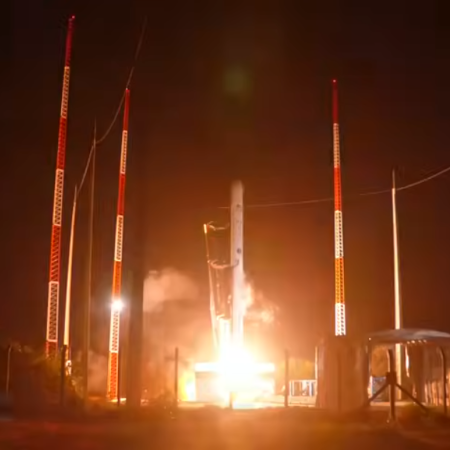
Though details are not yet available, the first launch by South Korean rocket startup Innospace of its Hanbit-Nano rocket failed less than 2 minutes after liftoff from Brazil’s long unused Alcantera spaceport. The failure occurred sometime after the rocket passed through max-q, the moment when the aerodynamic pressure of the atmosphere and the speed of the rocket stresses the rocket the most.
The live stream provided no details, other than to say “we experienced an anomaly during the flight.” No other details have yet been released.
The image to the right is a screen capture of the rocket lifting off the pad, less than a few seconds after T-0. Though the rocket appeared to move upward in a smooth controlled flight, soon thereafter it became impossible to see anything but the bright engine flame at its base. Either the flames were so bright it overexposed the live stream, or the fire was spreading beyond the nozzles. At the moment however we know nothing about what happened.
Though details are not yet available, the first launch by South Korean rocket startup Innospace of its Hanbit-Nano rocket failed less than 2 minutes after liftoff from Brazil’s long unused Alcantera spaceport. The failure occurred sometime after the rocket passed through max-q, the moment when the aerodynamic pressure of the atmosphere and the speed of the rocket stresses the rocket the most.
The live stream provided no details, other than to say “we experienced an anomaly during the flight.” No other details have yet been released.
The image to the right is a screen capture of the rocket lifting off the pad, less than a few seconds after T-0. Though the rocket appeared to move upward in a smooth controlled flight, soon thereafter it became impossible to see anything but the bright engine flame at its base. Either the flames were so bright it overexposed the live stream, or the fire was spreading beyond the nozzles. At the moment however we know nothing about what happened.
Handel – Pastoral Symphony from Messiah
An evening pause: One of the most beautiful sections of Handel’s masterpiece, often missed because it is quiet and gentle in tone.
Tory Bruno resigns as CEO of United Launch Alliance
According a brief announcement today from Robert Lightfoot (ULA Lockheed Martin Board Chair) and Kay Sears (ULA Boeing Board Chair), Tory Bruno has resigned as CEO and president of United Launch Alliance, effective immediately.
After nearly 12 years leading United Launch Alliance (ULA), current ULA President and CEO Tory Bruno has resigned to pursue another opportunity.
We are grateful for Tory’s service to ULA and the country, and we thank him for his leadership.
Effective immediately, John Elbon is named as the Interim CEO. We have the greatest confidence in John to continue strengthening ULA’s momentum while the board proceeds with finding the next leader of ULA. Together with Mark Peller, the new COO, John’s career in aerospace and his launch expertise is an asset for ULA and its customers, especially for achieving key upcoming Vulcan milestones.
No further information was provided.
The timing is intriguing, as after a decade of effort, Bruno was about to get ULA’s new Vulcan rocket launching on a regular basis. I could speculate, but at the moment there isn’t enough information to make even a good guess.
Hat tip to reader Gary.
According a brief announcement today from Robert Lightfoot (ULA Lockheed Martin Board Chair) and Kay Sears (ULA Boeing Board Chair), Tory Bruno has resigned as CEO and president of United Launch Alliance, effective immediately.
After nearly 12 years leading United Launch Alliance (ULA), current ULA President and CEO Tory Bruno has resigned to pursue another opportunity.
We are grateful for Tory’s service to ULA and the country, and we thank him for his leadership.
Effective immediately, John Elbon is named as the Interim CEO. We have the greatest confidence in John to continue strengthening ULA’s momentum while the board proceeds with finding the next leader of ULA. Together with Mark Peller, the new COO, John’s career in aerospace and his launch expertise is an asset for ULA and its customers, especially for achieving key upcoming Vulcan milestones.
No further information was provided.
The timing is intriguing, as after a decade of effort, Bruno was about to get ULA’s new Vulcan rocket launching on a regular basis. I could speculate, but at the moment there isn’t enough information to make even a good guess.
Hat tip to reader Gary.
December 22, 2025 Quick space links
Courtesy of BtB’s stringer Jay. This post is also an open thread. I welcome my readers to post any comments or additional links relating to any space issues, even if unrelated to the links below.
- Smallsat company Axelspace signs multi-launch agreement with launch integrator Exolaunch
Exolaunch acts as the agent for the satellite company to find the right launch provider.
- Pale Blue to provide thrusters for Axelspace microsatellite
The deal is for a demo flight in 2027.
- Video of Dawn Aerospace’s Mk-II Aurora drone as it reaches 20 kilometer altitude in 118 seconds
Beats the F-15 Streak Eagle’s 1975 record by 4 seconds.
- ISRO successfully tests deployment of the Gaganyaan drogue parachutes
Fun video of the test.
- NordSpace’s commercial Atlantic Spaceport Complex (ASX) on Newfoundland gets its environmental assessment approved
One of two new spaceport startups on Canada’s eastern seaboard.
- Rocket Lab wins its largest satellite contract award yet, $816 million to build 18 missile tracking satellites for the Pentagon
Rocket Lab continues to establish itself strongly in all aspects of space, from rockets to satellites.
- Notice to Airman (NOTAM) suggests China will attempt the first launch of its reusable Long March 12A on December 23, 2025
The launch will be from China’s Jiuquan spaceport, with the interior landing zone probably the same used by the Zhuque-3 rocket two weeks ago. Note that this is not the first Long March 12A NOTAM, so there are no certainties about this launch.
- Today, December 21, 2025, marks the tenth year anniversary of SpaceX’s the first successful landing of an orbital class Falcon 9 booster
The video at the link, by National Geographic, unfortunately turns this historic event into a fake movie drama, with music and editing to rob it of its reality. Go here to watch the actual live stream.
That landing changed rocketry forever. As I wrote the next day:
Despite living in a time when freedom is denigrated, when free speech is squelched, and when oppressive regulation and government control is the answer to every problem, the enduring spirit of the human soul still pushed through to do an amazing thing.
SpaceX’s success is only the beginning. The ability to reuse the engines and first stage will allow them to lower their launch costs significantly, meaning that access to space will now be possible for hundreds if not thousands of new entrepeneurs who previously had ideas about developing the resources of the solar system but could not achieve them because the launch costs were too high.
Courtesy of BtB’s stringer Jay. This post is also an open thread. I welcome my readers to post any comments or additional links relating to any space issues, even if unrelated to the links below.
- Smallsat company Axelspace signs multi-launch agreement with launch integrator Exolaunch
Exolaunch acts as the agent for the satellite company to find the right launch provider.
- Pale Blue to provide thrusters for Axelspace microsatellite
The deal is for a demo flight in 2027.
- Video of Dawn Aerospace’s Mk-II Aurora drone as it reaches 20 kilometer altitude in 118 seconds
Beats the F-15 Streak Eagle’s 1975 record by 4 seconds.
- ISRO successfully tests deployment of the Gaganyaan drogue parachutes
Fun video of the test.
- NordSpace’s commercial Atlantic Spaceport Complex (ASX) on Newfoundland gets its environmental assessment approved
One of two new spaceport startups on Canada’s eastern seaboard.
- Rocket Lab wins its largest satellite contract award yet, $816 million to build 18 missile tracking satellites for the Pentagon
Rocket Lab continues to establish itself strongly in all aspects of space, from rockets to satellites.
- Notice to Airman (NOTAM) suggests China will attempt the first launch of its reusable Long March 12A on December 23, 2025
The launch will be from China’s Jiuquan spaceport, with the interior landing zone probably the same used by the Zhuque-3 rocket two weeks ago. Note that this is not the first Long March 12A NOTAM, so there are no certainties about this launch.
- Today, December 21, 2025, marks the tenth year anniversary of SpaceX’s the first successful landing of an orbital class Falcon 9 booster
The video at the link, by National Geographic, unfortunately turns this historic event into a fake movie drama, with music and editing to rob it of its reality. Go here to watch the actual live stream.That landing changed rocketry forever. As I wrote the next day:
Despite living in a time when freedom is denigrated, when free speech is squelched, and when oppressive regulation and government control is the answer to every problem, the enduring spirit of the human soul still pushed through to do an amazing thing.
SpaceX’s success is only the beginning. The ability to reuse the engines and first stage will allow them to lower their launch costs significantly, meaning that access to space will now be possible for hundreds if not thousands of new entrepeneurs who previously had ideas about developing the resources of the solar system but could not achieve them because the launch costs were too high.