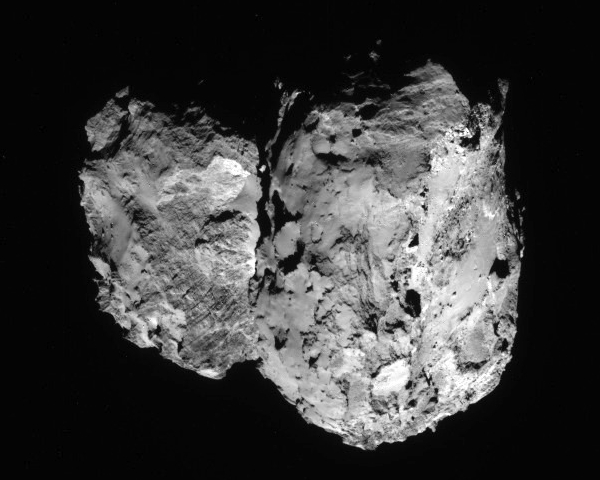
The first four cubesats of a fleet of 28 launched from ISS on Tuesday.

The first four cubesats of a fleet of 28 launched from ISS on Tuesday.

The four “cubesats,” each about the size of a loaf of bread, were deployed from the space station this morning and began zipping freely around Earth. Twenty-four more will join them over the coming days, filling out the “Flock 1” satellite fleet operated by San Francisco-based startup Planet Labs. Planet Labs’ Flock 1 will provide frequent, low-cost, high-resolution imagery of Earth that could serve a variety of purposes, company officials say, from tracking deforestation and natural disasters to monitoring leaks in oil pipelines.

DARPA opens the competition for awarding the first design contracts for a new experimental unmanned space plane, set to launch in 2017.

DARPA opens the competition for awarding the first design contracts for a new experimental unmanned space plane, set to launch in 2017.

DARPA has high expectations for the XS-1 program, which it hopes can eventually launch 3,000- to 5,000-lb (1,361 to 2,268 kilograms) payloads to orbit for less than $5 million per flight — and to do it at least 10 times per year….

DARPA officials laid out their broad vision of the robotic XS-1 vehicle in a press release issued in September: “XS-1 envisions that a reusable first stage would fly to hypersonic speeds at a suborbital altitude,” they wrote. “At that point, one or more expendable upper stages would separate and deploy a satellite into low-Earth orbit. The reusable hypersonic aircraft would then return to earth, land and be prepared for the next flight.”

But DARPA is leaving the specifics of the XS-1 system — which aims to provide routine, aircraft-like access to space — up its potential builders, Sponable said. “We don’t care if it’s vertical take-off, horizontal land, vertical-vertical, which brings in a lot of the entrepreneurs,” he said in the FISO presentation. “We don’t care if they air-launch it, air-tow it, whatever. So we’ve left all those wide open.”

This DARPA program dovetails nicely with NASA commercial manned space program, as well as the emerging suborbital tourist industry. The combination should energize the reusable launch market quite effectively.

Arianespace, under severe competitive price pressure from SpaceX, begs for more subsidies from ESA.

The competition heats up? Arianespace, under severe competitive price pressure from SpaceX, begs for more subsidies from ESA.

In comments responding to a Feb. 11 audit of the French Accounting Court, Cour des Comptes, Israel said that since 2005 Arianespace has improved its competitiveness to the extent that some €200 million ($273 million) in annual subsidies from the 20-nation European Space Agency (ESA) have been halved. In addition, the reliability of the Ariane 5, which has seen 58 consecutive successes since 2002, has allowed the company to increase launch prices. The company also has reduced costs with a recent bulk buy of 18 Ariane 5 rockets that saved Arianespace 5%.

Nevertheless, Israel said the arrival of the medium-lift Falcon 9 as a competitor at the low end of the commercial communications satellite market, with prices substantially lower than what Arianespace charges for Ariane 5, means the company may be forced to ask ESA governments to increase price supports beyond the current €100 million per year. [emphasis mine]

In other words, this government-funded boondoggle doesn’t know how to compete effectively on the open market, and wants an additional government bailout to keep its head above water.

Note also the text in bold. Several commenters on this website have repeatedly insisted that SpaceX’s Falcon 9 was not the bargain claimed, despite numerous examples in the past three years of their competition saying they were that inexpensive. This statement by Arianespace’s CEO reaffirms the fact that SpaceX is cheaper, and is forcing major changes to the launch industry.

In related news, French government auditors have found much wrong with Arianespace’s current long term commercial strategy.

Richard Branson today claimed that Virgin Galactic will fly its first space tourists this year.

Did you ever get the feeling of deja-vu? On Monday Richard Branson claimed that Virgin Galactic will fly its first space tourists this year.

I am all for his success, but I must admit I am becoming skeptical. Branson said exactly the same thing in May 2013, except then he was claiming that the first tourist flight would occur before the end of 2013. It didn’t happen.

There are too many rumors about the engine troubles with SpaceShipTwo to allow me to accept Branson’s claims any longer at face value.

Russia considers building a heavy-lift rocket, even as it completes the design and construction of its new Angara commercial rocket family.

The competition heats up: Russia considers building a heavy-lift rocket, even as it completes the design and construction of its new Angara commercial rocket family.

The headline of the article focuses on the heavy-lift rocket, but the meat of the article is its details on Angara, which is expected to make its first launch in 2014.

Scientists have found that bumblebees have the capability of flying at altitudes higher than the top of Mount Everest.

Scientists have found that bumblebees have the capability of flying at altitudes higher than the top of Mount Everest.

In a study published today in Biology Letters, two zoologists, Michael Dillon, now at the University of Wyoming in Laramie, and Robert Dudley of the University of California, Berkeley, tested whether bumblebees’ vertical range was limited by aerodynamics and physiology. Working in the mountains of Sichuan, China, the duo caught five male bumblebees (Bombus impetuosus) foraging at 3,250 meters and placed them in a plexiglas chamber. Once the bees began to fly upwards, the pressure inside the chamber was reduced using a hand pump to simulate altitude increases in 500-meter intervals. All five bees could hover at air pressures equivalent to elevations of 7,400 meters; three could fly above 8,000 meters; and two got to above 9,000 meters.

If you read the entire article, you will notice that it completely ignores the false urban legend that bumblebees are aerodynamically unsound and shouldn’t be able to fly. Scientists have known for decades that it is false, but for some reason it keeps getting repeated.

After resuming drilling in Seattle — and only going four feet — Bertha has been stopped again.

After resuming drilling in Seattle — and only going four feet — Bertha has been stopped again.

High temperatures near the machine’s cutting face prompted contractors to stop mining after the drill advanced a total of 4 feet in test runs Tuesday and Wednesday. And that ended Bertha’s attempt to resume mining after an eight-week layoff.

The earlier stoppage remains unexplained. They found some concrete chunks and steel pipe sections in the way, but nothing that could have explained why the drill was blocked. Now the high temperatures pose a more significant problem, as they suggest there is something technical wrong with the giant drill.

A new harvest of vegetables in space!

A new harvest of vegetables in space!

Notice that this research is a partnership of the Russians and an American university. NASA is not included. When I wrote about this subject for Air & Space a few years ago, the American researcher explained that there was too much bureaucracy working with NASA. Moreover, the Russians were much more knowledgeable about crop research in space, as they had been doing it for decades already on their Salyut and Mir stations.

What life has been like for one engineer who works at SpaceX.

What life has been like for one engineer who works at SpaceX.

Key quote:

According to Pearce, the best and the worst things about working for Musk are actually the same. “He doesn’t feel the need to make reasonable requests,” Pearce says. “The whole idea of SpaceX is not reasonable. The idea that a dot-com millionaire could take [US] $100 million and start a rocket company that within 13 years would be taking supplies to the International Space Station, that’s on track to take crew to the International Space Station — that’s not reasonable.”

But SpaceX did it.

Better medicine through engineering

For me, the last eight months have been very interesting when it comes to medical treatment. I have had my left hand rebuilt to eliminate chronic pain, I had my heart inspected to make sure it was working properly, and this week I had the retina in my right eye re-attached using some very clever engineering.

For once, this essay will not be about the politics of medicine and the disaster of Obamacare, which is still ongoing. Instead, I will outline how freedom and human creativity has now made possible a whole range of modern medical techniques that are either improving the quality of life for patients or literally saving their lives.
» Read more

The National Science Foundation wants to get rid of some of its older big telescopes, and you can buy them!

The National Science Foundation wants to get rid of some of its older big telescopes, and you can buy them!

We are not talking small here. The biggest is the Green Bank Radio Telescope in West Virginia, which though only fourteen years old is unable to compete scientificially with the new large radio telescope arrays. In truth, when it was mostly built to satisfy the pork ambitions of the late Democratic Senator Robert Byrd.

In celebration of the tenth anniversary of Opportunity’s landing on Mars, the journal Science publishes a special section of the newest findings from Mars.

In celebration of the tenth anniversary of Opportunity’s landing on Mars, the journal Science has published a special section of the newest findings from Mars.

The main conclusion of all this research is that Mars was once potentially habitable, though there is no evidence so far to show that anything actually inhabited it. The data obtained however is now giving scientists clues on the best places to look for the remains of that ancient life, should it exist.

Virgin Galactic today announced the successful testing of their own new rocket engine.

The competition heats up: Virgin Galactic today announced the successful testing of their own new rocket engine.

Virgin Galactic, the world’s first commercial spaceline, announced today that it has reached a significant milestone in the testing of a new family of liquid rocket engines for LauncherOne, the company’s small satellite launch vehicle. As part of a rapid development program, Virgin Galactic has now hot-fired both a 3,500 lbf thrust rocket engine and a 47,500 lbf thrust rocket engine, called the “NewtonOne” and “NewtonTwo” respectively. Further, the NewtonOne engine has successfully completed a full-mission duty cycle on the test stand, firing for the five-minute duration expected of the upper stage engine on a typical flight to orbit. These tests are being conducted on two new state-of-the-art test stands that the team designed, assembled and installed internally. [emphasis mine]

Though they say that these engines are for their orbital rocket, not SpaceShipTwo, I find it interesting that their development was in-house, not by Scaled Composites which has so far been building everything for Virgin Galactic. Moreover, note the highlighted words, “rapid development program.” Though you should never be leisurely about this stuff in order to compete, giving this particular title to this engine program suggests they are in a particular hurry to develop it.

Both factoids suggest again that they are not happy with the performance of the hybrid engines Scaled Composites built for them, under their direction, and are now working hard to replace them.

1 430 431 432 433 434 520