SpaceX to use both Falcon 9 and Starship to launch 2nd gen Starlink satellites

Capitalism in space: In a letter sent to the FCC, SpaceX has revealed that it has revised its plans for launching the second generation of Starlink satellites, and has decided to launch them with both Falcon 9 and Starship rockets.

SpaceX has decided to use a mix of Falcon 9 and Starship rockets to launch the 30,000 satellites in its proposed second-generation Starlink broadband constellation. Launching some of the satellites with SpaceX’s “tested and dependable Falcon 9” will accelerate the constellation’s deployment to improve Starlink services. SpaceX director of satellite policy David Goldman wrote in an Aug. 19 letter to the Federal Communications Commission. Goldman did not say when SpaceX could start launching the second-generation constellation, which remains subject to FCC approval.

Previously the company’s plan had been to use Starship only, essentially retiring Falcon 9 once Starship was flying. This change could be for two fundamental reasons. First, the company has been launching Starlinks on Falcon 9 like clockwork this year, at a pace that could launch as many as 2,500 Starlink satellites in 2022 alone. With about 70% of that rocket reusable, it might now seem cost effective to continue to use it, even after Starship is flying.

The second reason is more worrisome, and has to do with Starship itself. SpaceX officials might now realize that the delays being imposed by the federal regulatory leviathan on Starship development might be significant enough that it won’t be ready when they need it for the full deployment of Starlink’s second generation constellation. If the FCC approves that deployment (an approval that is presently pending), SpaceX will have to launch at least half the full constellation of 30,000 satellites by around 2024 (thought that date might have been revised slightly).

It now might be necessary to use Falcon 9, because the federal government under Biden is standing in the way of Starship development.

Of course, it is possible that the engineering challenge of building Starship might be another reason. SpaceX might have realized that the rocket will be delayed anyway, and thus needs Falcon 9 to meet its timetable as promised to the FCC.
10 comments

NASA again approves design concept for Orbital Reef commercial space station

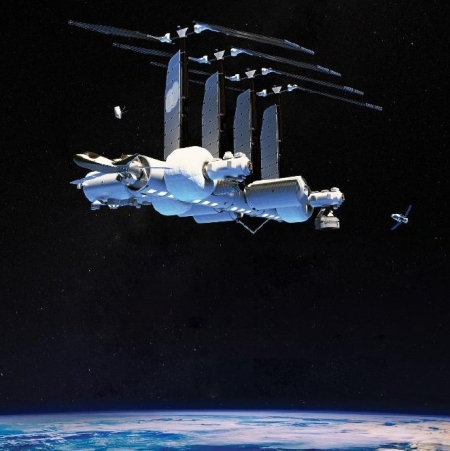
Proposed Orbital Reef space station

Capitalism in space: Sierra Space announced today that NASA has completed, apparently for the second time, the design review for the Orbital Reef space station that the company wants to build in partnership with Blue Origin and others, thus allowing the actual design of the station to begin.

This press release announcement, on August 22, 2022, is a bit puzzling, as Sierra Space made almost the exact same announcement in April 2022. What, did NASA have to do this twice? Did issues come up after the first approval? Was the agency reviewing different things?

Regardless, NASA as usual is slowing things down considerably. Sierra Space and Blue Origin, the primary partners in this private space station project, first announced it in October 2021. It took the government almost a year to simply approve the basic concept so that the design phase could finally begin. At this pace it will be 2090 before the station is launched.

13 comments

SpaceX and China complete launches

Two launches have just occurred in the 2022 launch race. First, SpaceX today successfully launched another 53 Starlink satellites, using its Falcon 9 rocket.

The first stage successfully landed on its drone ship in the Atlantic, completing its ninth flight.

China in turn used its Long March 2D rocket to launch three military reconnaissance satellites, at what was the early morning hours of August 20, 2022, China time. The launch path took the rocket over China’s interior as well as Taiwan, with the first stage crashing somewhere in China.

The leaders in the 2022 launch race:

37 SpaceX
31 China
11 Russia
6 Rocket Lab
5 ULA

American private enterprise still leads China 52 to 31 in the national rankings, and the entire world 52 to 49. The 52 launches so far this year is now the fifth best total for the U.S. since the launch of Sputnik in 1957.

0 comments

An armored manta-ray-shaped small submarine for commercial and military applications

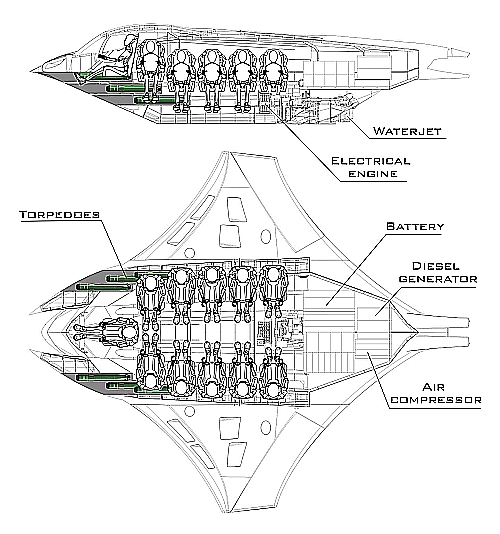
Kronos sub

A private company, Highland Systems, that was founded in the Ukraine but now is based both in the UK and the UAE, appears to be building an armored manta-ray-shaped small submarine for both commercial and military applications.

It’s designed for a mix of commercial, military and allegedly rescue operations – and from the looks of the stark, largely windowless interior, it certainly doesn’t seem interested in tourism or luxury. A little over 9 m (29.6 ft) long, Kronos will weigh somewhere around 10,000 kg (22,000 lb). Its fat wings will fold upward, allowing you to tow it on a trailer if you wish to cause a series of gawking-related accidents among oncoming traffic.

Plonk it in the water, and it’ll seat 10 passengers plus a driver. The hybrid powertrain marries a diesel generator to a 1,200-horsepower, 2,400-Nm (1,770-lb-ft) electric motor driving a waterjet propulsion system. It can dive to a working depth of 100 m (328 ft), or a max critical depth of 250 m (820 ft), which is pretty decent in the scheme of things. The air supply is good for around 36 hours.

The performance figures are nuts. Highland says it’ll do 80 km/h (50 mph) on top of the water, or 50 km/h (31 mph) underwater; that’s seriously fast through water, just ask Michael Phelps. It carries enough battery on board for a 36-hour all-electric mission, or you can fire up the diesel generator to add a further 18, taking total range up to a very impressive 54 hours of autonomy. There’s adaptive lighting, an automated life support system and air-con – and the schematics show spots for torpedoes as well.

Nor is this entirely a fantasy of the company. It has already built the submarine’s main shell.

As the quote notes, though the company claims this submarine will have civilian uses, the submarine being built now seems entirely military in nature, especially because there is no information at all about the customer paying for its construction. Also, note the torpedoes shown in the schematic above, as well as the packed passengers. Since the company has its roots in the Ukraine, I can just imagine it being used by the Ukraine to transport soldiers to the Crimea on an undercover sabotage mission to destroy Russian assets.

9 comments

Indian company delivers Gaganyaan fairing and high altitude launch abort motor to ISRO

Capitalism in space: The Indian private company, Hindustan Aeronautics Limited, yesterday delivered to India’s space agency ISRO the fairing and high altitude launch abort motor that will be used in Gaganyaan, that nation’s first manned spaceflight.

Though the article at the link does not say so, the fairings and abort motor will likely be used in one of two unmanned launch abort test flights ISRO intends to do before the actual manned mission, now set for sometime in ’24.

Hindustan Aeronautics is also a space company in India that will require watching. It not only built these major components for Gaganyaan, it also has built major components for India’s PSLV and GSLV rockets. It would not surprise me if the company eventually decides to build its own rocket, assuming the India government loosens the stranglehold it presently has over space and lets private companies compete against its government space operations. It was a similar stranglehold by NASA from the 1970s to the 2000s that squelched competition and innovation from the American private aerospace industry. When that ended, the renaissance in commercial space finally could begin.

UPDATE: It appears I was in error assuming Hindustan Aeronauts was a private company, as it is owned by the Indian government. I have edited the post above to reflect this. It appears the stranglehold the government has over India’s aerospace industry is no closer to loosening.

3 comments

Firefly completes a dress rehearsal countdown of Alpha rocket; schedules launch

Capitalism in space: Having successfully completed both a full dress rehearsal countdown and static fire test of its fully stacked Alpha rocket, Firefly Aerospace has now scheduled the rocket’s launch for September 11, 2022.

These details come from a tweet by the company, so details are very limited. Nonetheless, this will be the company’s second attempt to complete an orbital launch. The first attempt, in September 2021, failed when one of its first stage engines shut down prematurely.

The company had hoped to attempt this second launch ten months ago, but was forced to delay it when the federal government demanded its chief investor, Ukrainian billionaire Max Polykov, first sell off his share in the company.

Hat tip to BtB’s stringer Jay.

0 comments

Maritime Launch Services signs land lease for its Nova Scotia spaceport

Capitalism in space: Maritime Launch Services yesterday obtained a 20-year land lease for its Nova Scotia spaceport from the province of Nova Scotia.

The lease covers 334.5 acres, and is renewable for an additional 20 years.

Unlike other spaceports, Maritime isn’t merely providing a launch site for rocket companies. Instead the company will also launch smallsats itself, using a Ukrainian-built rocket dubbed the Cyclone-4M. Initially the plan was to fly all launches in this manner, but the invasion of the Ukraine by Russia has caused Maritime to look for other launch providers as well.

0 comments

Starship gets its first communications satellite customer

Capitalism in space: Sky Perfect JSAT, a Japanese satellite communications company, today awarded SpaceX a launch contract using its giant Starship/Superheavy rocket to put its Superbird-9 communications satellite into orbit in 2024.

Superbird-9 will be launched by SpaceX’s Starship launch vehicle in 2024 to geosynchronous transfer orbit. SpaceX’s Starship is a fully reusable transportation system that will be the world’s most powerful launch vehicle. SKY Perfect JSAT and SpaceX will continue to work together ahead of the launch of Superbird-9 Satellite.

Sky Perfect is the first communications satellite company to choose Starship for a satellite launch. It is however the rocket’s fourth signed customer. Japanese billionaire Yusaku Maezawa made a deal in 2018 for a flight around the Moon, while NASA chose Starship in 2021 as the manned lunar lander in its Artemis program. UPDATE: SpaceX also has a second private manned customer, Jared Isaacman, whose present deal with SpaceX calls for two Dragon flights followed by a Starship flight.

Sky Perfect is not a new company, with sixteen satellites already in orbit providing communications, broadband, and entertainment to Japan and the Far East. It likely made this deal because it got a very good launch price, with options to back out if the rocket’s on-going development gets delayed by too much. It also made the deal because it helps to solidify Starship’s future, something Sky Perfect probably sees as a win considering the significant reduction of launch costs expected from Starship/Superheavy.

5 comments

A detailed description of Rocket Lab’s private Venus mission

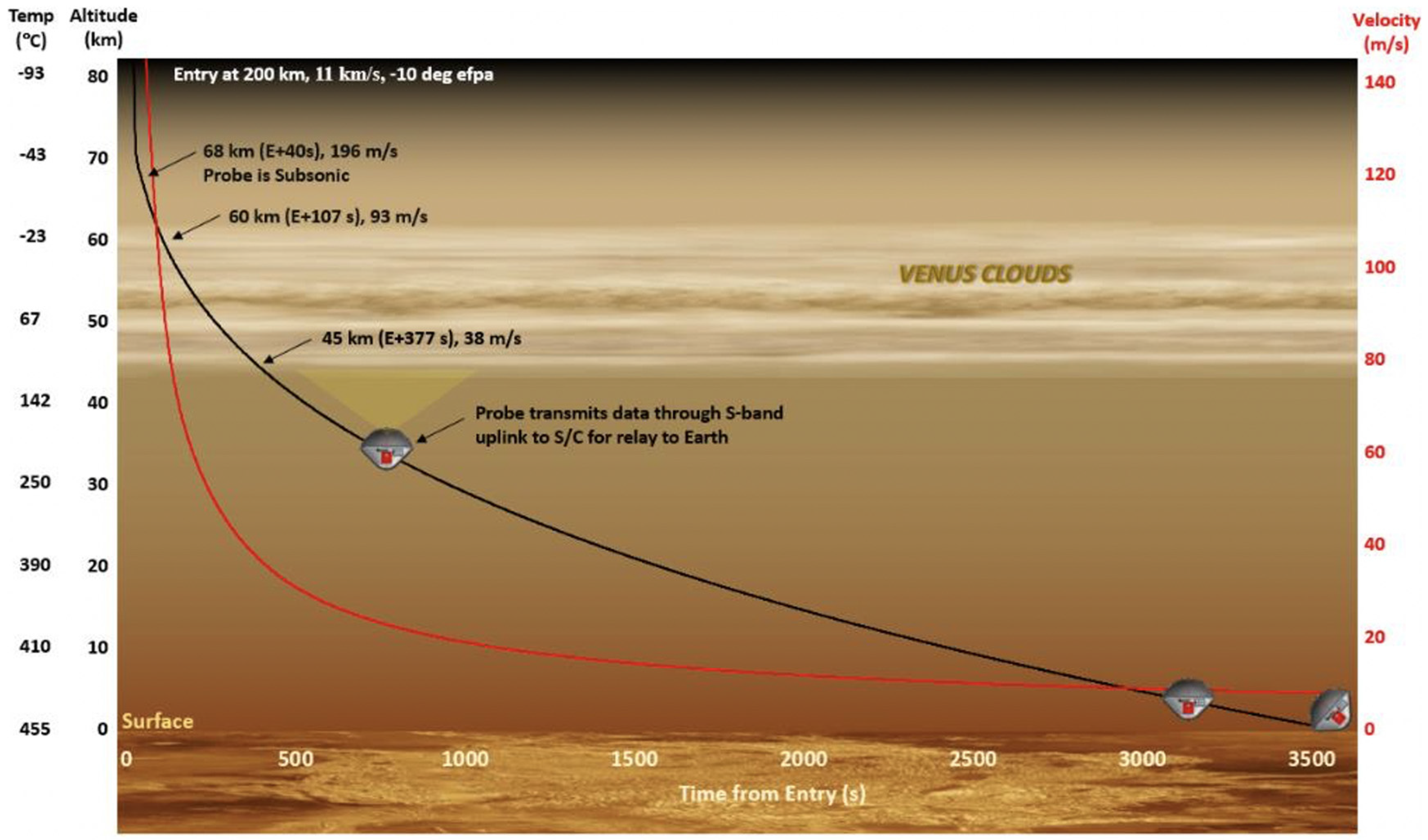
Planned insertion of Rocket Lab's probe into Venus's atmosphere
Click for full figure.

Capitalism in space: In partnership with scientists at MIT, the Planetary Science Institute, and others, Rocket Lab engineers this week published a detailed description of the company’s planned privately funded mission to Venus, presently targeting a launch in May 2023.

From the paper’s abstract:

The Rocket Lab mission to Venus is a small direct entry probe planned for baseline launch in May 2023 with accommodation for a single ~1 kg instrument. A backup launch window is available in January 2025. The probe mission will spend about 5 min in the Venus cloud layers at 48–60 km altitude above the surface and collect in situ measurements. We have chosen a low-mass, low-cost autofluorescing nephelometer to search for organic molecules in the cloud particles and constrain the particle composition.

The figure above is figure 6 from the paper. It shows the probe’s planned path through Venus’s atmosphere. If the mission launches in May ’23 the probe would enter the atmosphere in October ’23.

4 comments

Astrobotic makes bid to buy assets of bankrupt Masten

Capitalism in space: Astrobotic, a startup focused on building lunar and planetary unmanned landers, has now made a formal bid to buy the remaining assets of Masten Space Systems, which had also been a startup focused on planetary missions but recently went bankrupt.

In a filing with the U.S. Bankruptcy Court for Delaware Aug. 14, Masten said it received a “stalking horse” bid of $4.2 million for Masten’s assets, including a SpaceX launch credit worth $14 million, from Astrobotic. The agreement, in effect, sets a minimum price for the sale of those assets but does not prevent Masten from seeking higher bids through an auction process that runs through early September.

The agreement appears to supersede an earlier agreement between Masten and a third lunar lander company, Intuitive Machines, included in Masten’s Chapter 11 filing July 28. That agreement covered the SpaceX launch credits alone and Masten did not disclose the value of it in its original filing.

Masten’s long term specialty has been vertical take-off and landing, something it has successfully done for the last several years on suborbital flights. This technology would be of great value to both Astrobotic and Intuitive Machines in developing their own first lunar landers.

1 comment

August 14, 2022 Quick space links

Some weekend news from BtB’s top stringer, Jay.

1 comment

Professional software hacker demonstrates how to hack Starlink terminals

A professional software hacker not only recently succeeded in hacking the terminals SpaceX sells customers to use its Starlink satellite internet service, he first got a bounty from SpaceX for doing so, then made his technique freely available on the web for everyone else.

[Lennert] Wouters is now making his hacking tool open source on GitHub, including some of the details needed to launch the attack. “As an attacker, let’s say you wanted to attack the satellite itself,” Wouters explains, “You could try to build your own system that allows you to talk to the satellite, but that’s quite difficult. So if you want to attack the satellites, you would like to go through the user terminal as that likely makes your life easier.”

The researcher notified Starlink of the flaws last year and the company paid Wouters through its bug bounty scheme for identifying the vulnerabilities. Wouters says that while SpaceX has issued an update to make the attack harder (he changed the modchip in response), the underlying issue can’t be fixed unless the company creates a new version of the main chip. All existing user terminals are vulnerable, Wouters says.

Starlink says it plans to release a “public update” following Wouters’ presentation at Black Hat this afternoon, but declined to share any details about that update with WIRED prior to publication.

Wouters is a researcher at the Belgian university KU Leuven.

While it can certainly help SpaceX to figure this out, by publishing the hack to the world Wouters looks like a blackmailer unsatisfied with his payoff who is now following through with his blackmail threat. One also wonders why SpaceX, as part of its bounty payment, did not require Wouters to sign a non-disclosure agreement.

12 comments

SpaceX launches 46 more Starlink satellites

Capitalism in space: SpaceX today used its Falcon 9 rocket to launch another 46 Starlink satellites into orbit from Vandenberg Space Force Base in California.

The first stage completed its 10th flight, landing on a drone ship in the Pacific. It was also the fourth flight for both fairing halves. During the live stream the announcer also mentioned that because SpaceX has recently switched to using Starlink for transmitting its launch video feeds, the loss of picture signal that use to occur during the landing of the first stage on the drone ship has almost completely vanished.

The leaders in the 2022 launch race:

36 SpaceX
30 China
11 Russia
6 Rocket Lab
5 ULA

American private enterprise now leads China 51 to 30 in the national rankings, and the entire world combined 51 to 48.

I should also add that the United States has now matched the number of launches achieved in 1962, the nation’s fifth highest total of successful launches in a single year.

1 comment

Another and this time longer static fire tests for Superheavy prototype #7

Capitalism in space: SpaceX engineers yesterday conducted a second static fire engine test of the 7th prototype of its Superheavy first stage booster, firing a different engine for 20 seconds.

The action ramped up on Thursday (Aug. 11) for Booster 7, which conducted a much longer static fire on Starbase’s orbital launch mount. The burn, which occurred at 3:48 p.m. EDT (1948 GMT), lasted for 20 seconds, SpaceX said via Twitter (opens in new tab).

The long-duration burn aimed to “test autogenous pressurization,” according to a tweet posted by Musk (opens in new tab) shortly before Booster 7 fired up.

Expect these engine tests to occur on a regular basis over the next few weeks, as engineers ramp up their operations in preparation for the first orbital flight of both prototype #7 with Starship prototype #24 stacked on top.

6 comments

SpaceX gets FCC communications license for Starship orbital launch

Capitalism in space: The FCC yesterday approved SpaceX’s communications license for one or more Starship orbital launches, with a six month launch window beginning on September 1, 2022.

This FCC approval is not a launch license, which must be given by the FAA. It does tell us that SpaceX will not attempt the first orbital launch of Starship before the end of this month. It also tells us that the company likely plans on an aggressive test program from September ’22 through February ’23, assuming the FAA and the federal bureaucracy finally stops blocking that program.

1 comment

Superheavy prototype #7 and Starship prototype #24 undergo static fire tests

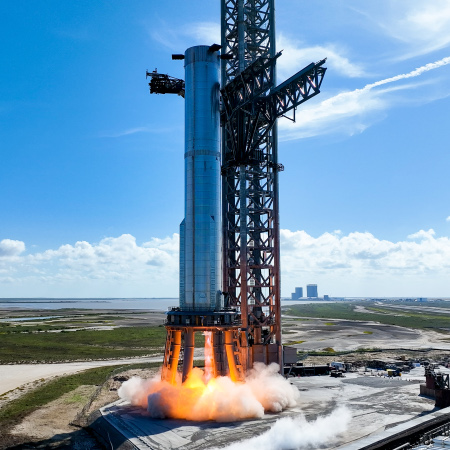
Superheavy #7's first launchpad engine test
Click for original photo.

Capitalism in space: SpaceX engineers yesterday performed static fire tests of both its Superheavy prototype #7 and its Starship prototype #24.

The Superheavy prototype fired one engine, and did so only a few weeks after that prototype experienced an explosive event the launchpad during earlier fueling/engine tests. Yesterday’s engine test was the first time any Superheavy prototype had fired its engines on the launchpad.

The Starship prototype meanwhile fired two engines on a nearby vertical test stand.

SpaceX’s plan is to stack #24 on top of #7 and attempt an orbital launch test that will have the Superheavy prototype land in the Gulf of Mexico while the Starship prototype reaches orbit and then returns to Earth in the Pacific northeast of Hawaii. Based on the company’s normal pace of operations, that flight is probably only weeks away. However, before that flight engineers will have to do a full static fire test of all 33 of #7 engines, and then like do it again with Starship #24 stacked on top.

13 comments

SpaceX successfully launches 52 more Starlink satellites

Capitalism in space: SpaceX tonight successfully used its Falcon 9 rocket to launch another 52 Starlink satellites into orbit.

The first stage completed its third flight, landing successfully on a drone ship in the Atlantic Ocean. The fairings also completed their third flight.

The leaders in the 2022 launch race:

35 SpaceX
29 China
11 Russia
6 Rocket Lab
5 ULA

American private enterprise now leads China 50 to 29 in the national rankings, and the entire world combined 50 to 37.

1 comment

Rocket Lab considering further targets for in-space Photon upper stage

Capitalism in space: As noted during a speech yesterday by CEO Peter Beck, Rocket Lab is considering further interplanetary targets for its still functioning Photon upper stage, that helped launch NASA’s CAPSTONE mission toward the Moon.

Rocket Lab is continuing to operate Lunar Photon more than a month after it deployed CAPSTONE. The spacecraft is currently about 1.3 million kilometers from Earth, he said, and will swing back to Earth later in the month.

The spacecraft still has 10-15% of its propellant remaining. “As it scoots past Earth,” Beck said, “we’ll have a crack at doing something cool with it and see how far into the solar system we can get with it.”

Rocket Lab hopes to use a future Photon stage to send a probe to Venus, and is using the Photon in space now for engineering tests. It is also selling this technology as a viable cheaper alternative to the typically expensive interplanetary probes.

8 comments
1 143 144 145 146 147 411