Medical issue forces NASA to postpone spacewalk and consider an early crew return

An unspecified medical issue by one crew member on ISS last night forced NASA to postpone a planned spacewalk — even as the astronauts were suiting up — and consider bringing the crew back early.

The agency is monitoring a medical concern with a crew member that arose Wednesday afternoon aboard the orbital complex. Due to medical privacy, it is not appropriate for NASA to share more details about the crew member. The situation is stable.

At this moment, we know nothing more, including the name of the astronaut with the problem. Though the crew member is “stable,” it does appear the condition is serious, as it apparently developed quite abruptly, based on the public communications feed.

In a brief space-to-ground radio exchange just after 2:30 p.m. EST, Yui called mission control in Houston and asked for a private medical conference, or PMC. Mission control replied that a PMC, using a private radio channel, would be set up momentarily. Yui then asked if a flight surgeon was available and if flight controllers had a live camera view from inside the station.

“Houston, do we still have, like, a camera view in Node 2, uh, 3, lab?” Yui asked.

“We don’t have any internal cameras right now, but we can put the lab view in if you’d like,” the mission control communicator replied.

“I appreciate that,” Yui replied. He then asked: “Do you have like a crew surgeon? … A flight surgeon?”

No additional exchanges were heard. Later Wednesday, NASA’s space station audio stream, normally carried live around-the-clock on YouTube, went silent without explanation.

Though NASA has never had to return a crew early due to an emergency medical situation, the Russians in the Soviet era did so twice. In 1976 on the Salyut 5 station the crew couldn’t get along, with one member becoming paranoid and both claiming (falsely) that the station’s atmosphere was becoming unbreathable. The crew came home early, but the next crew found nothing wrong with the station.

Then during a mission in 1985 mission to the Salyut-7 space station, one astronaut developed a prostate condition that also cancelled a spacewalk and eventually required an early return to Earth.

26 comments

NASA: The leak in the Zvezda module on ISS has apparently been sealed

According to one NASA official, the leaks in the Zvezda module on ISS that have been on-going for more than five years have apparently all been sealed.

However, recently two sources indicated that the leaks have stopped. And NASA has now confirmed this. “Following additional inspections and sealing activities, the pressure in the transfer tunnel attached to the Zvezda Service Module of the International Space Station, known as the PrK, is holding steady in a stable configuration,” a space agency spokesman, Josh Finch, told Ars. “NASA and Roscosmos continue to monitor and investigate the previously observed cracks for any future changes that may occur.”

While good news, no one should feel sanguine. The leaks occurred because the hull of Zvezda has developed stress fractures, due to age (more than a quarter century in orbit) and the repeated dockings to its aft port. Future fractures and leaks are still possible, with the chance of a catastrophic failure very possible.

It would be prudent for NASA to continue to shut the hatch between the U.S. and Russian halves of the station, whenever a docking is taking place.

14 comments

ESA cancels call for commercial cargo services to ISS

European Space Agency logo

In what might be a larger decision by the European Space Agency (ESA) to pull back from support to ISS, the agency has cancelled a call for proposals that asked private commercial startups to provide cargo to ISS.

On 3 October, ESA published a call for proposals under its CSOC Cargo Commercially Procured Offset (3CPO) initiative, seeking commercial transport services to the ISS to deliver between 4,900 and 5,000 kilograms of pressurised cargo to the orbiting laboratory. According to the call, the mission was intended to act as a “strategic offset’ to secure flight opportunities for ESA astronauts. It did, however, stipulate that the prospective procurement would only proceed if member states agreed to fund the initiative at the agency’s Ministerial Council meeting on 26 and 27 November 2025.

Following the late November meeting, ESA announced that member states had “agreed to implement short-term actions to guarantee European astronauts’ access to the International Space Station until its planned end of exploitation in 2030.” While this initially appeared to signal a favourable decision on the 3CPO initiative, the agency formally cancelled the call on 17 December, citing “the implementation of programmatic adjustments.”

What makes me speculate that this decision is part of a larger strategy to pull back from ISS is based on other statements by ESA officials cited in the article. It appears ESA is also delaying the mission of one astronaut to ISS that had originally been planned for ’26, possibly by as much as two years.

Though that official said ESA had fully funded its commitments to ISS at its recently concluded ministerial council meetings, both of the above decisions suggest it is shifting its support elsewhere. It could very well be that ESA is beginning the process of transferring its support from ISS to the new commercial private stations, most especially Starlab, which it already has signed a partnership agreement. By delaying funding to ISS, it reserves that money for later use at the new stations.

1 comment

Three astronauts return from ISS in Soyuz capsule

Early today one American and two Russians safely returned to Earth, their Soyuz capsule touching down on the plains of Kazakhstan after spending more than eight months on ISS.

NASA astronaut Jonny Kim returned to Earth on Tuesday alongside Roscosmos cosmonauts Sergey Ryzhikov and Alexey Zubritsky, wrapping up an eight-month science mission aboard the International Space Station to benefit life on Earth and future space exploration. They made a safe, parachute-assisted landing at 12:03 a.m. EST (10:03 a.m. local time), southeast of Dzhezkazgan, Kazakhstan, after departing the space station at 8:41 p.m. on Dec. 8, aboard the Soyuz MS-27 spacecraft.

Over the course of 245 days in space, the crew orbited Earth 3,920 times, traveling nearly 104 million miles. They launched to the space station on April 8. This mission marked the first spaceflight for both Kim and Zubritsky, while Ryzhikov completed his third journey to space, logging a total of 603 days in space.

There remains on ISS one Soyuz, with its crew of three, with a planned return in July 2026. Getting its replacement crew launched however remains an unknown right now because of the damage to the Soyuz-2 rocket launchpad in Baikonur that occurred when they were launched two weeks ago. Roscosmos has provided no public updates about its plans to fix the pad or replace it, and until such plans are revealed, the Russians have no ability to launch any further manned missions.

This is why I speculated earlier that the present Soyuz crew might be starting an extended mission, awaiting repairs to the launchpad.

3 comments

Russian astronaut kicked out of the U.S. for stealing proprietary SpaceX designs

A Russian astronaut scheduled to fly on the next upcoming Dragon mission to ISS as part of the barter agreement between NASA and Roscosmos, has been removed from that mission after being caught taking pictures of SpaceX equipment in violation of State Department ITAR regulations.

Russian cosmonaut Oleg Artemyev has been removed from the prime crew of SpaceX’s Crew-12 mission to the International Space Station and replaced by fellow Roscosmos cosmonaut Andrey Fedyaev after sources alleged he photographed confidential SpaceX materials in California in violation of US export control rules, according to The Insider on December 2.

The outlet reported that Trishkin also said NASA did not want the controversy around Artemyev to become public, while Artemyev was removed from training at SpaceX’s Hawthorne California, facility last week after allegedly photographing SpaceX engines and other internal materials on his phone and taking them off-site.

The sources for this story all come from within Russia but it appears the story is true. It now appears that when the next manned Dragon launches to ISS in February, Fedyaev will fly instead of Artemyev.

The irony of this is that Russia doesn’t really have the capability of developing a comparable SpaceX rocket using this information. If anything, it would be more likely for Russia to sell the information to China in exchange for military hardware it could use in the Ukraine.

Either way, this violation by Artemyev of ITAR does not speak well for the future of the U.S./Russian partnership in space. It will certainly continue until ISS is retired, but this incident cements the likelihood that it will then end. None of the American commercial stations have shown any interest in signing agreemennts with Russia, though they all have signed numerous international deals, some with former Soviet bloc nations and even former Soviet provinces. After ISS Russia will be on its own.

And based on its inability to develop anything new in the past three decades, don’t expect much from it in space.

15 comments

All eight ports on ISS occupied for the first time; Longest manned mission about to start?

ISS as presently configured
ISS as presently configured. Click for original.

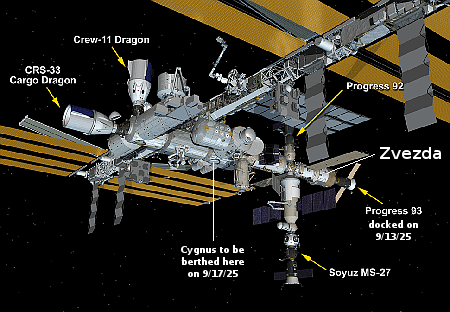
For the first time in its more than quarter century history, all eight docking ports on ISS are occupied, as shown in the graphic to the right.

For the first time in International Space Station history, all eight docking ports aboard the orbital outpost are occupied following the reinstallation of Northrop Grumman’s Cygnus XL cargo spacecraft to the Earth-facing port of the station’s Unity module. The eight spacecraft attached to the complex are: two SpaceX Dragons, Cygnus XL, JAXA’s (Japan Aerospace Exploration Agency) HTV-X1, two Roscosmos Soyuz crew spacecraft, and two Progress cargo ships.

This milestone follows the reattachment of the Cygnus XL spacecraft, supporting the Northrop Grumman-23 commercial resupply services mission for NASA, which was removed last week by the robotics officer at the agency’s Mission Control Center in Houston using the space station’s Canadarm2 robotic arm. The Cygnus XL movement was coordinated between NASA, Northrop Grumman, and Roscosmos to provide appropriate clearance for the arriving crewed Soyuz MS-28 spacecraft on Nov. 27.

Cygnus will remain attached to the orbiting laboratory until no earlier than March 2026, when it is scheduled to safely depart and dispose of up to 11,000 pounds of trash and unneeded cargo when it harmlessly burns up in Earth’s atmosphere.

This situation will not last of course, and in fact it may never happen again before the station is retired around 2030. First, Cygnus will leave in March. Second, one Russian Soyuz capsule will leave shortly, as the presence of two simply indicates a crew rotation is underway.

Third, it is presently unclear when the Russians will be able to launch further Soyuz or Progress capsules. » Read more

11 comments

Moss placed on the outside of ISS for nine months was still capable of reproducing

Graphic from research paper
Graphic from paper.

Scientists have now demonstrated that moss, a bryophyte, can still reproduce despite spending nine months exposed to the harsh vacuum and radiation environment of space on the outside of ISS.

In fact, the researchers found that more than 80% of the spores survived and were able to germinate. You can read their peer-reviewed paper here [pdf].

That the moss could survive is in itself not as surprising as you might think. When the Apollo 12 astronauts brought back pieces from the unmanned Surveyor-3 lander scientists found a single bacterium that survived in space for more than two years. What makes this new result more significant is that moss isn’t simply bacteria, but plant life far more complex. More important, the results found that the moss was far more tolerant of that harsh environment than other lifeforms. From the paper:

In contrast, desiccation-tolerant animals such as tardigrades (Hypsibius dujardini and Ramazzottius varieornatus) and UV-resistant insects’ hydrated larvae undergoing anhydrobiosis (Polypedilum vanderplanki) failed to match the UVC tolerance observed in P. patens spores. Similarly, spores of bacteria and fungi, such as Bacillus subtilis and Aspergillus niger, showed only limited UVC resistance. Thus, these patterns highlight that certain plant structures, namely spores and seeds, tend to exhibit superior UV resistance, likely due to the presence of specialized UV-screening pigments such as flavonoids and carotenoids, which help protect DNA and cellular structures from UV-induced damage.

As the paper notes in its conclusion:

As pioneer plants, bryophytes have the potential to transform regolith into fertile soil, facilitating ecosystem development on other planets, similar to peat moss improving soil fertility on Earth.

That moss isn’t bother significantly by radiation means any greenhouse on Mars need not be shielded as aggressively as previously thought, at least in the initial stages.

5 comments

Update on Vast’s first planned space station, Haven-1

Haven-2
Haven-2 station once completed

Link here. The article essentially puts together a number of X links that Jay has provided Behind the Black previously in his daily Quick Space Links reports to provide an overall picture. Two aspects stand out however.

One, the demo Vast launched this weekend on SpaceX’s bandwagon mission is expected to fly for about six months, and has successfully deployed its solar panels. During its flight the company will “test out key capabilities, such as Reaction Control Systems (RCS), power systems, and propulsion, in preparation for Haven-1”, which it hopes to launch in the spring.

Two, Haven-1’s planned mission remains unchanged. The company still intends to fly four crewed missions to it during its three-year mission, though who will make-up the crew and passengers remains unknown. This single module station is aimed at proving Vast’s capabilities at space station design and operation to convince NASA to award it a much larger contract to build its much larger Haven-2 multi-module station.

Max Haot [Vast’s CEO] described Haven-1 as the “minimum viable product”. With its one docking port and reliance on a SpaceX Crew Dragon for key life support systems, the station will enable the company to test out capabilities needed for larger stations in the future. The Dragon spacecraft requires a daily change of its CO2 scrubber; therefore, the station will launch with the necessary amount needed for 30-40 days on station for four astronauts.

All in all, Vast appears to be strongly demonstrating its capabilities, on schedule, making my listing it number one as most likely to win that big NASA contract increasingly correct. That ranking is made even more reasonable with the decision by NASA to now award several of those contracts, at smaller amounts, in a step-by-step process that matches milestones. Below is my updated rankings of the four commercial stations under development:
» Read more

0 comments

ISS study suggests that weightlessness impacts the eyes of men more than women

Eye flattening while in space
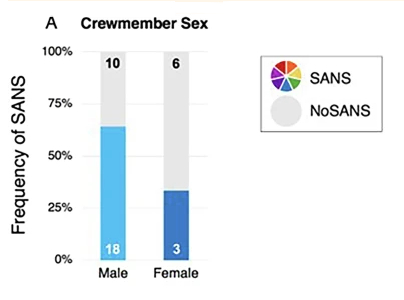
Astronauts who experienced changes in their
eyes (SANS) while on long missions in space

The uncertainty of science: A recent study of 30 astronauts during long term stays on ISS suggests that weightlessness impacts the shape of the eyes more in men than in women.

You can read the paper here.

In addition to changes in fluid around the brain, the team also found that a form of eye compression, a hallmark of Spaceflight Associated Neuro-ocular Syndrome known as globe flattening, was the most consistent eye change among crew members. “By far the most prevalent sign of eye changes that we observed was globe flattening, suggesting that this should be the primary monitoring target for ocular health,” Seidler said. “Interestingly, eye changes were more prevalent in males than females.”

Globe flattening, when the back of the eyeball becomes slightly indented or pushed inward, might sound minor, but it can have significant effects on vision and raise concerns for long-duration space missions.

Surprisingly, there was no strong link between brain structural changes and eye changes, suggesting that the effects on the eyes and brain may arise from distinct mechanisms rather than shared physiological cause

For the eye research, the sample was so small, 28 individuals of which only 9 were females, the researchers readily admit in their abstract that and “interpretation of these findings should be tempered by the fact that our sample included a relatively small number of females.” Nonetheless, the research did suggest that, regardless of sex, about half of all humans will experience these eye issues during long missions in weightlessness.

The results underscore the need to do artificial gravity experiments in orbit, to find out the minimum amount of gravity needed to mitigate or even eliminate these health issues. Otherwise, interplanetary travel is going to be seriously hampered, if not impossible.

4 comments

Roscosmos forced to replace next manned Soyuz capsule due to damage during test

Russia’s space agency Roscosmos has replaced the Soyuz capsule it was going to use in the next manned mission to ISS, scheduled for launch in late November, because of “major damage” the capsule experienced during normal pre-flight testing.

[D]uring routine post-production tests at ZEM’s Checkout and Test Facility, KIS, Vehicle No. 759 reportedly suffered major damage to its thermal protection system, which could not be repaired in time for the Expedition 74 launch at the end of 2025. According to one source, quoting an officer within the military certification service, Voennaya Priemka, which traditionally oversees quality control in the Russian rocket and space industry, the ship’s main thermal control heat shield, attached to the base of the Descent Module, was accidentally jettisoned, perhaps by a stray signal triggering the pyrotechnic bolts, connecting the Frisbee-shaped structure to the capsule. According to another source, the thermal layers of the shield peeled off, as a result of botched thermal tests.

That Russia can quickly swap capsules this late in the game speaks well of its Soyuz capsule manufacturing process. It doesn’t just build one or two capsules, it has an assembly line.

That the capsule was damaged during the test however once again raises questions about the overall quality control within the Russian space industry, as well as the reliability of its workforce. It has been building Soyuz capsules now for more than a half century, during which it has steadily implemented upgrades along the way. For there to be “a stray signal triggering the pyrotechnic bolts” during routine testing is disturbing. The circumstances are too similar to the earlier sabotage to both Progress and Soyuz capsules, where the evidence suggested someone on the ground had drilled holes in their hulls prior to launch, then patched them to hide their existence until later while in orbit.

Under Putin the living wages of Russian engineers has suffered. It remains a distinct possibility that there are more than a few malcontents within Roscosmos willing to do such stuff. That Roscosmos investigated the previous sabotage, claimed it identified the cause, but refused to release any information about its conclusions, suggests strongly that this is what what happened in those earlier cases. This new incident in turn raises the possibility now of further sabotage.

It once again is critical that the U.S. get out of its space station partnership with Russia as soon as possible. There are too many known and unknown risks.

1 comment

Japan launches a new upgraded version of its HTV cargo freighter

Japan today (October 26th in Japan) successfully launched to ISS a new upgraded version of its HTV cargo freighter, its H3 rocket lifting off from its Tanegashima spaceport in southern Japan.

The HTV-X1 carries more than freight. After its cargo is unloaded at ISS it will spend an additional three months flying independently in orbit, where engineers will conduct three additional experiments. JAXA, Japan’s space agency, hopes it can market HTV-X1 for use by the commercial space stations presently being developed. It is also marketing it as a potential orbital capsule that others can use for in-space manufacturing.

This was only the third launch by Japan in 2025, so there is no change to the 2025 leader board:

138 SpaceX
64 China
13 Russia
13 Rocket Lab

SpaceX now leads the rest of the world in successful launches, 138 to 106.

19 comments

Inspector General: The state of NASA’s spacesuits on ISS is becoming critical

NASA's failed spacesuit
NASA’s failed Moon spacesuits

A new NASA inspector report issued today [pdf] has found that the single contractor NASA uses to maintain the spacesuits on ISS, Collins Aerospace, has increasingly been unable to do the job, and NASA has no alternative contractor to turn to. From the report’s executive summary:

We previously reported on NASA’s spacesuit management in 2017 and 2021, finding that the Agency faced a wide array of risks to sustaining the EMUs [the spacesuits], including design inadequacies, health risks, and low inventories of spacesuit life support systems, ultimately leading to NASA’s efforts to design and develop next-generation suits to replace the existing EMUs. Specifically, the EMU design flaws have increased the chance of and led to unexpected water in helmets, thermal regulation malfunctions, and astronaut injuries. Given that spacesuits are necessary to meet future ISS maintenance needs until its planned decommissioning in 2030, it is critical that NASA effectively manages the contract performance and subsequent safety risks associated with ESOC [the contract with Collins].

…Until the ISS’s planned decommission at the end of the decade, NASA will continue to require spacewalking capabilities to perform upgrades and corrective and preventative maintenance to the Station. However, Collins’ performance on ESOC increases programmatic risks to NASA as it attempts to conduct safe spacewalks outside the ISS and maintain critical EMU life support component inventories. The contractor is experiencing considerable schedule delays, cost overruns, and quality issues that significantly increase the risk to maintaining NASA’s spacewalking capability.

Collins was awarded this five-year cost-plus maintenance contract in 2010 for $324 million. Since then NASA has been repeatedly extending it, so that it now runs through 2027 and has funneled $1.4 billion into Collins’ bank account. Yet Collins has repeatedly failed to deliver necessary repair parts, even as there have been more frequent problems on ISS, including several cases where spacewalks had to be aborted because an astronaut’s life was in danger. Here are just a few examples cited in the report:
» Read more

10 comments
1 2 3 4 5 124