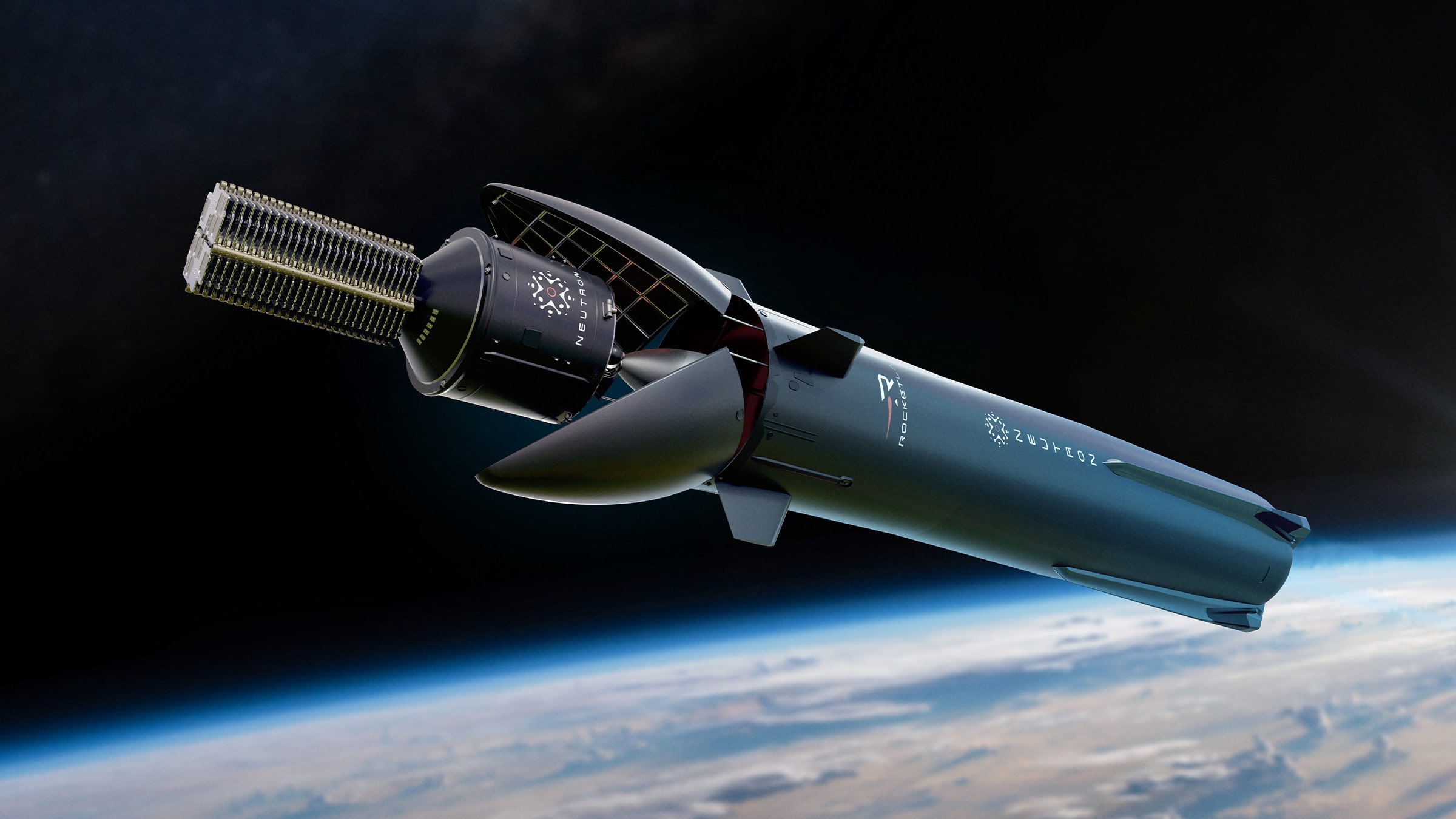
First launch of Rocket Lab’s Neutron rocket delayed until 2026
Artist's rendering of the Neutron first stage deploying its second stage
Artist’s rendering of Neutron’s first stage fairings opening
to deploy the payload with the second stage engine.

Despite a concerted effort in the past year to achieve the first launch of its new reusable larger Neutron rocket before the end of 2025, Rocket Lab this week revealed that the company is now targeting a 2026 launch instead.

Sir Peter Beck, the CEO of Rocket Lab, announced the shift in plans during the third quarter earnings call with investors on Nov. 10. He said that the company’s goal is to get the rocket out to Launch Complex 3 at the Virginia Spaceport Authority’s (VSA) Mid-Atlantic Regional Spaceport (MARS) within the first quarter of 2026 “with first launch thereafter.”

“As always, this is a rocket program that’s been completed at a pace and a cost that nobody has achieved before and the financial and long-term impacts are insignificant to take a little bit more time to get it right,” Beck told investors on the call.

During the call officials also made clear that there would be no attempt to recover the first stage on that first flight, as the landing barge won’t be ready by then. It hopes a landing attempt will occur on the second flight.

Finally, officials revealed that the company has spent a bit more to develop Neutron then the originally planned cost of between $250 to $300 million. Right now it expects to spend about $360 million by the end of 2025.

This delay or the increased cost are relatively inconsequential when looked at in context. Rocket Lab had only started this project in 2021. To create a new rocket in less than five years for only about a quarter of a billion dollars is quite unprecedented.

Rocket Lab to unveil its completed Neutron launchpad by end of August

As part of a series of press releases in connection with the release of Rocket Lab’s second quarter financial report, the company announced that it is inviting shareholders to enter a sweepstakes for attending the official opening of its just completed launchpad at Wallops Island for its new Neutron rocket.

According to the announcement, the opening is scheduled for August 28, 2025.

Rocket Lab will randomly select ten (10) eligible entrants to win admission to the event. Eligible entrants are limited to U.S. citizens who are at least 18 years old and shareholders of Rocket Lab. Winners are responsible for their own travel and accommodation costs, and any other costs and expenses associated with traveling to and attending the event

The sweepstakes is a fun idea, but what is really significant is that the company appears to be continuing to meet its schedule for a first launch of Neutron before the end of 2025. If so it will be a major achievement, considering the company began work on this rocket in December 2021. To go from a blank sheet to launch in only four years is unprecedented. Normally it takes about twice as long to get a rocket to the launchpad.

Even if the launch date slips into the first quarter of 2026 the achievement will be spectacular.

Rocket Lab’s 2nd quarter financial report appears bright as well, noting a 36% increase in revenues from the previous year. While its rocket division continues to ramp up launches, the company has also done well diversifying into other space areas, from low Earth orbital constellations to deep space technology.

Rocket Lab’s new Neutron rocket faces red tape delays at Wallops

Proposed dredged channel
Proposed dredged channel. Click for original.

We’re here to help you! Rocket Lab appears to be having regulatory problems getting approvals to transport hardware for its new Neutron rocket to its new launchpad at the Mid-Atlantic Regional Spaceport (MARS) on Wallops Island in Virginia, delays that might prevent it from launching as planned later this year.

It appears the company needs to dredge a deeper channel to ship the heavier Neutron hardware into Wallops, but it has not been able to begin work because of approval delays by the federal government.

The dredging project was approved by VMRC [Virginia Marine Resources Commission] in May, but the company has yet to start digging because it’s still awaiting federal sign-off from the Army Corps of Engineers.

Lacking this approval and unable to get the channel ready for this year’s launch, the company is seeking permission to use a stop-gap different approach to transport the hardware through these shallow waters.

Kedging, a little-known nautical method, is used to ensure the barges can safely navigate the existing shallow channel. Workers would use a series of anchors and lines to steer the barge through the shallow waters. The company is seeking permission to use this method through the end of June 2026 or until the dredging work is complete, whichever comes first.

Lacking an okay to do even this alternative approach, Rocket Lab will be forced to transport the hardware using “ramps and cranes,” an approach that is impractical in the long run for achieving a profitable launch pace. It also would likely result in not meeting its targeted launch date before the end of 2025 for the first Neutron launch.

Rocket Lab’s as-yet unlaunched new Neutron rocket gets military contract

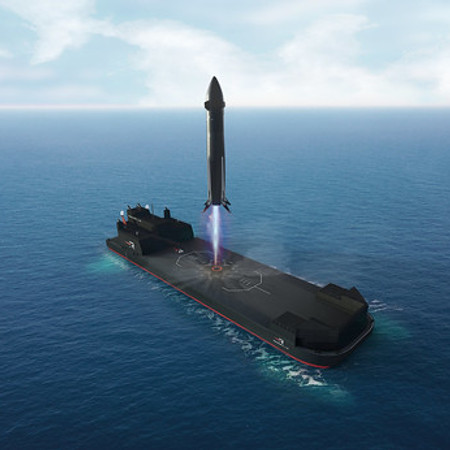
Neutron landing platform
Graphic showing Neutron landing on Rocket Lab’s
barge

Capitalism in space: Rocket Lab has won a contract from the Air Force to test the use of its new Neutron rocket for tranporting cargo quickly across the globe, despite the fact that the rocket won’t make its first launch until later this year, at the earliest.

The mission, slated for no earlier than 2026, will fall under the Air Force Research Laboratory’s (AFRL) “rocket cargo” program, which explores how commercial launch vehicles might one day deliver materiel to any point on Earth within hours—a vision akin to airlift logistics via spaceflight.

…The cargo test would be a “survivability experiment.” Neutron is expected to carry a payload that will re-enter Earth’s atmosphere, demonstrating the rocket’s ability to safely transport and deploy cargo.

Neutron is designed to bring its first stage back to a vertical landing on Earth for re-use, similar to what SpaceX does with its Falcon 9. Unlike the Falcon 9, however, Neutron’s fairings remain attached to the rocket, opening and closing like alligator jaws to deploy its satellite payloads. Since it brings the fairing back attached to the rocket and closed after satellite deployment, the plan will be to see if it can carry within this enclosed fairing this Air Force test payload and bring it back unscathed.

This contract suggests the military is very confident that Neutron will fly as planned, and will succeed in its early launches.

Rocket Lab unveils its modified barge its Neutron rocket will use for ocean landings

Neutron landing platform
Graphic showing the barge after modification
with Neutron landing

Rocket Lab today unveiled a modified barge that it will use as a drone ship for ocean landings of the first stage of its new Neutron rocket.

‘Return On Investment’ is a 400 ft (122 m) modified barge that will be customized to enable landings at sea for its reusable Neutron rocket. Modifications will include autonomous ground support equipment to capture and secure the landed Neutron, blast shielding to protect equipment during Neutron landings, and station-keeping thrusters for precise positioning. The Company has acquired the barge and construction of ‘Return On Investment’ will take place throughout 2025, with expectations of being ready to enter service in 2026.

The name appears to be a dig against the stock market analyst who gave the company a negative report a few days ago, predicting Neutron won’t launch for the first time in 2025 — as Rocket Lab continues to predict — but in 2026.

At the same time, not having the landing platform ready until 2026 means that the first few launches will have to attempt a return to land or that first launch is delayed to 2026.

Meanwhile, Rocket Lab’s just released quarterly report appears to defy that negative assessment as well.

Rocket Lab founder and CEO, Sir Peter Beck, said: “2024 was a record-setting year for Rocket Lab, with our highest annual revenue ever posted of $436.2 million and a record Q4 2024 revenue of $132.4 million – a 382% increase compared to Q4 2021, our first full quarter following our debut on the Nasdaq as a publicly-traded company. Top achievements across launch and space systems include a record number of 16 launches for Electron in 2024 (a 60% increase in launch cadence compared to 2023) and more than $450 million in newly-secured launch and space systems contracts.”

More and more it appears to me that this stock market analyst was simply attempting to lower the stock price so as to garner profits when the price rebounded back to its proper value.

Rocket Lab’s shares lose 10% because of a negative assessment by stock analyst

Because one stock market analyst, Bleeker Street Research (BS) this week issued a negative assessment of Rocket Lab’s schedule for launching its new Neutron rocket, the company’s shares have lost about 10% of their value in the past few days.

In the report, BSR opines that while Rocket Lab has captivated investors with the promise of Neutron, its research shows the promise is built on shaky ground.

BSR believes the Neutron launch won’t take place until mid-2026, and could be delayed until mid-2027. Engine development, structure production, Wallops Island in Virginia, USA, launch pad construction, and transporting Neutron to the site are all factors cited by BSR as driving the delay.

BSR also questioned whether Rocket Lab could get its launch price of $50-$55 million.

Delays in launching a new rocket are to be expected, though as of now Rocket Lab has not indicated any issues that would preclude their predicted first Neutron launch in 2025.

One wonders if this report is merely the typical price manipulation you see all the time from stock market honchos. Issue a negative report which causes the price to drop, and then use that drop to buy up shares at discount prices.

At the same time, the analysis could be correct, though it depends on unnamed sources.

Rocket Lab wins another multi-launch contract

Rocket Lab today announced it has won a four-launch contract with a Japanese company, the Institute for Q-shu Pioneers of Space, Inc. (iQPS), to launch its Earth-imaging satellites.

The multi-launch contract, signed in July 2024 [but apparently not publicly announced till now], includes three dedicated missions for launch in 2025 from Rocket Lab Launch Complex 1 in New Zealand, with a fourth launch scheduled for 2026. Each mission will carry a single satellite to form part of iQPS’ planned constellation of 36 synthetic aperture radar (SAR) satellites that are capable of collecting images through cloud and at night with a high resolution of less than a meter.

Rocket Lab previously completed one launch for iQPS in 2023, signing the contract and launching within four months.

Though the company has not yet announced officially the number of launches it hopes to fly in 2025, it appears the number will exceed the 14 orbital launches it completed in 2024. Before adding the three 2025 iQPS launches above, Rocket Lab had 18 Electron launches listed for 2025 at the rocketlaunch.live website, as well as the first launch of the company’s new Neutron rocket. Altogether that adds up to a total of 22 launches.

Rocket Lab announces first launch contract for its new Neutron rocket

Though the press release was lacking in many details, Rocket Lab yesterday announced the signing of its first launch contract for its new Neutron rocket, scheduled to make its first orbital test launch in 2025.

Under the contract, Rocket Lab will launch two dedicated missions on Neutron starting from mid-2026. The missions will launch from Rocket Lab Launch Complex 3 on Wallops Island, Virginia. The launch service agreement for these missions signifies the beginning of a productive collaboration that could see Neutron deploy the entire constellation.

The press release did not name the satellite constellation, or the company building it. Rocket Lab’s founder and CEO, Peter Beck, was quoted as follows: “Constellation companies and government satellite operators are desperate for a break in the launch monopoly.” [emphasis mine] That launch monopoly is clearly SpaceX, and Beck was positioning Rocket Lab with Neutron as the company to provide an alternative.

The announcement as well as the company’s third quarter report caused a 45% surge in its stock price.

Rocket Lab completes first static fire test of new more powerful rocket engine

Neutron first stage deploying second stage with satellite

Rocket Lab yesterday announced it has successfully completed the first static fire test of its new Archimedies rocket engine, designed to be used on its new larger Neutron rocket scheduled for launch next year.

Archimedes performed well and ticked off several key test objectives, including reaching 102% power, anchoring the engine’s design ahead of Neutron’s first flight scheduled for mid-2025 – a schedule that would make Neutron the fastest a commercially developed medium-class launch vehicle has been brought to market. With the hot fire complete and full qualification campaign now underway, the Rocket Lab team is moving into full production of flight engines.

The design of Neuton is clever, as shown in the graphic to the right. In order to reuse as much as possible, the fairing encloses both the payload and upper stage. Before stage separation, the fairing will open, allowing the upper stage and its payload to be deployed. Afterward it remains with the first stage, which will land vertically back at the launch site.

Rocket Lab delays first launch of new Neutron rocket

Rocket Lab has delayed the first launch of its new larger Neutron rocket from late 2024 to mid-2025 in order to complete the testing of that rocket’s new methane-fueled Archimedes engine.

Many component, subsystem, and all-up system tests will be conducted throughout the test campaign. These tests will validate Archimedes’ transient start-up, steady-state, and shut down performance. The engine test and development campaign is a key driver of the schedule for Neutron’s first launch, which the Company today confirmed is now expected to take place no earlier than mid-2025.

That testing will also certify it for use in as many as twenty flights, as the Neutron rocket is being designed from the get-go to be reusable.

Six launch companies give updates on the status of their rockets

Link here. The event was a panel at a conference where officials from SpaceX, ULA, Mitsubishi, Arianespace, Relativity, and Rocket Lab gave presentations.

Based on what is reported at the link, the Mitsubishi update was the most significant:

Mitsubishi Heavy Industries (MHI) successfully launched its H3 rocket Feb. 16 after the rocket’s inaugural launch failed nearly a year earlier, a setback that Iwao Igarashi, vice president and general manager at MHI, called a “nightmare.” “There were no major problems with the rocket” on its second flight, he said.

We will have to see. Though everything worked as planned on the second flight, the true test on whether Mitsubishi has overcome the issues from the first launch will be the rocket’s third launch, presently scheduled for sometime next year.

A Relativity official said their Terran-R rocket is still targeting a first launch in 2026, while Rocket Lab was hopeful that the first launch of its larger Neutron rocket would occur by the end of this year.

Rocket Lab revises design of its new Neutron rocket

Rocket Lab has revised the design of its new Neutron rocket, reducing the number of fairing shells from four to two, and shifting the location of the first stages fins.

One of the major changes shown is how the payload fairing operates. In prior concepts, the fairing was comprised of 4 quarters that opened outward to allow second stage and payload separation. The new design shows two halves of the fairing opening. Moving from four to two fairings will provide more reliability for the rocket and fewer moving parts.

Another change is a slight design to the forward strakes (fins) that help steer the rocket back to its landing site. Unlike SpaceX, which uses grid fins, the Neutron rocket will use fins that provide more lift and can return to the launch site from further downrange. The forward fins also appear to have moved further up on the rocket, and the fairing halves size made a bit smaller.

The landing legs have also been redesigned, apparently to more closely match the design used on SpaceX’s Falcon 9 rocket.

These are all relatively minor changes, none of which change the fundamental design that calls for the rocket to be almost entirely reusable.

Rocket Lab leases engine test facility at Stennis

Rocket Lab has finalized a 10-year lease for using one of the engine test facilities at NASA’s Stennis Space Center in Mississippi for developing the Archimedes rocket engine for its new Neutron rocket.

With the new agreement, the A-3 Test Stand and about 24 surrounding acres at Stennis will be incorporated into the Archimedes Test Complex. Archimedes is Rocket Lab’s new liquid oxygen and liquid methane rocket engine that will power its large, reusable Neutron rocket.

Rocket Lab will have exclusive access to use and develop the A-3 Test Stand area, including associated propellant barge docks and buildings. The initial 10-year agreement includes an option to extend an additional 10 years.

The Mississippi Development Authority is providing assistance for Rocket Lab to develop the new site and to relocate and install needed equipment.

With this agreement Rocket Lab is clearly moving forward aggressively in its project to build a new rocket that can complete head-to-head with SpaceX’s Falcon 9.

Rocket Lab gets contract with military to study point-to-point cargo transport

Capitalism in space: Rocket Lab yesterday revealed that the U.S. military has given it a contract to study whether its rockets could eventually be used for point-to-point cargo transport.

This study contract is similar to the one the military gave SpaceX for its Starship/Superheavy rocket. Both are intended not to actual fly missions, but to look at the engineering of the rockets to see if it will be practical to use them for point-to-point cargo transport on Earth.

The deal suggests the military has been impressed with Rocket Lab’s efforts to make its smallsat Electron rocket resusable, as well as its development program for its newer and larger Neutron resusable rocket.

Rocket Lab breaks ground on Neutron rocket factory

Capitalism in space: Rocket Lab yesterday broke ground on the construction of its larger proposed Neutron rocket factory at Wallops Island, Virginia, right next door to where the company plans to launch it.

The 250,000 square foot Neutron Production Complex is being constructed on a 28-acre site adjacent to the NASA Wallops Flight Facility and Mid-Atlantic Regional Spaceport on Virginia’s Eastern Shore. The complex will support Neutron production, assembly, and integration, and is expected to bring up to 250 highly-skilled roles to the region. Construction will also soon begin on a launch pad for Neutron at the southern end of Wallops Island, near Rocket Lab’s existing launch pad for the Electron rocket.

Neutron will largely reusable, its first stage returning to Earth for reuse, and carrying with it the skin of the second stage. The design combines this skin with the fairings that protect the payload and second stage engine, so that only the second stage engine is lost in orbit.

Rocket Lab to build new Neutron rocket at Wallops Island in Virginia

Capitalism in space: Rocket Lab announced yesterday that it will build the manufacturing factory for its new Neutron rocket at the Wallops Island in Virginia, close to the company’s launchpad there.

The complex will be home to a rocket production, assembly, and integration facility, as well as a dedicated launch pad for the Neutron rocket located on the southern end of Wallops Island. The estimated 250,000 square foot state-of-the-art complex will be constructed on a 28-acre site adjacent to the Wallops Island Flight Facility and will include a Launch Control Center, Rocket Lab’s fifth global operations center for launch activities and on-orbit operations. To support rapid production of the Neutron rocket, current plans for the complex include automated fiber placement robotic production systems capable of laying up meters of Neutron’s new, specially formulated carbon composite structures in minutes. As a reusable rocket, Neutron is designed to land back on the launch pad after a mission and from there it would be returned to the production complex for refurbishment and re-flight.

The Wallops Island spaceport hopes the state of Virginia will commit $45 million of its own money to this project, but that money still needs to be approved by the state’s legislature.

“Assuming that is done and blessed by the legislature, and we have no reason to believe it will not be, $15 million will go into construction for the facility, and the 30 million will be geared toward the construction of the new launch pad,” Mercer said, noting that the pad would be multi-purpose, not a Neutron exclusive.

Rocket Lab unveils its new big rocket, Neutron

Capitalism in space: In a video released today, Rocket Lab founder Peter Beck provided the major design details for the company’s new larger rocket, Neutron, planned for launch it appears sometime in the next two years.

I have embedded the video below the fold. The rocket has these innovations:

  • The landing legs do not deploy, but are permanently mounted around a relatively wide rocket base.
  • The fairings never release. They open like a clamshell to allow the upper stage and payload to exit as a unit, and then close and return with the first stage.
  • The rocket body will be made from carbon fiber, which Beck claims Rocket Lab can manufacture fast.
  • The first stage will always return to the launch site rather than land on a barge in the ocean.
  • The rocket’s engine, dubbed Archimedes, is expected to do first static tests in ’22.

It appears Beck is specifically disagreeing with some of SpaceX’s approach with this design, using carbon fiber instead of metal, and making the engine simple without pushing its power limits too hard.
» Read more

Rocket Lab to build new bigger rocket

Capitalism in space: As part of its announcement yesterday that Rocket Lab is going to become a publicly traded stock, the company also announced it is going to develop a new larger rocket, dubbed Neutron, to supplement its smaller Electron rocket.

The second link provides some additional details about Neutron.

Today, Monday, 1 March, the company revealed its “Neutron” rocket, a medium-class launch vehicle that can lift up to 8,000 kilograms (eight tonnes) into orbit, comparable to Russia’s Soyuz rocket. The two-stage vehicle will be 40 meters (131 feet) tall, more than double the company’s existing Electron rocket, which measures 18 meters (60 feet) tall and has so far flown 97 satellites across 18 launches.

They will design it to be human-rated from the start, and will also have the first stage land vertically using its engines so it can be reused. According to video from the company, they are aiming for a ’24 launch date.