Rosetta repositions to improve contact with Philae

Engineers have begun shifting Rosetta’s trajectory paralleling Comet 67P/C-G in order to maximize communications with the lander Philae.

Commands to adjust the trajectory were successfully uploaded Monday evening; further commands will be uplinked on Thursday evening. The spacecraft will perform two manoeuvres, one on Wednesday morning and the second on Saturday morning. The effect of the two ‘dog-leg’ burns will be to bring the orbiter to a distance of 180 km from the comet and to reproduce the orbiter-comet geometry of the first contact.

We should therefore not expect further news from Philae for the rest of this week.

0 comments

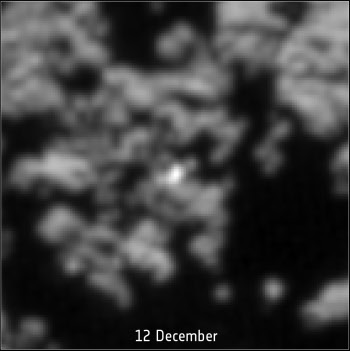
Is this Philae?

Philae?

Cool image time! The Rosetta science team has spent much effort trying to locate Philae, which attempted to land on Comet 67P/C-G in November. The image on the right shows what they think is their best candidate, the bright feature in the center. It was not there prior to Philae’s landing attempt.

Because there are many uncertainties, however, this might not be Philae.

Ultimately, a definitive identification of this or any other candidate as being Philae will require higher-resolution imaging, in turn meaning closer flybys. This may not be possible in the near-term, as issues encountered in navigating close to the comet mean that the opportunity to make flybys at significantly less than 20 km from the surface may be on hold until later in the mission. But after the comet’s activity has subsided, Rosetta should be able to safely operate in close proximity to the comet nucleus again.

The other possibility of further refining Philae’s location would come if the lander were to receive enough power to wake-up from its hibernation and resume its scientific study of 67P/C-G. Then, CONSERT could be used to perform additional ranging measurements and significantly reduce the uncertainties on the lander’s location. At the moment, Philae is still in hibernation, but the mission team remain hopeful that, as the comet moves closer to the Sun along its orbit, the lander will receive enough power in the coming weeks or months to wake up and transmit a signal to Rosetta.

0 comments

Rosetta team adopts new approach strategy

Because of the problems Rosetta experienced during its last close fly-by of Comet 67P/C-G the engineering team has worked out a new approach strategy for future observations.

Essentially, they are postponing any close fly-bys for the near future. Instead, they will observe from farther away, while reassessing the situation and planing for later opportunities.

Meanwhile, on April 12 the next opportunity to listen for Philae begins.

0 comments

Rosetta’s first attempt to contact Philae ends with no contact

After eight days of sending signals, listening for Philae, and getting no response, Rosetta has ceased its effort.

β€œIt was a very early attempt; we will repeat this process until we receive a response from Philae,” says DLR Project Manager Stephan Ulamec. β€œWe have to be patient.” On 20 March 2015 at 05:00 CET, the communication unit on the Rosetta orbiter was switched off. Now, the DLR team is calculating when the next favourable alignment between the orbiter and the lander will occur, and will then listen again for a signal from Philae. The next chance to receive a signal from the lander is expected to occur during the first half of April.

They always knew that it was unlikely for the lander to come alive this soon, but they tried anyway. The odds improve, however, in the coming months.

0 comments

New areas of Comet 67P/C-G come out of the shadows

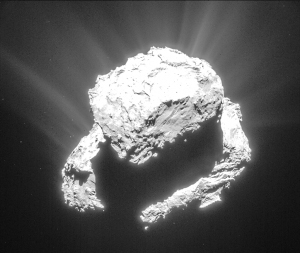
Comet 67P/C-G's smaller lobe

Rosetta has snapped a new image of Comet 67P/C-G’s smaller lobe that not only shows the increased activity around the nucleus but captures areas of the comet that had formally been in darkness. The image also includes the region where engineers think Philae landed, which I think is the area just below the brightest flat area in the center of the lobe. That this area is now in daylight is why engineers are hopeful that Philae might soon wake up.

0 comments

Monitoring for a signal from Philae to begin this week

Beginning on Thursday Rosetta engineers will start searching for a signal from their lander Philae, hidden somewhere on the surface of Comet 67P/C-G.

The likelihood of getting an answer this soon is not high, but the lander is now getting about twice as much sunlight as it did when it landed in November. There is a chance it will warm up enough and get enough stored power to come to life.

0 comments

Update on Philae on Comet 67P/C-G

The Rosetta team has provided a detailed update describing their so far unsuccessful search for Philae on the surface of Comet 67P/C-G.

In addition, the update also looks into the possibility that Philae might wake up in the late spring when the comet’s orbit and rotation changes enough so its solar panels are more exposed to the Sun.

Bottom line: Don’t expect them to find the lander from images. Right now it is a mere three pixels in size. And whether it will come back to life as well also remains unknown.

0 comments

Philae’s bouncing, tumbling landing sequence

Scientists and engineers have pieced together the bouncing and tumbling land sequence that Philae went through before it came to rest on Comet 67P/C-G, including the possibility that the second touch down was actually the spacecraft grazing a crater rim.

After the first touchdown, the spin rate started increasing. As the lander bounced off the surface, the control electronics of the flywheel were turned off and during the following 40 minutes of flight, the flywheel transferred its angular momentum to Philae. After this time, the lander was now spinning at a rate of about 1 rotation per 13 seconds;

At 16:20 GMT spacecraft time the lander is thought to have collided with a surface feature, a crater rim, for example. “It was not a touchdown like the first one, because there was no signature of a vertical deceleration due to a slight dipping of our magnetometer boom as measured during the first and also the final touchdown,” says Hans-Ulrich. β€œWe think that Philae probably touched a surface with one leg only – perhaps grazing a crater rim – and after that the lander was tumbling. We did not see a simple rotation about the lander’s z-axis anymore, it was a much more complex motion with a strong signal in the magnetic field measurement.”

Following this event, the main rotation period had decreased slightly to 1 rotation per 24 seconds. At 17:25:26 GMT Philae touched the surface again, initially with just one foot but then all three, giving the characteristic touchdown signal. At 17:31:17 GMT, after travelling probably a few more metres, Philae found its final parking position on three feet.

The search for the spacecraft itself, sitting on the surface, continues.

3 comments

Philae’s landing site dust-covered ice

Based on the data that Philae beamed down prior to going into hibernation, scientists believe the landing site on Comet 67P/C-G is made of a layer of dust 4 to 8 inches thick covering solid ice.

At Philae’s final landing spot, the MUPUS probe recorded a temperature of –153Β°C close to the floor of the lander’s balcony before it was deployed. Then, after deployment, the sensors near the tip cooled by about 10Β°C over a period of roughly half an hour. β€œWe think this is either due to radiative transfer of heat to the cold nearby wall seen in the CIVA images or because the probe had been pushed into a cold dust pile,” says JΓΆrg Knollenberg, instrument scientist for MUPUS at DLR.

The probe then started to hammer itself into the subsurface, but was unable to make more than a few millimetres of progress even at the highest power level of the hammer motor. β€œIf we compare the data with laboratory measurements, we think that the probe encountered a hard surface with strength comparable to that of solid ice,” says Tilman Spohn, principal investigator for MUPUS.

Looking at the results of the thermal mapper and the probe together, the team have made the preliminary assessment that the upper layers of the comet’s surface consist of dust of 10–20 cm thickness, overlaying mechanically strong ice or ice and dust mixtures.

In many ways, this result is a testament to the magnificence of science and the industrial revolution. The methods and technology that made it possible for scientists to predict the make up of comets (dirty snowballs) were developed in the period from the 16th to the 19th centuries, hundreds of years before it was even possible to see Comet 67P, no less land on it and sample its surface. And what do we find when we do land there? The data gathered beforehand from far away is confirmed, as precisely as one can imagine.

Update: Another of Philae’s instruments also detected organics on the surface, though the reports so far are very vague.

0 comments

Philae spotted before and after first bounce

A close review of a series of Rosetta images has identified Philae’s first landing site, as well as the spacecraft itself as it approached and bounced away.

The second link is especially amazing, as it includes a gif animation of the landing site, showing the before situation, the puff of dust just after impact, and then Philae drifting away with its shadow hitting the surface of the comet.

0 comments

Philae has gone to sleep

Despite several attempts to reposition the lander to get more sunlight to its solar panels, Philae went into hibernation on Saturday.

There is still a chance the lander will come back awake, but right now the Rosetta science team considers its mission complete. Meanwhile, Rosetta will continue its flight with Comet 67P/C-G, tracking it closely for the next year as it makes its next close approach to the sun.

6 comments

Drill baby drill!

Faced with a loss of power in Philae’s batteries due to a lack of sunlight, scientists plan to activate the lander’s drill today.

This action might push the lander off the surface again, but it also might move it into daylight. At the least it might get them some geological data.

If the reserve battery runs out of power and the spacecraft shuts down on Saturday, there is still a chance that it could come back to life at a later time, should Comet 67P/C-G’s position change enough to put its solar panels in daylight and it can charge its main battery.

0 comments

Engineers have until Saturday to reposition Philae before its batteries go dead

Sitting in the shade under a cliff and on its side, engineers have until Saturday to nudge it into brighter territory before Philae’s batteries go dead.

One of Philae’s major scientific goals is to analyse the comet for organic molecules. To do that, the lander must get samples from the comet into several different instruments, named Ptolemy, Cosac and Civa. There are two ways to do this: sniffing and drilling. Sniffing involves opening the instruments to allow molecules from the surface to drift inside. The instruments are already doing this and returning data.

Drilling is much riskier because it could make the lander topple over. Newton’s third law of motion says that for every action there is an equal and opposite reaction. In the minuscule gravity of the comet, any movement on Philae will cause motion. The drill turning one way will make Philae want to turn the other. Pushing down into the surface will push the lander off again. β€œWe don’t want to start drilling and end the mission,” said Bibring.

But the team has decided to operate another moving instrument, named Mupus, on Thursday evening. This could cause Philae to shift, but calculations show that it would be in a direction that could improve the amount of sunlight falling on the probe. A change in angle of only a few degrees could help. A new panoramic image will be taken after the Mupus deployment to see if there has been any movement.

2 comments

Philae’s status on the surface

European engineers have released an overall status update on Philae’s generally good condition after its landing on Comet 67P/C-G.

Later on 12 November, after analysing lander telemetry, the Lander Control Centre (in Cologne) and Philae Science, Operations and Navigation Centre (SONC, Toulouse) reported;There were three touchdowns at 15:34, 17:25 and 17:32 UTC; in other words, the lander bounced. The firing of the harpoons did not occur. The primary battery is working properly. The mass memory is working fine (all data acquired until lander loss of signal at 17:59 UTC were transmitted to the orbiter). Systems on board the lander recorded a rotation of the lander after the first touchdown. This is confirmed by ROMAP instrument data, which recorded a rotation around the Z-axis (vertical).

The lander did receive some power from the solar panels on Wall No. 2 (technical description of the lander’s solar walls here), but it appears that parts of the lander were in shadow during the time that last night’s surface telemetry were being transmitted.

An additional update here.

Philae is between a rock and a hard place. More specifically, it’s on its side, one leg sticking up in the air — and in the shadows of a looming crater wall a few meters away. Solar panels are receiving only about 1.5 hours of light a day, when the goal was for 6 or 7 hours per day to recharge the lander’s batteries. Drilling into the subsurface would have to wait until the very end of Philae’s 60 hours of battery life — for fear that it could upset the lander. Yet mission leaders were largely upbeat about being alive and doing science. Most of the lander’s 10 instruments were taking data, and engineers were exploring options to use the spring of the lander legs or other ground-poking instruments to jostle the lander into a more favorable position.

Even more here, including the first image from the surface.

1 comment

Philae might have bounced

Data from the Philae lander suggests that, when the spacecraft’s harpoons failed to fire, the probe might have bounced and then settled to the surface.

[T]elemetry from the craft suggested it might have drifted off the surface after landing and started to turn. This subsequently came to an end, which the German Space Agency official interpreted as a possible “second landing” on Comet 67P. This “bounce” was always a possibility, but had been made more likely by the failure of the harpoons to deploy, and the failure of a thruster intended to push the robot into the surface.

1 comment
1 2 3