
Portugal signs Artemis Accords

Portugal yesterday become the 60th nation to sign the Artemis Accords, according to an announcement posted by NASA administrator Isaacman on X.

In October 2025 a Latvia government report had indicated that it had signed the accords, making it the 60th nation in this American alliance, but Isaacman’s announcement did not include it.

Thus, Portugal is the 60th nation, with this the full and corrected list: Angola, Argentina, Armenia, Australia, Austria, Bahrain, Bangladesh, Belgium, Brazil, Bulgaria, Canada, Chile, Colombia, Cyprus, Czech Republic, Denmark, Dominican Republic, Ecuador, Estonia, Finland, France, Germany, Greece, Hungary, Iceland, India, Israel, Italy, Japan, Liechtenstein, Lithuania, Luxembourg, Malaysia, Mexico, the Netherlands, New Zealand, Nigeria, Norway, Panama, Peru, Poland, Portugal, Romania, Rwanda, Saudi Arabia, Senegal, Singapore, Slovakia, Slovenia, South Korea, Spain, Sweden, Switzerland, Thailand, the Philippines, the United Kingdom, the United Arab Emirates, the Ukraine, the United States and Uruguay.

I suspect Latvia will soon make it official, especially because its neighbors, Estonia and Lithuania, have already signed. These three former Soviet vassal states try to work together as this reduces the Russian threat.

Portugal’s signing means practically all of Europe is now on board.
South Korean rocket startup Innospace signs deal with Portugal’s Santa Maria spaceport

Santa Maria spaceport

The South Korean rocket startup Innospace, which just last month attempted its first launch out of Brazil, has now signed a deal to launch its rocket from Portugal’s proposed Santa Maria spaceport in the Azores, located about 900 miles west of the European mainland.

Through this agreement, INNOSPACE has secured priority and long-term access to the Malbusca Launch Center, located on Santa Maria Island in the Azores, Portugal, for a five-year period starting in 2026. The company plans to gradually establish key launch infrastructure required for initial operations, including launch pads, operations and control systems, and testing facilities, with the goal of conducting its first commercial launch in the fourth quarter of 2026.

Despite the launch failure last month, Innospace has been aggressive about obtaining agreements for launching its rockets from multiple locations. That first launch occurred at Brazil’s long unused Alcantera spaceport on its eastern coast, and the company will use it for its second launch attempt later this year. It has also signed agreements with two spaceports in Australia (Southern Launch and Equatorial Launch), though the latter spaceport is not yet operational and might never exist.

Portugal issues spaceport license to Santa Maria Island

Santa Maria spaceport

Portugal today issued a spaceport license to the Atlantic Spaceport Consortium (ASC) that wishes to build an orbital spaceport on the island of Santa Maria in the Azores, located about 900 miles west of the mainland.

On 13 August, ASC and the Portuguese Space Agency announced in a joint statement that the consortium had received a licence to operate a launch site on the island. The licence was issued by the country’s Autoridade Nacional de Comunicações (ANACOM), the entity acting as Portugal’s space authority. The licence is valid for five years and does not cover the launch operations themselves, which will be subject to a separate licensing process on a per-launch basis.

ASC has already conducted two demonstration suborbital launches there. In addition, it has signed a deal with the Polish rocket startup SpaceForest for additional suborbital launches.

This location is excellent for orbital launches, though getting rockets to it is an extra cost that will at least initially limit its appeal. Either way, it appears the Portuguese government does not wish to stand in the way of progress, and has been moving fast to clear away the red tape.

Polish rocket startup signs second spaceport deal this week

Santa Maria spaceport

The Polish rocket startup SpaceForest today announced that it has signed a deal to launch its Perun suborbital rocket with the Atlantic Spaceport Consortium that is developing a spaceport on the island of Santa Maria in the Atlantic.

The launch planned for early 2026 will allow for comprehensive testing of launch procedures and confirmation of the capabilities and compliance of the Polish platform for conducting space experiments and research outside Poland, fully aligned with international standards. The mission will also serve as an opportunity to verify the operation of the PERUN suborbital flight system under nominal mission parameters.

This is the second spaceport launch contract SpaceForest has signed this week, the first being with the Eurospaceport launch platform to be located in the North Sea. According to the press releases, the Santa Maria launch will likely occur first. SpaceForest has also signed an agreement to launch its rocket from Norway’s Andoya spaceport. All three contracts suggest the company is marketing its suborbital rocket to new proposed European spaceports as a way to demonstrate the spaceport’s viability as a launch location.

The Santa Maria spaceport was first proposed by the Atlantic Spaceport Consortium in August 2024, and has already done two suborbital test launches, both using what appeared to be large model rockets. This contract gives it is first customer.

Proposed commercial spaceport in Azores launches two suborbital demonstration rockets

Santa Maria spaceport

A spaceport startup, the Atlantic Spaceport Consortium (ASC), has successfully launched two small suborbital demonstration rockets from the island of Santa Maria in the Azores of Portugal, where it hopes to eventually establish a spaceport.

The first of the two flights was launched from a mobile platform at 13:04 UTC on 27 September. The rocket reached an altitude of 5,596 metres. The second was launched at 11:49 UTC on 28 September 2024. According to the company, the second launch ‘was not perfect,’ but it did not provide any further details on what occurred during the flight.

The rocket was developed and built by ASC, and was intended to demonstrate its own rocket capabilities as well as provide information to the Portuguese government for establishing its own regulatory guidelines, as per an agreement signed in August.

Portugal’s air traffic agency signs deal with company wishing to build spaceport in Azores

Santa Maria spaceport

Portugal’s air traffic agency, Portugal NAV, today signed an agreement with the spaceport company Atlantic Spaceport Consortium, to work out the details of placing a commercial spaceport on the island of Santa Maria in the Azores.

Under the cooperation agreement, the pair aim to define the guidelines that a future spaceport will need to adhere to when launching from Santa Maria. This includes defining exclusion zones, examining how to monitor and authorize launch activities, and studying under what conditions to impose partial or total launch restrictions for safety reasons.

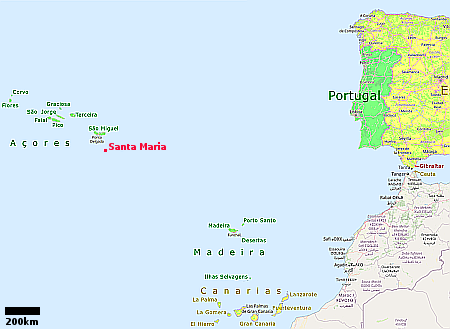
The map to the right shows the location of the island, relative to Europe and Africa. No timeliine for construction has been given, though the consortium hopes to launch “a small atmospheric rocket” in September. It has also signed a deal in 2022 (just before Russia’s invasion) with a Ukrainian rocket startup.

Ukrainian rocket company signs deal with Portuguese spaceport organization

Capitalism in space: Ukrainian startup rocket company Promin Aerospace has signed an agreement with the Atlantic Spaceport Consortium (ASC), a Portugal organization that is aimed at building launch facilities on Portuguese-controlled islands in the Atlantic.

Promin has raised $500K for what it claims will be “the smallest solid rocket capable of launching a payload into orbit.” ASC meanwhile is presently building a suborbital launch site in the Azores.

How much of this is real is entirely unknown. The reality of both appear to me to be somewhat nebulous. Nonetheless, if successful the partnership will put another new cheap orbital rocket as well as another spaceport on the map.

World’s longest pedestrian suspension bridge to open in ’21

A new tourist attraction, the world’s longest pedestrian suspension bridge, is set to open in Portugal next year.

At this length, the new bridge will be considered the longest pedestrian suspension bridge in the world, beating out the Charles Kuonen Suspension Bridge in Switzerland, which spans 1,621 feet and opened in 2017, according to The Sun. But it isn’t just long, it’s also situated 575 feet above the ground, connecting the Aguieiras Waterfall and Paiva Gorge.

I have embedded below the fold a video showing the bridge under construction. As the article notes, if you are afraid of heights this is not the tourist attraction for you.
» Read more