Patricia Neway – Climb Every Mountain
An evening pause: The Rodgers and Hammenstein song from The Sound of Music, performed live on the Ed Sullivan Show, 1959.
Makes an interesting contrast with yesterday’s pause.
Hat tip Diane Zimmerman.
An evening pause: The Rodgers and Hammenstein song from The Sound of Music, performed live on the Ed Sullivan Show, 1959.
Makes an interesting contrast with yesterday’s pause.
Hat tip Diane Zimmerman.
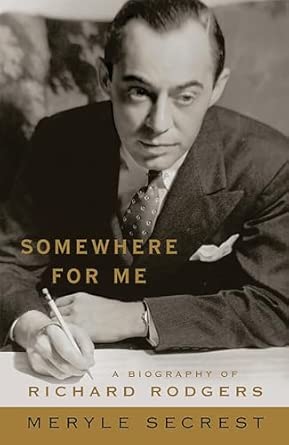
Sometimes in art there are times when culture, timing, talent, and teamwork combine to produce a magic that is eternal and beyond measure. For Richard Rodgers and Oscar Hammerstein, that time occurred from 1943 to 1959, when these two men created a string of musicals so grand that each
would become not just familiar but universally beloved, played over and over again until the words and melodies had become meshed, it seemed, with one’s very existence. To have one’s complete score memorized by a whole population would, it would seem for a composer, to have been all that life has to offer.
This quote comes from Meryle Secrest’s fine 2001 biography of Richard Rodgers, Somewhere for me: a biography of Richard Rodgers. It tells a story of a man who from childhood was obsessed with writing music, who struggled for decades to write musicals where the music and song flowed naturally from the plot and characters, and who changed with time as time changed him. Outside of his music and his commitment to it, he was however a very normal man, with a marriage that at times was stormy but held together despite those storms.
But it is Rodgers’ best music — written for the lovely words of Oscar Hammerstein — for which we most remember him. I grew up in the 1950s and 1960s, so I lived at a time when these Rodgers and Hammerstein musicals were being memorized by a whole population. As a child my parents subscribed to a musical record club, which sent them a new album every month. I would spend hours listening to the songs from Oklahoma, South Pacific, The Sound of Music, the King and I, and Carousel. And on television I got to see Julie Andrews in a live production of Cinderella.
In listening to these songs, I quickly realized, even as a child, that there was something deeply profound in those words and music, touching something deeper than mere beauty, a more fundamental but utterly inexplicable aspect of our existence. As I wrote in 2018 when I posted an evening pause of Juanita Hall singing Bali Ha’i from South Pacific,
» Read more
An evening pause: A nice cover of the Rogers & Hammerstein song from The Sound of Music (1965).
Hat tip Alton Blevins.
An evening pause: The Rogers & Hammerstein classic from the 1945 musical Carousel. Pop groups in the 1960s routinely covered classics like this, because they knew their music history, used it to influence their own work, and also wished to celebrate it.
Hat tip Diane Zimmerman.
An evening pause: From the movie The Sound of Music (1965), a song about teaching children to face fear, to push past it, and live boldly and with courage. And to do it with humor. As Ray Bradbury wrote in his book, Something Wicked This Way Comes, you defeat evil and fear by laughing at it. The world needs to recapture this idea, or else we are doomed.
Hat tip Tom Wilson.
An evening pause: From the 1958 movie of the great Rodgers & Hammerstein musical, South Pacific.
I first saw this movie as a child when I was around five years old. I didn’t understand the story really, and was especially puzzled by some lyrics, especially because my young mind took them very literally. (Just consider “I’m going wash that man right out of my hair!”)
What I do remember was that this song became one of my favorites throughout my early childhood. In hearing it recently again, I was struck by something I clearly remember, from that childhood. The song is about the draw of love and desire, which is what Bali Ha’i partly represents. However, Hammerstein’s lyrics refer to more, to the greater magic hidden in life everywhere, the mystery that lies behind the black, you might say. It is a theme he repeated in many of the songs he wrote for Richard Rodgers.
What struck me now was how I clearly remember, as a child of five, being very aware of this second somewhat sophisticated meaning. At first I was a little surprised that a child of five could comprehend such concepts, but then as Wordsworth wrote,
The Soul that rises with us, our life’s star,
Hath had elsewhere its setting,
And cometh from afar:
Not in entire forgetfulness,
and not in utter nakedness,
But trailing clouds of glory do we come
From God, who is our home:
Heaven lies about us in our infancy!
As a child I knew nothing of the sexual draw of Bali Ha’i, but I understood its mystical nature quite naturally. I have since spent my life trying to hold onto those “clouds of glory,” because they help connect us better to the enigma that is existence.
This version uses Juanita Hall’s own voice, from an earlier recording. For the movie they dubbed her singing because Rodgers no longer thought her aging voice sounded right.
An evening pause: From the live television premiere of Rodgers & Hammerstein’s Cinderella in 1957, their only musical written for television. Edith Adams plays the fairy godmother.
For the world is full of zanies and fools
Who don’t believe in sensible rules
And won’t believe what sensible people say
And because these daft and dewey-eyed dopes keep building up impossible hopes
Impossible things are happening every day!
I first posted this in 2011. Time to see it again.
An evening pause: This clip includes the scene that leads up to the song, and helps explain its dramatic context.
To be honest, this has never been one of my favorite Rodgers & Hammerstein songs. The musical, South Pacific, is magnificent, and has been featured before as an evening pause, but this song to me always seemed a bit preachy. It was written in the 1950s, however, and thus for its time was, as was the musical, important components of the civil rights movement that ended the bigoted discrimination against blacks in the United States.
I should add that as a child who loved this musical when I first heard and saw it in the early 1960s, I never understood what Nellie’s problem was. Why did it matter that the kids’ mother had been Polynesian?
Hat tip Edward Thelen.
An evening pause: From the 1955 movie, Oklahoma. This Broadway musical is one of the best examples of the fundamental differences between American culture and what preceded it. In the past, all music, drama, fiction, etc, revolved around telling the stories of the powerful, the nobility, the rulers, and the great. In the United States, “of the people, for the people, by the people,” literature, art, drama, and music has focused instead mostly on the lives and concerns of ordinary people. In this musical, for example, the story is about how two ordinary cowpokes decide to give up their roaming ways to settle down and become farmers, all for love. And in doing so, Rodgers and Hammerstein end up also telling the story of the American west as it transitioned from the wild west of gold rush boom towns and cattle drive cowboys into a settled society of cities and families.
And the music and choreography is great too!
Hat tip Edward Thelen.