Rocket Lab launches satellites for Japan’s space agency JAXA

Rocket Lab today successfully placed eight smallsats for Japan’s space agency JAXA, its Electron rocket lifting off from one of its two launchpads in New Zealand.

Because all of JAXA’s rockets are presently grounded due to technical failures, Japan’s space agency has had to turn to Rocket Lab. In fact, these eight satellites were originally supposed to launch on JAXA’s Epsilon-S rocket, which remains grounded after an explosion during a static fire test. There have been no updates on the status of Epsilon-S since December 2024.

Rocket Lab was also supposed to do a suborbital hypersonic test flight yesterday out of Wallops Island in Virginia, using the first stage of Election in its HASTE suborbital configuration. As this is a test for the War Department, little information is generally released. This video from a distance confirms the launch apparently took place, but whether it was a success or not remains unknown. That Rocket Lab’s announcers did not tout its success either before or after today’s JAXA launch — as they have routinely done in the past — suggests something might have gone wrong, though this too is pure speculation.

The leaders in the 2026 launch race:

48 SpaceX
21 China
6 Russia
6 Rocket Lab

For the third straight year SpaceX continues to lead the entire world combined in total launches, 48 to 38.

Rocket Lab launches GPS-type demo satellite for Europe

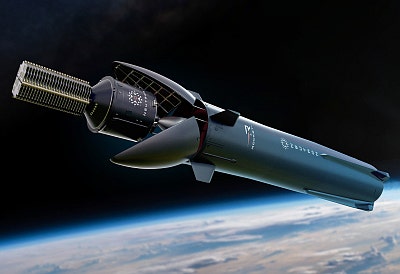
Rocket Lab this morning successfully placed a European Space Agency (ESA) smallsat into orbit, its Electron rocket lifting off from one of its two launchpads in New Zealand.

The smallsat, dubbed Celeste, is the first of two such demo satellites that ESA has contracted Rocket Lab to launch. They are designed to test a low Earth orbit constellation for providing global navigation and location information to users on the ground, similar to the U.S.’s GPS constellation. Celeste will work from low orbit with Europe’s medium orbit Galileo constellation, but being smaller will be cheaper and faster to build and launch.

The leaders in the 2026 launch race:

38 SpaceX
15 China
5 Rocket Lab
4 Russia

SpaceX continues to lead the entire world combined in total launches, as it did in both ’24 and ’25.

Two launches today by Rocket Lab and SpaceX

The launch pace continued today with two American commercial launches.

First Rocket Lab placed a Synspective radar satellite into orbit, its Electron rocket lifting off from one of its two launchpads in New Zealand. This was the company’s eighth launch for Synspective, out of a 27-launch contract.

Next, SpaceX placed 25 more Starlink satellites in orbit, its Falcon 9 rocket lifting off from Vandenberg Space Force Base in California. The first stage completed its fourth flight, landing on a drone ship in the Pacific.

The leaders in the 2026 launch race:

36 SpaceX
12 China
4 Rocket Lab
2 Russia

SpaceX continues to lead the entire world combined in total launches, as it did in both ’24 and ’25.

Rocket Lab wins $190 million hypersonic test contract from War Department

War Department logo

Rocket Lab yesterday announced it has won a $190 million contract from War Department to do another twenty suborbital test launches using its HASTE first stage version of its Electron rocket.

Rocket Lab Corporation … today announced the signing of its single largest launch agreement yet: a $190 million contract for a block buy of 20 hypersonic test flights with its HASTE launch vehicle for the Test Resource Management Center (TRMC) Multi-Service Advanced Capability Hypersonic Test Bed (MACH-TB) 2.0 program – a U.S. Department of War effort executed in partnership with Naval Surface Warfare Center Crane Division (NSWC Crane) to rapidly accelerate hypersonic flight tests and advanced aerospace technologies shaping the future of defense missions.

Under MACH-TB 2.0 Task Area 1, led by Kratos Defense & Security Solutions, Inc, Rocket Lab will perform 20 hypersonic test flights with its HASTE launch vehicle over a four-year period. The first of these 20 new missions is expected to take place within months of contract signing, demonstrating Rocket Lab’s operational efficiency and ability to move quickly to meet modern warfare demands.

This is the work that Stratolaunch had hoped to grab with its giant Roc airplane and Talon hypersonic test vehicle. Rocket Lab saw an opportunity and quickly reconfigured the first stage of its Electron rocket for the same work, dubbing this version HASTE. In the past three years both it and Stratolaunch have done hypersonic test flights, but Rocket Lab’s work has been more frequent and extensive, doing seven HASTE hypersonic launches to one test by Stratolaunch. That success apparently convinced the military to give Rocket Lab this larger new contract.

Rocket Lab completes another launch yesterday

Rocket Lab yesterday successfully placed a satellite into orbit, its Electron rocket lifting off from one of its two launchpads in New Zealand.

The company did not reveal the name of its customer, though according to this source the satellite was a Blacksky Earth imaging satellite, the fourth launch of a four-launch contract with that satellite company.

The 2026 launch race:

28 SpaceX
8 China
3 Rocket Lab
2 Russia
1 ULA
1 Europe (Arianespace)

Not only is SpaceX this year leading the entire world combined in total launches — as it did in both ’24 and ’25 — at the moment its pace is about twice as much as the rest of the globe.

Rocket Lab completes in-space commissioning of two Escapade Mars orbiters

Built by Rocket Lab for NASA and launched in November 2025, the company has now completed the in-space commissioning of two Escapade Mars orbiters and is about to hand operations over to the University of California Berkeley Space Sciences Laboratory (UC-Berkeley).

With both spacecraft now fully commissioned and successfully operating at the Earth–Sun Lagrange Point 2 (L2), Rocket Lab is preparing to hand over operational control to [UC-Berkeley], who will lead science operations at L2 and prepare the mission for its cruise to Mars.

Under contract from [UC-Berkeley], Rocket Lab was selected to design, build, and provide commissioning operations of the two high delta-V Explorer-class interplanetary spacecraft for ESCAPADE. Rocket Lab moved from concept to launch readiness in just over three years, proving commercial collaboration can deliver important science key to supporting future human and robotic exploration of Mars on ambitious schedules and for significantly smaller budgets than typical interplanetary missions. This speed was made possible through Rocket Lab’s vertically integrated spacecraft production, with key components including solar arrays, reaction wheels, propellant tanks, star trackers, radios, avionics, and flight software designed and built in-house.

Launched from Cape Canaveral Space Force Station in November 2025, the twin ESCAPADE spacecraft, known as Blue and Gold, completed spacecraft commissioning and executed two precise trajectory correction maneuvers, placing both spacecraft into their loiter trajectory near L2, approximately 1.5 million kilometers from Earth.

Both spacecraft will be sent on their way to Mars in December 2026 when orbital mechanics between the Red Planet and Earth are right for the journey. Once in Mars orbit the two orbiters will allow for a three-dimensional study of the interaction between the solar wind and Mars’ atmosphere.

Though this is a NASA-funded mission, note that it was built a commercial company and operated not by NASA but by a university. For this reason, it was not only built fast and at a low cost, it uses an innovative flight path that allowed it to be launched anytime and wait in orbit for the right moment to go to Mars. This last innovation provides for a lot more flexibility.

Rocket Lab completes another HASTE suborbital mission

Rocket Lab late yesterday successfully completed its seventh HASTE suborbital mission, using the first stage of its Electron rocket to do a hypersonic test mission for the War Department.

In this case, the test vehicle was from the Australian company Hypersonix, and it lifted off from Rocket Lab’s Electron launchpad at Wallops Island in Virginia.

This was Rocket Lab’s second flight for this particular military agency in the past three months, and its eleventh overall launch from Wallops Island. The company’s quick reconfiguration of Electron for hypersonic suborbital testing made it possible for it to capture a bulk of the military’s suborbital hypersonic testing business that others, such as Stratolaunch, had hoped to win.

New Zealand raises its annual cap of rocket launches from 100 to 1,000

The New Zealand government has now increased the number of launches it will allow from within its territory each year from 100 to 1,000.

The government is raising the total number of launches allowed to 1000, as the cap set at 100 in 2017 comes close to being breached. The US-NZ company Rocket Lab dominates the launch market from its pad at Mahia.

Space Minister Judith Collins said the 100 cap was likely to be hit this year. “This change ensures our space and advanced aviation industries can continue to expand while operating within clear environmental boundaries.” The environmental impact from more debris from space vehicle launches had been newly determined to be low.

The rules would have required a special marine consent for every launch over the 100 cap.

The article at the link is a typical leftist anti-achievement propaganda piece, spending more time airing the complaints by one physics professor than reporting the details of this new ruling. Nonetheless, this decision will likely benefit Rocket Lab’s operations significantly, as it hopes this year to make as many as two launches per month. While that remains below the old 100 launch cap, the new 1,000 launch cap gives it a limit it won’t face for decades, if ever.

It will also likely benefit several spaceports to the west in Australia. Some of their launches would likely need New Zealand clearance, and this new limit will ease their regulatory burden.

Two American launches this evening

Two American companies, Rocket Lab and SpaceX, successfully completed launches during the evening of January 29-30.

First, Rocket Lab today (January 30th in New Zealand) placed a South Korean test smallsat, its Electron rocket lifting off from one of its two launchpads in New Zealand. The satellite is the first of a planned mass-produced constellation to provide precise observations of the Korean peninsula.

Next, SpaceX placed another 29 Starlink satellites into orbit, its Falcon 9 rocket lifting off from Cape Canaveral in the early morning hours. The first stage completed fifth flight, landing on a drone ship in the Atlantic.

The 2026 launch race:

13 SpaceX
5 China
2 Rocket Lab

Rocket Lab experiences a tank failure during Neutron pressure test

Artist's rendering of the Neutron first stage deploying its second stage
Artist’s rendering of Neutron’s first stage fairings opening
to deploy the payload with the second stage engine.

According to an update posted yesterday, during a pressure test of a first stage tank for Rocket Lab’s new Neutron rocket, the tank ruptured.

As the company pushes Neutron to the limits and beyond to qualify its systems and structures for launch, qualification testing of the Stage 1 tank overnight resulted in a rupture during a hydrostatic pressure trial. Testing failures are not uncommon during qualification testing. We intentionally test structures to their limits to validate structural integrity and safety margins to ensure the robust requirements for a successful launch can be comfortably met.

There was no significant damage to the test structure or facilities, the next Stage 1 tank is already in production, and Neutron’s development campaign continues while the team assesses today’s test outcome.

The team is reviewing the Stage 1 test data, which will determine the extent of the impact to Neutron’s launch schedule.

The company was aiming to do Neutron’s first launch in the first quarter of this year. Though the press release is vague on this point, its language suggests the rupture did not occur at the expected maximum pressure, but took place sooner, at a lower pressure level. If the tank failed at maximum pressure, then there would be no need to reconsider the launch schedule. A failure at lower pressures would require changes in tank design, and thus a launch delay.

The company says it will provide an update in February, which further suggests a launch in the first quarter is now unlikely.

Rocket Lab completes its 7th launch for Japanese company iQPS

Rocket Lab this evening successfully completed its 7th launch of a radar satellite for Japanese company Q-Shu Pioneers (iQPS), its Electron rocket lifting off from one of the two launchpads in New Zealand.

Q-Shu has signed Rocket Lab to do eleven launches total, so expect four more launches next year.

In 2025 Rocket Lab also completed three launches of its HASTE version of Election, which is designed to do suborbital hypersonic tests for the Pentagon. If we count these, the company has completed 21 launches in 2025. And even if we don’t count these suborbital launches, Rocket Lab has now launched more times than any other private company, except for SpaceX.

The leaders in the 2025 launch race:

168 SpaceX
85 China
18 Rocket Lab (a new record)
15 Russia

SpaceX still leads the rest of the world in successful launches, 168 to 142.

Rocket Lab launches a set of technology test satellites for Space Force

Rocket Lab tonight successfully placed into orbit a set of Space Force technology test satellites dubbed DISKSat, its Electron rocket lifting off from Wallops Island in Virginia.

DISKSat is a new standard satellite design, shaped like a flat disk about a yard across and developed by the Aerospace Corporation. The idea is that these disk-shaped satellites will more efficiently fit payload into the standard cylindrical fairings used by rockets. This mission includes four that will be deployed in low Earth orbit, but during the mission will also test operation in much lower orbits than satellites normally fly. I suspect the flat design reduces the atmospheric drag at those low orbits, thus allowing the satellite to remain in orbit for longer time periods.

The leaders in the 2025 launch race:

168 SpaceX
84 China
17 Rocket Lab (a new record)
15 Russia

SpaceX still leads the rest of the world in successful launches, 168 to 140.

The two American launches today set a new global annual launch record exceeding 300+

Liberty enlightens the world
Now liberty is enlightening the solar system!

Two American companies today successfully completed launches from opposite sides of the globe, and in doing so set a new global benchmark for rocket launches in a single year.

First, Rocket Lab placed a Japanese technology test smallsat into orbit, its Electron rocket taking off from one of its two launchpads in New Zealand. The satelliite, dubbed Raise-4, was built by Japan’s space agency JAXA and carries eight different experimental payloads from a variety of academic and industry entities, including a test of a new solar sail design.

SpaceX then followed, launching another 27 Starlink satellites, its Falcon 9 rocket lifting off from Vandenberg Space Force Base in California. The first stage completed its 9th flight, landing on a drone ship in the Pacific.

The leaders in the 2025 launch race:

165 SpaceX (a new record)
83 China
16 Rocket Lab (a new record)
15 Russia

SpaceX now leads the rest of the world in successful launches, 165 to 136.

More significantly, with these two launches the total number of successful orbital launches in 2025 has now exceeded 300, for a present total of 301. To put the spectacular nature of this number in perspective, until 2020 it was rare for the world to exceed 100 launches in a year, especially after the fall of the Soviet Union. Most often, the total each year ranged between 50 to 80 launches.

Those numbers are now history, and it has been competition and freedom that has made all the difference.
» Read more

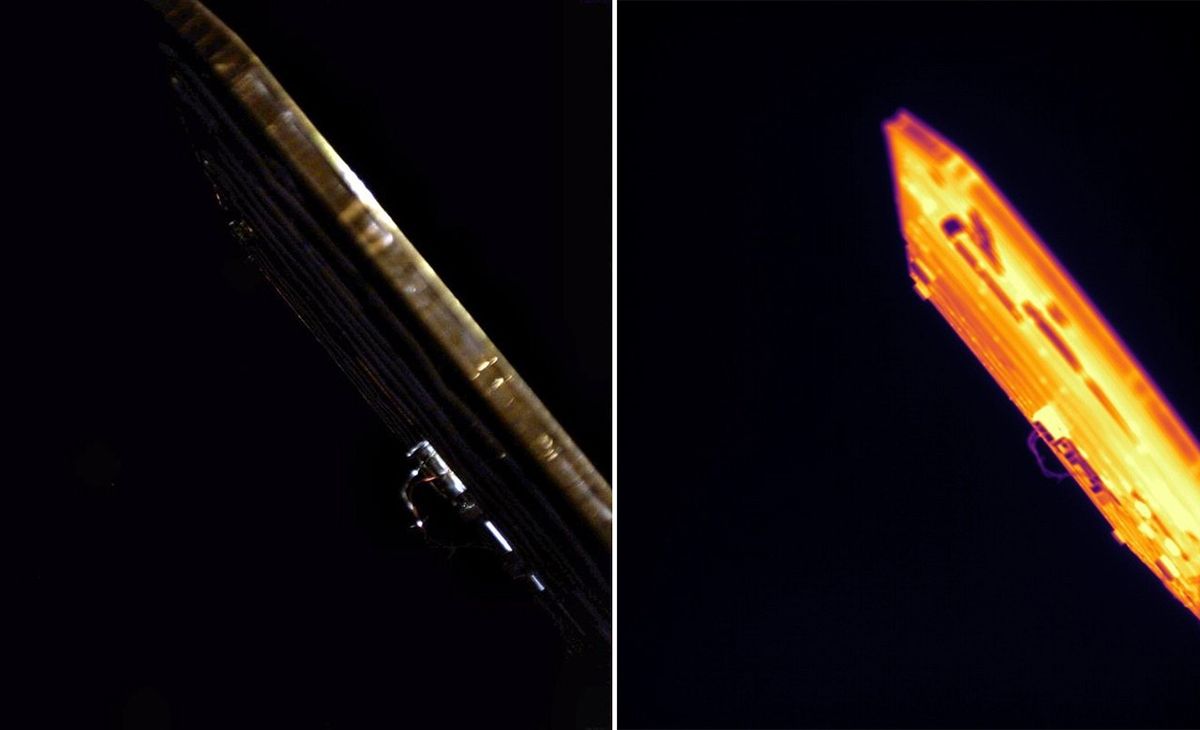
Twin Escapade Mars orbiters take first images to test instruments

Escapade camera test
Click for original image.

The two twin Escapade Mars orbiters, built by Rocket Lab, that were launched last week by Blue Origin’s New Glenn rocket have both successfully activated and tested their optical and infrared cameras.

The optical picture to the right, reduced to post here, shows the side of one solar panel on one of the orbiters.

The images prove the cameras are working well. The visible-light image also suggests that the spacecraft should have the sensitivity to image Martian aurora from orbit. The infrared camera will be used at Mars to better understand how materials on the surface heat up and cool down during Mars’ day-night cycle and over the planet’s seasons.

The second ESCAPADE spacecraft also successfully took its first photos, but it was targeted toward deep space, so the images were simply black.

The NASA press release did not explain why the second spacecraft’s camera was pointed in that manner. One would think the engineers would want it to look at the spacecraft in order to test its pointing and resolution. It could be it is placed in this manner and cannot be changed, or it could be there is a problem not mentioned by the release.

The two spacecraft are taking a different path to Mars than normal. Both will remain as Lagrange Point 2, a million miles from Earth until November 2026, when they will then be sent back towards Earth to slingshot past to arrive at Mars in September 2027. This plan allowed the spacecraft to be launched with greater flexibility, rather than be tied to the launch windows that occur every two years that all other Mars probes have used.

Rocket Lab sets new annual launch record for the company

Rocket Lab today set new annual launch record for the company, quickly scheduling and launching a payload for a “confidential commercial customer”, its Electron rocket lifting off from one of the company’s two launchpads in New Zealand.

This was the 15th orbital launch by Rocket Lab in 2025, beating the record of 14 the company set in 2025. Rocket Lab has also launched its HASTE suborbital version of Electron three times, so the company has actually completed the equivalent of 18 Electron launches this year, though three were not intended to reach orbit.

What made this launch unusual is that it was not announced in advance, and took place suddenly without revealing the customer. It is likely the customer was flying a classified military payload. UPDATE on November 26, 2025: That customer was actually the commercial imagery company BlackSky, launching another one of its satellites for its constellation used by both the military and the public. The company did not explain why it wished its identity hidden during the launch.)

The leaders in the 2025 launch race:

151 SpaceX
71 China
15 Rocket Lab (a new record)
13 Russia

SpaceX still leads the rest of the world in successful launches, 151 to 119.

First launch of Rocket Lab’s Neutron rocket delayed until 2026

Artist's rendering of the Neutron first stage deploying its second stage
Artist’s rendering of Neutron’s first stage fairings opening
to deploy the payload with the second stage engine.

Despite a concerted effort in the past year to achieve the first launch of its new reusable larger Neutron rocket before the end of 2025, Rocket Lab this week revealed that the company is now targeting a 2026 launch instead.

Sir Peter Beck, the CEO of Rocket Lab, announced the shift in plans during the third quarter earnings call with investors on Nov. 10. He said that the company’s goal is to get the rocket out to Launch Complex 3 at the Virginia Spaceport Authority’s (VSA) Mid-Atlantic Regional Spaceport (MARS) within the first quarter of 2026 “with first launch thereafter.”

“As always, this is a rocket program that’s been completed at a pace and a cost that nobody has achieved before and the financial and long-term impacts are insignificant to take a little bit more time to get it right,” Beck told investors on the call.

During the call officials also made clear that there would be no attempt to recover the first stage on that first flight, as the landing barge won’t be ready by then. It hopes a landing attempt will occur on the second flight.

Finally, officials revealed that the company has spent a bit more to develop Neutron then the originally planned cost of between $250 to $300 million. Right now it expects to spend about $360 million by the end of 2025.

This delay or the increased cost are relatively inconsequential when looked at in context. Rocket Lab had only started this project in 2021. To create a new rocket in less than five years for only about a quarter of a billion dollars is quite unprecedented.

Two American launches today, setting several new launch records

The beat goes on! Three different American companies attempted launches today, with two successfully getting off the ground while the third was forced to scrub due to an unspecified technical issue.

First Rocket Lab successfully launched another radar satellite for the Japanese company Q-Shu Pioneers (iQPS), its Electron rocket lifted off from one of Rocket Labs’ two New Zealand launchpads. This was the fifth launch out of a total eleven-launch contract that Rocket Lab has from Q-Shu. The launch also tied Rocket Lab’s record for the most successful orbital launches in a single year, 14, set in 2024.

Next, SpaceX launched another 29 Starlink satellites into orbit, its Falcon 9 rocket lifting off from Cape Canaveral in Florida. The first stage completed its fifth flight, landing on a drone ship in the Atlantic. The launch once again set a new annual launch record for SpaceX.

Only about two hours later, ULA attempted to launch a Viasat communications satellite using its Atlas-5 rocket, also lifting off from Cape Canaveral. At T-minus 4 minutes however there was an unplanned hold. After trouble-shooting the problem for almost an hour, they scrubbed the launch with only a few minutes left in the launch window. They will try again tomorrow.

With the two successful launches, the world’s global launch industry tied the record that was set last year for the most successful orbital launches in a single year, 256. That record will certainly be passed in the next few days.

What is more significant is that until 2020, the industry struggled to reach 100 launches per year. Since then the numbers have skyrocketed, led mostly by SpaceX’s overwhelming success.

The leaders in the 2025 launch race:

144 SpaceX (a new record)
67 China
14 Rocket Lab (tying its previous record)
13 Russia

SpaceX now leads the rest of the world in successful launches, 144 to 112.

Is the German government holding up Rocket Lab’s purchase of German space communications company Mynaric?

Even though Rocket Lab announced in March that it was acquiring the German laser communications company Mynaric for $150 million, and entered into the stock purchase agreement in September, the company has not yet gotten approval for the purchase from the German government, raising questions that approval might be denied.

A central question for regulators and industry observers is whether Mynaric, once owned by Rocket Lab, would still be deemed a European entity — a status that could determine its eligibility to compete for Europe’s planned sovereign communications network, known as IRIS² (Infrastructure for Resilience, Interconnectivity and Security by Satellite). The multibillion-euro program, backed by the European Union, is designed to strengthen Europe’s independence in secure satellite communications and may restrict participation to European-controlled firms.

Those regulators however also have to consider whether IRIS will even fly. Designed to provide a government option to the internet constellations being operated or built by Starlink, Kuiper, and several Chinese projects, it is significantly delayed, vastly over budget, and unlikely to compete very successfully. There have been rumors several EU nations are even balking at building it at all.

If Rocket Labs’ purchase of Mynaric is denied, it will likely not harm that company significantly. It will however be another example of Europe cutting off its nose to spite its face. It will block this American company from providing business to Europe, even as its own government projects wither on the vine.

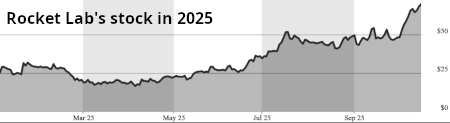
New Morgan Stanley report reflects Wall Street’s generally optimistic view of Rocket Lab

Rocket Lab's stock in 2025
Click for source.

Though Rocket Lab is still not in the black, a new positive analysis of the company this week from Morgan Stanley reflects Wall Street’s generally optimistic view of Rocket Lab during the past year.

Rocket Lab (NASDAQ:RKLB) had its price target raised by equities researchers at Morgan Stanley from $20.00 to $68.00 in a research report issued on Monday, Benzinga reports. The brokerage presently has an “equal weight” rating on the rocket manufacturer’s stock. Morgan Stanley’s price target would suggest a potential upside of 1.63% from the company’s current price.

The article at the link also notes that Morgan Stanley is not alone in giving Rocket Lab a positive report, and in fact in the past year it shows that the recommendations from many analysts to buy its stock have risen considerably. These positive reviews have been reflected in a steady rise in the company’s stock price in 2025, as shown by the graph on the right.

Nor are these reports written in a vacuum. In recent weeks Rocket Lab has signed a bunch of new launch contracts, some extending deals with old customers, some with new customers of some note.

Buying the stock of a startup like Rocket Lab always carries risk, but it appears Wall Street is beginning to see the future of this particular startup as very promising.

Three launches in the past day

Even as all eyes focused on SpaceX’s 11th test launch of Starship/Superheavy yesterday, there were three other launches in the past fourteen hours taking place on three different continents by China and two different American companies.

First, China placed a technology test satellite into orbit, its Long March 2D rocket lifting off from its Jiuquan spaceport in northwest China. The only information about the satellite is that it will test “new optical imaging.” No information at all was released on where the rocket’s lower stages, using very toxic hypergolic fuels, crashed inside China.

Next, SpaceX placed 24 of Amazon’s Kuiper satellites into orbit, its Falcon 9 rocket lifting off from Cape Canaveral in Florida. The first stage completed its second flight, landing on a drone ship in the Atlantic.

With this launch, Amazon now has 154 satellites in orbit, out of a planned constellation of about 3,200. Its FCC license requires it to have about 1,600 in orbit by July of ’26, but that goal seems increasingly unlikely to be met. With this launch SpaceX completed its three-launch contract for Amazon. It has contracts with ULA for 46 launches (having so far completed three in 2025), and that company appears ready to launch regularly in the coming months. Amazon’s other launch contracts with Blue Origin’s New Glenn (27 launches) and ArianeGroup’s Ariane-6 (18 launches) however are more uncertain. Neither company has achieved any launches on their contracts, and it is not clear when either company, especially Blue Origin, will ever begin regular launches.

Finally, this morning Rocket Lab placed the seventh radar satellite into orbit for the company Synspective, its Electron rocket lifting off from one of its two launchpads in New Zealand. Rocket Lab has a contract for another twenty Synspective launches over the next few years. The launch also featured a larger fairing that will give the company the ability to launch bigger-sized satellites with Electron.

The leaders in the 2025 launch race, now including yesterday’s Starship/Superheavy launch:

131 SpaceX
60 China
13 Russia
13 Rocket Lab

SpaceX now leads the rest of the world in successful launches, 131 to 101.

Rocket Lab gets two-launch contract from Japan’s space agency JAXA

In what appears to be a significant slap at its own rockets (especially its delayed Epsilon-S rocket), Japan’s space agency JAXA this week signed a two-launch deal with the American rocket company Rocket Lab.

Launching from Rocket Lab Launch Complex 1 in New Zealand, the two Electron missions will deploy satellites for JAXA’s Innovative Satellite Technology Demonstration Program. The first launch, scheduled from December 2025, will deploy the agency’s RApid Innovative payload demonstration SatellitE-4 (RAISE-4) spacecraft, a single satellite that will demonstrate eight technologies developed by private companies, universities, and research institutions throughout Japan.

The second launch, scheduled for 2026, is a JAXA-manifested rideshare of eight separate spacecraft that includes educational small sats, an ocean monitoring satellite, a demonstration satellite for ultra-small multispectral cameras, and a deployable antenna that can be packed tightly using origami folding techniques and unfurled to 25 times its size.

Rocket Lab has previously won contracts from several private Japanese satellite companies (Q-Shu, Astroscale, ALE), but this I think is the first JAXA contract it has won. What makes it significant is that JAXA has always focused on using its own rockets, the large retired H2A and the new H3 as well as the smaller Epsilon-S. To go to an American company is somewhat unprecedented.

Though larger than Rocket Lab’s Electron rocket, Epsilon-S was being developed to compete for the same market. That development however has been plagued by failure, including explosions of engines during tests of both its upper and first stages in ’23 and ’24 respectively. After the second explosion JAXA announced in December 2024 the rocket’s first launch would not occur in the spring of 2025 as planned, but provided no additional information. Since then there have been no updates.

This Rocket Lab deal suggests the Epsilon program is in big trouble. In the long run however this might be a very good thing for both JAXA and Japan’s own nascent rocket industry. JAXA might finally be recognizing that building and owning its own rockets is not the best plan, that it would be better to use the capitalism model and simply be a customer buying the services from the private sector. At the moment Japan doesn’t yet have a viable commercial rocket sector, with only Mitsubishi having an operational commercial rocket, the H3 (mostly controlled by JAXA). There are a number of new startups however, including Interstellar, Honda, Space One, and Tispace, all of which have done tests of one kind or another. If JAXA is ready to abandon its own government rockets and buy the service from the private sector, those Japanese startups will start to prosper.

Japanese satellite company extends its launch contract with Rocket Lab

The Japanese satellite company Q-shu Pioneers of Space, Inc. (iQPS) has purchased three more launches from Rocket Lab, for a total of seven planned.

The multi-launch contract includes three dedicated Electron missions that will launch no earlier than 2026 from Rocket Lab Launch Complex 1 in New Zealand. With four dedicated missions already booked by iQPS on Electron, these three additional missions bring the total number of upcoming launches for iQPS to seven.

Each dedicated launch will deploy a single synthetic aperture radar (SAR) satellite from a Rocket Lab Motorized Lightband separation system – demonstrating Rocket Lab’s vertical integration across launch and space systems that improves reliability and streamlines the launch process for its customers.

Rocket Lab has already completed four successful launches for iOPS, so with this deal means that it will complete eleven launches total for the satellite company. Essentially iQPS has made Rocket Lab its prime launch provider.

This is also the second major launch contract for Rocket Lab in the past week. On September 30, 2025 Synspective purchased its second multi-launch contract with the company, buying ten more launches. Its first contract was for eleven launches, with six already completed. Synspective hopes to have its entire radar constellation of 30 satellites in orbit by the late 2020s.

Both contracts tell us that Rocket Lab’s Electron rocket is going to have a very busy launch schedule for the next few years, even as the company initiates its larger Neutron rocket.

Rocket Lab to unveil its completed Neutron launchpad by end of August

As part of a series of press releases in connection with the release of Rocket Lab’s second quarter financial report, the company announced that it is inviting shareholders to enter a sweepstakes for attending the official opening of its just completed launchpad at Wallops Island for its new Neutron rocket.

According to the announcement, the opening is scheduled for August 28, 2025.

Rocket Lab will randomly select ten (10) eligible entrants to win admission to the event. Eligible entrants are limited to U.S. citizens who are at least 18 years old and shareholders of Rocket Lab. Winners are responsible for their own travel and accommodation costs, and any other costs and expenses associated with traveling to and attending the event

The sweepstakes is a fun idea, but what is really significant is that the company appears to be continuing to meet its schedule for a first launch of Neutron before the end of 2025. If so it will be a major achievement, considering the company began work on this rocket in December 2021. To go from a blank sheet to launch in only four years is unprecedented. Normally it takes about twice as long to get a rocket to the launchpad.

Even if the launch date slips into the first quarter of 2026 the achievement will be spectacular.

Rocket Lab’s 2nd quarter financial report appears bright as well, noting a 36% increase in revenues from the previous year. While its rocket division continues to ramp up launches, the company has also done well diversifying into other space areas, from low Earth orbital constellations to deep space technology.

Rocket Lab’s new Neutron rocket faces red tape delays at Wallops

Proposed dredged channel
Proposed dredged channel. Click for original.

We’re here to help you! Rocket Lab appears to be having regulatory problems getting approvals to transport hardware for its new Neutron rocket to its new launchpad at the Mid-Atlantic Regional Spaceport (MARS) on Wallops Island in Virginia, delays that might prevent it from launching as planned later this year.

It appears the company needs to dredge a deeper channel to ship the heavier Neutron hardware into Wallops, but it has not been able to begin work because of approval delays by the federal government.

The dredging project was approved by VMRC [Virginia Marine Resources Commission] in May, but the company has yet to start digging because it’s still awaiting federal sign-off from the Army Corps of Engineers.

Lacking this approval and unable to get the channel ready for this year’s launch, the company is seeking permission to use a stop-gap different approach to transport the hardware through these shallow waters.

Kedging, a little-known nautical method, is used to ensure the barges can safely navigate the existing shallow channel. Workers would use a series of anchors and lines to steer the barge through the shallow waters. The company is seeking permission to use this method through the end of June 2026 or until the dredging work is complete, whichever comes first.

Lacking an okay to do even this alternative approach, Rocket Lab will be forced to transport the hardware using “ramps and cranes,” an approach that is impractical in the long run for achieving a profitable launch pace. It also would likely result in not meeting its targeted launch date before the end of 2025 for the first Neutron launch.

Two American launches this evening

This evening two different American companies completed successful commercial launches, doing so from opposites sides of the globe.

First, SpaceX launched another 27 Starlink satellites, its Falcon 9 rocket lifting off from Cape Canaveral, with the first stage completing its fifth flight, landing on a drone ship in the Atlantic Ocean. This launch was on the evening of June 27th.

Then, a few hours later Rocket Lab completed the first of two quickly scheduled launches for an unnamed commercial customer, its Electron rocket lifting off from one of its two launchpads in New Zealand. This launch, on June 28th in New Zealand, was the company’s second launch in less than two days, its fastest turn around yet. As of posting the payload was not yet deployed.

The leaders in the 2025 launch race:

81 SpaceX
35 China
10 Rocket Lab
7 Russia

SpaceX still leads the rest of the world in successful launches, 81 to 60.

Rocket Lab launches four radio surveillance satellites

Rocket Lab today successfully launched four radio surveillance satellites for the company Hawkeye 360, its Electron rocket lifting off from one of its two launchpads at its New Zealand spaceport.

This was Rocket Lab’s second of three launches under a Hawkeye 360 three-launch contract.

The leaders in the 2025 launch race:

80 SpaceX
35 China
9 Rocket Lab
7 Russia

SpaceX still leads the rest of the world in successful launches, 80 to 59.

Rocket Lab wins launch contract from the European Space Agency

The American rocket company Rocket Lab announced today that it has been awarded a launch contract from the European Space Agency (ESA) to place two European-built GPS-type test satellites into orbit.

Rocket Lab will launch two “Pathfinder A” spacecraft for ESA, provided by European satellite prime contractors Thales Alenia Space and GMV, from Rocket Lab Launch Complex 1 no earlier than December 2025. The spacecraft will be deployed to a 510km low Earth orbit as part of a mission to test a new approach of providing location, direction, and timing services from satellites in low orbit – otherwise called LEO-PNT (Low Earth Orbit Positioning, Navigation, and Timing). ESA’s LEO-PNT demonstration mission will assess how a low Earth orbit fleet of satellites can work in combination with the Galileo and EGNOS constellations in higher orbits that provide Europe’s own global navigation system.

That ESA gave Rocket Lab this contract illustrates the failure of this government agency’s own commercial rocket division, Arianespace, as well as the slowly emerging new commercial rocket startups in Europe. ESA likely rejected Arianespace’s Ariane-6 and Vega-C rockets as too expensive. These rockets were also likely unable to meet the required launch time table. It also could not pick any independent private European companies, because none have yet to successfully launch.

And ESA did this even as top government officials in Europe have been loudly demanding that Europe only launch its satellites on European rockets. That demand might make a nice sound bite, but reality trumps nice sound bites every time.

Rocket Lab gets a quick launch contract from unnamed customer

Rocket Lab today announced it has been awarded a launch contract from an unnamed “confidential commercial customer” calling for two launches before the end of this year, with the first to occur only four days from today.

Launching from Rocket Lab Launch Complex 1 in New Zealand, the first dedicated mission on Electron – named “Symphony In The Stars” – will take place no earlier than June 20, 2025 to deploy a single spacecraft to a 650km circular Earth orbit. A second dedicated launch on Electron to meet those same mission requirements is scheduled for launch before the end of 2025.

That the customer name is classified suggests these are both military launches, and are designed to demonstrate Rocket Lab’s ability to launch something fast under short notice. The new contract also increases the chances that Rocket Lab will manage two dozen launches in 2025, a pace of twice a month.

1 2 3 9