
China’s rover about to go to sleep for the long lunar night.

China’s rover is about to go to sleep for the long lunar night.

According to Wu Fenglei of the Beijing Aerospace Control Center, the lander will “go to sleep” at about 7 a.m. on Christmas Day and the moon rover, Jade Rabbit, will fall asleep at about 1 a.m. on Boxing Day. The forthcoming lunar night, expected to begin on Dec. 26, will last for about two weeks, experts with the center estimated. During their “sleep”, both lander and rover will have to tolerate minus 180 degrees Celsius. Scientists tested the lander early Tuesday to ensure it can stand the temperature drop. Both lander and rover are stable, said Wu, adding they have completed a series of scientific tasks in the past two days.

This report states the rover landed in Sinus Iridum, the original announced landing site, contradicting other reports that said the lander came down in Mare Imbrium.

0 comments

It seems Curiosity’s wheels are wearing out faster than expected and engineers want to know why.

It seems Curiosity’s wheels are wearing out faster than expected and engineers want to know why.

The increasedwear recently appears to be because the rover was traveling over rougher terrain. Nonetheless, JPL engineers are going to monitor the rover’s travel and wheel damage more closely in order to gauge that wear better for future travel.

5 comments

The rover Opportunity has settled into its winter haven on Mars.

The rover Opportunity has settled into its winter haven on Mars.

The rover’s handlers plan to get Opportunity up onto Solander Point’s north-facing slope before mid-December, NASA officials said. But the golf-cart-size robot won’t hibernate through the winter; rather, it will continue to move about, investigating several different Solander Point outcrops.

0 comments

On Friday an astronaut on ISS controlled and steered a rover on Earth.

On Friday an astronaut on ISS controlled and steered a rover on Earth.

While zipping around Earth several hundred miles above the planet’s surface, European Space Agency astronaut Luca Parmitano drove a 220-pound (100 kilograms) rover across a moon-mimicking landscape here at NASA’s Ames Research Center, even ordering the robot to deploy a simulated film-based radio telescope antenna.

4 comments

NASA announced yesterday plans to launch by 2020 a twin rover of Curiosity to Mars.

NASA announced yesterday plans to launch by 2020 a twin rover of Curiosity to Mars.

Though it makes sense to use the same designs again, saving money, I must admit a personal lack of excitement about this announcement. First, I have doubts it will fly because of the federal government’s budget woes. Second, it is kind of a replacement for the much more challenging and exciting missions to Titan and Europa that the Obama administration killed when they slashed the planetary budget last year.

2 comments

The mysterious shiny particles uncovered by Curiosity’s scoop are from Mars, not the rover.

The mysterious shiny particles uncovered by Curiosity’s scoop are from Mars, not the rover.

After last week’s plastic encounter, Curiosity’s science team worried the new particles might be man-made. Since they turned up in scoop holes, however, the granules must have been buried in the subsurface. They likely came from larger minerals that broke down. They might also represent the product of some geological soil process that generates a bright but unknown mineral.

These are not the same mysterious objects first seen when the rover began science operations. Those particles were on the surface, and looked like bits of plastic that might have come off the rover or its descent stage.

1 comment

Curiosity views its surroundings.

Curiosity views its surroundings. More images here.

In another story, there is speculation that Curiosity’s first image actually captured the dust cloud produced when the spacecraft’s Sky Crane/rockets crashed after placing the rover on the ground and then flying away.

Compare this image, taken right after landing, with this image, taken later. The splotch on the horizon has disappeared.

0 comments

A fitting memorial

Greeley Haven

Opportunity has settled into its winter haven.

NASA’s Mars Exploration Rover Opportunity will spend the next few months during the coldest part of Martian winter at Greeley Haven, an outcrop of rock on Mars recently named informally to honor Ronald Greeley, Arizona State University Regents’ professor of planetary geology, who died October 27, 2011.

I met and interviewed Greeley a number of times in writing articles for magazines like Sky & Telescope and Astronomy. For years he was a central figure in the field of planetary geology, and his life effort is one of the prime reasons the United States has dominated this field for most of the past half century, with a fleet of planetary missions presently at Mercury, Mars, Jupiter, Saturn, and Pluto, with many more to come.

The article notes that the International Astronomical Union (IAU) has the job of naming objects in space, and could take years to honor Greeley. I say that if these scientists, the true explorers of Mars, want to name something for him, then they should go ahead, and future generations should honor that choice, regardless of what the IAU says.

0 comments

A preview of the new Mars unmanned rover Curiousity, set for launch on Saturday

A preview of the new Mars unmanned rover Curiousity, set for launch on Saturday. This is the part of its mission that scares me the most:

The final stages of the entry, descent and landing sequence will be especially tense as the rover, dubbed Curiosity in a student naming contest, is gently lowered to the surface on cables suspended from a rocket-powered “sky crane” making its debut flight. Too large to use airbags like those that cushioned NASA’s Pathfinder, Spirit and Opportunity rovers, Curiosity will rely instead on landing rockets positioned above the rover, avoiding the challenge of coming up with a reliable way to get a one-ton vehicle off of an elevated, possibly tilted lander. Instead, Curiosity will be set down on its six 20-inch-wide wheels, ready to roll.

If it works.

0 comments

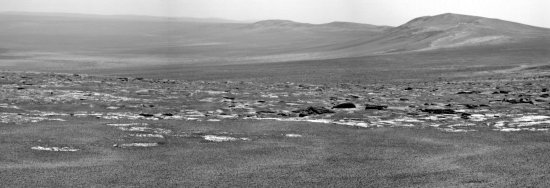
Endeavour Crater at last!

The science team for the rover Opportunity have released their first image taken from the rim of Endeavour Crater.

Since this picture looks south from Spirit Point less than a football field’s distance from the rim, it appears to look into the crater, the mountains on the right being the crater’s rim. What looks like a debris field running across the center of the image looks to me to be a combination of exposed patches of bedrock and boulders on the plateau above the rim. For the scientists, those boulders will be the prime research targets, as they are possibly ejecta produced at crater impact and could therefore be material thrown out from deep within the Martian crust.

a view of Endeavour Crater

0 comments
1 2 3 4 5