Curiosity tops a ridge to see its rough path forward
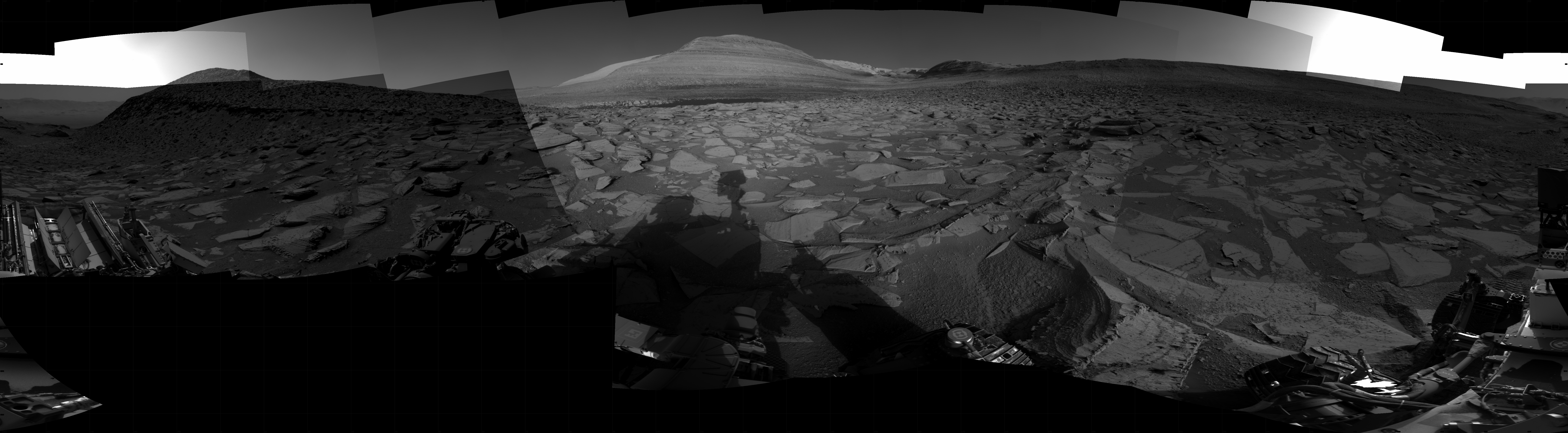
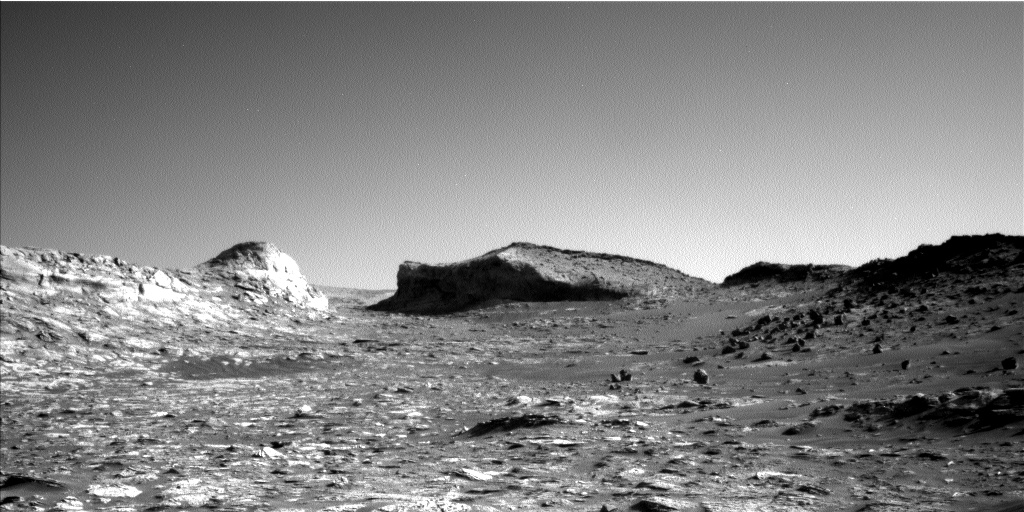
Curiosity's view ahead on June 29, 2023
Click for original image.

Overview map
Click for interactive map

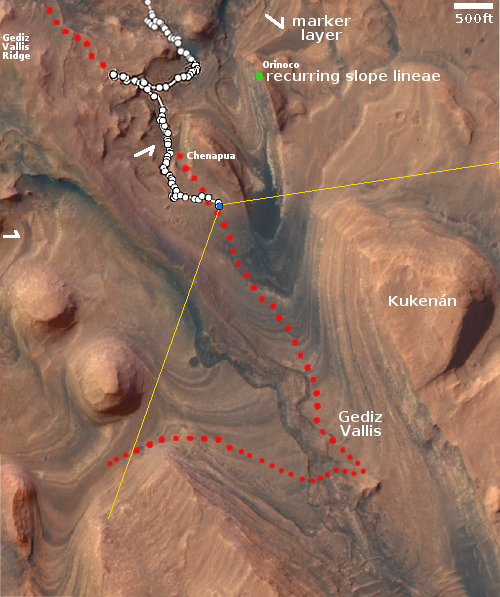
After more than a month of struggle to get Curiosity to maneuver uphill through a very rocky and steep terrain, the science team today finally announced that the rover had topped the ridge and could once again see its way forward into Gediz Vallis, the slot canyon it plans to use as its route up Mount Sharp.

The panorama above, cropped, reduced, sharpened, and annotated to post here, was taken on June 29, 2023 following Curiosity’s last move forward. The yellow lines on the overview map to the right indicate the approximate area covered by this panorama. The red dotted line on both images indicates Curiosity’s planned route, with the white dotted line its actual course.

The white ridge to either side of the central peak dubbed Kukenan is actually the higher flanks of Mount Sharp. The peak of Kukenan is about a half mile away and about 400 feet higher, with those white flanks about 2.5 miles beyond. The actual peak of Mount Sharp is about 25 miles farther south and about 17,000 feet higher.

The panorama makes clear that the path forward is not going to be any less rough for Curiosity and its damaged wheels. Expect progress to be slow for many months to come.

0 comments

Determining whether a Martian crater is impact or volcanic

Determining whether a Martian crater is impact or volcanic
Click for original image.

Overview map

Cool image time! The picture above, rotated, cropped, reduced, and sharpened to post here, was taken on March 22, 2023 by the high resolution camera on Mars Reconnaissance Orbiter (MRO). The camera team labeled this “Crater rim and ejecta,” which subtly reveals the picture’s scientific purpose.

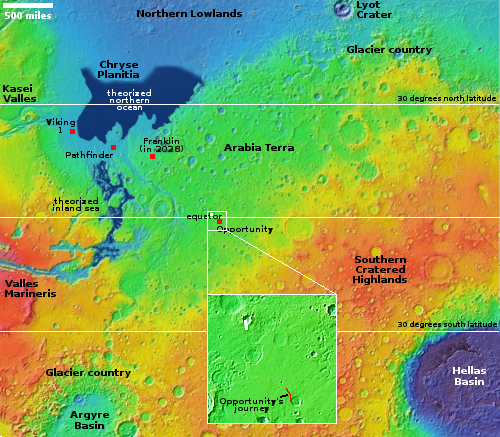
The white dot on the overview map to the right indicates the location of this 15-mile-wide unnamed crater, about 150 miles northwest of where the rover Opportunity landed and traveled south to the rim of Endeavour Crater. It also shows in the inset that the crater appears to sit in the center of an upraised mound, suggesting it was formed not by impact but by volcanic processes.

This picture however says otherwise. The many small mounds and mesas to the south of the crater rim are not what one would expect on the apron of a volcano. Instead, they suggest this crater is an impact, with those mounds the eroded ejecta from that impact, now also partly buried by dust. This hypothesis is strengthened by the data from Opportunity, which found a great deal of impact ejecta during its travels, possibly from the very event that created this crater.

6 comments

Startup Astrolab unveils its manned lunar rover design

Capitalism in space: A small startup company, Astrolab, yesterday unveiled its concept for a manned lunar rover, designed for NASA’s Artemis program.

The company has already built a full scale prototype, which it tested in Death Valley. It also intends to try to win NASA’s contract for building it, with bidding expected to begin in only a few months.

Astrolab will likely have major competition for the LTV contract. Lockheed Martin announced in May 2021 a partnership with General Motors to design lunar rovers but said at the time their concept was still in the early stages. Northrop Grumman announced in November it was working with several companies on a lunar rover design but also provided few technical details.

By contrast, Astrolab, based in Hawthorne, California, is a 15-person company founded two years ago after [Jaret Matthews, the founder of the company,] left SpaceX.

In a rational world, Astrolab’s small size and newness would not matter, if its design was best. In the strange world of our modern federal government, however, the political clout of big companies like General Motors and Northrop Grumman could easily be more important, even if their designs are mediocre and cost much more. Their designs might not be inferior, but their clout cannot be ignored. It will make Astrolab’s success far more difficult, requiring this startup to offer something much more superior to have a chance of winning.

At the same time, the competition might very well force the older big space companies to up their game, which will be all to the good, for everyone.

0 comments

Ingenuity’s next flight and the plans beyond

Overview map
Click for interactive map.

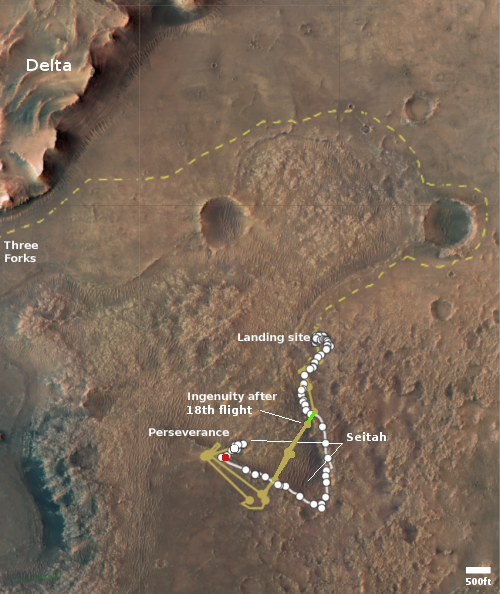
In an update posted today written by Ingenuity pilot Martin Cacan, he outlined the engineering team’s goal for the Mars’ helicopter’s next flight, its nineteenth.

This flight, which will take place no earlier than Friday, Jan. 7, takes the scout vehicle out of the South Séítah basin, across the dividing ridge, and up onto the main plateau. The precise landing target for Flight 19 is near the landing site of Flight 8. Images taken during Flight 9 by the rotorcraft’s high-resolution Return-To-Earth (RTE) camera were used to select a safe landing zone.

…Spanning 207 feet (63 meters), this flight will last about 100 seconds at a groundspeed of 2.2 mph (1 meter per second) and altitude of 33 feet (10 meters) while taking 9 new RTE images. The final act of the flight is to turn nearly 180 degrees to flip the RTE camera to a forward-facing orientation for future flights toward the river delta. [emphasis mine]

The green line in the map to the right indicates the exact path, going about 207 feet to the northeast. The red dot marks the location of Perseverance on December 8, 2021, the last time the Perseverance science team updated their map showing the rover’s travels.

The highlighted words are the most important. Cacan also said this in his update:

The current mission goal is to reach the Jezero river delta to aid the Perseverance rover in path planning and scientific discovery.

Assuming the helicopter continues to function correctly, their next flights will apparently be aimed towards the delta. Whether that path will follow the planned route marked by the dashed yellow line, or cut straight across, is not clear. If the latter, that implies they have revised Perseverance’s planned route so that it also cuts straight across from about the point of Ingenuity’s next landing site.

More likely Cacan was not speaking literally, and that the route Ingenuity will take to the delta will follow the planned route, around that crater to the northeast.

0 comments

Nissan reveals prototype lunar rover

Capitalism in space: Nissan today unveiled its first prototype design of an unmanned lunar rover, built for the Japanese space agency JAXA.

Nissan Motor Co. unveiled Thursday a prototype of a lunar rover co-developed with Japan’s space exploration agency that will employ the automaker’s motor control technology to maneuver across the Moon’s loose terrain. The automaker said it aims to make the rover capable of traversing the undulating Moon surface smoothly by applying technology developed for use in its roadgoing electric vehicles such as the Leaf and Ariya.

The picture of the prototype at the link is, to put it mildly, not impressive. It uses rubber tires, and is really nothing more than a control box attached to four tires.

JAXA apparently also has Toyota working on a competitive project. The competition should therefore eventually produce something worthwhile.

2 comments

Curiosity marches on into the mountains

Curiosity marches onward to Maria Gordon Notch
Click for full image.

Overview map
Click for interactive map

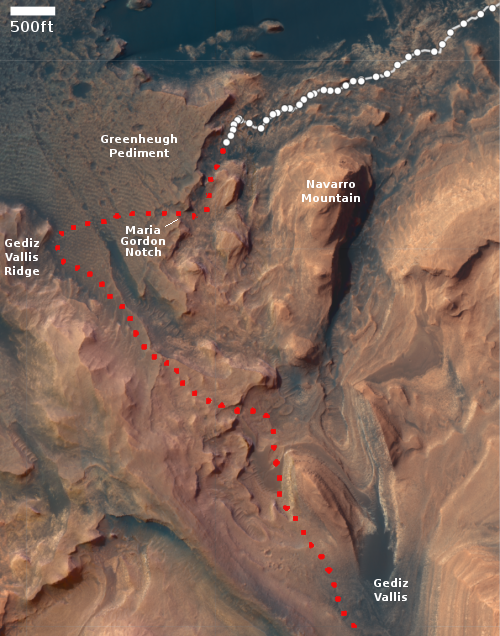
With the end of the solar conjunction in the first half of October, blocking communications with Mars because the Sun was in the way, Curiosity has resumed its travels. It has moved past the spectacular outcrop I have highlighted previously, an outcrop the science team has labeled Siccar Point.

They are now moving south at the base of the cliff to the west, the top of which is a plateau they call the Greenheugh Pediment, heading for a gap where the rover will be able to turn right and head up onto that pediment. The red dotted line on the overview map to the right shows this route, which corresponds to the red dotted line on the photo above.

I estimate the cliffs on both sides of Maria Gordon Notch are about 100 feet high. The notch itself I estimate is about 750 feet away. At the pace Curiosity has been traveling across this rough ground, it could probably reach it in about two to three weeks. However, I expect the science team will stop at least once along the way to do more detailed science work, so that journey might take a month or slightly more.

0 comments

Deployment process of Ingenuity begins

Ingenuity on the bottom of Perseverance
Click for full image.

Ingenuity vertical under Perseverance
Click for full image.

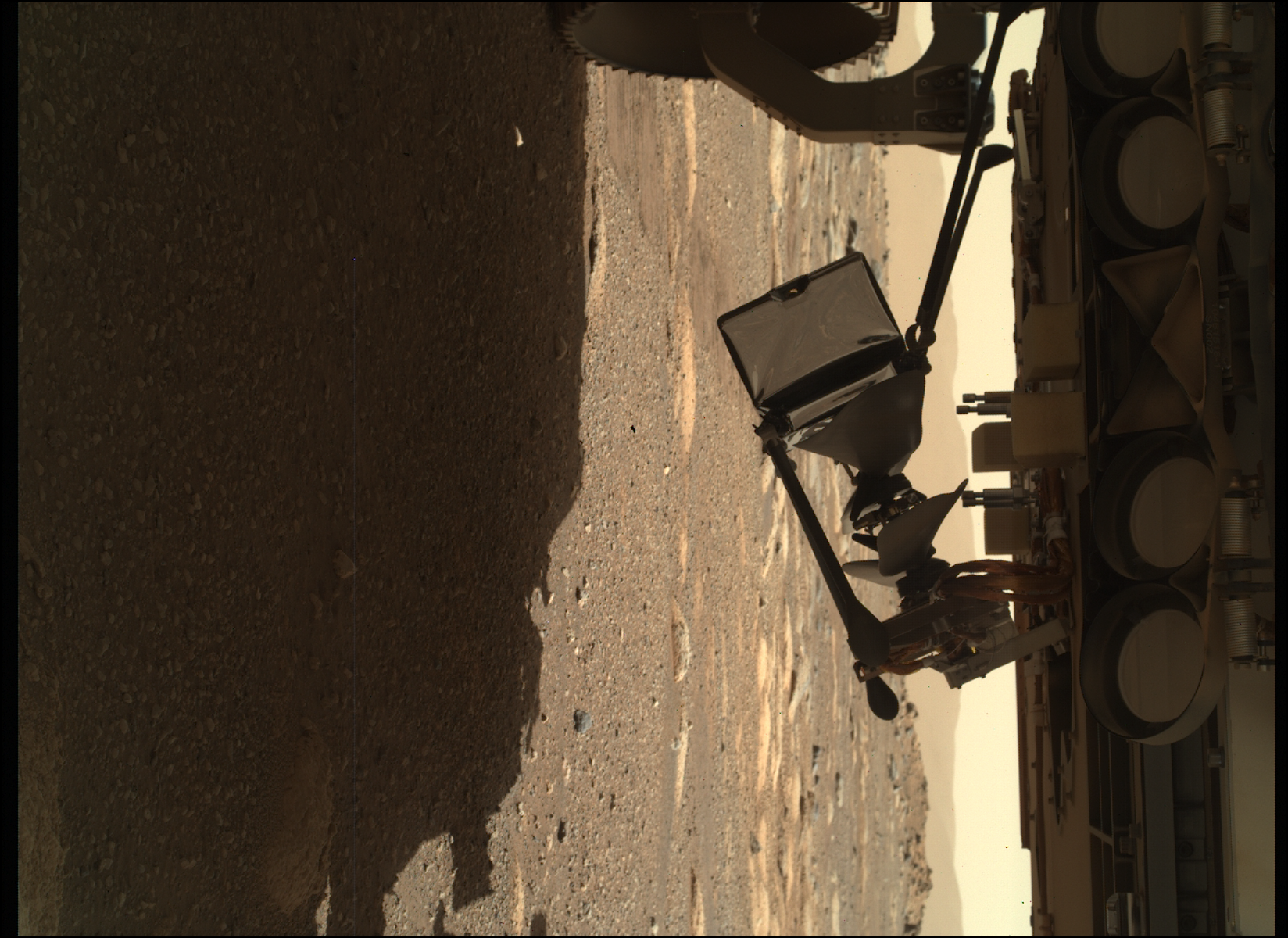
The photo to the right, cropped and reduced to post here, shows the Ingenuity helicopter attached to the base of the Perseverance rover, with its left end (the white box in the middle) now lowered. Previously the helicopter was stored horizontal against the rover’s base.

This photo was taken yesterday by Perseverance’s Watson camera, which provides images of the rover’s bottom and wheels.

The deployment process has only begun. They need to get that white box vertical and on the ground, then unfold the blades that are attached above it. I suspect as the base is dropped the two blades to the left will remain attached to Perseverance, thus partly unfolding them. I also suspect that full deployment of all four blades (the right two blades are what looks like a post with a bulbous end on the right of the base) will not occur until Ingenuity is fully detached and Perseverance has moved away. My error. I mistook the helicopter’s landing legs for its blades. Two of the legs (on the left) appear deployed, while two (on the right) remain in their stored position.

UPDATE: Ingenuity is now vertical, underneath Perseverance, as shown by the second image to the right.

These images are from yesterday, so these are actions that the rover and helicopter are doing autonomously. It appears from later images that the second set of legs began deploying next.

5 comments

Hungarian company awarded NASA contract to develop Moon mini-rover

A Hungarian company has won a NASA contract worth $225K to develop what the company calls its Puli Moon mini-rover.

Named after a Hungarian breed of dog, the Puli rover is a low-cost platform designed to carry different payloads, including the ice water snooper, which won the 2020 “Honey, I Shrunk the NASA Payload” challenge, a competition organised by the U.S. space agency. Weighing less than 400 grammes (14 oz), its purpose is to probe for water ice by identifying and mapping the subsurface hydrogen content of the lunar soil.

The “news article” at the link appears to be a poorly researched article distributed by Reuters that has now been reprinted without changes by such stalwart American mainstream news outlets like the New York Post and MSN.com, to name two. Neither bothered to do any further research.

The article falsely claims that the airplane-based SOFIA telescope recently confirmed there is water on the Moon. It also claims that this rover will be on a lunar mission next year, something that does not seem likely at all.

A look at the company’s website clarifies things. The company competed in a NASA contest offering its design of a very tiny lightweight rover, won, and was then awarded a larger development contract of $225K. No launch is presently set, though if the company is successful in building it for this cost, they will likely get a berth on a later unmanned mission.

0 comments

Curiosity checks out its wheels

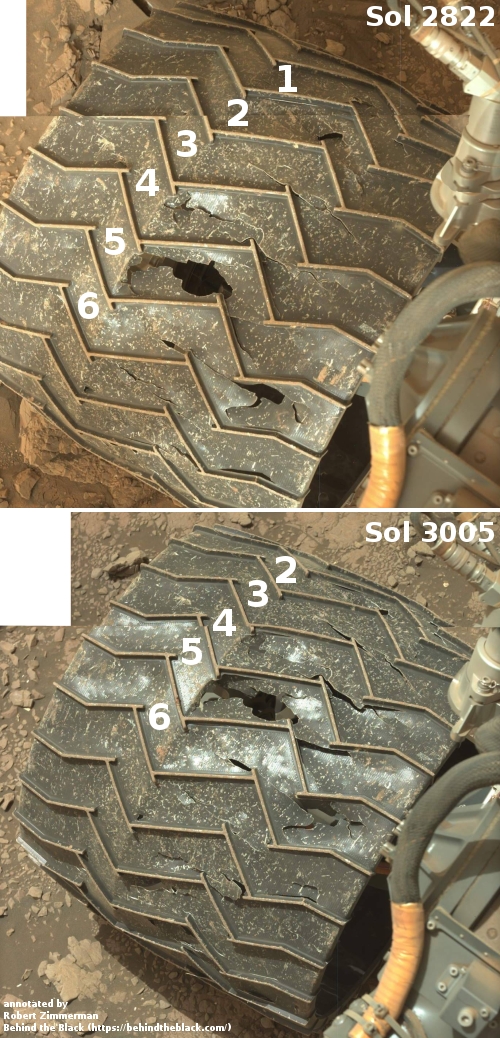
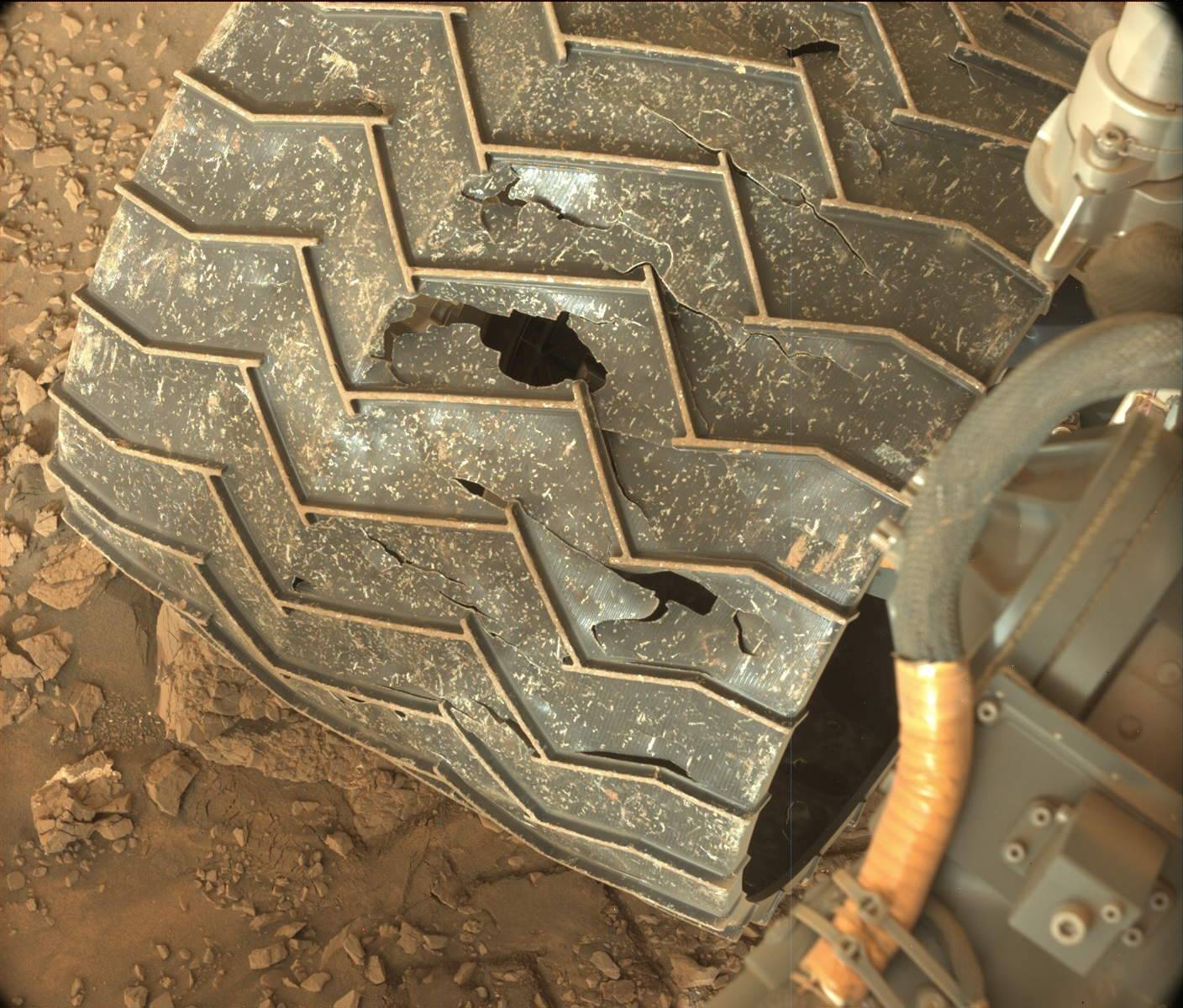
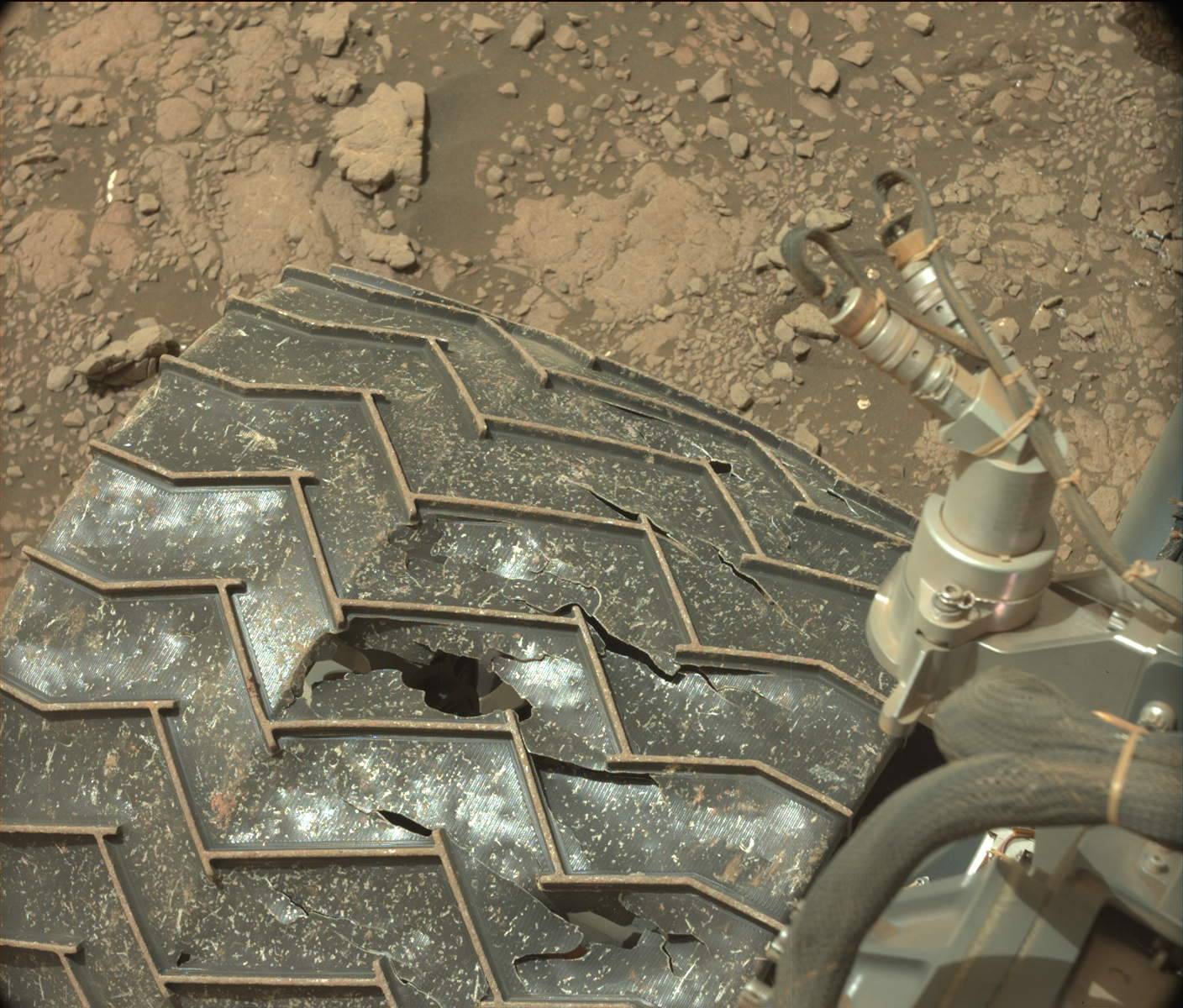
One wheel on Curiosity, as seen in July 2020 and January 2021
For full resolution images, go here and here for the
top image, and here and here for the bottom image.

Having finished a two week look at a sea of sand, Curiosity’ science team has resumed its journey east towards the higher slopes of Mount Sharp.

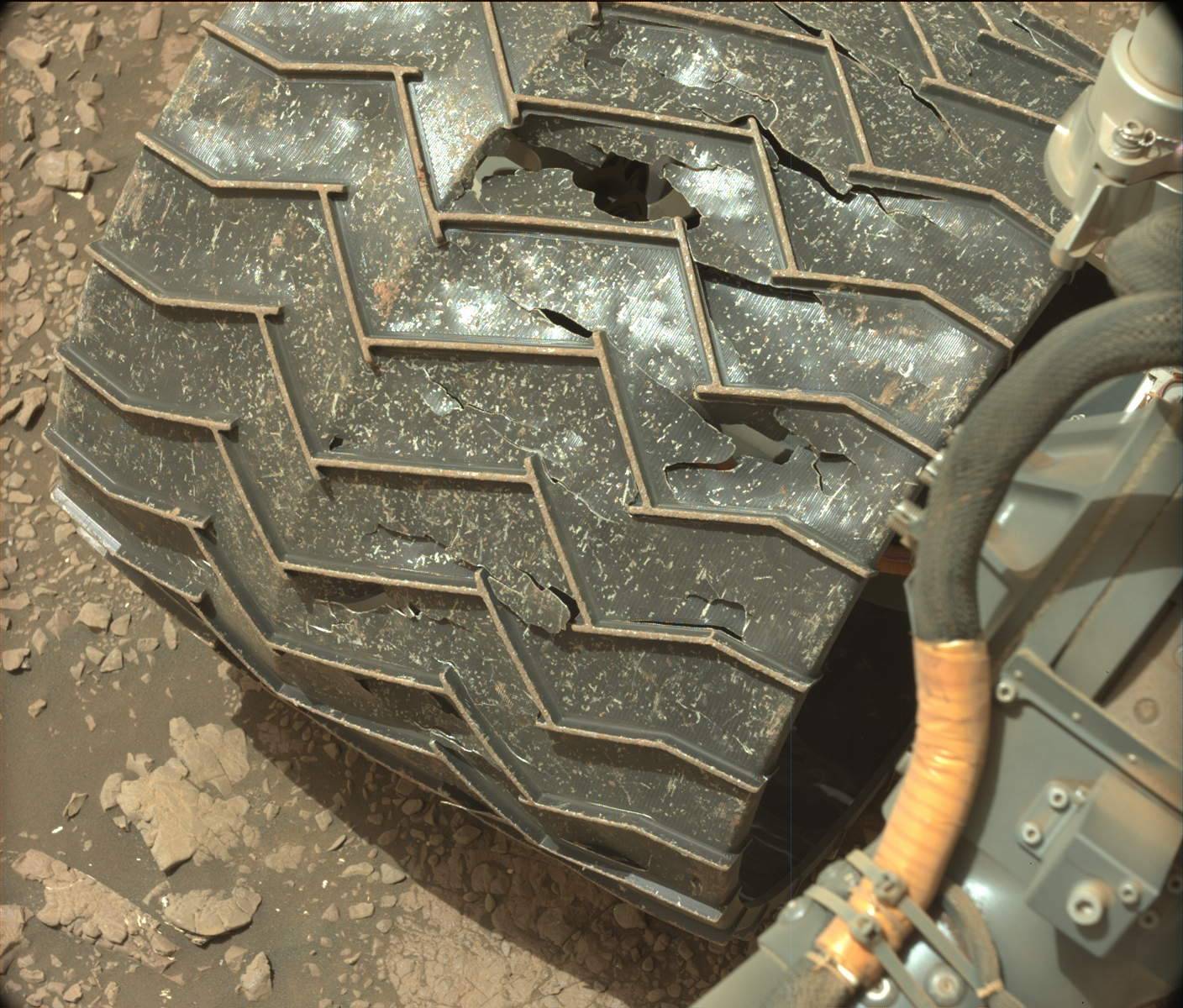
Before they started out however, they decided to aim the rover’s high resolution mast camera at Curiosity’s wheels to see how they are faring and whether any of the damage that occurred in the early days of the mission has worsened. The photo on the right compares what was seen this week with the damage on the same wheel as seen in July 2020. This is also the same wheel I have posted images of since September 2017.

Not only does there appear to be no appreciable new damage to this wheel in the six months since July, remarkably, a comparison between today’s image and the photo from September 2017, shows little change as well.

In the more than three years since that 2017 photo, Curiosity has crossed Vera Rubin Ridge, crossed the clay unit, climbed up the next ridge to take a look at the incredibly rough terrain of the Greenheugh Pedimont, and then continued across the clay unit on its way to higher and possibly more challenging terrain.

In all those travels it appears this particular wheel has fared rather nicely, accumulating in at least this part little new damage. This bodes well for the rover’s future, as the wheels have been a concern since Curiosity’s first two years on Mars, when engineers found they were experiencing more damage than expected. The travel techniques they have adopted since to protect the wheels appear to be working.

4 comments

Rover update: Curiosity on the shore of a sand sea

Curiosity stops on the shore of a sand sea, while Yutu-2 continues its journey west away from Chang’e-2. On the way: Perseverance and China’s first Mars rover on Tianwen-1.

A sand sea on Mars
Click for full image.

Curiosity

The photo on the right, taken in late December, shows the large sand lake the science team has labeled “the Sands of Forvie” that the rover has been working its way uphill to reach since it left the Mary Anning drill site back in November.

Since they arrived there, they have used the rover to roll across the sand, cutting into a ripple to expose its interior, followed by high resolution close-up images. They have also used the rover to analyze the chemical composition of the sand’s grains, from that interior section, from the top of several ripples, and from the troughs in between.

Once finished here, the rover will be turned east again to continue its journey around this sand sea to the very base of Mount Sharp. The overview map below shows the planned route.
» Read more

0 comments

ESA completes new parachute test for its 2022 Mars rover

On November 9, 2020 the European Space Agency finally conducted the high altitude parachute test of the landing system for its 2022 Mars rover Rosalind Franklin that had been planned for March but had been delayed due to the Wuhan flu panic.

The timeline of the latest test, including extraction and deceleration, went exactly to plan. However, four tears in the canopy of the first main parachute and one in the second main parachute were found after recovery. The damage seemed to happen at the onset of the inflation, with the descent otherwise occurring nominally.

The team are now analysing the test data to determine further improvements for the next tests. Planning is underway for future tests in the first half of next year, to ‘qualify’ the complete parachute system ready for launch in September 2022.

Overall they consider the test a success, though the damage issues must be solved before the ’22 launch. Based on this test it also appears that the ESA made a very wise choice delaying the mission from launch this year, as its parachute system was clearly not ready.

0 comments

Perseverance’s planned journey in Jezero Crater

Jezero Crater delta
Jezero Crater delta

If all goes right, on February 18, 2021 the rover Perseverance will gently settle down onto the floor of Jezero Crater on Mars. The image to the right is probably the most reproduced of this site, as it shows the spectacular delta that some scientists believe might be hardened mud that had once flowed like liquid or lava from the break in the rim to the west.

They hope to put Perseverance down to the southeast of that delta, as shown in the overview map below.
» Read more

0 comments

Live stream of Perseverance launch tomorrow

I have embedded below the fold NASA’s live stream channel for tomorrow’s 7:50 am (Eastern) launch of the Perseverance rover to Mars on a ULA Atlas-5 rocket.

At present the channel is carrying NASA’s programming leading up to the launch. The actual live stream for the launch begins at 7 am (Eastern).

The weather looks good, and there appear to be no issues, as of 11 pm (Eastern).

» Read more

5 comments

Rover update: The state of Curiosity’s wheels

[For the overall context of Curiosity’s travels, see my March 2016 post, Pinpointing Curiosity’s location in Gale Crater. For the updates in 2018 go here. For a full list of updates before February 8, 2018, go here.]

In my last rover update (April 16, 2020), I posted some new images taken of Curiosity’s wheels, showing the damage that they have experienced during the rover’s journey so far in Gale Crater.

At the time, I was unable to match any of the released images, taken on Sol 2732 (April 13, 2020), with the previous wheel image I have used to quickly gauge any new damage (see my July 9, 2019 report).

As it turns out, one of those images did match the earlier image. I simply failed to realize it. Today’s daily download of raw images from Curiosity included additional photos of the rover’s wheels, apparently also taken on Sol 2732 but not available until now. One of those images matches the earlier wheel image, and this time I spotted the match. A comparison is posted below, with my analysis.
» Read more

1 comment

China completes remote communications test of Mars rover

The new colonial movement: Though the report today in China’s state-run press is remarkably vague and lacking in details, it appears that they have successfully completed a remote communications test between their planned Mars rover and their ground control center.

The report also said that this will be the “only” such test before the summer launch of their orbiter/lander/rover to Mars.

China has been exceedingly closed-mouthed about this Mars project. Except for one landing test (which I found far from impressive), they have provided very little information about their progress.
While this does not mean they are having problems, it also does not engender confidence, especially because the launch window is only about four months away.

0 comments

NASA dubs next Mars rover “Perseverance”

NASA today announced that they have named their next Mars rover, due to launch in July, “Perseverance.”

The name was announced Thursday by Thomas Zurbuchen, associate administrator of the Science Mission Directorate, during a celebration at Lake Braddock Secondary School in Burke, Virginia. Zurbuchen was at the school to congratulate seventh grader Alexander Mather, who submitted the winning entry to the agency’s “Name the Rover” essay contest, which received 28,000 entries fromK-12 students from every U.S. state and territory.

“Alex’s entry captured the spirit of exploration,” said Zurbuchen. “Like every exploration mission before, our rover is going to face challenges, and it’s going to make amazing discoveries. It’s already surmounted many obstacles to get us to the point where we are today – processing for launch. Alex and his classmates are the Artemis Generation, and they’re going to be taking the next steps into space that lead to Mars. That inspiring work will always require perseverance. We can’t wait to see that nameplate on Mars.”

I truly hope that the rover is well-named, and lives a very long life on Mars, long enough that it is still in use the day an human arrives to touch it again.

6 comments

Mars 2020 rover takes first and last test drive

Engineers on December 17 gave the Mars 2020 rover its first and last test drive before it is launched in July 2020.

In a 10-plus-hour marathon on Tuesday that demonstrated all the systems working in concert, the rover steered, turned and drove in 3-foot (1-meter) increments over small ramps covered with special static-control mats. Since these systems performed well under Earth’s gravity, engineers expect them to perform well under Mars’ gravity, which is only three-eighths as strong. The rover was also able to gather data with the Radar Imager for Mars’ Subsurface Experiment (RIMFAX).

I have embedded a short video showing a tiny part of that driving test below the fold. This is the last and only time we will ever be able to see the rover move. Once it is on Mars in Jezero Crater there will be no third party cameras to record its travels.
» Read more

1 comment

China unveils Mars lander during landing simulation test

The new colonial movement: China today unveiled to the international press its first prototype Mars lander, showing it attempting a simulated controlled descent on a gigantic test stand.

The demonstration of hovering, obstacle avoidance and deceleration capabilities was conducted at a site outside Beijing simulating conditions on the Red Planet, where the pull of gravity is about one-third that of Earth.

China plans to launch a lander and rover to Mars next year to explore parts of the planet in detail.

This is the first time I have heard anything about China sending a lander/rover to Mars in 2020. Previously the reports had discussed only sending an orbiter.

I have embedded video of the test below the fold. It shows the prototype hanging by many wires from the test stand, then dropping quickly, with its engine firing, before stopping suddenly, followed by an engine burst. While impressive, it did not strike me that China is even close to sending this spacecraft to Mars. The test only proved the spacecraft’s ability to do some maneuvering during descent. It did not show that it could land.

That the project’s designer said that landing would take “about seven minutes” also suggests that they are copying the techniques used by JPL to land Curiosity. Considering that JPL’s computers have been repeatedly hacked, including some hacks identified as coming from China, it would not surprise me if China has simply stolen those techniques.

I still expect them to launch an orbiter to Mars in 2020. Whether they also send a lander and rover remains to be seen.
» Read more

7 comments

Wheel update on Curiosity

Periodically, the Curiosity science team stops from its research to reassess the condition of the rover’s wheels. To do this they use the rover’s color camera, dubbed the Mast Camera (Mastcam), taking close-up pictures of the wheels to compare those with earlier photographs see if there has been any additional damage and deterioration over time.

Yesterday Mastcam took a new series of images of the rover’s wheels. Below are two pictures, the left taken on August 27, 2017, the right taken on July 7, 2019. I have annotated the images to help indicate where they match.
» Read more

0 comments

Europe inaugurates ExoMars control center

The Europe Space Agency yesterday inaugurated the control center where it will control and download data from the ExoMars rover, Rosalind Franklin, scheduled to launch to Mars in the summer of 2020.

The control center also includes a dirt filled enclosure where they can simulate Martian conditions with a rover model.

The article outlined the project’s upcoming schedule:

Over the summer the rover will move to Toulouse, France, where it will be tested in Mars-like conditions. At the end of the year Rosalind Franklin will travel to Cannes to meet the landing and carrier modules for final assembly.

As I noted yesterday in my most recent rover update, this assembly, only six months before launch, gives them very little margin. If there are any problems during assembly, they will likely miss the 2020 launch window.

I also wonder if this will allow them any time to do acoustical and environmental testing, as was just completed on NASA’s 2020 rover, to make sure ExoMars can survive launch, landing, and the journey to Mars. If they forego those tests, they might discover after launch that they were launching a paperweight, not an expensive planetary probe.

1 comment
1 2 3 5