A wish list of spectacular future planetary missions

Steve Squyres of Cornell University and the project scientist of the Mars rovers Spirit and Opportunity spoke today at an astrobiology symposium in Arlington, Virginia. He described several spectacular planetary missions that might be flown in the coming decade. All are being considered. None have yet been chosen or funded.

  • A mission to grab a sample from a comet and return it to Earth.

  • A mission to put a rover or lander on one of the poles of Mars to study the frozen layers of water under the icecap.

  • Mars sample return mission. This mission is so difficult and expensive that it probably would be broken down into three parts:
    • Two rovers on the surface to gather and cache sample material.

    • A lander/rover mission to grab the samples and bring them up to Mars orbit. “Putting into orbit a precious cargo the size of a coconut,” Squyres said.

    • A mission to grab the sample cargo in Martian orbit and return it to Earth.

  • An orbiter to study both Jupiter and its moon Europa.

  • An orbiter to Enceladus, the moon of Saturn, to study the water and organic chemistry in its mysterious plumes.

  • An orbiter to Titan, with balloon to probe the atmosphere as well as a “lake lander, a boat” to study Titan’s lakes.

  • A variety of landers and rovers to go to Venus. One of the more astonishing mission concepts would land, then take off again to visit different places on the surface.

Squyres is the co-chair of a committee of the National Science Foundation that is right now putting together a decadal survey for outlining unmanned planetary research for the next decade. This survey is expected to be released in March, which is when we will find out which of the above missions the planetary science community prefers.

The basic ingredients of life might exist in Titan’s atmosphere

Big news! In a simulation of the upper atmosphere of Titan at about 600 miles altitude, scientists have discovered the basic ingredients of life are quickly synthesized when exposed to the kind of hard radiation found there. Key quote from the press release, issued today at the 42nd meeting of the AAS Division for Planetary Sciences:

The molecules discovered include the five nucleotide bases used by life on Earth (cytosine, adenine, thymine, guanine and uracil) and the two smallest amino acids, glycine and alanine.

For those who don’t remember their high school biology, these nucleotides are the building blocks of DNA.

The abstract of the scientist’s work can be found here.

What the scientists did was recreate the basic ingredients of Titan’s upper atmosphere, comprised of nitrogen, methane and carbon monoxide. Cassini data has shown that within this atmosphere are very large molecules, as yet unidentified.

The scientists then bathed their recreation in the kind of intense radiation expected at that altitude, and amazingly produced the complex organic molecules that are basic to life. Moreover, the experiment was the first to produce these complex molecules without the presence of water, something that scientists have previously thought was required. These results suggest that in addition to forming in the oceans, life could also form in the upper atmospheres of planets.

This result also suggests strongly that it is incredibly easy to produce the basic building blocks of life, almost anywhere in the universe where organic molecules are present.
The moons of Saturn

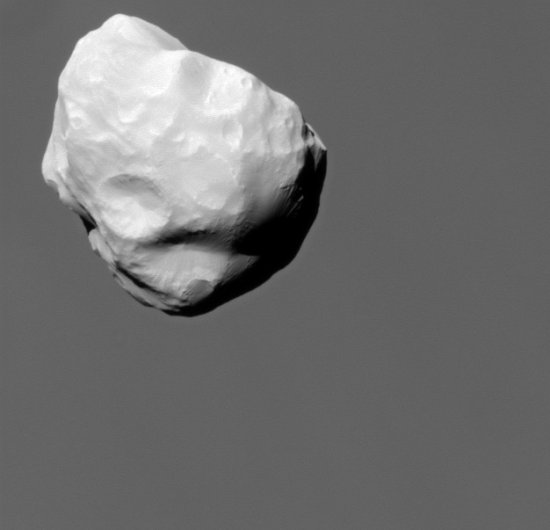
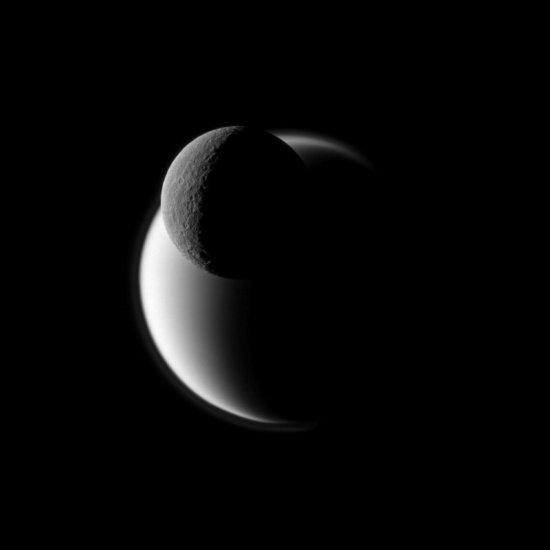
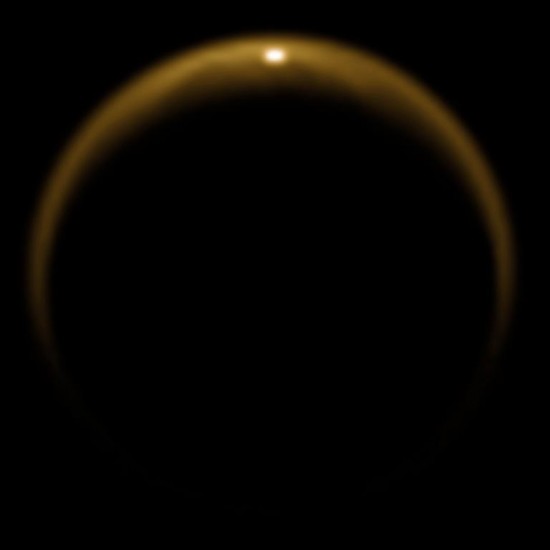
The Cassini spacecraft orbiting Saturn continues to send back a wealth of data, and some gob-smacking wonderful images. Below are two of the more recent examples. The first is not a computer-generated graphic: it shows the small moon Helene (21 miles across) during a fly-by on March 3, 2010, with Saturn’s atmosphere providing the background. The second captures Saturn’s two largest moons, with the smaller Rhea crossing in front of the larger Titan.

Saturn's moon Helene

Rhea eclipses Titan

1 6 7 8