The rings of Saturn

Saturn's rings in 2006
Click for original image.

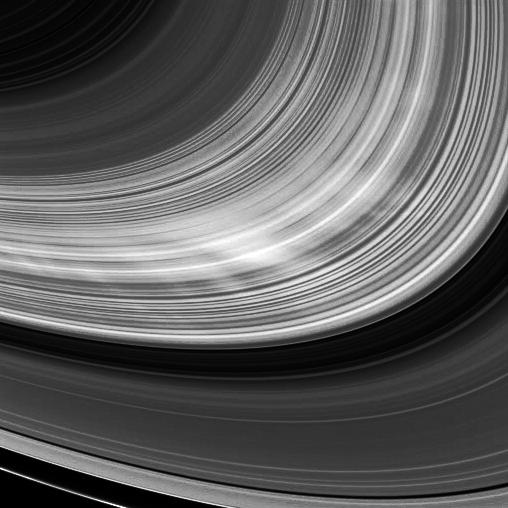
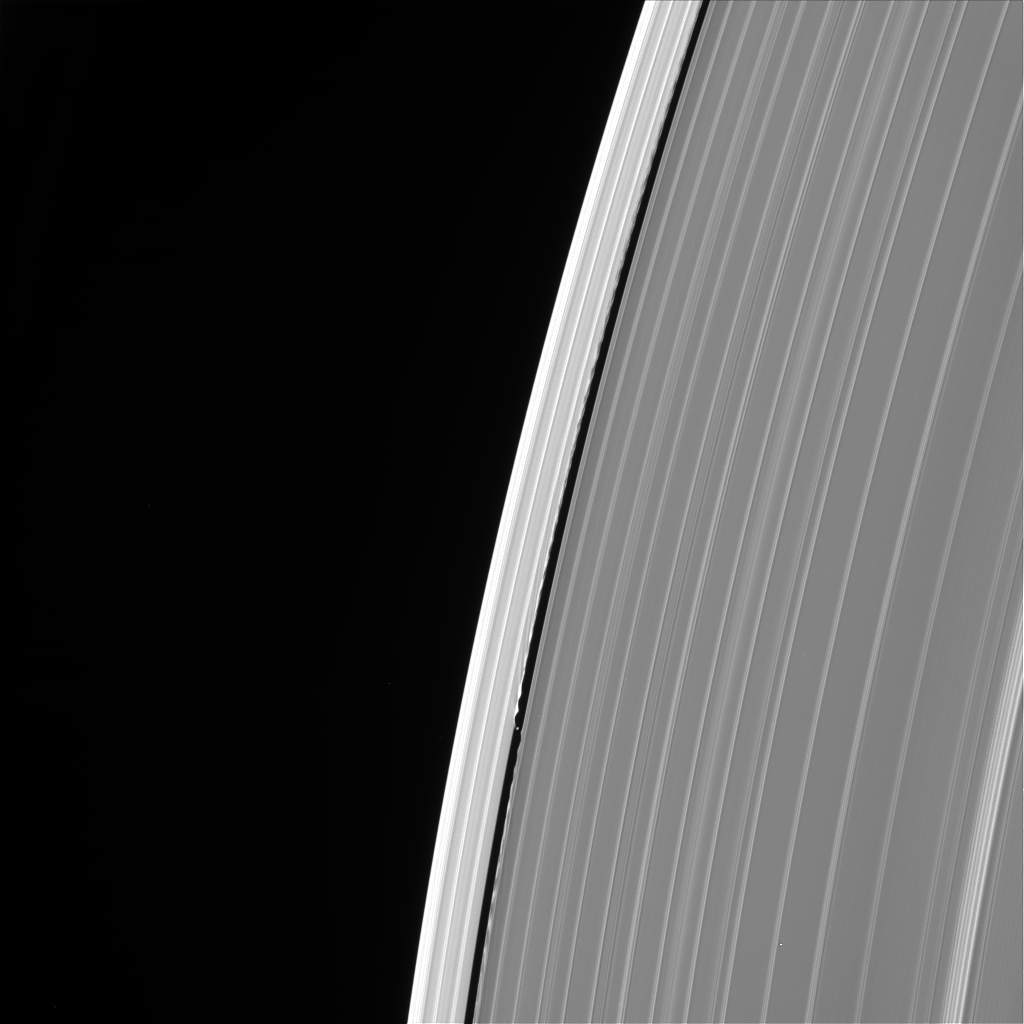
Cool image time! Rather than post another Mars image, I decided today to dig back into the Cassini orbiter archives, which orbited Saturn for almost fourteen years, beginning in 2004.

The picture to the right, reduced and sharpened to post here, was taken on September 6, 2006 from about 397,000 miles away. It has a resolution of about 22 miles per pixel, so no object smaller than that is resolved.

This wide and sweeping view of the sunlit rings of Saturn takes in the impressive variety in their structure — from the clumpy and perennially intriguing F ring to the many waves, ringlets and gaps in the A and B rings and the Cassini Division in between.

The F ring is the outermost thin clumpy ring. The B ring is the brighter set of rings inside the wide Cassini Division, with the A ring the darker set beyond. For a labeled map of all the rings and gaps go here. The seemingly incoherent naming sequence is because the rings are named alphabetically in their order of discovery. Thus, the A ring was first identified, followed by the inner B Ring. The F ring was discovered by the Pioneer 11 when it flew past Saturn in 1979.

While the many Cassini wide-view images of Saturn’s rings tend to look somewhat the same, they all remain breath-taking regardless. Imagine a hotel in orbit around Saturn, where you could look out your window and see this evolve over time as your spacecraft orbited the ringed planet.

1 comment

Scientists: Saturn’s magnetic field is warped

Saturn's theorized magnetic field

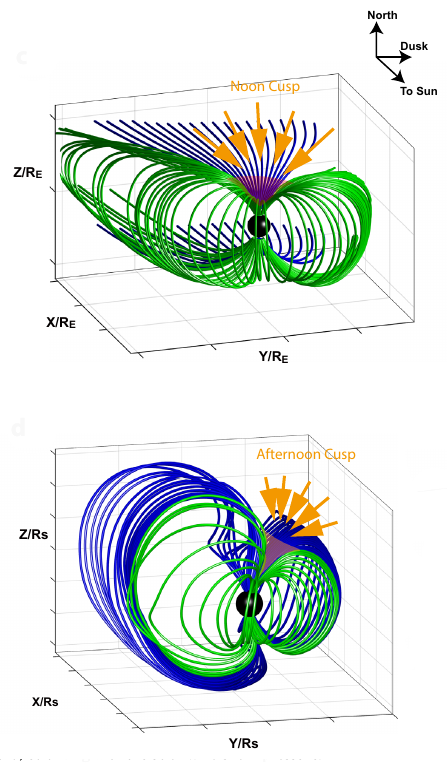
Using six years of archival data from the Cassini Saturn orbiter, scientists now think Saturn’s magnetic field is lopsided, pulled sideways due to the planet’s very fast rotation as well as the material that surrounds the ringed planet.

The graphic to the right, Figure 4 from the research paper [pdf], compares the Earth’s symmetric magnetic field (top) with that of Saturn’s (bottom). From the press release:

The team found that the cusp was dragged to the right as viewed from the Sun, and was located most often between 1:00 and 3:00 (as it might appear on a clockface), compared to 12:00 as it would be on Earth.

The researchers said this was likely because of Saturn’s extremely fast rotation (a Saturn day is 10.7 hours) and the heavy “soup” of plasma (ionised gas) it pulls around it, a product of gases emitted by Saturn’s moons, especially Enceladus. Together, these are thought to drag the magnetic field lines to the right. But more simulations are needed to confirm this interpretation.

When the solar wind hits the Earth’s magnetic field lines at the cusp, that wind is funneled down along those lines to the poles, where it produces the aurora. This new analysis at Saturn will help scientists better understand the behavior of Saturn’s aurora, which is made even more complex by the planet’s many moons.

3 comments

Webb and Hubble take a look at Saturn

Saturn seen by Webb and Hubble

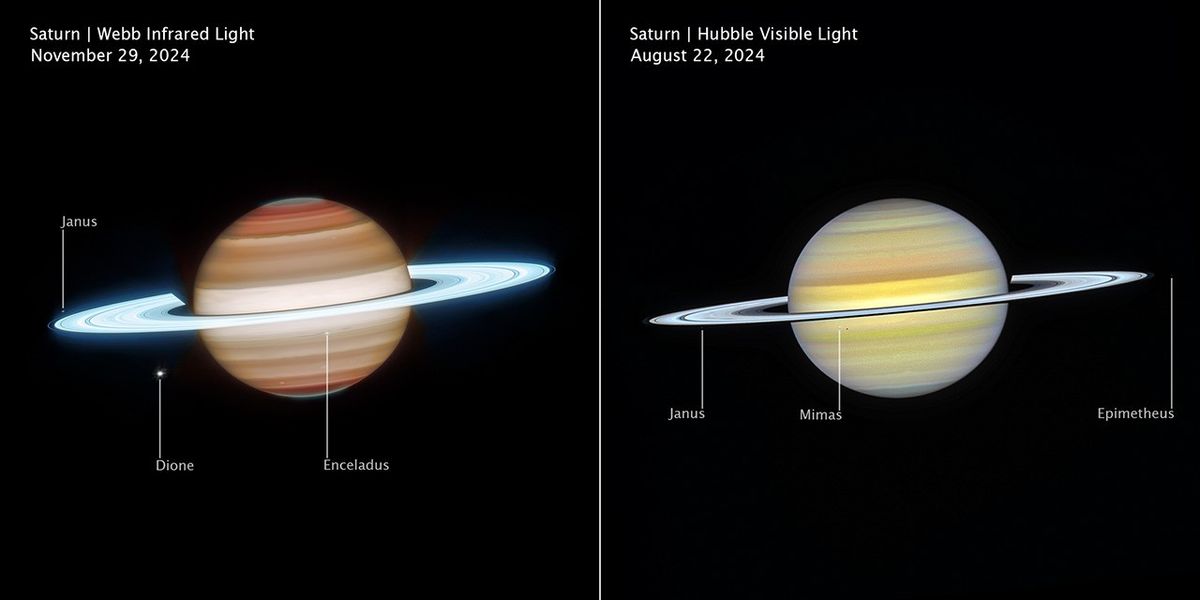
Astronomers using both the Hubble Space Telescope and the Webb Space Telescope have produced new complementary views of the ringed planet Saturn.

Those photographs are shown above, with Webb’s false-color infrared image to the left and Hubble’s optical image to the right. From the press release:

In the Webb image, a long-lived jet stream known as the “ribbon wave” meanders across the northern mid-latitudes, influenced by otherwise undetectable atmospheric waves. Just below that, a small spot represents a lingering remnant from the “Great Springtime Storm” of 2010 to 2012. Several other storms dotting the southern hemisphere of Saturn are visible in Webb’s image, as well. All these features are shaped by powerful winds and waves beneath the visible cloud deck, making Saturn a natural laboratory for studying fluid dynamics under extreme conditions.

…In Webb’s infrared image, the rings are extremely bright because they are made of highly reflective water ice. In both images, we’re seeing the sunlit face of the rings, a little less so in the Hubble image, hence the shadows visible underneath on the planet.

There are also subtle ring features such as spokes and structure in the B ring (the thick central region of the rings) that appear differently between the two observatories. The F ring, the outermost ring, looks thin and crisp in the Webb image, while it only slightly glows in the Hubble image.

The press release says little about the Hubble image, mostly because it shows little new by itself. It however is part of an on-going decade-long survey using Hubble to track Saturn’s changing weather patterns.

While both images are valuable, they also highlight our present limits in observing Saturn. Views from Earth can only see so much. It is like trying to watch a football game from ten miles away, with binoculars. And sadly, no mission is presently planned to return to Saturn.

1 comment

Iapetus: Saturn’s ying-yang moon

Iapetus as seen by Cassini in 2007
Click for original image.

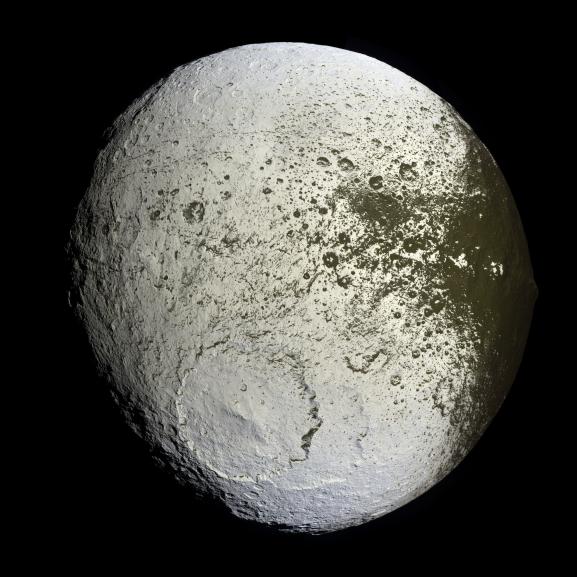
Cool image time! The image to the right, reduced and sharpened to post here, was taken on September 10, 2007 by the Saturn orbiter Cassini as it made its first close fly-by of the moon Iapetus, from a distance of about 45,000 miles.

Iapetus, about 912 miles in diameter, is one of the strangest objects in the solar system. As it orbits Saturn, its leading hemisphere is very dark, covered with almost pitch black material, while its trailing hemisphere is very bright. This picture captures a bit of both, with the dark leading hemisphere visible along the right edge.

In many places, the dark material–thought to be composed of nitrogen-bearing organic compounds called cyanides, hydrated minerals and other carbonaceous minerals–appears to coat equator-facing slopes and crater floors. The distribution of this material and variations in the color of the bright material across the trailing hemisphere will be crucial clues to understanding the origin of Iapetus’ peculiar bright-dark dual personality.

There are several theories to explain the planet’s strange ying-yang two-tone coloration. One suggests it is material thrown off by other Saturn moons that Iapetus sweeps up. Other theories suggest the planet’s orbit itself causes the two hemispheres to have different temperatures, allowing material to sublimate off the dark side and to the bright side.

No theory is presently accepted. Nor does any explain the data fully.

Tomorrow I’ll post a most intriguing close-up of Iapetus taken by Cassini during that 2007 fly-by.

0 comments

The mysterious spokes in Saturn’s rings

A bent spoke in Saturn's rings
Click for original.

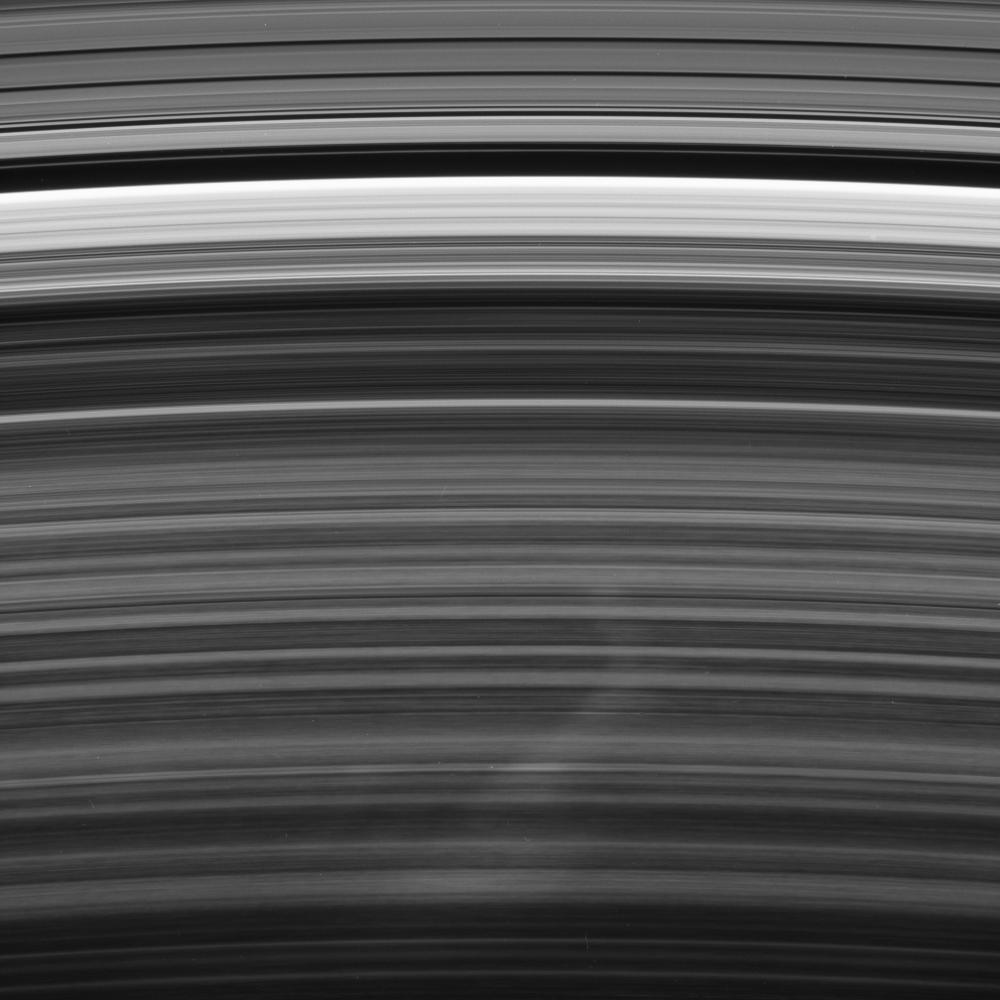
Cool image time! When Voyager-1 did its fly-by of Saturn in December 1980, its cameras captured something in the gas giant’s rings that no one had predicted or expected, spokes of brightness pointing outward along the surface of the rings at right angles to the planet. Even more puzzling, these spokes actually appeared to rotate around Saturn, always pointing away from it.

The picture to the right, cropped, reduced, and enhanced to post here, was taken on March 7, 2007 by the Saturn orbiter Cassini. It shows a close-up of one such spoke, though in this case it is bent. From the press release:

A bright spoke extends across the unilluminated side of Saturn’s B ring about the same distance as that from London to Cairo. The background ring material displays some azimuthal (i.e., left to right) asymmetry. The radial (outward from Saturn) direction is up in this view. A noticeable kink in the spoke occurs very close to the radius where ring particles orbit the planet at the speed of Saturn’s magnetic field. Such a connection is most intriguing to scientists studying these ghostly ring phenomena.

If gravity alone were affecting the spoke material, there would be no kink and the entire spoke would be angled toward right, like the bottom portion. That it bends to the left above the kink indicates that some other force, possibly related to the magnetic field, is acting on the spoke material. The shape might also indicate that the spoke did not form in a radial orientation, thus challenging scientists’ assumptions about these features.

In other words, the spokes exist because of multiple factors, some still unknown, that cause these streaks of brightness in the rings. For some reason, the millions of tiny ice particles that comprise the rings are brightened along these spokes, and it isn’t just gravity that is causing it.

9 comments

Two moons of Saturn against its majestic rings

Mimas and second moon against Saturn's rings
Click for original image.

Cool image time! The picture to the right, cropped and enhanced to post here, was taken on December 23, 2005 by Cassini as it orbited Saturn.

The larger cratered moon is Mimas, known best for the single giant crater that dominates one hemisphere. I have not been able to identify the brighter but smaller moon.

Note the pattern within the largest bright central ring in the background. It is possible this is an optical illusion, but it is also possible this pattern is inherent in the ring itself. Other images show similar patterns that scientists have concluded were real.

This image was part of a set of eight images all taken in the space of less than two minutes, as the smaller moon moved from the lower left to the upper right and was eclipsed by Minas as it did so. Below are four of those pictures, showing the sequence.
» Read more

8 comments

Saturn’s moon Enceladus, as seen during Cassini’s last close fly-by

Enceladus as seen during Cassini's last close fly-by
Click for original.

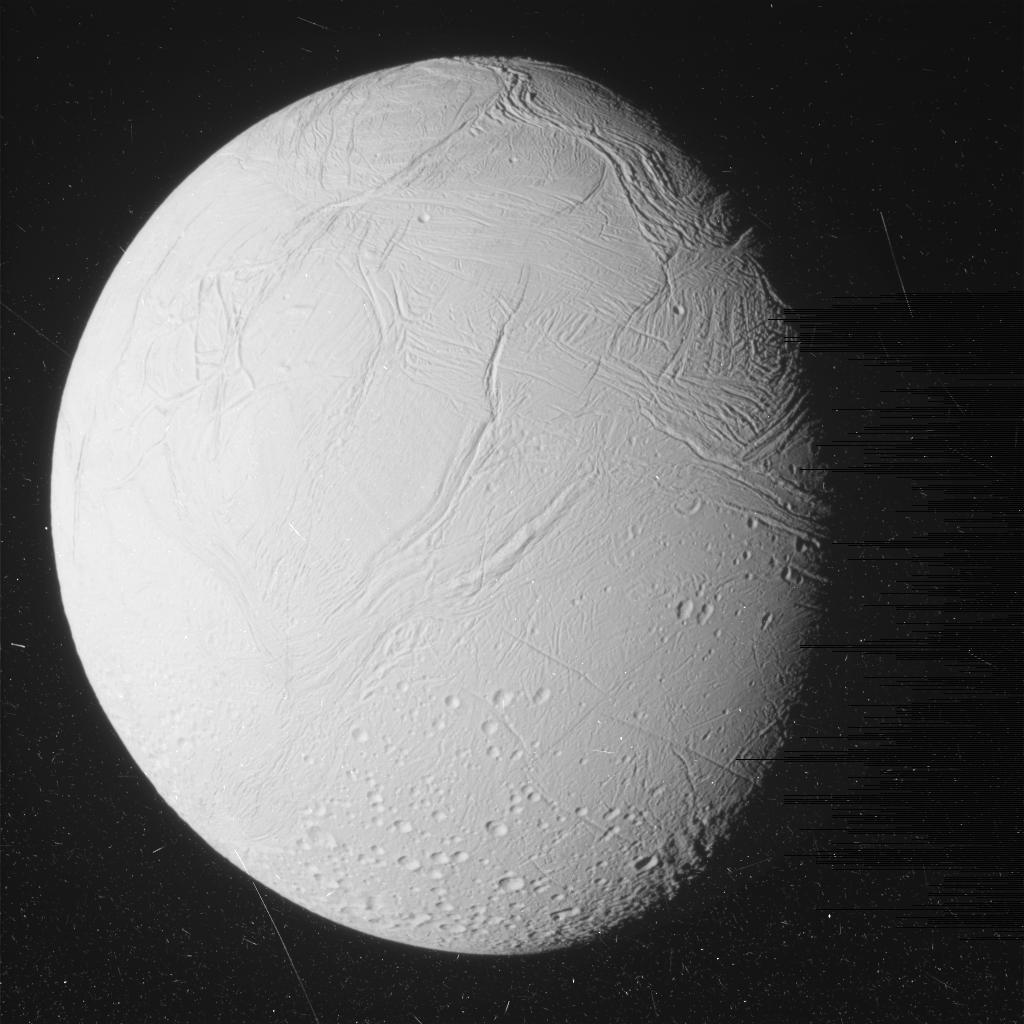
Cool image time! On December 19, 2015 the Saturn orbiter Cassini made its last close fly-by of the moon Enceladus, known best for the many geysers detected on its surface venting water and other carbon-based materials.

The picture to the right, reduced and enhanced to post here, shows that the entire face of this
Saturn’s moon Enceladus, as seen during that fly-by. The moon itself is only about 310 miles across.

Its icy surface is evident, as are the many fractures, some meandering almost like rivers. Interestingly, for some reason there are a lot more craters in the lower hemisphere, while the upper hemisphere is more completely covered with fractures.

The black outline indicates the approximate area captured by the two close-up images below.
» Read more

0 comments

How Saturn’s moon Enceladus causes an aurora on Saturn

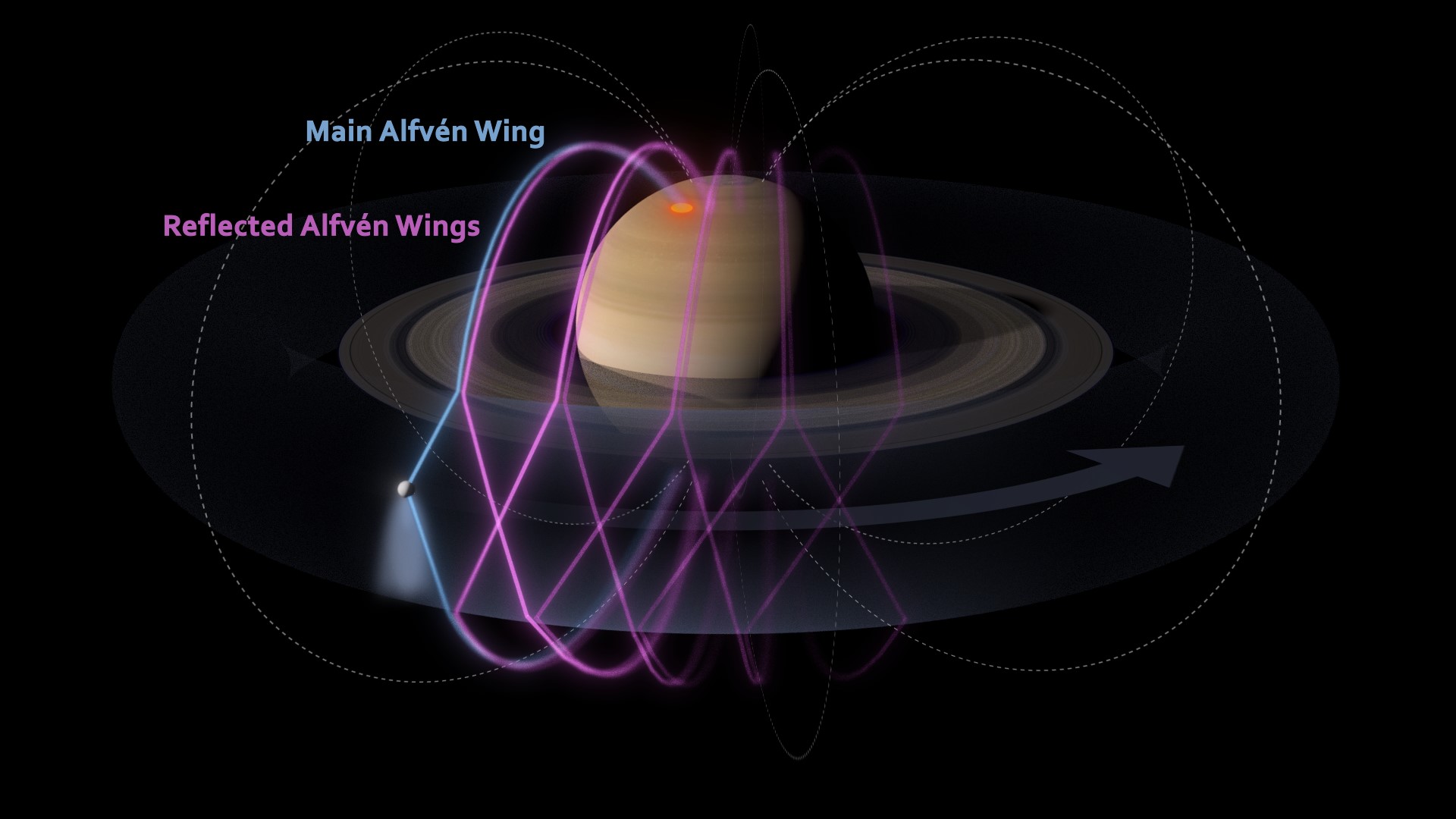
Enceladus orbiting Saturn
Click for original image.

Using data collected by the orbiter Cassini while it orbited Saturn more than a decade ago, scientists now think they have mapped out how the moon Enceladus interacts with Saturn’s magnetic field and helps create an aurora in Saturn’s polar regions.

You can read the paper here. The artist rendering to the right comes from the press release, and shows that interaction. From that release:

The study, published in the Journal of Geophysical Research: Space Physics, shows how wave structures, known as ‘Alfvén wings’, travel like vibrations on a string along magnetic field lines connecting Enceladus to Saturn’s pole. The initial ‘main’ Alfvén wing is reflected back-and-forth both by Saturn’s ionosphere and the plasma torus that encircles Enceladus’s orbit, resulting complex and structured system. By using a multi-instrumental approach, researchers were able to show that the influence of Enceladus extends over a record distance of over 504,000 km – more than 2,000 times the moon’s radius.

…As well as the large-scale structures, the team found evidence that turbulence teases out the waves into filaments within the main Alfvén wing. This fine-scale structure helps the waves bounce off Enceladus’s plasma torus and reach the high-latitudes in Saturn’s ionosphere where auroral features associated with the moon form.

The white haze below Enceladus in the graphic represents the material that comes out of the “tiger stripe” fractures near its south pole.

3 comments

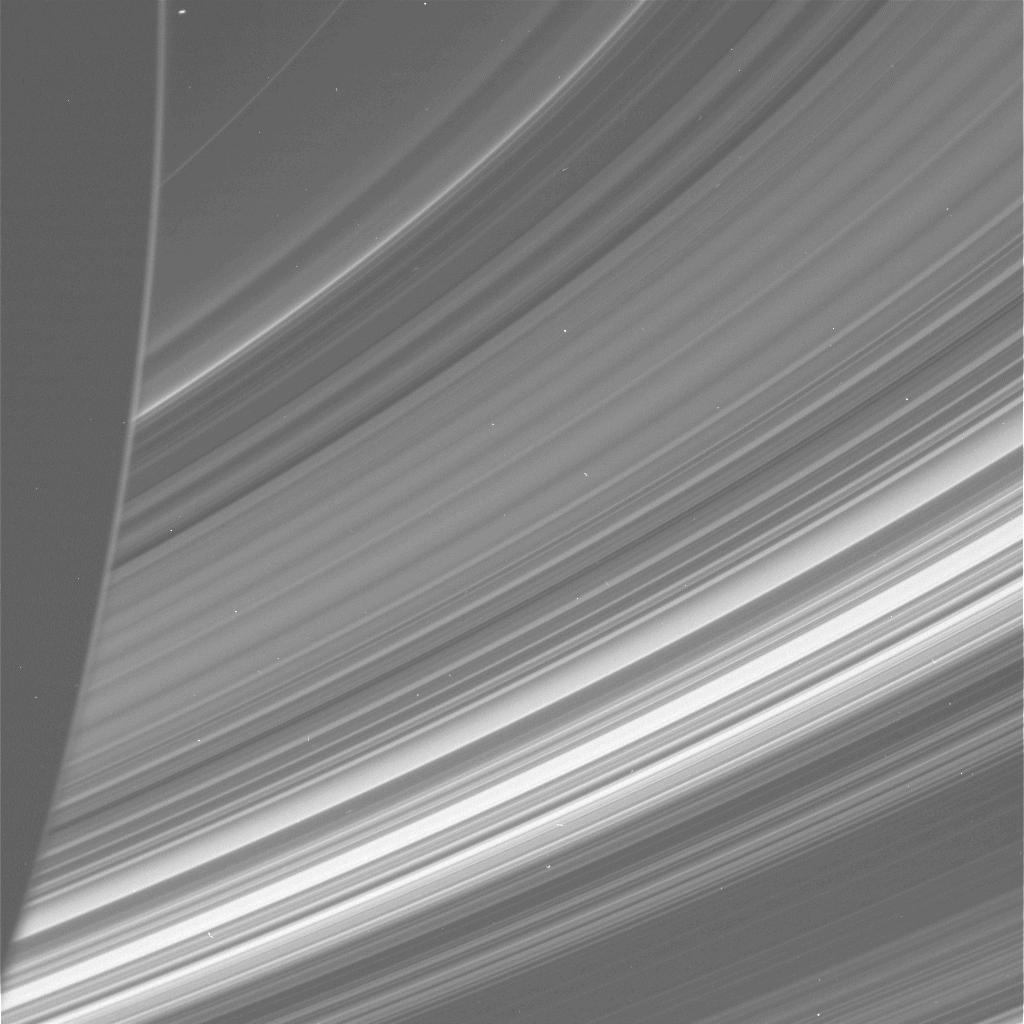
One of Cassini’s first close-up images of Saturn’s rings

The rings of Saturn
Click for original image.

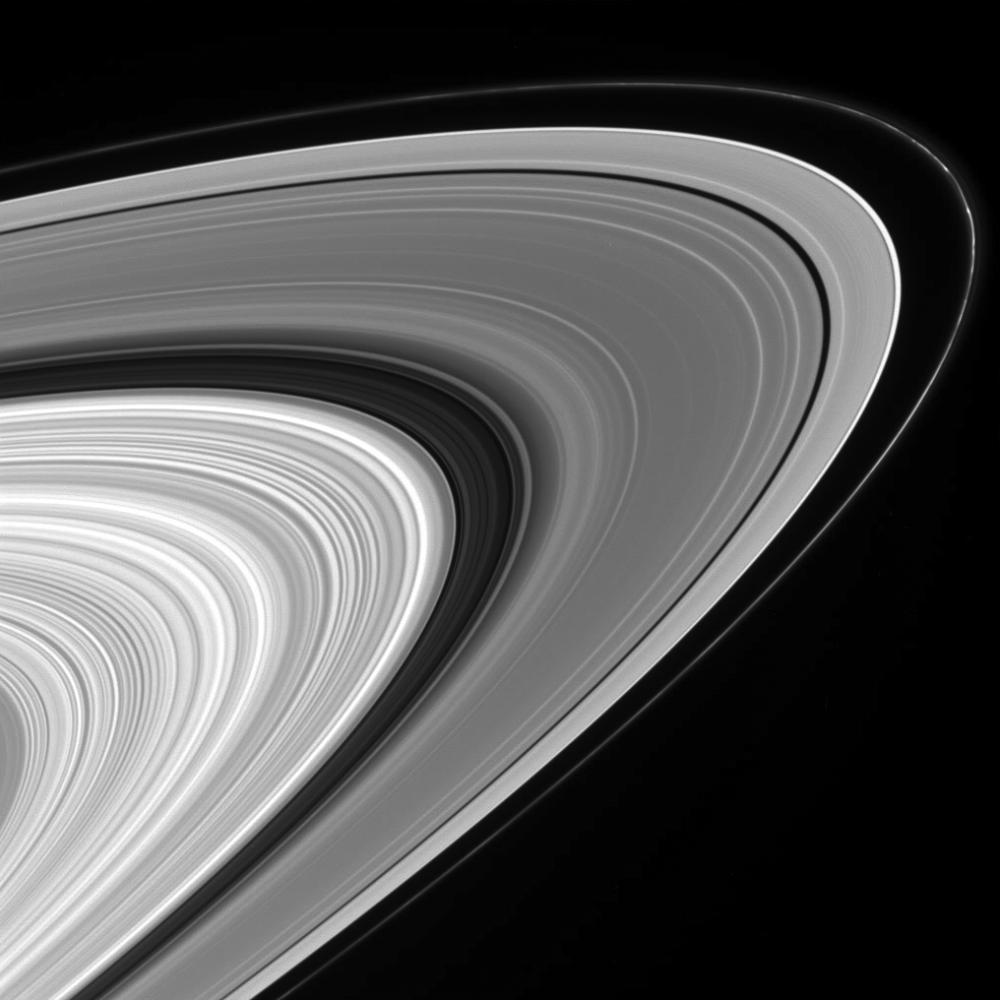
Cool image time! My exploration of the Cassini image archive continues. The picture to the right, reduced and enhanced to post here, was taken on May 2, 2005 by Cassini soon after it moved into a close orbit of Saturn where it could get high resolution images of Saturn’s rings. This is one of the first.

This is also a raw image that has not been calibrated or validated, to use the science team’s terms. Thus, the white dots scattered across the image could be artifacts that need to be cleaned up, not examples of Saturn’s many moons.

Regardless, the image illustrates the incredible delicacy of these rings, despite the fact that they are gigantic, spanning almost 45,000 miles in width, with a thickness ranging from 30 to 1,000 feet. And yet, there are so many distinct rings they almost resemble an old-fashioned vinyl record.

0 comments

One of Saturn’s many weird moons

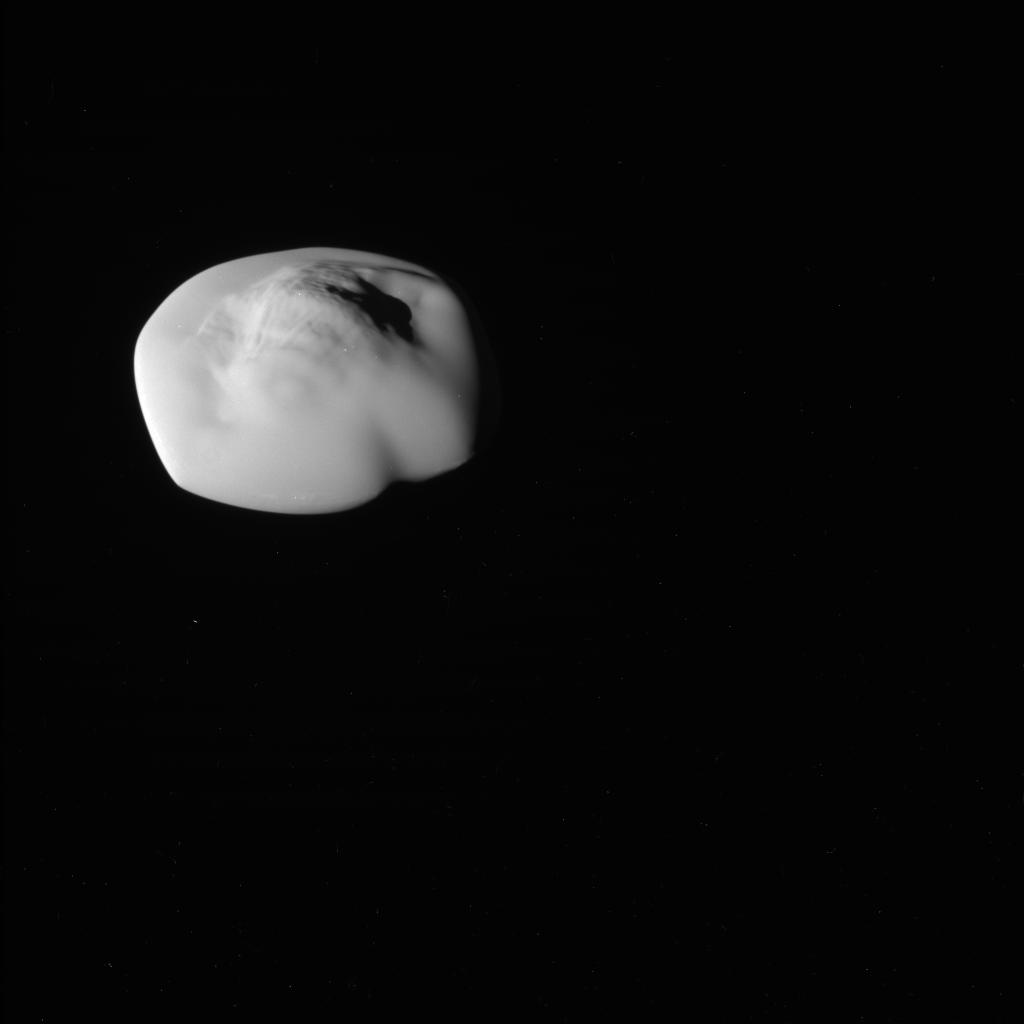
Saturn's moon Atlas
Click for original image.

Cool image time! The picture to the right, cropped and reduced to post here, was taken on April 13, 2017 by the orbiter Cassini as it began it last close loops around Saturn before diving into its atmosphere to burn up.

Those close loops allowed it to get good close-up images of a few of the tiny moons that orbit in or close to the gas giant’s rings. On the right is one of those pictures, of the moon Atlas, taken from a distance of about 10,000 miles.

The moon’s weird ravioli shape is thought to be caused by the accretion of dust and ice from the nearby rings along Atlas’s equator.

Scientists also found the moon surfaces to be highly porous, further confirming that they were formed in multiple stages as ring material settled onto denser cores that might be remnants of a larger object that broke apart. The porosity also helps explain their shape: Rather than being spherical, they are blobby and ravioli-like, with material stuck around their equators. “We found these moons are scooping up particles of ice and dust from the rings to form the little skirts around their equators,” Buratti said. “A denser body would be more ball-shaped because gravity would pull the material in.”

Atlas itself is about 25 miles wide and about 11.5 miles thick, at its thickest point. I suspect if you tried to walk on it you would sink into the accumulated dust and ice, as it is likely no more dense as newly fallen snow.

5 comments

Saturn’s rings with two of its moons perfectly aligned

Two of Saturn's moons above its rings
Click for original image.

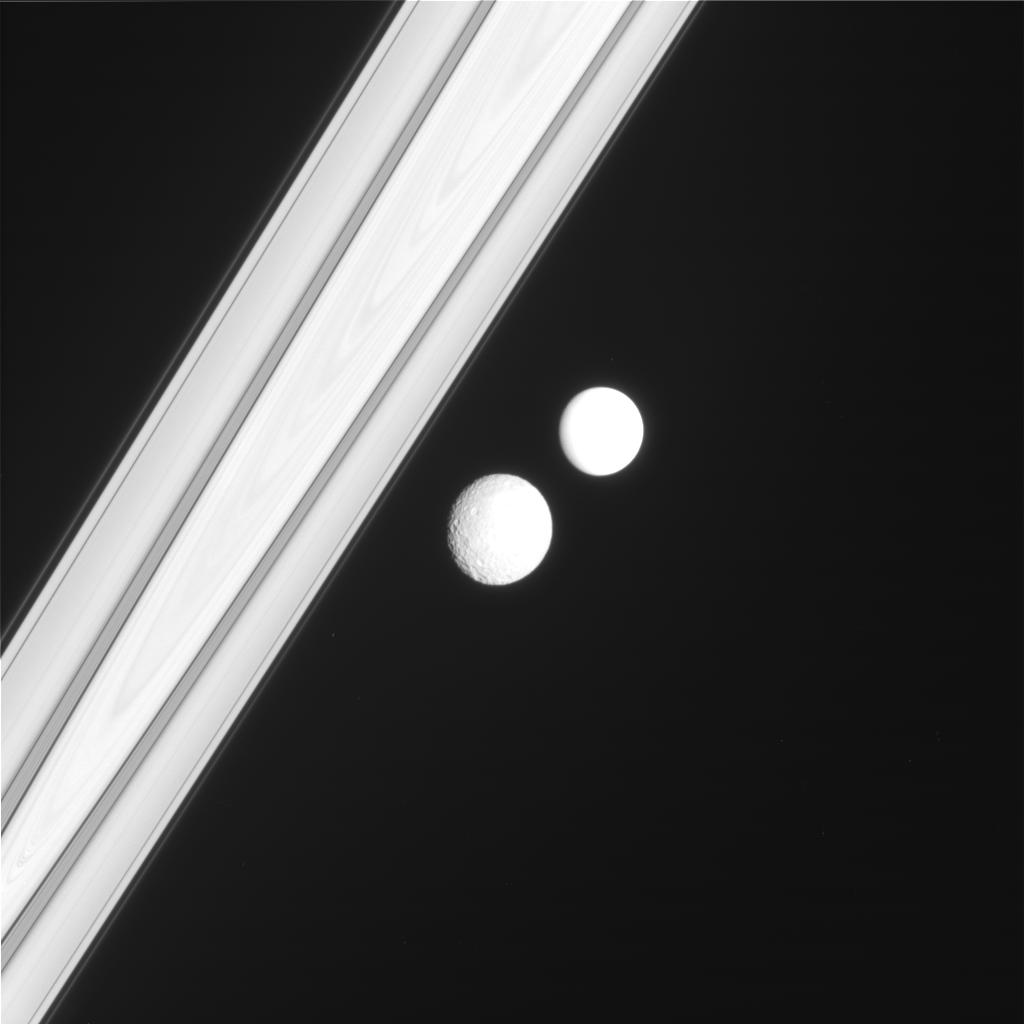
Cool image time! Rather than posting another Mars orbital image, I decided today to delve into the archive of pictures taken by the Cassini orbiter during the thirteen years it circled Saturn, from 2004 until 2017. The picture to the right, cropped to post here, was released on December 14, 2015, and is just one example of the many breath-taking photographs that the Cassini science team took during that mission. From the caption:

Like a cosmic bull’s-eye, Enceladus and Tethys line up almost perfectly for Cassini’s cameras. Since the two moons are not only aligned, but also at relatively similar distances from Cassini, the apparent sizes in this image are a good approximation of the relative sizes of Enceladus (313 miles across) and Tethys (660 miles across).

This view looks toward the un-illuminated side of the rings from 0.34 degrees below the ring plane. The image was taken in red light with the Cassini spacecraft narrow-angle camera on Sept. 24, 2015.

The image was obtained at a distance of approximately 1.3 million miles from Enceladus. Image scale on Enceladus is 7 miles per pixel. Tethys was at a distance of 1.6 million miles with a pixel scale of 10 miles per pixel.

Enceladus is in the foreground, and is the planet that has what scientists have labeled tiger stripe fractures that vent water and other material, including carbon molecules.

6 comments

Computer simulations suggest Jupiter and Saturn have fundamentally different interiors

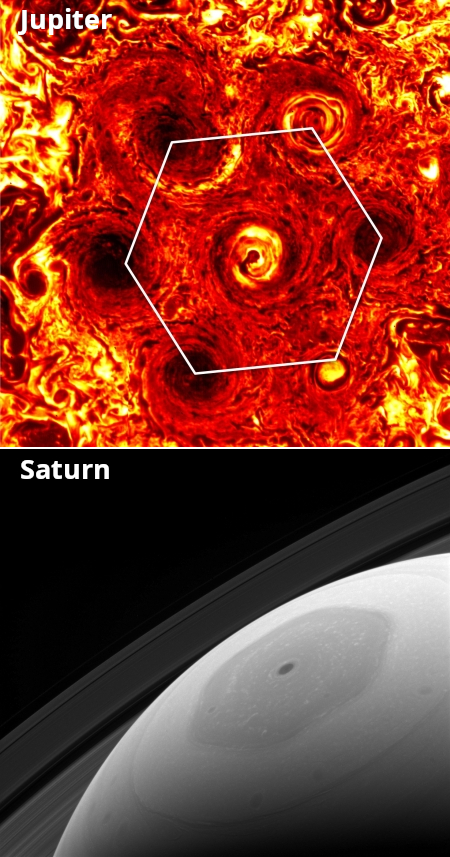
The different polar vortexes of Jupiter and Saturn

The uncertainty of science: In attempting to explain why the polar vortexes of Jupiter and Saturn are so different, scientists running large computer simulations have found that the difference could be because Jupiter’s interior is “softer” than Saturn’s.

The two images to the right illustrate the different polar vortexes of both planets. Jupiter’s (top) is made up of multiple chaotic small storms that form a hexagon-like ring around the pole. Saturn’s (bottom) is a single very coherent hexagon-shaped storm.

Over multiple different simulations, they observed that some scenarios evolved to form a single large polar vortex, like Saturn, whereas others formed multiple smaller vortices, like Jupiter. After analyzing the combinations of parameters and variables in each scenario and how they related to the final outcome, they landed on a single mechanism to explain whether a single or multiple vortices evolve: As random fluid motions start to coalesce into individual vortices, the size to which a vortex can grow is limited by how soft the bottom of the vortex is. The softer, or lighter the gas is that is rotating at the bottom of a vortex, the smaller the vortex is in the end, allowing for multiple smaller-scale vortices to coexist at a planet’s pole, similar to those on Jupiter.

Conversely, the harder or denser a vortex bottom is, the larger the system can grow, to a size where eventually it can follow the planet’s curvature as a single, planetary-scale vortex, like the one on Saturn.

If this mechanism is indeed what is at play on both gas giants, it would suggest that Jupiter could be made of softer, lighter material, while Saturn may harbor heavier stuff in its interior.

This conclusion however runs completely counter to what we should expect. Jupiter has a much great mass, and one would assume from this that its interior would therefore be denser and thus harder.

5 comments

The smooth and extremely calm methane lakes of Titan

The Cassini radar track on Titan
Click for full image.

Using archival radar data obtained by the Saturn orbiter Cassini from one of its many fly-bys of the moon Titan, scientists now believe that most of the high northern latitude lakes on Titan are mostly made of pure methane, not ethane, and that their surface is remarkably calm and smooth. From the abstract:

During its 119th flyby of the moon, the Cassini spacecraft conducted a bistatic radar experiment observing a group of seven lakes in Titan’s Northern Lake District located between (72°N, 143°W) and (77°N, 131°W). The orbiter transmitted a continuous-wave signal at a wavelength of 3.56 cm (X-band) toward Titan’s surface, targeting the moving specular reflection point between the spacecraft and Earth. As the antenna footprint intercepted the liquid surfaces of the lakes, distinct specular reflections were detected on Earth by the 70-m antenna at NASA’s Canberra Deep Space Network complex. Analysis of these reflections shows that all seven lakes exhibit similar dielectric properties—linked to their composition—and surface roughness, suggesting they are methane-dominated and may have a few millimeters of surface roughness. [emphasis mine]

The highlighted phrase underscores what previous data had shown, that the methane lakes of Titan are remarkably calm, almost to the point of absurdity.

The image to the right, figure 1 of the paper, shows the track of this radar observation. Based on this data as well as data obtained during a later fly-by of another nearby lake, the scientists posit that all the lakes in this region are likely similar, mostly filled with methane having a surface with barely no ripples at all.

This information is crucial for the planned Dragonfly mission, that will fly over and onto Titan’s methane lakes, though not in the high latitudes but in its equatorial regions. Knowing the conditions as best as possible will increase the odds that this very risky mission will succeed.

12 comments

Saturn’s rings, warped by one of Saturn’s moons

Daphne inside Saturn's rings
Click for original image.

Cool image time! Rather than post another Mars image, I decided today to dig into the archive left from the Cassini orbiter that circled Saturn from July 1, 2004 until September 15, 2017. The picture to the right, cropped to post here, was taken on September 13, 2017, only two days before the orbiter burned up in Saturn’s atmosphere. From the caption:

This image of Saturn’s outer A ring features the small moon Daphnis and the waves it raises in the edges of the Keeler Gap. The image was taken by NASA’s Cassini spacecraft on Sept. 13, 2017. It is among the last images Cassini sent back to Earth. The view was taken in visible light using the Cassini spacecraft wide-angle camera at a distance of 486,000 miles from Saturn. Image scale is 2.7 miles [per pixel].

The moon is traveling downward in this image. As it moves past the outer ring, its gravity causes that edge to ripple, producing the waves.

The scale will give you an idea of how big the rings of Saturn are. The Keeler Gap is at the outer edge of the A ring of Saturn, which is the outermost ring that is clearly visible using ordinary amateur telescopes. That edge however is more than 90,000 miles from Saturn. And grayish bands to the right of Daphne and the Keeler Gap are only the outer half of the A ring, which is by itself about 9,000 miles wide.

1 comment

Saturn as seen by Cassini in 2004, four months before orbital insertion

Saturn as first seen up close by Cassini
Click for original.

Cool image time! As most of the new cool images coming down from space seem mostly limited to Mars and deep space astronomy, I decided today to dig into the archive of the probe Cassini, which orbited Saturn from July 1, 2004 until September 15, 2017, when it was sent plunging into the gas giant’s atmosphere.

The picture to the right heralded the start of that mission, in that it was taken on February 19, 2004, a little over four months before the spacecraft fired its engines and entered orbit. I have rotated the image and cropped it to post here.

When Cassini snapped this picture it was just approaching the gas giant. The image itself is relatively small, with the resolution also relatively poor. You can see one of Saturn’s moons above the planet, but I can’t tell you which one. As noted at the webpage, this is a raw image that has not been “validated or calibrated.”

While not up to the amazing standard exhibited by Cassini’s images during its thirteen year stay at Saturn, it gave us a flavor of the wonders to come. Of all the planets, Saturn might be the most beautiful.

7 comments

Inexplicable very large patterns found in Saturn’s upper atmosphere

Beads and arms in Saturn's upper atmosphere
Click for original image.

Using the Webb Space Telescope’s infrared capabilities, scientists have detected several different and inexplicable large atmospheric structures linked somehow to the gas giant’s north pole aurora.

The two images to the right, cropped, reduced, and annotated to post here, show both types of newly discovered features.

The international team of researchers, comprising 23 scientists from institutions across the UK, US and France, made the discoveries during a continuous 10-hour observation period on 29 November 2024, as Saturn rotated beneath JWST’s view. The team focused on detecting infrared emissions by a positively charged molecular form of hydrogen, H3+, which plays a key role in reactions in Saturn’s atmosphere and so can provide valuable insights into the chemical and physical processes at work. JWST’s Near Infrared Spectrograph allowed the team to simultaneously observe H₃⁺ ions from the ionosphere, 1,100 kilometres above Saturn’s nominal surface, and methane molecules in the underlying stratosphere, at an altitude of 600 kilometres.

In the electrically-charged plasma of the ionosphere, the team observed a series of dark, bead-like features embedded in bright auroral halos. [top picture] These structures remained stable over hours but appeared to drift slowly over longer periods.

Around 500 kilometres lower, in Saturn’s stratosphere, the team discovered an asymmetric star-shaped feature [bottom picture]. This unusual structure extended out from Saturn’s north pole towards the equator. Only four of the star’s six arms were visible, with two mysteriously missing, creating a lopsided pattern.

A more accurate word for the “beads” I think would be “patches”, as they are not small but major dark regions that appear to rotate with the planet, as do the arms. Both also seem to be related to each other as their rotations match, though one sits about 300 miles lower in the atmosphere. As noted in the press release, “the processes that are driving the patterns may influence a column stretching right through Saturn’s atmosphere.”

All guesses. All we have at this point is a truly intriguing observation.

1 comment

NASA inspector general: Dragonfly mission is vastly overbudget and behind schedule

Artist rendering of Dragonfly soaring over Titan's surface
Artist rendering of Dragonfly soaring
over Titan’s surface

According to a new NASA inspector general report issued today, NASA’s Dragonfly mission to Titan is now billions overbudget and is likely not be ready to launch in 2028.

You can download the report here [pdf]. From its executive summary:

Dragonfly was selected under a New Frontiers Announcement of Opportunity with a $850 million cost cap on Principal Investigator-Managed Mission Costs, which primarily includes development costs but excludes launch vehicle and post-launch operations costs. However, by April 2024, those costs had grown to $2.6 billion and the launch delayed by more than 2 years, from April 2026 to July 2028. The cost increase and schedule delay were largely the result of NASA directing APL to conduct four replans between June 2019 and July 2023 early in Dragonfly’s development. Justifications for these replans included the COVID-19 pandemic, supply chain issues, changes to accommodate a heavy-lift launch vehicle, projected funding challenges, and inflation.

The report now estimates the budget will eventually rise above $3 billion, cost that is eating away at NASA’s entire planetary budget, making other missions impossible. The project itself is far from ready, with multiple unfinished issues that make its present launch target of 2028 very unlikely.
» Read more

6 comments

Astronomers observe cloud changes above the northern polar lakes of Titan

Changes seen in Titan's atmosphere
Click for full resolution image.

Using data from both ground- and space-based telescopes, astronomers have now observed clouds rising in the thick atmosphere of the Saturn moon Titan.

The team observed Titan in November 2022 and July 2023 using both Keck Observatory and the James Webb Space Telescope. Those observations not only showed clouds in the mid and high northern latitudes on Titan — the hemisphere where it is currently summer — but also showed those clouds apparently rising to higher altitudes over time. While previous studies have observed cloud convection at southern latitudes, this is the first time evidence for such convection has been seen in the north. This is significant because most of Titan’s lakes and seas are located in its northern hemisphere and evaporation from lakes is a major potential methane source. Their total area is similar to that of the Great Lakes in North America.

The image to the right shows these methane clouds, indicated by the arrows, as seen by Webb on July 11, 2023 and then three days later by Keck. The clouds appear to have shifted downward during these observations.

The data suggests we are seeing one small aspect of Titan’s atmospheric methane cycle, where the liquid methane in the lakes evaporates to form clouds, which later than condense to rain back down. Though superficially similar to the water cycle here on Earth, the details suggest it will be very different on Titan.

0 comments

Astronomers discover 128 more moons around Saturn

Using a ground-based telescope, astronomers have now identified 128 new moons circling Saturn, bringing its moon count to 274, more than the total moons around all the other planets in the solar system combined.

Edward Ashton at Academia Sinica in Taipei, Taiwan, and his colleagues found the new moons with the Canada-France-Hawaii Telescope, revealing dozens that have previously evaded astronomers. They took hours of images of Saturn, adjusted them for the planet’s movement through the sky and stacked them on top of each other to reveal objects that would otherwise be too dim to see.

All the new moons are between 2 and 4 kilometres in diameter and are likely to have been formed hundreds of millions or even billions of years ago in collisions between larger moons, says Ashton.

That Saturn has so many moons should surprise no one. Saturn actually has possibly millions, maybe even billions, of moons, if you count every particle in its rings. In fact, the gas giant poses a problem for astronomers in defining what a moon actually is. How small must an object be before you stop calling it a moon?

10 comments

New computer simulations suggest Saturn’s rings are not young but formed at the same time as the solar system

A bright spot in Saturn's rings
Click for original source.

The uncertainty of science: Scientists doing computer simulations now posit that Saturn’s rings are not young, between 100 to 400 million years old as has been believed for the last few decades, but formed instead when Saturn formed, 4.6 billion years ago.

You can read their paper here [pdf].

The young age had been based on data from the Cassini orbiter, which showed the ring particles to be very bright and clean. If old those particles would have been darker as they accumulated dust over time on their surface. The new computer simulations suggest a process whereby those particles get “cleaned,” thus making it possible for the rings to be very old, possibly as old as Saturn itself.

Must I point out the uncertainties? The paper itself admits in its abstract “uncertainties in our models that assume no porosity, strength, or ring particle granularity.” Seems these assumptions make the conclusions very uncertain indeed.

Then again, the previous young estimates of the age of the rings had many similar assumptions and uncertainties. Essentially, we don’t have enough information to make any definitive determinations.

1 comment
1 2 3 12